![[ ESO ]](http://www.eso.org/images/eso-logo.gif)
|
|
|
||||||
|---|---|---|---|---|---|---|---|
FORS1:
|
|||||||
description:
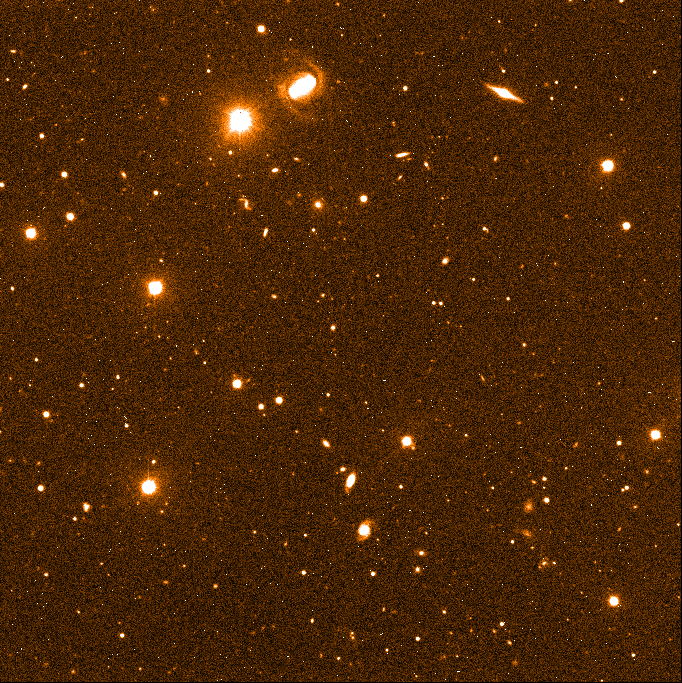
The incoming science frame is searched for overexposed pixels and some basic
statistical parameters are determined.
Then the science frame goes through a standard reduction procedure, i.e. bad
pixel, bias and dark correction as well as flatfielding. All these operations are
done in case an appropriate calibration frame is present in the set of reference
frames. If SCALE=NO, the bias correction is performed by just subtracting
a master bias image. If SCALE=MED , the bias correction is performed
using the scaled master bias. The scaling is
done as follows: Each of the sections of the master bias is divided by its
median and multiplied by the median of the corresponding pre-/overscan region
of the input frame. If SCALE=OVE , the master bias is also scaled, but
each of the sections of the master bias is divided by the median of its
corresponding pre-/overscan region and multiplied by the median of the
pre-/overscan region of the input frame.
Alternatively to the master bias and master dark images constant
values ( BIAS_CONS , DARK_CONS ) may be used.
The luminosities of the objects on the image are now determined and stored
in a photometry table . The image quality is determined and written to the QC1 Log. By means
of the extinction coefficients table the science frame and the
photometry table are flux calibrated.
products:
| Reduced Science Frame | PS | GIF | Header |
| r.FORS1.2003-03-27T00:06:18.022_0000 |  |
 |
 |
purpose:
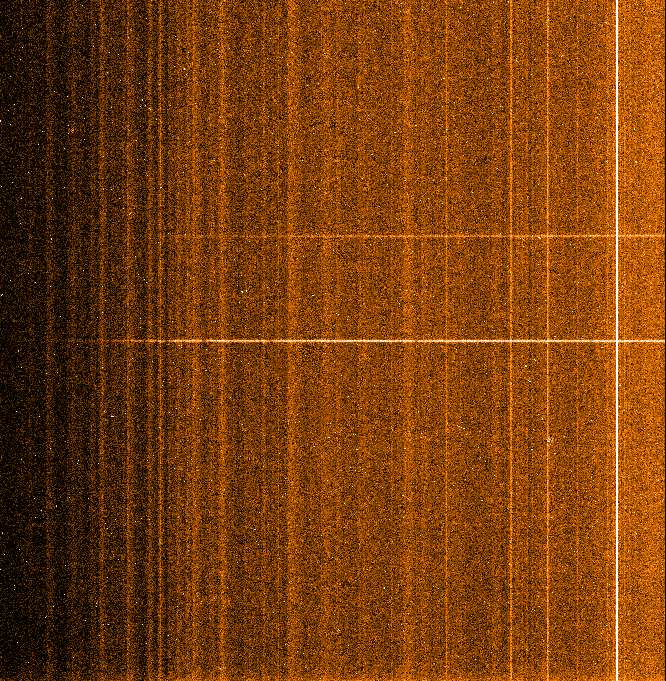
The incoming science frame is searched for overexposed pixels.
The frame is then corrected for bias and dark if the
appropriate frames are found in the set of reference frames or if a non zero bias
and dark value is given by the first two values of CCDPAR respectively.
If the third value of CCDPARis NO , the bias correction is
performed by just subtracting a master bias image. If the third value of
CCDPAR is MED , the bias correction is performed using the scaled
master bias. The scaling is done as follows:
Each of the sections of the master bias is divided by its median and multiplied
by the median of the corresponding pre-/overscan region of the input frame. If
the third value of CCDPAR is OVE , the master bias is also scaled,
but each of the sections of the master bias is divided by the median of its
corresponding pre-/overscan region and multiplied by the median of the
pre-/overscan region of the input frame.
The science frame is then
divided by a normalized master flat field to remove pixel to pixel
variations. Finally the science frame is remapped from pixel space to
wavelength space by the application of the dispersion relation and is then
rebinned to constant wavelength steps.
In the end the rebinned frame is searched for point source
spectra. The sky background at the positions of the object
spectra are fitted and subtracted. Now the spectra are extracted
using the algorithm of Horne (Horne, 1986, PASP, 98, 609).
products:
| Reduced Science Frame | PS | GIF | Header |
| r.FORS1.2003-03-26T00:46:13.245_0000 | |
 |
|
purpose:
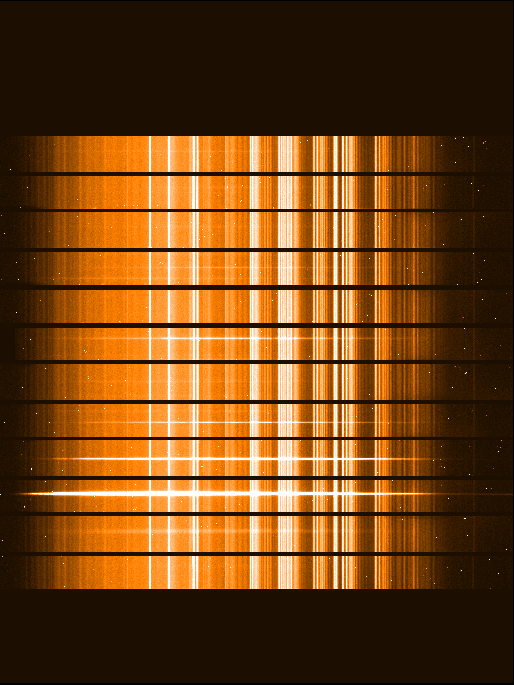
The incoming science frame is searched for overexposed pixels.
The frame is then corrected for bias and dark if the
appropriate frames are found in the set of reference frames or if a non zero bias
and dark value is given by the first two values of CCDPAR respectively.
If the third value of CCDPARis NO , the bias correction is
performed by just subtracting a master bias image. If the third value of
CCDPAR is MED , the bias correction is performed using the scaled
master bias. The scaling is done as follows:
Each of the sections of the master bias is divided by its median and multiplied
by the median of the corresponding pre-/overscan region of the input frame. If
the third value of CCDPAR is OVE , the master bias is also scaled,
but each of the sections of the master bias is divided by the median of its
corresponding pre-/overscan region and multiplied by the median of the
pre-/overscan region of the input frame.
The science frame is then
divided by a normalized master flat field to remove pixel to pixel
variations. Finally the science frame is remapped from pixel space to
wavelength space by the application of the dispersion relation and is then
rebinned to constant wavelength steps.
In the end the rebinned frame is searched for point source
spectra. The sky background at the positions of the object
spectra are fitted and subtracted. Now the spectra are extracted
using the algorithm of Horne (Horne, 1986, PASP, 98, 609).
products:
| Reduced Science Frame | PS | GIF | Header |
| r.FORS1.2003-04-04T06:42:57.302_0000 | |
 |
|
![[FORS1 QC]](/images/icon-up.gif) ![[Observing Facilities and Operations]](/images/icon-observing.gif) ![[ESO]](/images/icon-home.gif) ![[Index]](/images/icon-index.gif) ![[Search]](/images/icon-search.gif) ![[Help]](/images/icon-help.gif) ![[News]](/images/icon-whatsnew.gif) |