Plot
? |
Symb
? |
Source
* |
Average ? |
Thresholds ? |
N_
data |
QC1
parameter |
Data
downloads |
Remarks |
| method |
value |
unit |
method |
value |
| 1 |
• | QC1DB |
MEDIAN |
11.4 |
[C] |
none | |
713 |
ins_temp1_mean |
this |
last_yr |
all
|
Mean temperature of CAMERA |
| 2 |
• | QC1DB |
MEDIAN |
11.4 |
[C] |
none | |
713 |
ins_temp1_mean |
this |
last_yr |
all
|
temperature (repeated) |
| 3 |
• | QC1DB |
MEDIAN |
11.4 |
[C] |
none | |
713 |
ins_temp1_mean |
this |
last_yr |
all
|
temperature (repeated) |
| 4 |
+ | QC1DB |
MEDIAN |
-0.216 |
[pix] |
OFF | ± 1.5 |
92 |
mean_dx |
this |
last_yr |
all
|
DX between solution and Physical Model, CD#4, REDU 860nm, 1x1 |
| 5 |
+ | QC1DB |
MEDIAN |
5.02 |
[pix] |
OFF | ± 1.5 |
92 |
mean_dy |
this |
last_yr |
all
|
DY (ins_mode = RED only) |
| 6 |
+ | QC1DB |
MEDIAN |
314 |
NONE |
VAL | 280,500 |
92 |
nlin_sel |
this |
last_yr |
all
|
Number of lines used in solution |
| |
|
*Data sources: QC1DB: QC1 database; LOCAL: local data source
|
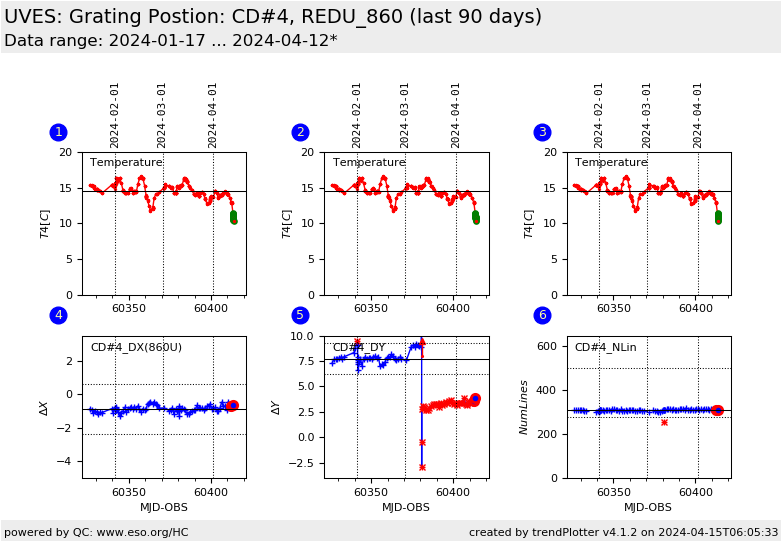
Plot 1
scores: not implemented
| | data source: | uves_fmtchk
(QC1 database) |
| dataset: | ins_temp1_mean | • |
| median: | 11.4 | [C] |
| thresholds: | none | |
| N_data plotted: | 713 |
| [click plot for closeup] |
Plot 2
scores: not implemented
| | data source: | uves_fmtchk
(QC1 database) |
| dataset: | ins_temp1_mean | • |
| median: | 11.4 | [C] |
| thresholds: | none | |
| N_data plotted: | 713 |
| [click plot for closeup] |
Plot 3
scores: not implemented
| | data source: | uves_fmtchk
(QC1 database) |
| dataset: | ins_temp1_mean | • |
| median: | 11.4 | [C] |
| thresholds: | none | |
| N_data plotted: | 713 |
| [click plot for closeup] |
Plot 4
scores:  8| 8|
| | data source: | uves_fmtchk
(QC1 database) |
| dataset: | mean_dx | + |
| median: | -0.216 | [pix] |
| rel. thresholds: | -1.7165...1.2835 | [pix] |
| N_data plotted: | 92 |
| [click plot for closeup] |
Plot 5
scores: 8|
| | data source: | uves_fmtchk
(QC1 database) |
| dataset: | mean_dy | + |
| median: | 5.02 | [pix] |
| rel. thresholds: | 3.517...6.517 | [pix] |
| N_data plotted: | 92 |
| [click plot for closeup] |
Plot 6
scores: 8|
| | data source: | uves_fmtchk
(QC1 database) |
| dataset: | nlin_sel | + |
| median: | 314 | NONE |
| fixed thresholds: | 280...500 | NONE |
| N_data plotted: | 92 |
| [click plot for closeup] |
This is the trending report for UVES QC parameters derived from
the Echelle format check calibrations taken in
wavelength setting 860nm, RED Upper CCD. The results are redundant with the
"860L" plot except for plot #6 which monitors the number of lines and
therefore also the pipeline recipe quality.
Calibrating SCIENCE observations made during the night with
calibrations taken during the day relies on the stability and
reproducibility of the positioning of the instrument components. To
ensure an accurate wavelength calibration, one of the critical
criteria is the accuracy of the positioning of the gratings. If the
highest possible accuracy is required for the wavelength calibration,
an attached wavelength calibration should be taken with the science.
Alternatively, since the exact grating position can not be measured in
the science image itself, we rely on the daily health check format
check data to verify the stability and reproducibility from day to
day, assuming that this is a reasonable indication of the
reproducibility between nighttime science and daytime calibrations.
With this in mind the important aspects in these plots are the day to
day scatter. The absolute level, within reason (i.e. plus or minus 10
pixels) is not important.
From time to time there are sudden jumps in the mean levels, sometimes due
to earthquakes, but often the cause of the jump is far from obvious.
Such jumps are not in themselves a cause for immediate concern. Only
if they are happening frequently, and liable to be happening during
the night. Or if they take the instrument so far from the Physical
Model that the pipeline will have serious difficulties to converge to
a solution, as a rule of thumb, intervention to realign should be
considered if the residuals exceed plus or minus 10 pixels.
The individual plots describe:
- average air temperature of the camera [C] (INS.TEMP4.NAME). Trends in the residuals often correlate with temperature.
- same as 1
- same as 1
- the mean residual in X of the fitted position of the emission lines with respect to the positions expected from the Physical Model
- the same in Y
- the number of emission lines selected in the final solution. Trends in this parameter can be due to lamp aging effects
Find more information about UVES Grating Position monitoring here.
General information
Click on any of the plots to see a close-up version.
The latest date is indicated on top of the plot.
If configured,
- data points belonging to the latest date are specially marked
- statistical averages are indicated by a solid line, and thresholds by broken lines
- outliers are marked by a red asterisk. They are defined as data points outside the
threshold lines
- "aliens" (= data points outside the plot Y limits) are marked by a red arrow (↑ or ↓)
- you can download the data for each parameter set if the 'Data downloads' link shows up
|