![[ ESO ]](http://www.eso.org/images/eso-logo.gif)
|
PULPO user manual |
|
|
Annex A - E
Annex A : PULPO status bits
PULPO has 6 status bytes located in bit addressable RAM positions,
used for maintaining information on PULPO operation. They are accessible
through the serial link, using the command SB,n where n can be any
number from 1 to 6.
| Status byte 1 |
Bit |
Function |
| TAlarm 1 |
0 (LSB) |
Set if any of the temperature sensors is over the alarm trip
point. |
| TAlarm 2 |
1 |
Not used. |
| TAlarm 3 |
2 |
Not used. |
| VAlarm |
3 |
Set if vacuum level is worse than vacuum limit. |
| LN2Alarm |
4 |
Set if LN2 gas temperature is over alarm limit. |
| Buzzer On |
5 |
Set if Buzzer is activated. |
| Dialer On |
6 |
Set if telephone Auto Dialer is activated (Relay OPEN). |
| LED Enab |
7 (MSB) |
Set if front panel status LEDs are enabled. |
| Status byte 2 |
Bit |
Function |
| ShOpen |
0 (LSB) |
Set if shutter is open. |
| ExpPaused |
1 |
Set if exposure is paused by CCD controller (PE,1). |
| ExpActive |
2 |
Set if exposure is active. |
| Shutter_Not_Connected |
3 |
Set if no shutter is detected at start-up shutter test. |
| Status_Open_Available |
4 |
Set if OPEN status is available at start-up shutter test. |
| Status_Close_Available |
5 |
Set if CLOSE status is available at start-up shutter test. |
| Status_Remote_Available |
6 |
Set if REMOTE status is available at start-up shutter test. |
| Shutter_Error |
7 (MSB) |
Set if a shutter error is detected during start-up or normal
exp. |
| Status byte 3 |
Bit |
Function |
| Heater1_Not_Connected |
0 (LSB) |
Set if heater 1 is not connected at start-up test. |
| Heater2_Not_Connected |
1 |
Set if heater 2 is not connected at start-up test. |
| Heater3_Not_Connected |
2 |
Set if heater 3 is not connected at start-up test. |
| Sensor1_Disconnected |
3 |
Set if sensor 1 is not connected at start-up test. |
| Sensor2_Disconnected |
4 |
Set if sensor 2 is not connected at start-up test. |
| Sensor3_Disconnected |
5 |
Set if sensor 3 is not connected at start-up test. |
| Sensor4_Disconnected |
6 |
Set if sensor 4 is not connected at start-up test. |
| Sensor5_Disconnected |
7 (MSB) |
Set if sensor 5 is not connected at start-up test. |
| Status byte 4 |
Bit |
Function |
| Sensor6_Disconnected |
0 (LSB) |
Set if sensor 6 is not connected at start-up test. |
| Sensor7_Disconnected |
1 |
Set if sensor 7 is not connected at start-up test. |
| Vac_Sensor_Disconnected |
2 |
Set if vacuum gauge is not connected at start-up test. |
| PID1_On |
3 |
Set if PID for heater 1 is working. |
| PID2_On |
4 |
Set if PID for heater 2 is working. |
| PID3_On |
5 |
Set if PID for heater 3 is working. |
| DefaultPIDpar |
6 |
Set if PIDs have default Kp, Ki, Kd constant. This happens
when PULPO detects a corrupt internal database at start-up time. |
| Tuner_Active |
7 (MSB) |
Set if PID Auto Tuner for heater 1 and 2 is active. |
| Status byte 5 |
Bit |
Function |
| RTCError |
0 (LSB) |
Set if PULPO detects errors in the Real Time Clock (RTC). |
| RAMCheckSumError |
1 |
Set if PULPO internal RAM has checked sum error. |
| RTCRAMCheckSumError |
2 |
Set if RTC internal RAM has checked sum error. |
| LogRunnig |
3 |
Set if PULPO logger routine is running. |
| Shutter_NoDefect |
4 |
Set if SESO shutter driver has DEFECT status not asserted. |
| Shutter_Remote |
5 |
Set if external shutter driver is in REMOTE. |
| BiasLedOn |
6 |
Set if BIAS LED is ON. |
| HeaterOverCurrent |
7 (MSB) |
Set if heaters over current detected. |
| Status byte 6 |
Bit |
Function |
| TAlarm1_Enab |
0 (LSB) |
Set if temperature alarm is enabled. |
| TAlarm2_Enab |
1 |
Not used. |
| TAlarm3_Enab |
2 |
Not used. |
| VAlarm_Enab |
3 |
Set if vacuum alarm is enabled. |
| LN2Alarm_Enab |
4 |
Set if LN2 exhaustion alarm is enabled. |
| Alarm_Global_Enab |
5 |
Set if global alarm is enabled. |
| Spare56 |
6 |
Reserved for future use. |
| Spare57 |
7 (MSB) |
Reserved for future use. |
Annex B : Menu modes
Below there is a detailed explanation of each item accessible through the
front panel menu modes. The column with RS232 heading shows the serial command
available, if any, to perform the same action.
Note: On the RS232 column, f stands for a floating point value.
Menu mode MENU 1
| Variable |
Valid range |
Function |
RS232 command |
| Heater1 |
ON/OFF |
Turns ON/OFF PID for Heater 1. |
HE,1,1/HE,1,0 |
| Heater2 |
ON/OFF |
Turns ON/OFF PID for Heater 2. |
HE,2,1/HE,2,0 |
| Heater3 |
ON/OFF |
Turns ON/OFF PID for Heater 3. |
HE,3,1/HE,3,0 |
| Ref T1 |
100.0 to 333.0 K |
Sets reference temperature for Heater 1. |
SP,1,f |
| Ref T2 |
100.0 to 333.0 K |
Sets reference temperature for Heater 2. |
SP,2,f |
| Ref T3 |
100.0 to 333.0 K |
Sets reference temperature for Heater 3. |
SP,3,f |
| PIDTuner |
ON/OFF |
Turns ON/OFF the Auto Tuner routine. |
AT,1/AT,0 |
| Tslope |
0.5 to 10.0 K/min |
Sets the maximum rate of change on the controlled temperatures
(heaters 1,2 and 3). |
TS,f |
| Imax |
0.0 to 999 mA |
Displays (sets using potentiometer in front panel) the threshold
heater current to trip the heater over-current protection. This corresponds to
the sum of the three heaters. |
|
| KProp 1 |
0 to 1.000 |
Sets value for PID 1 proportional constant. |
KP,1,f |
| KInt 1 |
0 to 1.000 |
Sets value for PID 1 integral constant. |
KI,1,f |
| KDeri 1 |
0 to 0 |
Sets value for PID 1 derivative constant. |
KD,1,f |
| KProp 2 |
0 to 1.000 |
|
KP,2,f |
| KInt 2 |
0 to 1.000 |
|
KI,2,f |
| KDeri 2 |
0 to 0 |
|
KD,2,f |
| KProp 3 |
0 to 1.000 |
|
KP,3,f |
| KInt 3 |
0 to 1.000 |
|
KI,3,f |
| KDeri 3 |
0 to 0 |
|
KD,3,f |
| CABLING |
1 2 3
1 = 2 3
1 2 = 3
1 = 3 2
1 = 2 = 3 |
Three heaters working independently.
Heaters 1 and 2 working in parallel, heater 3 independently.
Heaters 2 and 3 working in parallel, heater 1 independently.
Heaters 1 and 3 working in parallel, heater 2 independently.
Heaters 1, 2 and 3 working in parallel. |
DM,0
DM,1
DM,2
DM,3
DM,4 |
Menu mode MENU 2
| Variable |
Valid range |
Function |
RS232 command |
| LEDS |
ENAB/DISAB |
Enable or disable front panel LEDs. |
|
| ALARMS |
ENAB/DISAB |
Global enable/disable for alarms. |
AE,0,0/AE,0,1 |
| TALARM |
ENAB/DISAB |
Enables or disables temperature alarm. |
AE,n,0/1 n = 1...6 |
| VALARM |
ENAB/DISAB |
Enables or disables vacuum alarm. |
AE,7,0/1 |
| LN2ALARM |
ENAB/DISAB |
Enables or disables LN2 exhaustion alarm. |
AE,8,0/1 |
| T1 LIMIT |
100.0 to 350.0 K |
Sets trip point for sensor 1 temperature alarm. |
TT,1,f |
| T2 LIMIT |
100.0 to 350.0 K |
Sets trip point for sensor 2 temperature alarm. |
TT,2,f |
| T3 LIMIT |
100.0 to 350.0 K |
Sets trip point for sensor 3 temperature alarm. |
TT,3,f |
| T4 LIMIT |
100.0 to 350.0 K |
Sets trip point for sensor 4 temperature alarm. |
TT,4,f |
| T5 LIMIT |
100.0 to 350.0 K |
Sets trip point for sensor 5 temperature alarm. |
TT,5,f |
| T6 LIMIT |
100.0 to 350.0 K |
Sets trip point for sensor 6 temperature alarm. |
TT,6,f |
| VA LIMIT |
10-9 to 1 mBar |
Sets trip point for vacuum alarm. |
VL,f |
Menu mode MENU 3
| Variable |
Valid range |
Function |
RS232 command |
| SHUTTER |
OPEN/CLOSE |
Opens or closes the shutter. |
OS/SC |
| BUZZER |
ON/OFF |
Turns on/off the internal buzzer. |
|
| BIAS LED |
ON/OFF |
Turns on/off the bias LED. |
|
| BIAS POWER |
0 to 100 % |
Sets current level to bias LED (0 to 20 mA). |
BP,f |
| KELVIN |
ON/OFF |
Sets temperature display mode in Kelvin or Celsius. |
|
Annex C : Serial commands (Firmware version 2.42)
Below you will find the complete list of serial commands recognised by PULPO.
The commands consist of two alphabetic characters follows by arguments.
The end of the command string is always a carriage return (ASCII 0 x 13).
The answer from PULPO is always a OK plus parameters if any.
The example shows in courier font the
commands sent by the controller and in courier
bold italic the answer from PULPO.
Alarm Enable
| Enable alarm warning for the various sensors attached
to PULPO. |
| Syntax: |
AE,n[,m]
n = 0 all sensors
n = 1 temperature sensor 1 alarm
n = 2 temperature sensor 2 alarm
n = 3 temperature sensor 3 alarm
n = 4 temperature sensor 4 alarm
n = 5 temperature sensor 5 alarm
n = 6 temperature sensor 6 alarm
n = 7 vacuum gauge alarm
n = 8 LN2 alarm
m = 0 disable alarm
m = 1 ensable alarm
If the parameter m is not included,
PULPO will return the enable status for the given sensor. |
| Example: |
| AE,0,0 |
|
disable all alarms |
| OK |
| AE,1 |
|
read alarm enable status |
| OK,0 |
|
alarm for sensor 1 disabled |
|
| Related commands: |
TT
temperature alarm trip point |
Average
| Computes the average value and standard deviation
for temperature sensors. The values are in ADUs and not converted to
temperature. |
| Syntax: |
AV,n[cr] |
| Example: |
AV,1
OK,42350,10.5 |
Auto Tuner
| Turns the PID auto tuner routine ON or OFF.
This routine allows PULPO to determine the PID parameters for heater 1 or 1 and 2
when they are connected in parallel. |
| Syntax: |
AT[,n]
n = 0, 1 |
| Example: |
| AT,1 |
|
start auto tuner |
| OK |
| AT,0 |
|
stop auto tuner |
| OK |
| AT |
|
check auto tuner status |
| OK,0 |
|
auto tuner off |
|
Bias Power
| Sets the current level [%] to the bias LED.
Full power (100 %) is approximately 25 mA. |
| Syntax: |
BP[,f]
f = 0 - 100 % |
| Example: |
| BP,50 |
|
set LED current to 12.5 mA |
| OK |
| BP |
|
read power to Bias LED |
| OK,50.0 |
|
|
Close Delay
| Requests PULPO to send, via RS232, the last shutter
opening delay. The answer is given in microseconds. |
| Syntax: |
CD[cr] |
| Example: |
| CD |
|
request shutter close delay |
| OK,45000 |
|
close delay was 45 msec |
|
Controller Mode
| Sets serial link in controller mode.
In this mode, PULPO doesn't echo back any character.
This is the normal mode for connecting PULPO to the CCD controller. |
| Syntax: |
CM |
Control Sensor
| This command associates the sensor "m" to heater "n".
If the parameter "m" is missing, PULPO send back the sensor "m" associated with
heater "n" according to the internal database.
For ESO dewars, the normal setting is sensor 1 with heater 1. |
| Syntax: |
CS,n[,m]
n = 1 - 3
m = 1 - 7 |
| Example: |
| CS,2,1 |
|
sensor 1 associated with heater 2 |
| OK |
| CS,2 |
|
read sensor associated with heater 1 |
| OK,1 |
|
Debug Mode
Sends information through serial link for
debugging purposes.
This command must be issue only when in terminal
mode (TM), not even in the PULPO maintenance panel! |
| Syntax: |
DB[cr] |
Disable LEDs
| Instructs PULPO to disable the front panel LEDs.
At startup time the LEDs are automatically enabled, so one of the first commands
sent by the controller is this one, to avoid light pollution near the detector. |
| Syntax: |
DL[cr] |
Dewar Model
Reads back or sets the dewar model connected to PULPO.
The dewar model is related with the heaters and sensor wiring inside the vessel.
There are 5 (0 - 4) possible connections of heaters:
| 0 |
|
three independent heaters |
| 1 |
|
1 and 2 in parallel and 3 independently |
| 2 |
|
2 and 3 in parallel and 1 independently |
| 3 |
|
1 and 3 in parallel and 2 independently |
| 4 |
|
1, 2 and 3 in parallel |
|
| Syntax: |
DM[,m]
m = 0 - 4 |
| Example: |
| DM,1 |
|
set dewar model 1 |
| OK |
|
Echo Mode
| Sets serial link in echo mode. In this mode,
all characters received through the serial port are echoed back. This mode
was implemented for testing the serial link reliability. This mode is abandoned
once a carriage return is detected in the incoming string. |
| Syntax: |
EC |
Filter Value
| Reads or sets the value for the A coefficient in
the digital recursive filter used to calculate the sensors temperature.
The low pass filter has the form of
Yi = A * Yi - 1 + ( 1 - A ) * Xi,
were Xi is the sensor readout, Yi-1 is the previous computed
value for the temperature. |
| Syntax: |
FV[,f]
f = 0.0 - 1.0 |
Heater n on/off
| Enables or disables the PID routine for heater "n".
When "m" is 0, the PID is turn off, "m" set to 1 turns the PID on in normal mode
and values for "m" equal to 2 and 3 are used by the auto tuner routine to find
out the optimal PID parameters; these are not meant to be used by the CCD controller
or in terminal mode. |
| Syntax: |
HE,n[,m]
n = 1 - 3
m = 0 - 3 |
Heater Mode
This command defines the sampling time for the
PID controller. The normal value is 1 (1 sec sampling time).
| "m" = 0 or 1 |
|
PWM with 1 sec of duty cycle |
| "m" = 2 |
|
PWM with 10 sec of duty cycle |
|
| Syntax: |
HM,n[,m]
n = 1 - 3
m = 0 - 2 |
| Example: |
| HM,1,1 |
|
set heater 1 mode equal to 1 |
| OK |
| HM,1 |
| OK,1 |
|
Heater Resistance
| This command was used in PULPO previous hardware
version (V 1.0) to get from the user the heaters resistance value. It is not
longer used, as in the new hardware version 2.0, PULPO is able to compute this
value during the initialization routine. |
| Syntax: |
HR,n[,m]
n = 1 - 3
m = resistance |
| Example: |
| HR,1 |
|
read resistance for heater 1 |
| OK,75.6 |
|
resistance equal to 75.6 ohms |
|
Init
| Initializes PULPO to a known state.
This includes a complete test to the hardware attached to PULPO,
with messages to the LCD and setting of status bytes.
This command takes more than 30 sec to complete, meanwhile,
the user should avoid any further command. |
| Syntax: |
IN |
Proportional Constant (kp) for PID Controller
| Reads or sets the proportional constant for the
PID controller "n" (associated with heater "n"). |
| Syntax: |
KP,n[,f]
n = 1 - 3
f = 0.0 or higher
(floating point value) |
| Example: |
| KP,1,50.5 |
|
set proportional constant for heater 1 equal
to 50.5 |
| OK |
| KP,1 |
| OK,50.5 |
|
Integral Constant (ki) for PID Controller
| Reads or sets the integral constant for the
PID controller. |
| Syntax: |
KI,n[,f]
n = 1 - 3
f = 0.0 or higher
(floating point value) |
Derivative Constant (kd) for PID Controller
| Reads or sets the derivative constant for the
PID controller. |
| Syntax: |
KD,n[,f]
n = 1 - 3
f = 0.0 or higher
(floating point value) |
Log Data
| This command starts the logging routine.
Each "t" seconds, PULPO stores in its internal RAM the values for the sensors
specified in the command string. The internal buffer is defined as circular,
so the oldest data is overwritten. |
| Syntax: |
LO,t,Xn[,Xm][,Xp]
t = time [sec]
X = T (temperature), P (power),
V (vacuum)
n, m, p = 1 - 7 |
| Example: |
| LO,5,T1,P2,V1 |
|
store each 5 sec temperature on sensor 1, power delivered
through heater 2 and vacuum level |
| OK |
|
Log Begin
| Sets the starting record from which you want to
start dumping out the logged data. |
| Syntax: |
LB |
Log Check
| Outputs the number of records already written
and the space that left on the circular buffer before overwrite occurs. |
| Syntax: |
LC |
| Example: |
| LC |
| OK,1300,400 |
|
1300 records already written and 400 to go |
|
Log Dump
Sends logged information through serial link.
When in terminal mode, all information is sent with one LD command.
In controller mode, one record of data is sent for each LD request.
Don't use this command through the
PULPO maintenance panel. |
| Syntax: |
LD |
| Example: |
LD
01/05 14:58:00 290.0 293.0
01/05 14:58:30 290.1 293.0
... |
Log Stop
| Requests PULPO to stop the logger. If the previous
command was a Log Dump, then the first LS will stop the dumping but PULPO will
continue logging data, the second LS will stop the logging. |
| Syntax: |
LS |
Log Restart
| Requests PULPO to restart the logger, without
overwrite the previous information and using the same input string issue with the
last LO command. |
| Syntax: |
LR |
Open Shutter
| Instructs PULPO to open the shutter. No timing is
performed. The shutter will remain open until a Shutter Close (SC) or
Initialize (IN) command is received. |
| Syntax: |
OS |
Open Delay
| Requests PULPO to send via RS232 the last opening delay.
The delay is measured in microseconds. |
| Syntax: |
OD |
Set Power
| Reads or sets the power delivered to heater "n".
The parameter "duty" defines the duty cycle with 100 % corresponding to
» 7 W for a 75 ohms heater. |
| Syntax: |
PW,n[,duty]
n = 1 - 3
duty = 0 - 100 % |
Pause Exposure
| This command is used to pause ("n" = 1) an active
exposure or continue a paused exposure ("n" = 0). This command works only for
scientific exposures. |
| Syntax: |
PE,n
n = 0, 1 |
Reset Shutter
| Runs a test on the shutter and updates the status.
It will reset all the error flags or conditions if the shutter is working properly. |
| Syntax: |
RS |
Reset Over Current on Heaters
| Resets the hardware heater watchdog (74HCT123) to
enable current to heaters. |
| Syntax: |
RO |
Reset Heaters
| Performs a test on the heaters connected to PULPO.
It sends the maximum current to each heater and determines the resistance.
According to this value it sets the status bytes to signal if the heater is
connected or not. |
| Syntax: |
RH |
Reset Temperature Sensors
| Tests all the sensor inputs to determine which ones
are connected. It sets the status bytes accordingly. |
| Syntax: |
RT |
Reset Vacuum Sensor
| Tests the vacuum gauge. |
| Syntax: |
RV |
Status Byte
| Sends the status byte through the serial port. |
| Syntax: |
SB,n
n = 1 - 6 |
Shutter Identifier
| Sets or reads the shutter identifier connected
to PULPO. |
| Syntax: |
SI[,n] |
Shutter Close
| Closes shutter. |
| Syntax: |
SC |
Set Date for Real Time Clock
| Sets or reads the date in the real time clock. |
| Syntax: |
SD[,dd/mm/yy] |
| Example: |
| SD,25/08/00 |
|
set date to August 25, 2000 |
| OK |
|
Send Value Sensor "n"
| Transmits through the serial link the current value
for sensor "n". If the sensor is not connected, an error message is generated. |
| Syntax: |
SE,n
| n = 0 - 7 |
|
(temperature sensors) |
| n = 9 |
|
(vacuum sensor) |
|
Shutter Logic
| Defines the logic level to open the shutter.
This value should normally be 0 (low TTL level) but depending on the external
shutter driver it might be necessary to use a high level (= 1) instead. |
| Syntax: |
SL[,n]
n = 0, 1 |
Set Mode for Shutter
| Defines or reads the type of exposure to perform when
the following "start exposure" (">") is received. |
| Syntax: |
SM[,n]
| n = 0 |
|
dark exposure |
| n = 1 |
|
science exposure |
| n = 2 |
|
operate Bias LED instead of shutter |
| n = 3 |
|
operate bias LED and shutter at the same time |
|
Set Point Temperature for Heater "n"
| Sets or reads out the reference temperature
("set point") for heater "n" (n = 1 - 3). |
| Syntax: |
SP,n[,t]
t = 100.0 - 333.0 K |
Set Time for Real Time Clock
| Sets or reads the time on the real time clock
installed in PULPO main board. |
| Syntax: |
ST[,hh:mm:ss] |
Terminal Mode
| Sets serial link in terminal mode.
In this mode, all the characters received through the RS232 are echoed back
and a line feed is added at the end. This mode is very comfortable when working
with PULPO connected to a dumb terminal. |
| Syntax: |
TM |
Temperature Slope
| Sets the maximum temperature variation the PIDs will
allow on their controlled sensors. |
| Syntax: |
TS[,f]
f = 0.0 - 10.0 K/min. |
Temperature Trip Point
| Sets or reads back the temperature value for
sensor "n" that will trip the temperature alarm. |
| Syntax: |
TT,n[,f]
n = 1 - 6 |
Vacuum Power
| Turns the vacuum gauge off or on, or reads the
present status. |
| Syntax: |
VA[,n]
n = 0, 1 |
Vacuum Limits
| Defines or reads the vacuum limit to trigger the
vacuum alarm. |
| Syntax: |
VL,f |
Version Software
| Returns the PULPO software version. |
| Syntax: |
VS |
| Example: |
VS
OK,2.42 |
Exposure Delay
| Makes a 1 second exposure and sends back the open
and close shutter delays in one string, "OK,od,cd", where "od" is the open delay
and "cd" is the close delay measured in microseconds. |
| Syntax: |
XD |
| Example: |
XD
OK,29300,35000 |
Exposure Time
| This command loads the internal timer with the
count for the next exposure. If the exposure is active, a "+" or "-" sign in
front of the floating point value will instruct PULPO to increment or decrement
the remaining time by the value of "f". One restriction of this command is that
you can add or subtract only integer values but the initial exposure command
accepts floating point values. The maximum exposure time is 65534 sec
(» 18.2 hrs). |
| Syntax: |
XT[,[+/-]f]
f = floating point number [sec] |
| Example: |
| XT,10.5 |
|
load internal timer to perform a 10.5 sec exposure |
| OK |
| XT,-3 |
|
decrement the remaining time by 3 sec |
| OK |
| XT,+20 |
|
increment the remaining time by 20 sec |
| OK |
| XT |
|
request remaining time |
| OK,26.3 |
|
still 26.3 seconds to go |
|
Annex D : PULPO rear panel connectors
Connector LEMO, size 2:4
( 24 V DC power supply plus sense )
| Pin |
Signal name |
Description |
| 1 |
Power 1 |
24 V DC at 2 Amp |
| 2 |
Power 2 |
Sense + |
| 3 |
Power 3 |
GND |
| 4 |
Power 4 |
Sense - |
Connector DB37 female
( Heaters and Pt100 sensors )
| Pin |
Signal name |
Description |
| 1 |
Heater 1 |
Heater 1 - |
| 2 |
Power Heat |
24 V DC, input to heater 1,2 or 3 |
| 3 |
PT4 |
Pt100 #1 current - |
| 4 |
PT6 |
Pt100 #2 sense + |
| 5 |
PT8 |
Pt100 #2 current - |
| 6 |
PT13 |
Pt100 #4 current + |
| 7 |
PT14 |
Pt100 #4 sense + |
| 8 |
PT15 |
Pt100 #4 sense - |
| 9 |
PT16 |
Pt100 #4 current - |
| 10 |
PT17 |
Pt100 #5 current + |
| 11 |
PT18 |
Pt100 #5 sense + |
| 12 |
PT19 |
Pt100 #5 sense - |
| 13 |
NC |
Not connected. |
| 14 |
NC |
Not connected. |
| 15 |
NC |
Not connected. |
| 16 |
NC |
Not connected. |
| 17 |
NC |
Not connected. |
| 18 |
Heater 2 - |
Heater 2 - |
| 19 |
PT2 |
Pt100 #1 sense + |
| 20 |
PT1 |
Pt100 #1 current + |
| 21 |
PT5 |
Pt100 #2 current + |
| 22 |
PT9 |
Pt100 #3 current + |
| 23 |
PT10 |
Pt100 #3 sense + |
| 24 |
PT12 |
Pt100 #3 current - |
| 25 |
NC |
Not connected. |
| 26 |
NC |
Not connected. |
| 27 |
PT20 |
Pt100 #5 current - |
| 28 |
NC |
Not connected. |
| 29 |
Heater 3 - |
Heater 3 - |
| 30 |
Power Heat |
24 V DC, input to heater 1,2 or 3 |
| 31 |
PT3 |
Pt100 #1 sense - |
| 32 |
PT7 |
Pt100 #2 sense - |
| 33 |
PT11 |
Pt100 #3 sense - |
| 34 |
NC |
Not connected. |
| 35 |
NC |
Not connected. |
| 36 |
NC |
Not connected. |
| 37 |
NC |
Not connected. |
Connector LEMO, size 2:10
( Heaters and sensors for old cryostats [La Silla] )
| Pin |
Signal name |
Description |
| 1 |
PT1 |
Pt100 #1 current + |
| 2 |
NC |
Not connected. |
| 3 |
NC |
Not connected. |
| 4 |
PT3 |
Pt100 #1 sense - |
| 5 |
PT2 |
Pt100 #1 sense + |
| 6 |
PT8 |
Pt100 #2 current - |
| 7 |
PT7 |
Pt100 #2 sense - |
| 8 |
PT6 |
Pt100 #2 sense + |
| 9 |
Power Heat |
24 V DC |
| 10 |
Heater 1 - |
Heater 1 - |
| Note: |
When using PULPO to control temperature on old cryostats,
make sure that jumpers JP3 and JP4 inside PULPO main board are closed.
These old cryostats have the 2 PT100 connected in series! |
Connector LEMO, size 0:4
( LN2 exhaustion alarm )
| Pin |
Signal name |
Description |
| 1 |
LN2ALARM1 |
Pt100 #6 current + |
| 2 |
LN2ALARM2 |
Pt100 #6 sense + |
| 3 |
LN2ALARM3 |
Pt100 #6 sense - |
| 4 |
LN2ALARM4 |
Pt100 #6 current - |
Connector LEMO, size 0:2
( Relay output )
| Pin |
Signal name |
Description |
| 1 |
RELAY1 |
contact 1 on normal close relay |
| 2 |
RELAY2 |
contact 2 on normal close relay |
Connector DB9 male
( RS232 link )
| Pin |
Signal name |
Description |
| 1 |
NC |
Not connected. |
| 2 |
TX |
TX from host RS232 |
| 3 |
RX |
RX from host RS232 |
| 4 |
5 V DC |
PS for opto-isolation modem |
| 5 |
GND |
GND from host |
| 6 |
NC |
Not connected. |
| 7 |
NC |
Not connected. |
| 8 |
NC |
Not connected. |
| 9 |
NC |
Not connected. |
Connector DIN 6
( Vacuum gauge PKR 250 )
| Pin |
Signal name |
Description |
| 1 |
VACUUM1 |
Identification (not used) |
| 2 |
VACUUM2 |
Signal output from PKR 250 |
| 3 |
VACUUM3 |
Signal common from PKR 250 |
| 4 |
VACUUM4 |
Supply (» 24 V DC from PULPO) |
| 5 |
VACUUM5 |
Supply common |
| 6 |
VACUUM6 |
Screen |
Connector DB15 female, high density
( PULPO shutter module CODE 0 [for IRIS shutters] )
| Pin |
Signal name |
Description |
| 1 |
SHUTTER1 |
opto input, OPEN status |
| 2 |
SHUTTER2 |
opto GND |
| 3 |
SHUTTER3 |
opto input, CLOSE status |
| 4 |
SHUTTER4 |
|
| 5 |
SHUTTER5 |
opto input, REMOTE status |
| 6 |
SHUTTER6 |
opto GND |
| 7 |
SHUTTER7 |
opto input, AUXILIARY status |
| 8 |
SHUTTER8 |
opto GND |
| 9 |
SHUTTER9 |
opto output collector OPEN |
| 10 |
SHUTTER10 |
opto output emitter OPEN |
| 11 |
SHUTTER11 |
|
| 12 |
SHUTTER12 |
BIAS + (5 V DC common to PULPO) |
| 13 |
SHUTTER13 |
BIAS - from DAC controlled current source |
| 14 |
SHUTTER14 |
current to COIL + |
| 15 |
SHUTTER15 |
current to COIL - |
Connector DB15 female, high density
( PULPO shutter module CODE 1
[opto-isolated I/O for SUSI II, SESO, FORS, etc.] )
| Pin |
Signal name |
Description |
| 1 |
SHUTTER1 |
opto input, OPEN status |
| 2 |
SHUTTER2 |
opto input, CLOSE status |
| 3 |
SHUTTER3 |
opto input, REMOTE status |
| 4 |
SHUTTER4 |
opto input, AUXILIARY status
(FAIL status when driving SESO) |
| 5 |
SHUTTER5 |
opto GND |
| 6 |
SHUTTER6 |
12 V DC GND (shorted to opto GND, pin 5) |
| 7 |
SHUTTER7 |
12 V DC isolated from PULPO |
| 8 |
SHUTTER8 |
opto collector 1, OPEN command |
| 9 |
SHUTTER9 |
opto collector 2, spare 1 |
| 10 |
SHUTTER10 |
opto collector 3, spare 2 |
| 11 |
SHUTTER11 |
opto common emitter for collectors 1,2 and 3 |
| 12 |
SHUTTER12 |
BIAS + (5 V DC common to PULPO) |
| 13 |
SHUTTER13 |
BIAS - from DAC controlled current source |
| 14 |
SHUTTER14 |
opto collector 4, spare 3 |
| 15 |
SHUTTER15 |
opto emitter for collector 4 |
Annex E : Cables between PULPO and SESO shutter controller
PULPO shutter connector
DB15 female, high density
Pin |
SESO connector
DB15 male
Pin |
| 1 |
3 |
| 2 |
2 |
| 3 |
4 |
| 4 |
5 |
| 5 |
9, 10, 11, 12 |
| 6 |
|
| 7 |
|
| 8 |
|
| 9 |
6 |
| 10 |
|
| 11 |
13 |
| 12 |
|
| 13 |
|
| 14 |
|
| 15 |
|
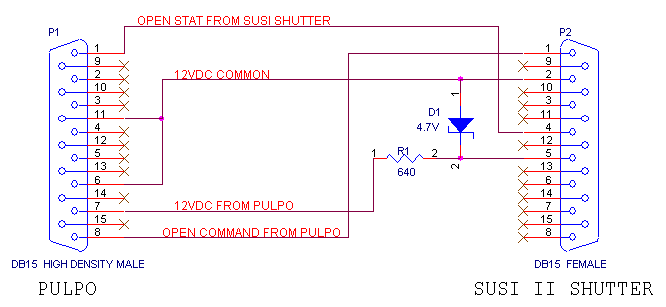
Shutter cable for SUSI II

![[ESO]](http://www.eso.org/images/icon-home.gif)
![[Index]](http://www.eso.org/images/icon-index.gif)
![[Search]](http://www.eso.org/images/icon-search.gif)
![[Help]](http://www.eso.org/images/icon-help.gif)
![[News]](http://www.eso.org/images/icon-whatsnew.gif)