![[ ESO ]](http://www.eso.org/images/eso-logo.gif)
|
PULPO user manual |
||||
|
|
|
PULPO user manual |
||||
|
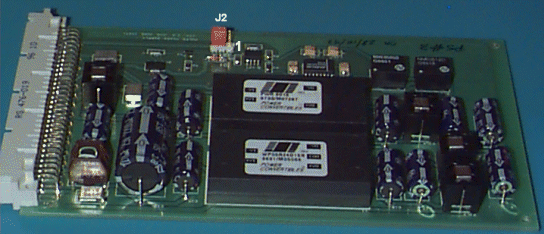
Inside the box, there are four printed circuit boards. Two of them have "credit card size" (power supply and main board), and the other two, front panel and back plane, are approximately 60 mm x 100 mm in size.
| Front panel | Rear panel |
| The front panel board is used to give physical support to the LCD and keyboard pads. It contains 3 LEDs to indicate PULPO peripheral activity like RS232, heaters and shutter status. There are also 4 potentiometers used to set heater current limits and shutter current wave shaping. This board is interconnected to PULPO main board through a flat ribbon cable. | This board provides electrical connection between the power supply board and the main board, it also connects the above mention boards to the eight connectors located in the back plate. |
To perform all its functions, PULPO needs a set of various voltages; 24 V DC @ 1 A for heaters, ± 15 V DC @ 150 mA for signal conditioning, 5 V DC @ 100 mA for digital circuitry, 5 V DC and 12 V DC with galvanic isolation from the others voltages to provide opto-isolation to the RS232 and power to external sensors. This, aiming to avoid ground loops between the cryostat and PULPO.
The input voltage to the power supply board is a 24 V DC, 2 Amp with sense leads. All the others voltages needed by PULPO are generated out of this 24 V DC via DC/DC modules. The power supply board also provide opto-isolation to the RS232 serial link using opto-couplers and a MAX232CWE chip.
All voltages have auto resetting SMT fuse protection.
Main board
PULPO heart is located on the main board. This board contains a "credit card size" micro-controller board (Phytec MiniModul 535), consisting in a Siemens 80C535 micro-processor running at 12 MHz suited with 64 KB of code EPROM, 64 KB of RAM, one serial port, one 8 channels multiplexed 10 bits ADC, 24 I/O ports. The 80C535 has three fully programmable 16 bits counters and some of the I/O ports can be used as interrupts inputs. The RAM contained in the Phytec micro-controller is battery backed up, allowing PULPO to "remember" the set values and operation mode in case of power failure.
The micro-controller board is piggy-back mounted on the "credit card size" main board which contains all the necessary conditioning electronics for sensors signals (temperature, vacuum), shutter, LED and heaters driving. The main boards also contains a serial ADC (16 bits of resolution) and multiplexers to select the temperature sensor.
Apart from the micro-controller, there is a 44 pin base to install another piggy-back board containing the electronic to drive/interface shutters. Three of this 44 pins are used to read the shutter board identification (code). Up to now, 2 different shutter driver modules has been designed. The first one (code 0) is able to drive a IRIS type of shutter, using a sort of pulse width modulation scheme. It contains opto-isolated inputs for hall effect sensors and galvanic isolated power supply (coming from power supply board) to feed the sensors. The second shutter module is a 5 opto-isolated outputs and 4 opto-isolated inputs plus galvanic isolated power supply (12 V DC) that can be interfaced with the SESO shutter driver or any external shutter driver accepting external control. The opto-isolated inputs are connected to interrupt sensitive inputs on the micro-controller, allowing accurate timing of external events.
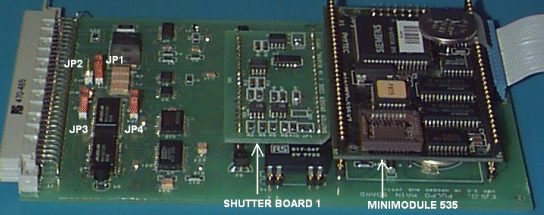
Jumpers JP1 and JP2 are used to select the output circuitry for heater 3. Only one of them should be closed. When JP1 is closed, heater 3 is driven through a power MOSFET, and when JP2 is closed, the driving is done through a DAC controlled current source. It is recommended to use JP1 closed as the MOSFET output is more efficient and reduce power dissipation inside PULPO.
| Send comments to
<odt@eso.org>
Last update: Mar 16, 2004 Webdesign by EVI |
|

![[ESO]](http://www.eso.org/images/icon-home.gif)
![[Index]](http://www.eso.org/images/icon-index.gif)
![[Search]](http://www.eso.org/images/icon-search.gif)
![[Help]](http://www.eso.org/images/icon-help.gif)
![[News]](http://www.eso.org/images/icon-whatsnew.gif)