



This documentation navigates through the observation logs and discusses their contents and how various parameters might be used to develop a better understanding of the environment during an exposure. However, the types and names of these observation log files, as well as the method for obtaining them, have changed in the past, so it is important that current documentation, such as this, be used for information. A more brief but useful discussion of obtaining and working with these files in IRAF, can also be found in the HST Data Handbook, Version 2, December 1995.
Observation log files are named according to the first 8 characters of the science root name, but with a `j' appended to the end, and each log reports the data in a time period encompassing that science exposure. They can be obtained from the HST DADS Archive, for any observation after 20 October 1994. Prior to this, no observation logs were routinely produced. For observations between October 1994 and August 1995, three files were produced, rootnamej.cmh, rootnamej.cmi, and rootnamej.cmj. The CMI and CMJ files are in STSDAS binary table format and can be manipulated using the IRAF/STSDAS table tools (ttools). The CMI table contains data averaged over 3 second intervals, while the CMJ table contains points at very high time resolution (a few points a second). The CMH file is an ascii file that accompanies the tables and provides keyword information. At the very end of August 1995, the files formats and names changed. The rootnamej.cmh file is now rootnamej.jih. Although very similar, the JIH file can now contain more keywords (discussed later). The rootnamej.cmi low time resolution table is now renamed rootnamej.jit, and the CMJ file has been replaced with rootnamej.jid, a 2-dimensional IRAF image of jitter excursions during the observation. The JIH, JID, and JIT files remain the current format. Note however that when de-archiving these files, they will arrive as a single rootnamej.jif. This file is in FITS format but is easily broken out into the header, image and table, by using the IRAF/STSDAS STRFITS task.
Below is a table summarizing the formats, and descriptions of each file's contents:
| Extension | Contents |
|---|---|
| October 94 to August 95 | |
| ascii header file | |
| high time resolution IRAF table | |
| 3 second average IRAF table | |
| After August 95 | |
| ascii header file | |
| 2-D IRAF histogram image | |
| 3 second average IRAF table | |
A representative .CMH/.JIH file: The ASCII header file contains the time interval, the rootname, averages of the pointing and spacecraft jitter, the guiding mode, guide star information, and alert or failure keywords.
SIMPLE  =                    F / data conforms to FITS standard               !
BITPIX  =                   32 / bits per data value                          !
DATATYPE= 'INTEGER*4         ' / datatype of the group array                  !
NAXIS   =                    2 / number of data axes                          !
NAXIS1  =                   64 / length of the 1st data axis                  !
NAXIS2  =                   64 / length of the 2nd data axis                  !
GROUPS  =                    T / image is in group format                     !
GCOUNT  =                    1 / number of groups                             !
PCOUNT  =                    0 / number of parameters                         !
PSIZE   =                    0 / bits in the parameter block                  !
OMS_VER = '16.2C             ' / OMS version used to process this observation
PROCTIME= '1994.133:06:24:18.35' / date-time OMS processed observation
                                 / date-times format (yyyy.ddd:hh:mm:ss.ss)

                               / IMAGE PARAMETERS
CRVAL1  =                  0.0 / right ascension of zero-jitter pixel (deg)
CRVAL2  =                  0.0 / declination of zero-jitter pixel (deg)
CRPIX1  =                   32 / x-coordinate of zero-jitter pixel
CRPIX2  =                   32 / y-coordinate of zero-jitter pixel
CTYPE1  = 'RA---TAN          ' / first coordinate type
CTYPE2  = 'DEC--TAN          ' / second coordinate type
CD1_1   =                  0.0 / partial of ra w.r.t. x (deg/pixel)
CD1_2   =                  0.0 / partial of ra w.r.t. y (deg/pixel)
CD2_1   =                  0.0 / partial of dec w.r.t. x (deg/pixel)
CD2_2   =                  0.0 / partial of dec w.r.t. y (deg/pixel)
COORDSYS= 'WFPC2             ' / image coordinate system
XPIXINC =                  2.0 / plate scale along x (mas per pixel)
YPIXINC =                  2.0 / plate scale along y (mas per pixel)
PARITY  =                   -1 / parity between V2V3 frame and image frame
BETA1   =               134.72 / angle from +V3 to image +x (toward +V2)
BETA2   =               224.72 / angle from +V3 to image +y (toward +V2)

                               / OBSERVATION DATA
PROPOSID=                05233 / PEP proposal identifier
PROGRMID= '288               ' / program id (base 36)
OBSET_ID= '02                ' / observation set id
OBSERVTN= '03                ' / observation number (base 36)
TARGNAME= 'NGC3379-PO        ' / proposer's target name
STARTIME= '1994.133:06:24:18.35' / predicted observation window start time
ENDTIME = '1994.133:06:39:18.35' / predicted observation window end time
SOGSID  = 'U2880203          ' / SOGS observation name                        !

                               / SCIENTIFIC INSTRUMENT DATA
CONFIG  = 'WFPC2             ' / proposed instrument configuration
PRIMARY = 'SINGLE            ' / single, parallel-primary, parallel-secondary
OPERATE = '1994.133:06:22:46.91' / predicted time instr. entered operate mode
TLMFORM = 'PN                ' / telemetry format
APERTURE= 'UWFALL            ' / aperture name
APER_V2 =                1.565 / V2 aperture position in vehicle frame (arcsec)
APER_V3 =                7.534 / V3 aperture position in vehicle frame (arcsec)

                               / SPACECRAFT DATA
ALTITUDE=               593.23 / average altitude during observation (km)
LOS_SUN =               106.08 / minimum line of sight to Sun (deg)
LOS_MOON=                77.11 / minimum line of sight to Moon (deg)
SHADOENT= '1994.133:05:11:29.00' / predicted Earth shadow last entry
SHADOEXT= '1994.133:05:42:45.00' / predicted Earth shadow last exit
LOS_SCV =                12.46 / minimum line of sight to S/C veloc. (deg)
LOS_LIMB=                 58.0 / average line of sight to Earth limb (deg)


                               / BACKGROUND LIGHT
ZODMOD  =                 22.3 / zodiacal light - model (V mag/arcsec2)
EARTHMOD=                 20.2 / peak Earth stray light - model (V mag/arcsec2)
MOONMOD =                 35.5 / moon stray light - model (V mag/arcsec2)
GALACTIC=                 -1.0 / diffuse galactic light - model (V mag/arcsec2)

                               / POINTING CONTROL DATA
GUIDECMD= 'FINE LOCK         ' / commanded guiding mode
GUIDEACT= 'FINE LOCK         ' / actual guiding mode at end of GS acquisition
GSD_ID  = '0084900235        ' / dominant guide star id
GSD_RA  =            161.70720 / dominant guide star RA (deg)
GSD_DEC =             12.45407 / dominant guide star DEC (deg)
GSD_MAG =               12.867 / dominant guide star magnitude
GSR_ID  = '0085201189        ' / roll guide star id
GSR_RA  =            161.93314 / roll guide star RA (deg)
GSR_DEC =             12.78141 / roll guide star DEC (deg)
GSR_MAG =               12.977 / roll guide star magnitude
GSACQ   = '1994.133:06:31:02.92' / actual time of GS acquisition completion
PREDGSEP=             1420.775 / predicted guide star separation (arcsec)
ACTGSSEP=             1421.135 / actual guide star separation (arcsec)
GSSEPRMS=                  3.8 / RMS of guide star separation (milli-arcsec)
NLOSSES =                    0 / number of loss of lock events
LOCKLOSS=                  0.0 / total loss of lock time (sec)
NRECENT =                    0 / number of recentering events
RECENTR =                  0.0 / total recentering time (sec)

                               / LINE OF SIGHT JITTER SUMMARY
V2_RMS  =                  4.5 / V2 axis RMS (milli-arcsec)
V2_P2P  =                 51.6 / V2 axis peak to peak (milli-arcsec)
V3_RMS  =                 20.9 / V3 axis RMS (milli-arcsec)
V3_P2P  =                267.3 / V3 axis peak to peak (milli-arcsec)
RA_AVG  =            161.85226 / average RA (deg)
DEC_AVG =             12.58265 / average dec (deg)
ROLL_AVG=            293.01558 / average roll (deg)

                               / PROBLEM FLAGS, WARNINGS and STATUS MESSAGES
                               / (present only if problem exists)
ACQ2FAIL= '                 T' / target acquisition failure
GSFAIL  = 'DEGRADED          ' / guide star acquisition failure  (*1)
TAPEDROP= '                 T' / possible loss of science data
TLM_PROB= '                  ' / problem with the engineering telemetry
TM_GAP  =               404.60 / duration of missing telemetry (sec)
SLEWING = '                 T' / slewing occurred during this observation
TAKEDATA= '                 F' / take data flag NOT on throughout observation
SIPROBnn= '                  ' / problem with specified science instrument (*2)

END
-----------------------------------------------------------------------------

notes
*1 - GSFAIL appears only once in a single header file.
     The following table lists all current possible values for the GSFAIL
     keyword:
     -------------------------------------------------------------
     GSFAIL   |DEGRADED         | / guide star acquisition failure
              |IN PROGR         | / guide star acquisition failure
              |SSLEXP           | / guide star acquisition failure
              |SSLEXS           | / guide star acquisition failure
              |NOLOCK           | / guide star acquisition failure
              |                 |
              |SREXCS?          | / guide star acquisition failure
              |SREXCS1          | / guide star acquisition failure
              |SREXCS2          | / guide star acquisition failure
              |SREXCS3          | / guide star acquisition failure
              |                 |
              |SREXCP?          | / guide star acquisition failure
              |SREXCP1          | / guide star acquisition failure
              |SREXCP2          | / guide star acquisition failure
              |SREXCP3          | / guide star acquisition failure
              |                 |
              |UNKNOWN          | / guide star acquisition failure
              |VEHSAFE          | / guide star acquisition failure
     -------------------------------------------------------------

*2 - The SIPROBnn keywords appear in the header file with nn = 01 - 99.
     The following table lists all current possible values for the SIPROBnn
     keyword:
     -------------------------------------------------------------------------
     SIPROBnn |DCF_NUM unchanged| / This observation may not have been taken
              |FOS Safing!      | / This observation affected when FOS Safed!
              |HRS Safing!      | / This observation affected when HRS Safed!
              |WFII Safing!     | / This observation affected when WFII Safed!
              |FOC Safing!      | / This observation affected when FOC Safed!
              |Shut             | / FOS aperture door is not Open!
              |FAILED           | / FGS astrometry target acquisition failed
     -------------------------------------------------------------------------
|
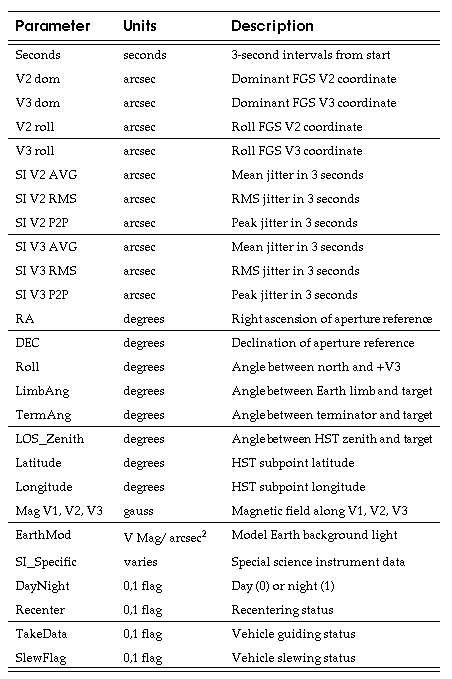
Column description of the "ROOTNAME"J.CMI/.JIT: This table contains data that were averaged over 3-second intervals. It includes the same information as the .cmj table but also includes orbital data (e.g., latitude, longitude, limb angle, magnetic field values, etc.) and instrument-specific items. This table is best suited for quick-look assessment of pointing stability and for studying trends in telescope or instrument performance with orbital environment. Listed are the table column headings, units and a brief definition.
 |
|---|
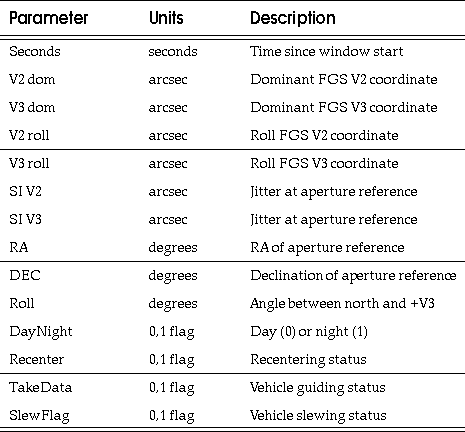
Description of columns in the "ROOTNAME"J.CMJ table: The table presents the data at the highest time resolution for the telemetry mode in use. It contains the reconstructed pointing, guide star coordinates, derived jitter at the SI aperture, and pertinent guiding-related flags. The intent is twofold: (1) to provide high-time resolution jitter data for deconvolution calculations or for assessing small aperture pointing stability, and (2) to display the slew and tracking anomaly flags with the highest resolution. As discussed, this table has been replaced with the .jid high resolution jitter image for observations after August 95.
 |
|---|