|
|
|
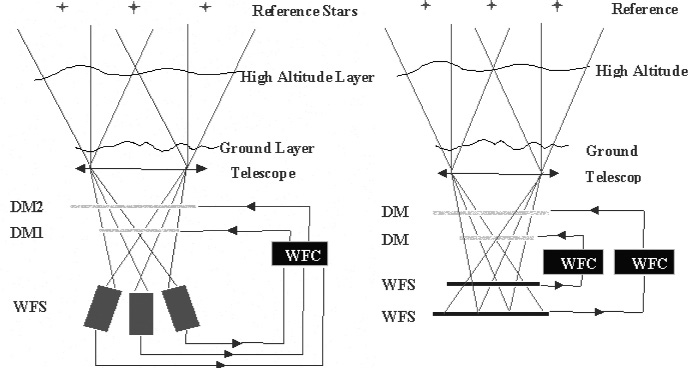
A property of the layer-oriented system is to be more sensible to the
nearest perturbing layer from the focusing altitude even if it
measures the wavefront variation of several layers. If the atmosphere
is composed by a single layer, the measurement precision of the layer
depends on how much it is far away from the focusing altitude of the
system. This distance introduces a smoothing of the layer with a known
amplitude and this smoothing can be numerically computed knowing the
relative layer altitude with respect to the focusing altitude.
We verified quantitatively the smoothing of the screen as a function of its distance to the focusing altitude by comparing the measured wavefront and the computed one. The system is focused on the ground. The screen 4 is successively placed at different altitudes going from layer 1 to layer 5. Using the wavefront obtained when the screen is on the ground layer, we compute the wavefronts which should be obtained at different altitudes ranging from layer 2 to layer 5 by numerically blurring it. We tried to reproduce the actual situation in which the screen is moved farther and farther from the conjugation altitude and it appears more and more blurred, due to the smoothing effect associated to the field of view. The numerical smoothing has been accomplished by convolving the reference wavefront by a circular dish, whose diameter, computed on the basis of geometrical considerations on the system optical layout, increases with the distance of the screen from the conjugation altitude: going from a given altitude to the adjacent one the diameter of the dish changes by approximately 5 pixels. We verify also that non-conjugated layers are perturbing marginally the sensing of the conjugated ones whatever is the altitude of sensing and that the turbulent layers are properly recognized if the WFS is conjugated to them. We measure the composite wavefront for different altitudes of sensing and compare it with the three screens used to simulate the atmosphere. |

|

|

|

