Project obs.tpr
Thu Mar 11 21:00:38 GMT+04:30 1999
Diagrams List
Class diagram obs
Diagrams Descriptions
Class diagram obs

Classes
Program
Declaration
- public class Program
Documentation
- The 'Program' class represents an astronomical, observational
research program with the aim to solve an explicit astronomical
problem. The Program may demand observations on several
different facilitiles which each requires a specific proposal for
observing time.
Association links
- PI pi
supplierCardinality
- 1
- CoI coIs
supplierCardinality
- 0..*
Aggregation links
- Vector proposals
associates
- Proposal
supplierCardinality
- 1..*
Proposal
Declaration
- public class Proposal
Documentation
- The 'Proposal' class represents a proposal for observing time
at a given Observatory. It is ranked by a TAC and may be
granted observing time if successfull. In this case, a set of
Time Allocations (TimeAlloc) will be associated to the Proposal.
Aggregation links
- Vector timeAllocations
associates
- TimeAlloc
supplierCardinality
- 1..*
TimeAlloc
Declaration
- public class TimeAlloc
Documentation
- The Time Allocation (TimeAlloc) class represents a period
of time allocated to a proposal. This time is not
necessarily contiguous and may be spread over more than
one instrument. It may include additional constraints on the
time allocated (lunar phase, seeing etv.)
Association links
- Observer observer
supplierCardinality
- 1
Aggregation links
- Vector obsComponent
associates
- ObsComp
supplierCardinality
- 1..*
Observatory
Declaration
- public class Observatory
Documentation
- The 'Observatory' class denotes an organization which offers
observational facilities to a user community. The may be
distributed over several sites (Site) which each may offer
a set of Instruments. An Observatory receives Proposals
for observing time and has a Time Allocation Commitee
to evaluate them.
Aggregation links
- Vector tooProposals
associates
- TOO
supplierCardinality
- 0..*
- TAC tac
associates
- TAC
supplierCardinality
- 1
- Vector sites
associates
- Site
supplierCardinality
- 1..*
PI
Declaration
- public class PI
Documentation
- The Principle Investigator 'PI' class defines the person
responsible for the definition and execution of the Program.
He/she makes all decisions related to the Program and will have
the access right to data acquired.
CoI
Declaration
- public class CoI
Documentation
- The CoInvestigator 'CoI' class represents a person associated
with a Program as a collaborator.
Observer
Declaration
- public class Observer
Documentation
- The Observer class denotes the person or system responsible
for carrying out observations.
Target
Declaration
- public class Target
Documentation
- The Target class represent s either an astronomical object (e.g.
stars or galaxies) or a telescope position (e.g. zenith or flat
field screen).
ObsScript
Declaration
- public class ObsScript
Documentation
- The Observing Script 'ObsScript' class defines a sequence of
atomic actions each defined by a instrument template
'InsTemplate', The parameters of the individual templates
may either be obtained from the Target, be parameters
specified in the 'ObsBlock' or constants. Typically, the first
template would acquire the Target while the subsequent
templates would perform exposures and configurations.
Aggregation links
- Vector templates
associates
- InsTemplate
supplierCardinality
- 1..*
TAC
Declaration
- public class TAC
Documentation
- The Time Allocation Committee (TAC) class is responsible for the
evaluation and ranking of Proposals for observing time
Association links
- Vector proposals
associates
- Proposal
supplierCardinality
- 0..*
Site
Declaration
- public class Site
Documentation
- The Observing Site 'ObsSite' class defines a logistic entity
consisting of a set of observing facilities i.e. Instruments.
The ObsSite is responsible for the detailed allocation of
resources and scheduling of its facilities.
Aggregation links
- Vector instruments
associates
- Instrument
supplierCardinality
- 1..*
Instrument
Declaration
- public class Instrument
Documentation
- The Instrument class reprersents an astronomical instrument
which typically is mounted on a telescope. All control of the
associated Telescope(s) is done through the Instrument. e.g.
an interferometric instrument may require full control over
a set of Telescopes. Depending on the operation, an Instrument
may require exclusive access to the Telescope (e.g. for science
exposures) or not (e.g. for dark current calibrations).
Association links
- Vector templates
associates
- InsTemplate
supplierCardinality
- 1..*
- Vector telescopes
associates
- Telescope
supplierCardinality
- 0..*
Telescope
Declaration
- public class Telescope
Documentation
- The 'Telescope' class denotes a physical telescope which can
have one or more Instruments. It is controled by a specific
Instrument which must acquire exclusive controlover it.
ObsBlock
Declaration
- public class ObsBlock extends ObsComp
Documentation
- The Observation Block 'ObsBlock' class defines a logical unit of
exposures needed to obtain a coherent set of data. It is the
smallest unit which can be scheduled for observation on an
Instrument. It specifies a set of instrument operation (defined
by an Observation Script 'ObsScript') to be performed for a
Target. The ObsBlock also contains all parameters required to
specify the ObsScript and any scheduling restrains.
Association links
- Target target
supplierCardinality
- 0..1
- ObsScript script
supplierCardinality
- 1
Generalization links
InsTemplate
Declaration
- public class InsTemplate
Documentation
- The Instrument Template 'InsTemplate' class specifies an atomic
sequence of instrument operations. The execution of a template
will change to instrument to a well defined state. Parameters
defined by a Template signature may be specified. Besides
an exit state, a template may also produce a set of data
related to exposures performed.
ObsGroup
Declaration
- public class ObsGroup extends ObsComp
Documentation
- The Observation Group 'ObsGroup' class defines a logical set of
Observation Block's which specifies a coherent set of
astronomical observations. This may include observations
of several target (e.g. calibration sources).
Aggregation links
- Vector components
associates
- ObsComp
supplierCardinality
- 1..*
Generalization links
ObsComp
Declaration
- public class ObsComp
TOO
Declaration
- public class TOO extends Proposal
Documentation
- The TargetOfOpportunity 'TOO' class represents a special
subclass of Proposal for target-of-opportunity. This type
of proposals is handled direct by the Observatory due to
time restrictions.
Generalization links
UseCase diagram UseCase2
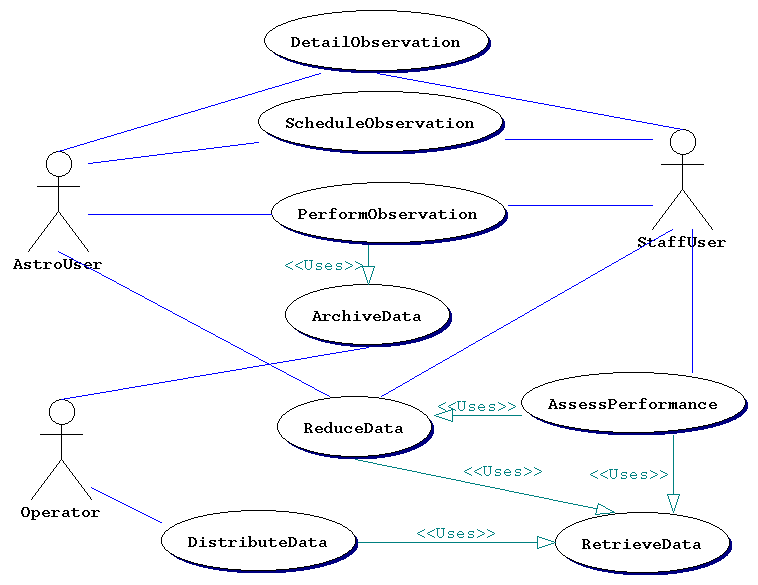
Usecases
-
note
- Based on an accepted Phase I proposal, the individual
observations in the form of 'ObsBlock's must be specified
in Phase II Preparation. The result is a complete set of
'ObsBlock's to be executed.
-
-
note
- A collection of 'ObsBlock's is checked which can be observed in a
specified period and what special requirements are associated to
them. This information is used to create a schedule for their
execution considering a set of criteria to be optimized.
-
-
note
- An 'ObsBlock' is extracted from the Schedule and executed. As
a result a set of data is produced by the Instrument. The data
is saved in an Archive.
-
UsesRelationships
-
note
- A set of data is saved in the Archive.
-
-
note
- A set of data is extracted from the Archive and reduced
depending on a set of rules. A typical reduction would
be to remove instrument specific features (e.g. flat field)
from raw data and calibrate it to physical units.
-
UsesRelationships
-
-
UsesRelationships
-
note
- A conplete set of data related to an observing run or a
proposal is
retrieved from the Archive and provided to the user.
-
UsesRelationships
-
note
- Data from the Archive is retrieved.
-
Actors
-
-
note
- Astrononmical user of the observatory
stereotype
- Astronomer
Communication
- DetailObservation
- PerformObservation
- ScheduleObservation
- ReduceData
-
-
note
- Operational staff of observatory
stereotype
- Staff
Communication
- ScheduleObservation
- PerformObservation
- DetailObservation
- ReduceData
- AssessPerformance
-
-
note
- Technical Operator
stereotype
- case worker
Communication
- ArchiveData
- DistributeData
UseCase diagram UseCase1
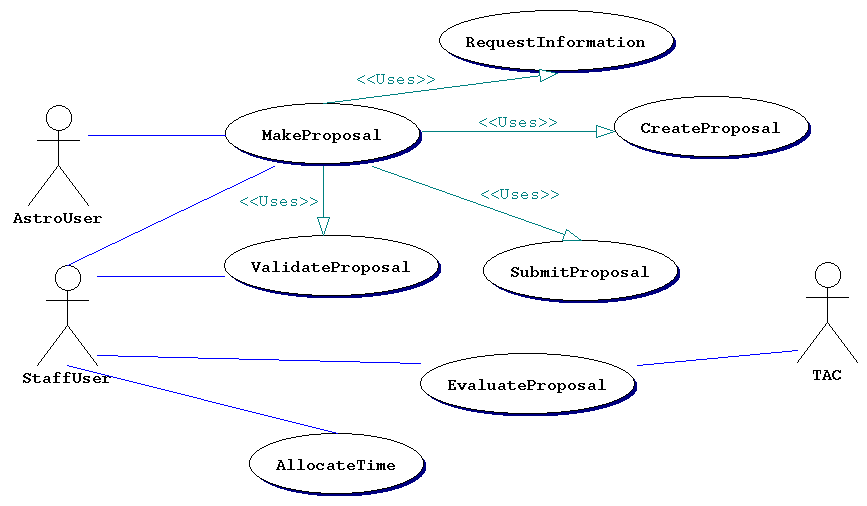
Usecases
-
note
- A new proposal for observing time is created. This includes
the following sequence of steps: information on available
facilities is acquired from an observatory, the proposal is
created, validated for correctness and finally submitted
to the observatory.
-
UsesRelationships
-
note
- A proposal for observing time is created. It contains ia
detailed description of the scientific aim and a list of
resources required such as instruments. An estimate of
the time required is also provided.
-
-
note
- The proposal is submitted to an observatory which acknowledge it
and forwards it to its Time Allocation Committee.
-
-
note
- The proposal is checked for consistency and syntactical errors.
-
-
note
- A set of proposals are checked for their technical feasibility
by staff. The TAC evaluates them on both their technical and
scientific merits. A rank is them assigned to the individual
proposals with recommendation for the time to be allocate.
-
-
note
- A set of proposals with their associated ranks are allocated time
depending on available time on the different facilities and
their technical schedule.
-
-
note
- Information on available facilities is requested from an
observatory. This includes technical data of instrument
and operational manuals. Tools to evaluate the efficiency
of different instrument mode are also provided (e.g.
Exposure Time Calculators).
-
Actors
-
-
note
- Astronomical user of the system.
stereotype
- Astronomer
Communication
-
-
note
- Operational staff of observatory
stereotype
- Staff
Communication
- MakeProposal
- ValidateProposal
- EvaluateProposal
- AllocateTime
-
-
note
- Member of Time Allocation Committee
stereotype
- TAC member
Communication