Concept baseline:
Wavefront tomography using 4 sodium LGSs
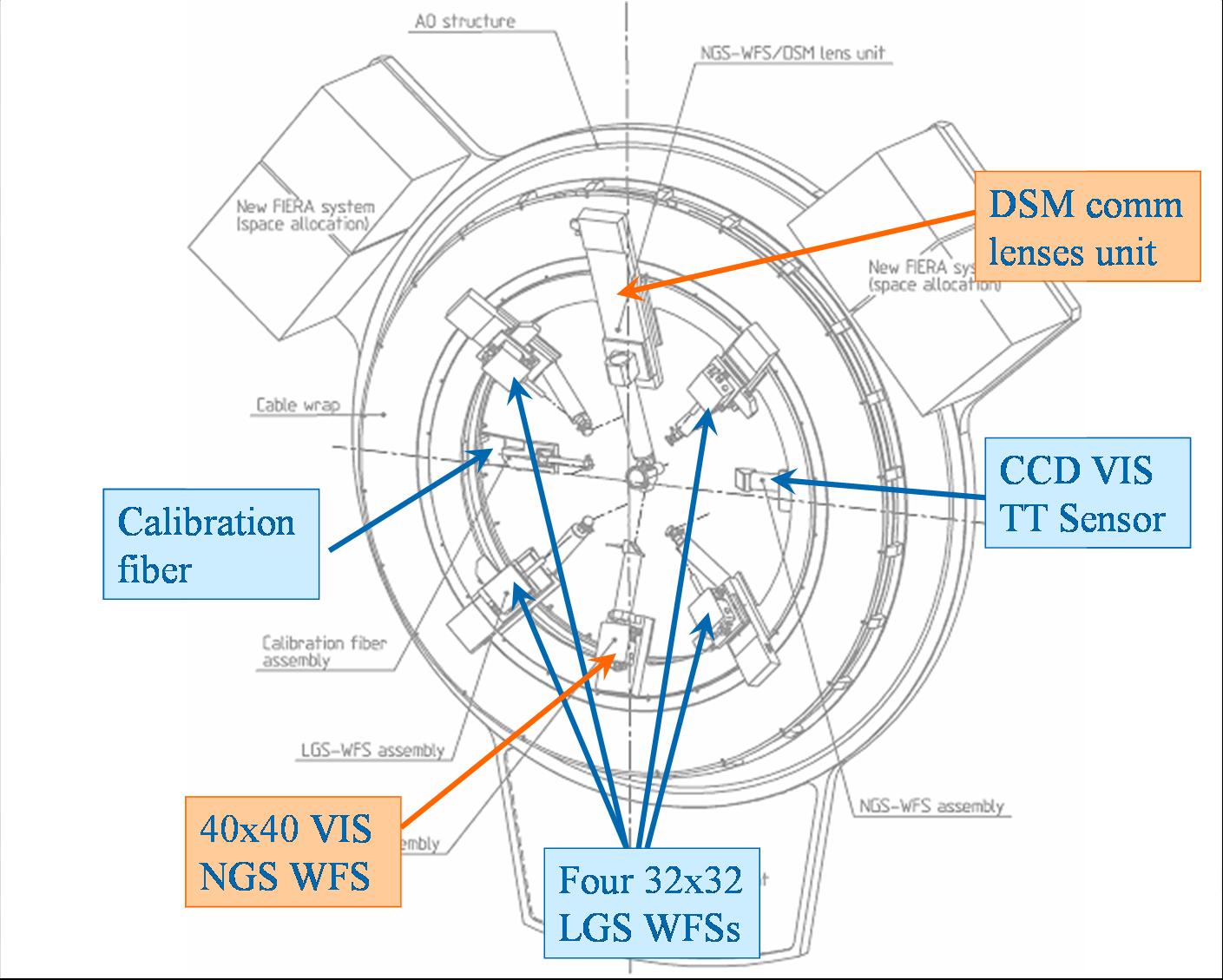
Four Shack-Hartmann WFS for LGSs
Ground layer correction: one Deformable Secondary Mirror
On-axis NIR tip-tilt NGS using the HAWK-I detector
As alternative, off-axis visible tip-tilt NGS
One NGS WFS for DSM commissioning & maintenance
|
 |
|
|
LGS wave front sensors:
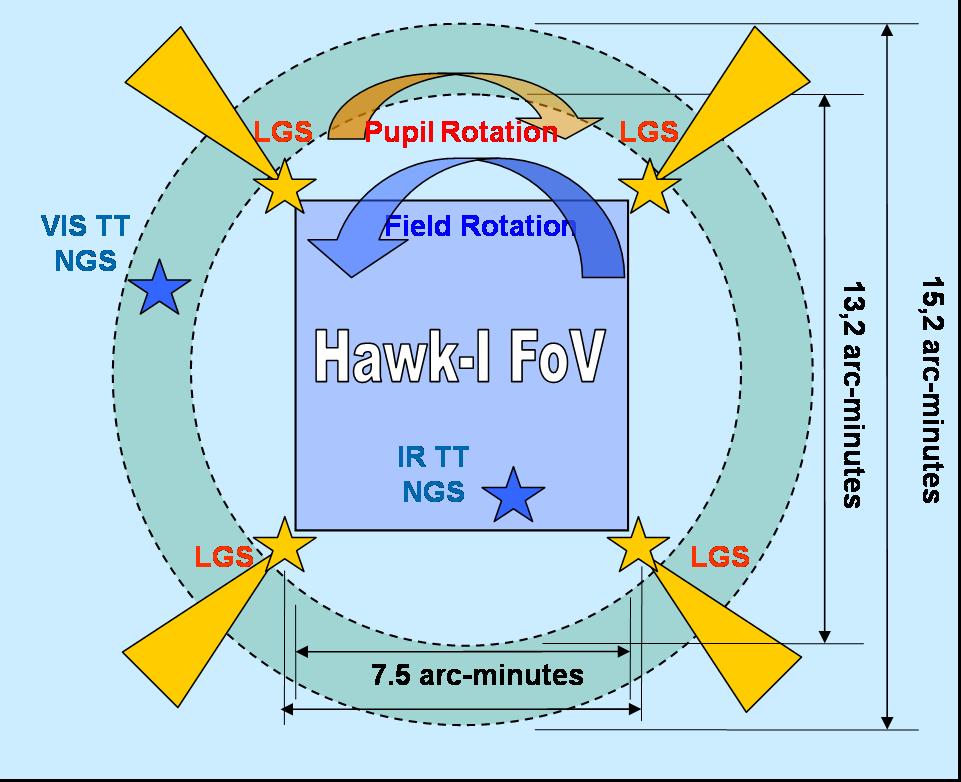
Systems mounted on rotating structure (to keep WFS pupil position aligned with DSM M2 actuator patterns + LGS position rotation)
4 pick up mirrors placed at 5.5 arcmin from HAWK-I center FOV
90 degrees configuration
32×32 sub-apertures WFSy
8×8 pixel per sub-aperture (256×256 CCD, 24?m pixel size)
4 arcsec FOV per sub-aperture (0.5 arcsec/pixel scale)
Each LGS WFS mounted on linear stage (altitude focus varying between 80 and 180 km)
Calibration fiber system available
Infrared Tip-tilt Sensing
HAWK-I camera size: 4k×4k, 7.5×7.5 arcmin, 0.1063 arcsec/pixel
Scientific frame readout: 2.6 sec without TT sensing (at 10?s/pix)
|
 |
|
|
For tip-tilt sensing (baseline):
Sub array of 16×16 pixel or 1.7×1.7 arcsec
Readout noise double correlated: 17 e- RON
32 channels for scientific readout, 33rd for TT window
With TT sensing readout: 3.93 sec with 65Hz TT frame rate and 5.12 msec integration time
Photon limit due to science filters not studied yet
Location TT window: programmable via OS command, 1 px accuracy.
Visible Wave front sensor
Back-up solution without vignetting the HAWK-I FOV.
Accept up to 25 arcsec dithering
Need the HAWK-I rotation for NGS selection
NGS selected in annular FOV between 13.2 and 15.2 arcmin
A 50mm pick-up mirror reflects a 54’’ FoV to the TT NGS detector
256×256 detector, 0.2 arcsec/pixel
Window size: 3” FOV, 16×16 pixel
|
 |
|
|
DSM commissioning mode
40x40 subapertures Shack-Hartmann WFS
6x6 pixels per subaperture, pixel scale: 0.3 arcsec/pix
1.8 arcsec FOV per sub-aperture
Focal Elongator in front of HAWK-I
Pixel scale up to 10 milli arcsec/pixel on a 10’’ FoV
|

