Research


KINEMATIC DECOUPLING IN GALAXIES

See the spectral decomposition in NGC 5719 (paper on MNRAS, 2011, 412, L113. here)
See the spectral decomposition in NGC 3593 and NGC 4550 (paper on A&A, 2013, 549, 3. here)


The two counter-rotating stellar disks in NGC 5719

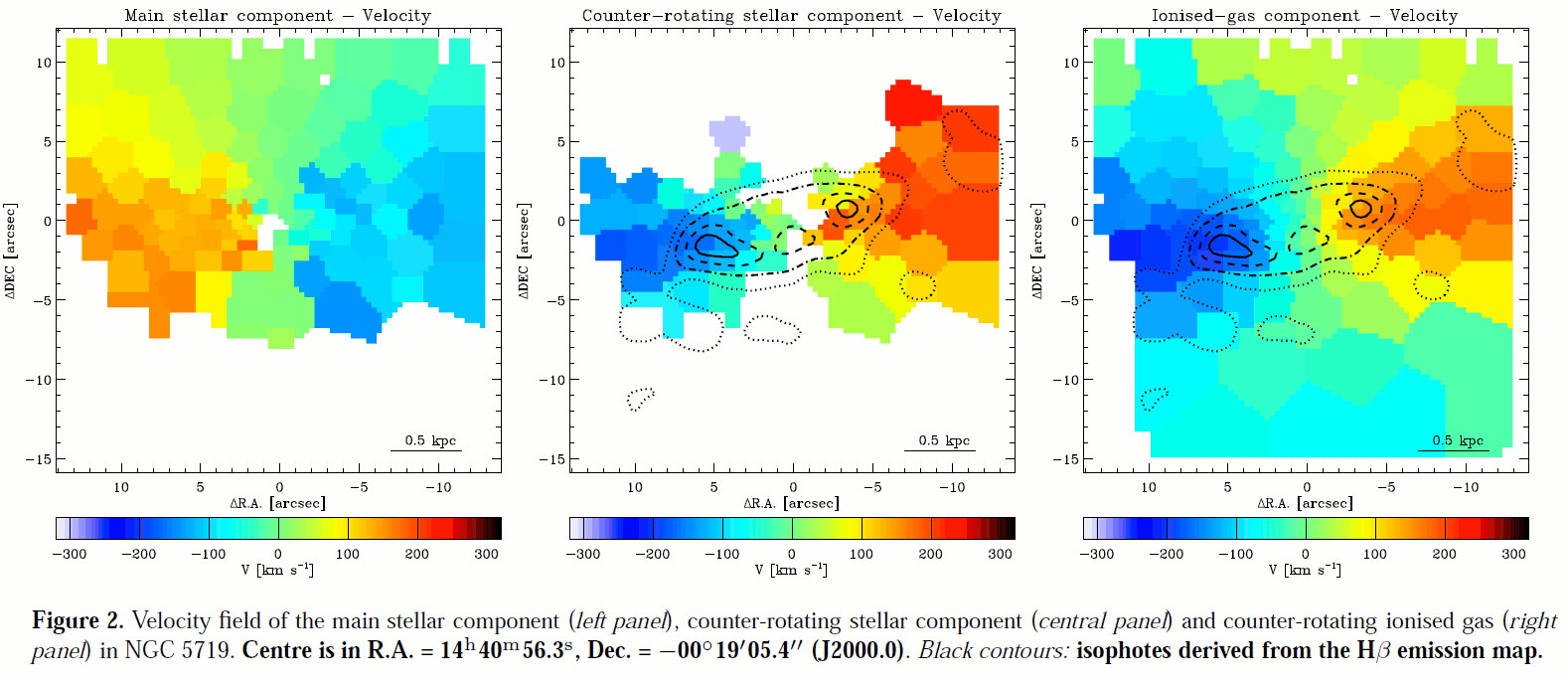
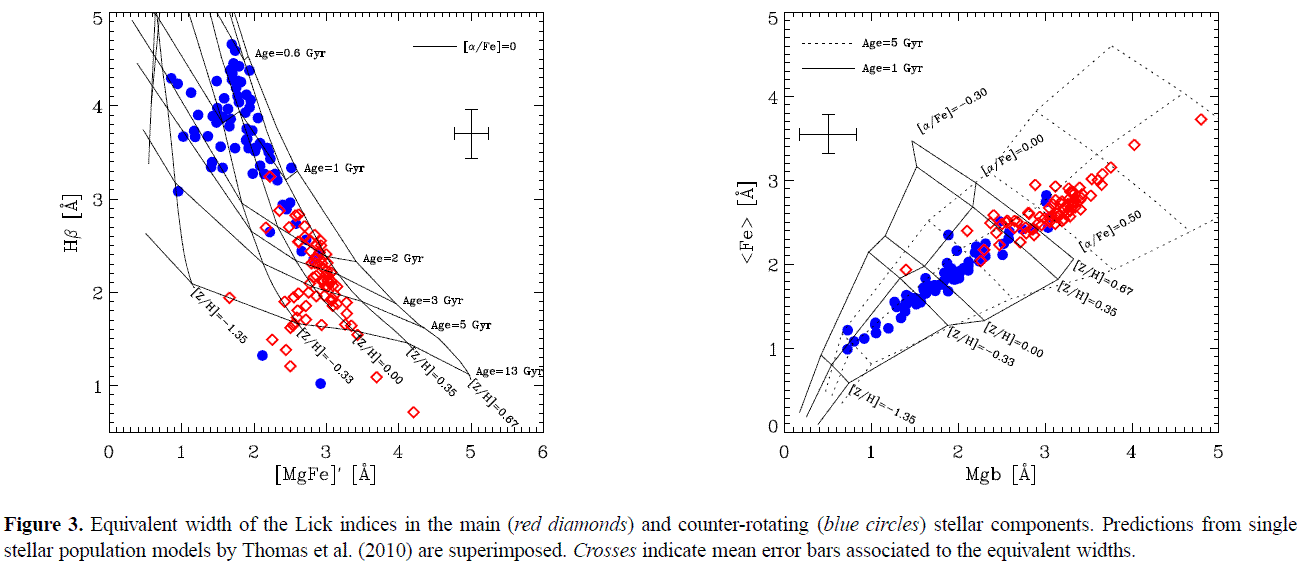
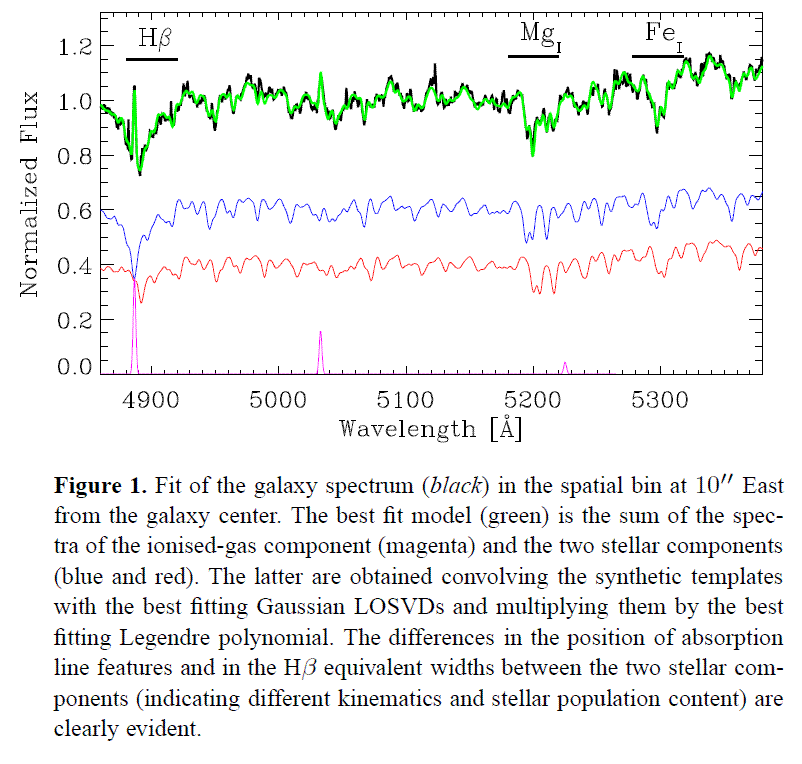
We study vith VIMOS/IFU the inner 28′′ × 28′′ (3.1 kpc × 3.1 kpc) of the interacting spiral NGC 5719, which is known to host two co-spatial counter-rotating stellar discs. At each position in the field of view, the observed galaxy spectrum is decomposed into the contributions of the spectra of two stellar and one ionised-gas components (Figure 1). We measure the kinematics (Figure 2) and the line strengths of the Lick indices (Figure 3) of the two stellar counter-rotating components. We model the data of each stellar componentwith single stellar populationmodels that account for the α/Fe overabundance. We also derive the distribution and kinematics of the ionised-gas disc, that is associated with the younger, less rich in metals, more enhanced, and less luminous stellar component. They are both counter-rotating with respect the main stellar body of the galaxy. These findings prove the scenario where gas was accreted first by NGC 5719 onto a retrograde orbit from the large reservoir available in its neighbourhoods as the result of the interaction with its companionNGC 5713, and subsequently fuelled the in situ formation of the counter-rotating stellar disc.


Minor axis velocity gradients
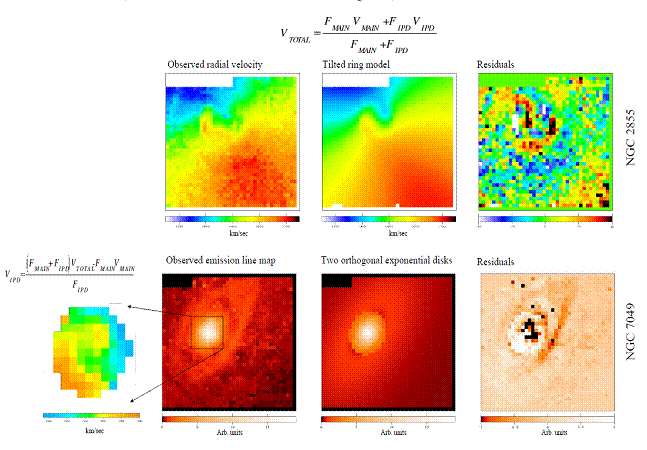
I studied the major and minor axis stellar and gaseous kinematics of a large sample of lenticular and spiral galaxies in order to probe the presence of inner polar disks (e.g. a decoupled gaseous and/or stellar structures rotating on a plane orthogonal to the galaxy main plane) and non-circular motions induced by the triaxial potential of the bulge or the bar. Results indicate that in more than 50% of unbarred galaxies the gaseous component shows remarkable rotation along the minor axis, sometimes associated also with stellar rotation. In some cases, the minor-axis rotation is extended towards all the galaxy disk, in some other cases it is confined only in the innermost few kpc. This shows that the use of only major axis long-slit kinematics could led in many cases to an underestimation of the circular velocity of the galaxy. Then, I followed up two Sa galaxies (namely NGC 2855 and NGC 7049, both characterized by a remarkable gaseous velocity gradient along the minor axis) and measured their two dimensional gaseous velocity field with integral field spectrography. The aim was to characterize the geometrical and physical properties of the inner polar disk in their center. We modeled the observed kinematics with a tilted ring model simulating a warp of the gaseous disk in their centers, and retrieving their correct circular velocity. In NGC 2855, the observed velocity field is consistent with the main disk being strongly warped in the innermost regions. In NGC 7049 the observed velocity field is consistent with a central and geometrically-decoupled disk, which is nested in the main disk (see Figure 4).


Related papers:
Coccato et al. 2007, A&A, 465, 777
Coccato et al. 2005, A&A, 440, 107
Coccato et al. 2004, A&A, 416, 507
Corsini et al. 2003, A&A, 408, 873


Figure 4: Upper panels: results for the tilted ring model for NGC 2855. Lower panels: results for the two component model for NGC 7049.