Research
Outer halo of early type galaxies:
kinematics with Planetary Nebulae
The study of kinematic properties, angular momentum and amount of
dark
matter in the halos of earlytype galaxies (ETGs) is limited by the
rapid fall-off of the stellar surface brightness. This difficulty can
be overcome by using radial velocities of Planetary Nebulae (PNe),
which can be obtained much further out than traditional absorption-line
kinematics, given their bright [OIII] emission lines. The use of PNe
allowed us to measure for the very first time two-dimensional velocity
and velocity dispersion fields out to ~6-9 effective radii in nearby
ETGs.
Over the past years we
conducted an observational campain with the Planetary Nebulae
Spectrograph (Douglas et al. 2002) aimed to measure the radial
velocities of PNe in the halos of ETGs (see Figure 1). In our first
official data release (Coccato et al. 2009) we combined absorption line
data and PNe radial velocity measurements in 16 ETGs. Our analysis
showed that: i) PNe are good tracers of the mean stellar population
kinematics, as their kinematics and number density agrees with the
stellar absorption line kinematics and surface brightness; ii) outer
halos have more complex radial profiles of the λ(R) parameter (a proxy
for the angular momentum, Emsellem et al. 2007) than observed within 1
Re. Interestingly, in the halo, some fast rotators have declining lR
radial profiles, almost reaching the slow rotator regime, while some
slow rotators have slowly increasing λ(R)
profiles, which reach the fast
rotator regime (see Figure 2); iii) the velocity dispersion profiles
fall into two groups, with part of the galaxies characterized by slowly
decreasing profiles and the remainder having steeply falling profiles;
iv) the halo kinematics are correlated with other galaxy properties,
such as luminosity, shape, total stellar mass, V/σ, and number of PNe
per unit luminosity, with a clear distinction between fast and slow
rotators.
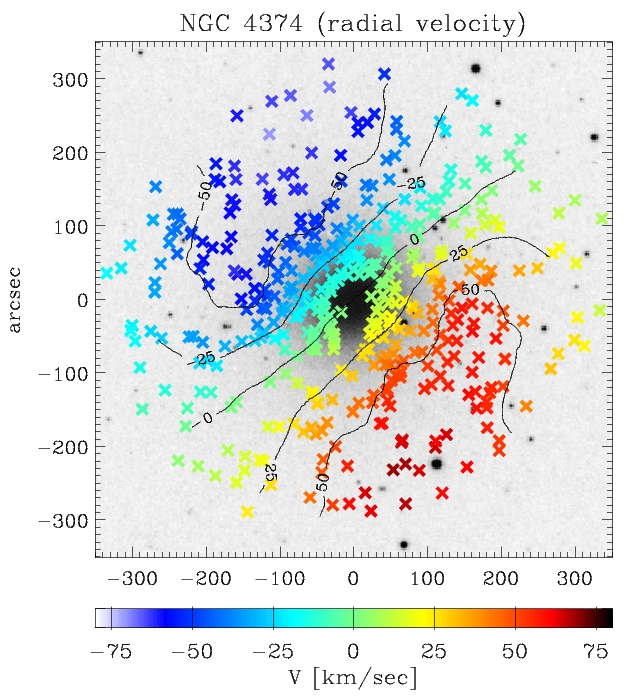 |
Figure
1. DSS image of NGC 4474 with PNe data superimposed. Crosses represent
the position of each PNe; colors indicate the mean value of the
two-dimensional velocity field reconstructed from the PNe data.
Iso-velocity contours are also shown. The field of view is 11'x11',
North is up, East is left.
|
|
|
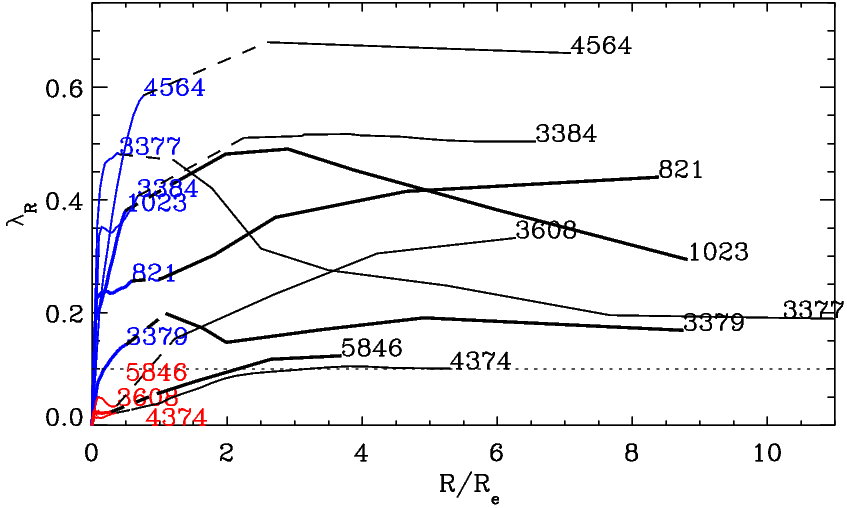 |
Figure
2. Radial profile of the angular momentum proxy λ(R). Red and
blue profiles are taken from the SAURON sample (Emsellem et al. 2007)
and represent slow rotators (galaxies with λ(R) < 0.1) and
fast
rotators (λ(R) > 0.1), respectively. Black profiles are computed
using PNe radial velocity measurements. |
Related
publications:
Coccato, L.,
Gerhard, O., Arnaboldi, M., Das, P., Douglas, N. G., Kuijken, K., et
al. 2009, MNRAS, 394, 1249. Kinematic
properties of early-type galaxy haloes using planetary nebulae. 2009MNRAS.394.1249C
Coccato, L., Gerhard, O., Arnaboldi, M., Das, P., Douglas, N. G.,
Kuijken, K., et al. 2008, AN, 329, 912. Probing
the kinematics of early-type galaxy halos using planetary nebulae. 2008AN....329..912C