Research


Outer halo of bright ellipticals: stellar population


NGC 4489 in the Coma cluster
We construct radial profiles of line strength indices along the major axis of NGC 4889 by combining literature data for the central regions and new deep spectroscopic data for the halo regions. We then derive age, metallicity and alpha-enhancement radial profiles and their gradients using Single Stellar Population models by Thomas et al. (2003), see Figure 1. This represents the most spatially extended dataset with both stellar kinematics and line strength indices for a brightest cluster galaxy.

We observe a different population content and gradient between the central regions of the galaxy (R<18 kpc) and the outer halo (R>18 kpc). The inner ~18 kpc (~1.2 Re) of NGC 4889 are characterized by a strong [Z/H] gradient and a nearly constant values of [α/Fe]. The outer regions (18 kpc < R < 60 kpc) are characterized by a constant metallicity content strong negative gradient in the abundance ratio and older ages.

Two steps formation process
. These data indicate that the central parts of NGC 4889 and its halo have undergone different formation mechanisms. Data in the center indicate a short star formation timescale, where the stars formed outside-in, reminiscent of a quasi-monolithic dissipative collapse. On the contrary, the data in the halo suggest that it was accreted from shredded satellite galaxies, as suggested also by numerical simulations, over the central galaxy that as already in place.

Size evolution. Our measurements are also consistent with recent results on the size evolution of bright Early Type Galaxies (ETGs) with redshift, i.e. at high redshifts ETGs are smaller and more compact than ETGs of similar mass at z = 0. Their effective radius evolves as Re ~ (1+z)-1.3 (van Dokkum et al. 2010). Scaling the present Re of NGC 4889 with this relation would predict Re = 6.2 kpc, at z = 1, which is consistent with the half light radius measured if considering the central regions of the galaxy only, on the assumption that outer regions of NGC 4889 were accreted later, at z < 1. Our finding for NGC 4889 suggests that we may have found local stellar population signatures of the observed ETG size evolution.
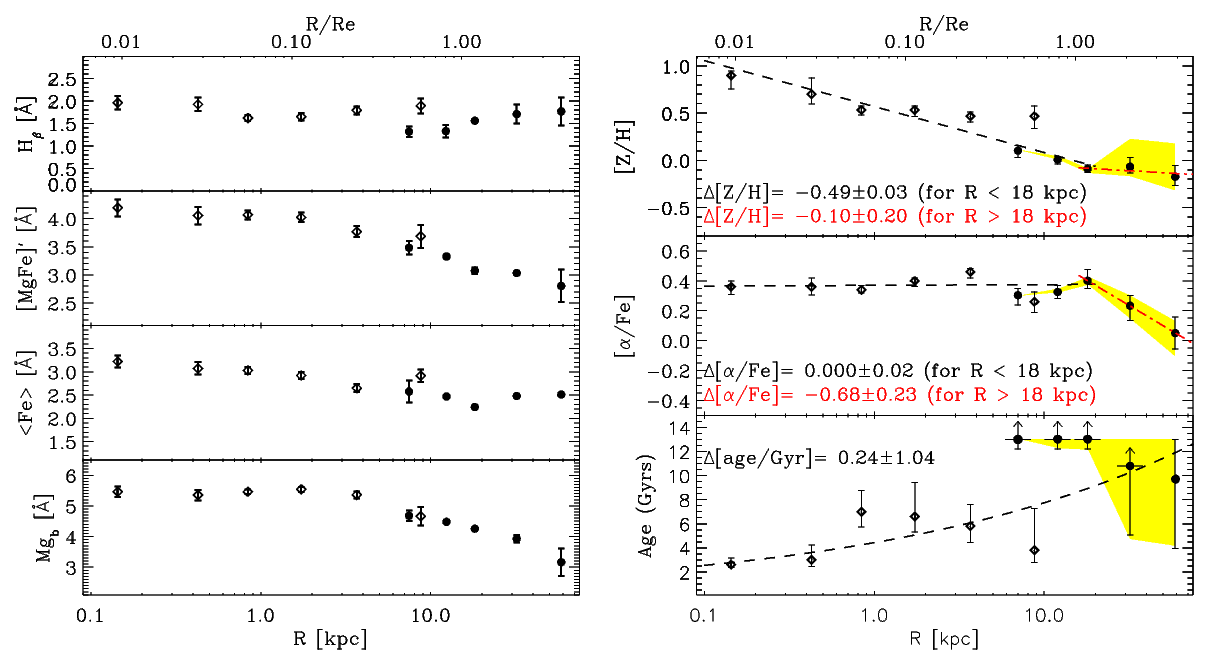

Figure 1. Left panel, radial profile of Lick line strength indices in NGC 4889; right panel, single stellar population model from indices in left panel. 
Open symbols: combined datased from Corsini et al. 2008, Mehlert et al. 2000 and corresponding models.
Filled circles: measurements from Coccato et al. 2010 and corresponding models. Stellar population gradients are shown.
Yellow region represent the allowed range of values considering uncertainties in the sky subtraction.


Related publications:

Coccato, L., Arnaboldi, M., Gerhard, O., K. C. Freeman, G. Ventimiglia, & N. Yasuda 2010, A&A, 519, 95 Kinematics and line strength indices in the halos of the COMA Brightest Cluster Galaxies NGC 4874 and NGC 4889.

Coccato, L., Gerhard, O. & Arnaboldi, M., 2010, MNRAS, 407, L26. Distinct core and halo stellar populations and the formation history of the bright Coma cluster early-type galaxy NGC 4889.


NGC 3311 in the Hydra I cluster
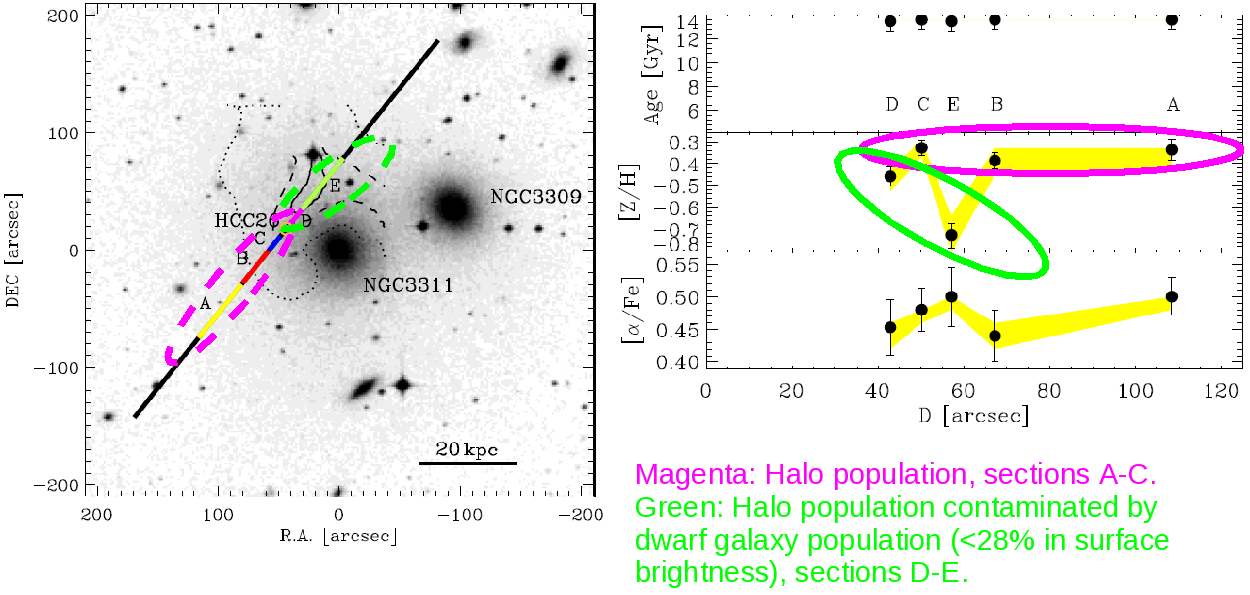


NGC 3311 is surrounded by a  stellar halo, which is characterized by large velocity dispersion that indicate that the halo is composed mainly by intracluster stars (Ventimiglia et al. 2010).
Its stellar population is old, metal poor and alpha enhanced. Our data suggest that the halo formed from accretion of multiple components onto the cluster center, mainly from stars stripped from the outer regions of earlytype galaxies, with a possible contribution from dwarf galaxies. In the long-slit sections D-E the metallicity is significantly lower than that measured in sections A-C. We associate this spectroscopic feature with the presence of a photometric substructure, which was detected in the same area of the halo around NGC 3311 (Arnaboldi et al. 2011). Simulations of the measurements over this region are consistent with the presence of a composite population made of stars from the stellar halo around NGC 3311 and stars from disrupted dwarf galaxies, which form part of the excess of light. Our findings therefore support the idea that the build-up of ICL in the Hydra I cluster core and the stellar halo around NGC 3311 are still ongoing.

Related publications:

Coccato, L., Gerhard, O., Arnaboldi, M. & Ventimiglia, G., 2011, A&A, in press. Stellar population and origin of intra-cluster stars around brightest cluster galaxies: the case of NGC 3311

Arnaboldi, M., Ventimiglia, G., Iodice, E. , Gerhard, O. 2011 & Coccato, L., A&A submitted. Debris from disrupted galaxies in the Hydra I cluster: Surface photometry and long-slit spectroscopy of diffuse light in the cluster core

Ventimiglia G., Gerhard, O., Arnaboldi, M. & Coccato, L.  2010, A&A, 520, L9. The dynamically hot stellar halo around NGC 3311: a small cluster-dominated central galaxy.