I am mainly concerned with stars which go through a very exciting phase in their life - puberty. They change their look rapidly, are stronlgy affected by their environment, and are very likely to appear in groups of at least two - just like their human counterparts. The less massive of these young stars with weights comparable to that of our sun are called T Tauri stars, and can be studied in the star forming regions Taurus-Auriga and Ophiuchus. The near environments of young stellar objects (YSO's) present a rich and complex variety of phenomena, from scattered light and thermal emission from circumstellar disks, to bipolar outflows and jets with a range of densities and speeds. In addition to direct imaging, near-infrared spectroscopy must be used to untangle these phenomena. Diagnostic spectral lines include the n=7-4 (Brackett Gamma) recombination line of hydrogen, which traces stellar winds, ionized regions and accretion, and the 2 mircron quadrupole lines of molecular hydrogen, which, through their distribution and ratios, will point to regions of shock excitation and ultraviolet fluorescence.
Since these star forming regions are located at a distance of 150 pc from earth, the seeing limit of about 1 arcsecond smears detail on scales of 150 AU (astronomical unit, distance sun - earth). Obviously image resolutions much higher than that are required to study the near environments (outflows, disks, companions) of YSOs. Ground-based observations can deliver those resolutions using techniques like adaptive optics, speckle interferometry or interferometry.
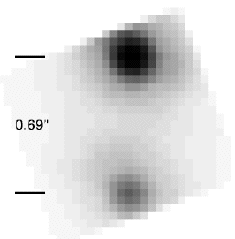
As an example, let's have a look at T Tau, which is the prototype for a whole class of objects but at no means typical. It exhibits an unusually complex system of multiple jets and outflows unlike that seen in any other T Tauri star (TTS). The optically visible primary T Tau North has an infrared companion (IRC) at 0.69 arcseconds separation. This IRC, T Tau South, has a very low infrared color temperature, a large infrared excess, and is one of only about ten such objects known today. Very recently, T Tau South turned out to be a 0.05 arcsecond binary itself.
Two almost perpendicular outflows have been found within a few arcseconds of T Tau, but the spatial resolution of these observations did not permit to non-ambiguously relate these with the two components.
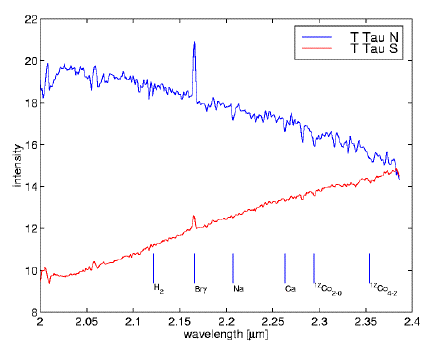
T Tau was observed with the 3D imaging spectrometer in H- and K-band in October 1999 at the 3.5-m-telescope on Calar Alto. The K band image (top) shows the two stars with the primary to the top and the infrared companion (IRC) to the bottom. Below are the K band spectra of the IRC,(red) and the primary (blue, y-shifted). The adaptive optics system ALFA was used in both cases delivering an angular resolution of about 0.15 arcseconds.
The spectra clearly show that the BrG line (2.166 microns) equivalent width of the secondary is not much less than that of the primary, indicating that both components are accreting classical T Tauri stars. Furthermore the stars themselves seem not to emit a large amount of H2 radiation which was found in the vicinity of T Tau at seeing scales and thought to be produced in shock fronts.