Public Member Functions | |
| StopWatch () | |
| StopWatch (Logger logger) | |
| void | setLogger (Logger logger) |
| void | reset () |
| StopWatch | createStopWatchForSubtask (String newSubtaskName) |
| Date | getStartTime () |
| void | stop () |
| long | getLapTimeMillis () |
| String | formattedMillis () |
| long | getLapTimeNanos () |
| void | logLapTime (String taskDesc) |
| void | logLapTime (String taskDesc, Level logLevel) |
| void | logLapTimeWithSubtaskDetails (String taskDesc, Level logLevel) |
| String | getSubtaskDetails () |
Class that facilitates elapsed-time runtime profiling. For per-thread time profiling better use an external profiler.
This class requires external synchronization if used from different threads.
About system clock issues and the JVM, see https://blogs.oracle.com/dholmes/entry/inside_the_hotspot_vm_clocks
Over the years also other open source libs have developed similar classes, but as of ACS 12.2 we do not see a need to replace our StopWatch or change its API. See http://docs.guava-libraries.googlecode.com/git/javadoc/com/google/common/base/Stopwatch.html, http://jamonapi.sourceforge.net/, http://commons.apache.org/proper/commons-lang/javadocs/api-release/index.html?org/apache/commons/lang3/time/StopWatch.html
| alma.acs.util.StopWatch.StopWatch | ( | ) |
Ctor without logger provided. Either call setLogger later, or logs will be printed to stdout.
Referenced by alma.acs.util.StopWatch.createStopWatchForSubtask().
| alma.acs.util.StopWatch.StopWatch | ( | Logger | logger | ) |
Constructor that resets the time count.
| logger | the logger to be used in logLapTime(String). If null, logs will be printed to stdout. |
| StopWatch alma.acs.util.StopWatch.createStopWatchForSubtask | ( | String | newSubtaskName | ) |
Creates a StopWatch for a subtask. The returned StopWatch can be used to profile blocks of code to get a single log in the end that contains details about how the total time was spent. The returned StopWatch can be used to create more sub-StopWatches, which is convenient if you pass it to a called method which itself uses subtask timing.
When a subtask is done, you must call stop() on the subtask's StopWatch.
Do not expect that subtask elapsed times add up exactly to the total elapsed time. The system-dependent timing granularity does not allow this.
References alma.acs.util.StopWatch.StopWatch().
Referenced by alma.acs.logging.AcsLogger.log(), alma.acs.logging.StdOutConsoleHandler.publish(), and alma.acs.logging.AcsLoggingHandler.publish().
| String alma.acs.util.StopWatch.formattedMillis | ( | ) |
Converts getLapTimeNanos() to fractional milliseconds, using the format from millisecFormatter.
References alma.acs.util.StopWatch.getLapTimeNanos().
| long alma.acs.util.StopWatch.getLapTimeMillis | ( | ) |
Gets the time in milliseconds that has elapsed since this object was created or reset() was called.
The implementation relies on System.nanoTime(), so that the granularity of measurements is OS dependent and can be more than one ms. Also, note that the time spent on all threads together is returned, which might be a poor measure for runtime profiling of a particular method.
References alma.acs.util.StopWatch.getLapTimeNanos().
Referenced by alma.acs.container.AcsContainer.activate_component(), alma.COUNTER.CounterConsumerImpl.CounterConsumerImpl.cleanUp(), alma.acs.container.corba.AcsCorba.deactivateComponentPOAManager(), com.cosylab.cdb.jdal.DALImpl.loadRecords(), alma.acs.profiling.orb.OrbProfilerParser.parse(), alma.acs.nc.AcsEventSubscriberImplBase< T >.processEvent(), and alma.acs.monitoring.blobber.BlobberWorker.run().
| long alma.acs.util.StopWatch.getLapTimeNanos | ( | ) |
Gets the time in nanoseconds that has elapsed since this object was created or reset() was called.
The implementation simply relies on System.nanoTime(), so that the granularity of measurements is OS dependent. Also, note that the time spent on all threads together is returned, which might be a poor measure for runtime profiling a particular method.
Referenced by alma.acs.util.StopWatch.formattedMillis(), alma.acs.util.StopWatch.getLapTimeMillis(), and alma.acs.logging.AcsLogger.log().
| Date alma.acs.util.StopWatch.getStartTime | ( | ) |
Returns the time when this StopWatch was created / started. This method can be useful for log output, to later correlate the profiled elapsed time with other occurrences in the system.
Referenced by alma.acs.logging.AcsLogger.log().
| String alma.acs.util.StopWatch.getSubtaskDetails | ( | ) |
Gets the subtask timing data as a string. The returned String has the same format that is also used in logLapTimeWithSubtaskDetails(String, Level).
Referenced by alma.acs.logging.AcsLogger.log().
| void alma.acs.util.StopWatch.logLapTime | ( | String | taskDesc | ) |
Logs a message about the elapsed time for a certain task. It uses log level Level.FINE and inserts the supplied description: "<code>elapsed time in ms to </code><i>taskDescription</i><code>: </code><i>elapsed-time</i>".
If no logger has been supplied, it will get one using Logger#getLogger(java.lang.String). This ad-hoc logger will likely not work in an ACS environment where log handlers are configured for the needs of containers and remote logging.
todo: provide nicer text mask for message
| taskDesc | the message to be include in the standard message which should describe the task for which the lap time is taken. |
Referenced by alma.acs.eventbrowser.parts.PopulateEventList.getThreadForEventList(), alma.acs.util.StopWatch.logLapTime(), alma.acs.util.StopWatch.logLapTimeWithSubtaskDetails(), and alma.acs.monitoring.blobber.BlobberWorker.run().
| void alma.acs.util.StopWatch.logLapTime | ( | String | taskDesc, | |
| Level | logLevel | |||
| ) |
Variant of logLapTime(String) that allows the user to specify the log level. Generally the FINE (=DEBUG) level is appropriate for performance logs, but in special cases such as unit tests it can be necessary to log at INFO or other levels.
References alma.acs.util.StopWatch.logLapTime().
| void alma.acs.util.StopWatch.logLapTimeWithSubtaskDetails | ( | String | taskDesc, | |
| Level | logLevel | |||
| ) |
References alma.acs.util.StopWatch.logLapTime().
| void alma.acs.util.StopWatch.reset | ( | ) |
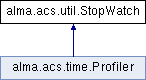
Reimplemented in alma.acs.time.Profiler.
Referenced by alma.acs.container.AcsContainer.activate_component(), and alma.acs.nc.AcsEventSubscriberImplBase< T >.processEvent().
| void alma.acs.util.StopWatch.setLogger | ( | Logger | logger | ) |
| void alma.acs.util.StopWatch.stop | ( | ) |
Stops the StopWatch. This method must be called for subtask StopWatches (see createStopWatchForSubtask(String)). It is optional in case of top-level StopWatches where it makes little difference whether or not we first stop the watch right before retrieving or logging the lap time.
This method can be called more than once without (side) effects.
Reimplemented in alma.acs.time.Profiler.
Referenced by alma.acs.logging.AcsLogger.log(), alma.acs.logging.StdOutConsoleHandler.publish(), and alma.acs.logging.AcsLoggingHandler.publish().
 1.7.0
1.7.0

