[Top] [Prev] [Next] [Bottom]
8.5 Long-Slit Spectroscopy
The f/48 camera of the FOC is equipped with a long-slit spectroscopy facility. Its entrance aperture has a 0.063 x 12.5 arcsecond slit that can be placed at the OTA tangential focus as shown in Figure 9 of the FOC Instrument Handbook, version 7.0. The effective wavelength range of this device in first order is 3600-5400Å, in second 1800-2700Å, in third 1200-1800Å, and in fourth 900-1350Å. The MgF2 window of the detector limits this last range to 1150-1350Å. The linear dispersion at the photocathode is 71, 36, 24, and 18 Å mm-1 for the respective orders, and the FOC spectrograph resolution is limited by the slit size and the OTA point spread function to about two to three 24 micron pixels. Using the Rayleigh resolution criterion, the actual resolving power of the instrument is ~1150 in all orders, yielding spectral resolutions of 4, 2, 1.3, and 1 Å for first, second, third, and fourth orders respectively.
8.5.1 Tribulations of the f/48 Spectrograph
Because of HST's spherical aberration, the long-slit facility was rarely used before COSTAR. In addition, a failure of the f/48 camera occurred in September 1992. The high voltage tripped while ramping up at the beginning of an observing sequence. For several years thereafter, the background in the f/48 camera was extremely high. As a consequence, the f/48 was unavailable to GOs during Cycles 4 and 5 while tests were carried out to establish its performance and operational reliability.
After a long period of inactivity, the f/48 was switched on again in November 1994, for the first time after the COSTAR deployment. Images and spectra of an extended target were successfully obtained, although they contained two zones of particularly high background that faded with time, a region in the center known as the flare and an arc across the top. The locations of these features can be seen in Figure 8.4, where the images from this observing sequence are displayed with the same intensity contrast to allow direct visual comparison. Because the background had finally decreased to manageable levels, the f/48 camera was made available to observers in Cycles 6 and 7, limited to long slit spectroscopy only. Since then, the prominence of the arc and flare have continued to diminish.
Figure 8.4: .Mosaic of f/48 Images from the November 1994 Test. Time since Switch-on increases from left to right. 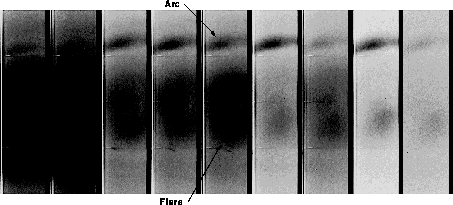
8.5.2 Reduction of f/48 Spectra
FOC long-slit spectra that have undergone geometric correction and wavelength calibration can be reduced with any IRAF task suitable for two-dimensional spectra, such as the apall task in the noao.twodspec.apextract package. The standard geometric correction procedure remaps the image so that the spectral dispersion runs directly along the y axis and the spatial dimension runs along the x axis. Corrected spectra have a dispersion of 1.7 Å pixel-1, shifted so that 5300 Å corresponds to y pixel 200. Calibration files that simultaneously correct distortion and calibrate the wavelength scale for the 512 zoomed x 1024, 512 x 1024, and 256 x 1024 formats are available through the STScI help desk (help@stsci.edu).
Because the standard geometric correction and wavelength calibration procedure does not account for temporal changes in the distortion of the f/48 camera, we recommend that you create your own custom geometric correction files, if contemporaneous f/48 flatfield observations are available. These internal flatfield images display the reseau marks that trace the geometry of the detector. The transformation that maps these marks to the fiducial positions they would have in a properly corrected image also transforms a contemporaneous raw spectral image into a geometrically-corrected, wavelength-calibrated spectral image. FOC ISRs 096 and 097 describe how to generate custom geometric correction files.
The standard spectrophotometric calibration (SDE) file for f/48 spectral images presumes that the target is centered in the 0.06" slit, an assumption that is not always valid. Multiplying your geometrically corrected image by the appropriate SDE file for the observing format will convert counts to erg cm-2 A-1, correcting for the vignetting of the slit as described in FOC Instrument Science Report 098. Integrating the spectrum over the spatial dimension and dividing by the exposure time would then yield a spectrophotometrically calibrated spectrum of a centered point source. To obtain calibrated spectra of extended sources, you will need to multiply by an additional factor of 0.6, because the standard calibration algorithm, geared towards centered point sources, assumes that only 60% of the PSF falls onto the slit.
8.5.3 Accuracy of f/48 Spectroscopy
A calibration program performed in support of the post-COSTAR f/48 spectroscopic observations has determined the slit position, geometric distortion, wavelength scale, and spectrophotometric sensitivity of the spectroscopic facility.
- Slit Position: FOC long-slit spectroscopy requires an interactive acquisition, and the position of the slit relative to the target position in an acquisition image is now known to better than 0.1". However, not all spectroscopic targets in the Archive have been perfectly centered on the slit.
It is difficult to tell whether a target is centered in an individual spectroscopic image. If the image is part of a series that scans the slit across the target, you can evaluate the location of the target relative to the slit by measuring how the overall spectral intensity varies from image to image. Otherwise, you can reconstruct, in principle, the relative positions of the target and the slit from the interactive acquisition image, the slew information in the OCX file, and the geometric distortion model of the f/48 camera. However, no systematic procedure exists for performing this reconstruction.
- Geometric Distortion: The geometric corrections for the f/48 imaging mode and the f/48 spectrographic mode have been determined separately. The distortion model for the imaging mode used for interactive acquisitions relies on the same crowded-field technique as the f/96 model. This correction, described in FOC Instrument Science Report 095, rectifies the imaging format to 0.5 pixels rms.
- Wavelength Calibration: Long-slit observations of the planetary nebula NGC 6543 form the basis of the geometric correction and wavelength calibration of the f/48 spectrographic mode (see FOC Instrument Science Reports 096 and 097.) The resulting transformation rectifies the spectra so that the dispersion direction aligns to within 0.2 degrees of the image y axis and the wavelength scale remains stable to within 0.5 Å across the x axis. Observers should bear in mind, however, that the geometric distortion of the f/48 camera is time-dependent at somewhat less than the 1% level, so custom geometric corrections are necessary to achieve these accuracies.
- Spectrophotometric Calibration: Above and beyond the difficult-to-measure uncertainties stemming from the placement of the target on the tiny FOC slit, there are other uncertainties with f/48 spectrophotometry. Dwell scans of the spectrophotometric standard star LDS 749B, taken as part of the f/48 calibration program, yielded one image in which the target fell directly in the center of the slit. The calibration of the FOC's spectrographic throughput rests on this one observation. Comparisons of the resulting sensitivity with the predictions from synphot show that the f/48 spectrograph is 10% more sensitive than expected at 4000 Å and about 50% less sensitive than expected at 5000 Å. We estimate that these direct sensitivity measurements are correct to about 20%.
Similar observations of LDS 749B at other scan positions show that the throughput drops by half at an offset of 0.04 arcsec and by 80% at an offset of 0.08 arcsec, so inaccuracies in the target position are likely to be the greatest source of spectrophotometric uncertainty. Furthermore, the wavelength dependence of the off-center throughputs is rather unexpected, being higher in the blue than in the red (see FOC Instrument Science Report 098 for more details.)
[Top] [Prev] [Next] [Bottom]
stevens@stsci.edu
Copyright © 1997, Association of Universities for Research in Astronomy. All rights
reserved.
Last updated: 11/13/97 16:46:45