


In order to determine the number of galaxies that can be observed simultaneously with IFS and MOS, it is necessary to take into account the density of galaxies, the field of view of each design, as well as those factors which restrict the multiplex gain in the MOS (eg, crowding and edge factors).
The basic information we have used to infer the number of galaxies in the field of view are the papers by:
The uncertainties at faint magnitudes are still important. For instance, in the Thompson et al data these are due to:
In table 1 the mean number counts used here are given.
(*)Values within brackets are not reliable. Corrected for completeness according to table 5 column Cs16 by Thompson et al. |
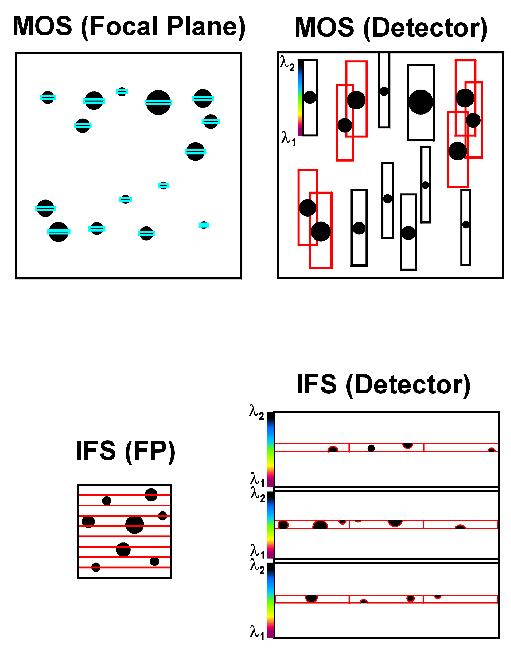
If galaxies are relatively close together, they cannot be observed simultaneously with MOS as their spectra overlap on the detector. This situation is illustrated schematically in figure 1. In the IFS, this problem never occurs since the spectra are uniquely ordered on the detector.
 |
The fraction of galaxies with such a conflict will depend on:
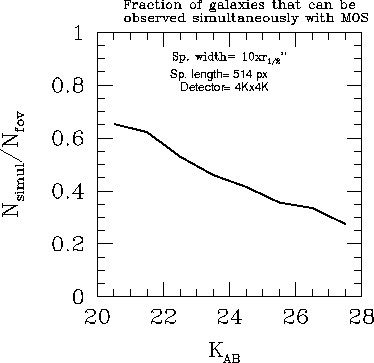
The observed number counts were discussed in the previous section. For the slit length, a value of 5 times the half-light galaxy diameter (10 x r1/2) is used. This relatively large slit length is justified in order to obtain local background information. Depending on calibration stability, it may be possible to utilise separate apertures distributed throughout the field, in which case the slits could be shorter. For the spectra, a length of 514 pixels is used. This value is derived using the grating R=300 in the range 0.8-2.0 microns. (It is assumed that for MOS R = 150 is obtained with a slit of 0.2'' wide, i.e. 2 micro-mirrors lines). Note that for higher resolutions, this problem is generally more important since the spectra need to be relatively larger in order to have a reasonable spectral coverage.
The calculations were done by generating galaxies at random positions according to the observed number counts and sizes, and analysing the conflicts on the detector. The code we use maximises the number of galaxies that can be observed simultaneously.
In addition to the crowding factors, a galaxy close to the edge of the FOV in the MOS design will have part of its spectrum outside the detector. This basically depends on:
As proposed by MacKenty in his report, rectangular arrays or detectors may reduce this problem, but these alternative designs will have implications in terms of pixelation, spectrograph size/weight, etc. Therefore, here we will retain the baseline square arrays for the MOS design.
In figure 2, the fraction of galaxies that can be observed simultaneously for the MOS baseline design (at R=150) is presented. This curve includes the edge factors which, in this case, amount to about 12.5%.
 |
Note that these results correspond to mean densities and mean sizes at a given magnitude. For specific programs involving clustered sources, these values can be rather different.
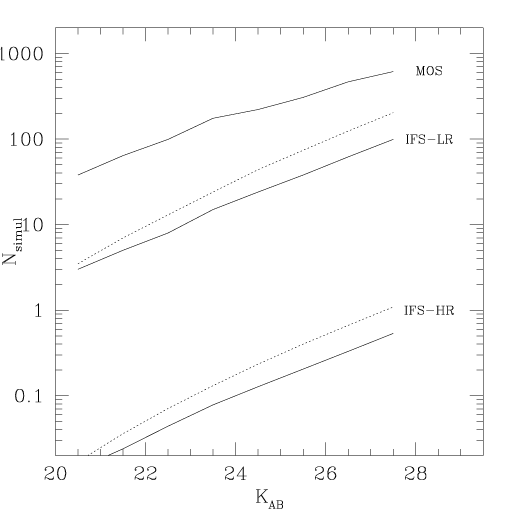
Figure 3 presents the number of objects in the field of view that can be observed simultaneously.
 |