European ARC Newsletter
12 Dec 2025

Welcome to the European ALMA Regional Centre Newsletter!  

This monthly newsletter is a compilation of recent European ALMA Regional Centre news and announcements, showcasing an exciting ALMA science result by European colleagues. Every month, you can learn an interesting ALMA fact in "Did you know" and give your opinion about a particular ALMA matter in the "Poll of the month".

News and announcements Science highlight Poll of the month Did you know


European ARC News and Announcements


Morphological Image Similarity Search on the ALMA Science Archive

02 Dec 2025:

The ALMA Science Archive (ASA) now allows you to visually search for images that are morphologically similar to a given ASA image (currently 259,126 continuum images and 196,322 peak-flux images of data-cubes) with the aim to help you find such images extremely rapidly within the vast ASA holdings. A description of the state-of-the-art deep learning method used to determine similar images - self-supervised contrastive affine-transformation-independent representation learning with a deep neural network - and the interface we have developed can be found in this ESO Messenger article.

Read more


assess_ms 3.0.1 released

28 Nov 2025:

An updated version of the uv coverage assessment tool "assess_ms" is now available here. The software will now run with NumPy 2 under the recently released CASA 6.6.6, the official CASA version for ALMA Cycle 12. Additional information can also be found here.

Read more


Targets for Band 2 Science Verification announced

19 Nov 2025:

New Science Verification targets that will demonstrate the Band 2 receivers are now listed on the Science Verification webpage. The possible targets are G31.41+0.31Arp 220SPT 0027-50 and HR 5907. The data are planned to be taken with about 25 antennas and will be released for public use; the release of any Science Verification data will also be preceded by a similar announcement. Please visit the above web page for more information.

Read more


Science Highlight

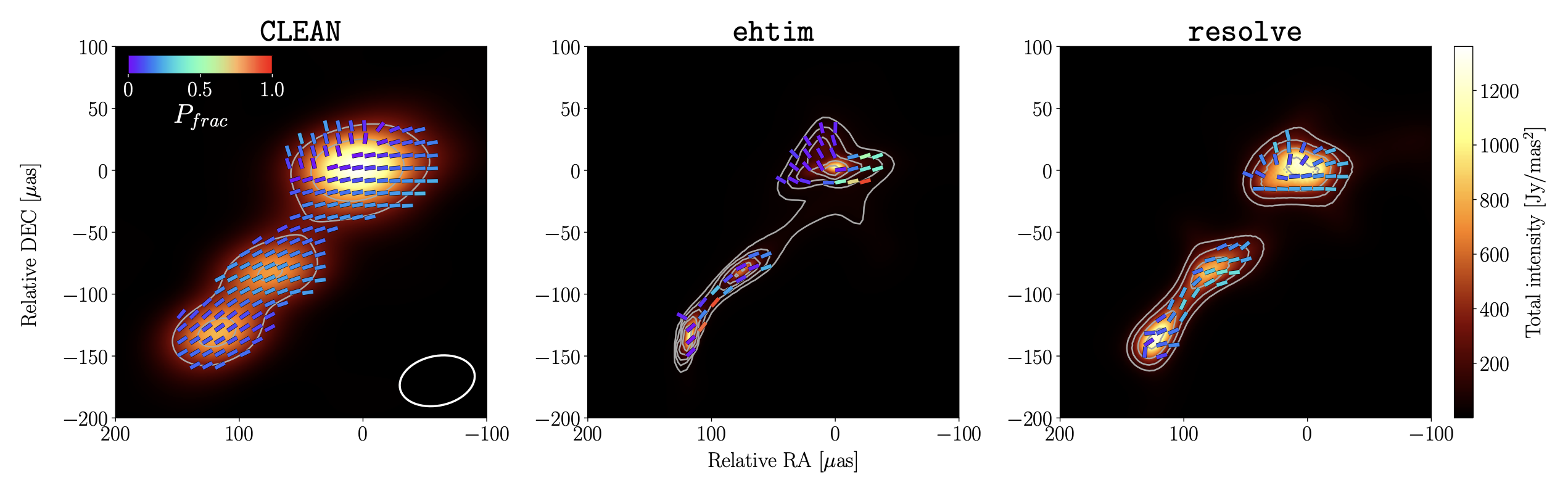
Bayesian polarization calibration and imaging in very long baseline interferometry
 

Figure from the paper
Comparison of CLEAN, ehtim, and resolve posterior mean linear polarisation reconstructions of GMVA+ALMA observations at 86 GHz. Coloured ticks indicate polarisation position angles, with colours corresponding to the fractional linear polarisation. The contours representing the total intensity of the corresponding images increase by a factor of 2, starting from 10% of the peak resolve posterior mean total intensity. All images were processed by Gaussian interpolation.
Interferometric data reduction often involves manual manipulation by an expert user, and typically produces results without full understanding of the statistical uncertainties involves in final product. However, sophisticated tools are being developed to overcome these limitations. A recent paper by Kim et al. demonstrated a method of Bayesian polarisation and imaging of full polarisation very long baseline interferometric data. The method jointly explores the posterior distribution of antenna-based gains, polarization leakages, and polarimetric images. The authors demonstrate their method on several datasets, including GMVA+ALMA very long baseline interfereometric observations, and compare with other methods. The pipeline developed for the work is publicly available.


ALMA poll of the month

                                
This poll is completely anonymous!    
Will you be submitting an observing proposal in Cycle 12?

Band 2 observations

Long baseline observations

A large programme

A joint programme

Any successful Cycle 13 proposal!


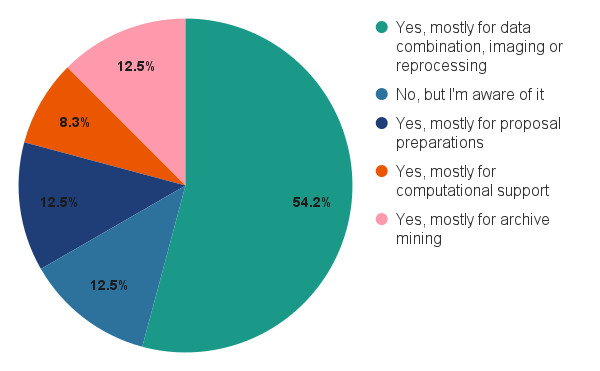
Results from last month's poll, "Have you ever obtained support from an ARC Node?"
What telescope do you use most frequently, apart from ALMA?


Did you know?

You can request calibrated measurement sets via the CalMS service of the EU ARC which will then be made available for download. The service is open both for ALMA PIs or Delegees with proprietary ALMA data and for archival users wanting to use datasets for which the proprietary time has expired.


If you would like to contribute an ALMA science highlight, please contact the newsletter editor at Hannah.Stacey@eso.org.