Welcome to the European ALMA Regional Centre Newsletter!
This monthly newsletter is a compilation of recent European ALMA Regional Centre news and announcements, showcasing an exciting ALMA science result by European colleagues. Every month, you can learn an interesting ALMA fact in "Did you know" and give your opinion about a particular ALMA matter in the "Poll of the month".
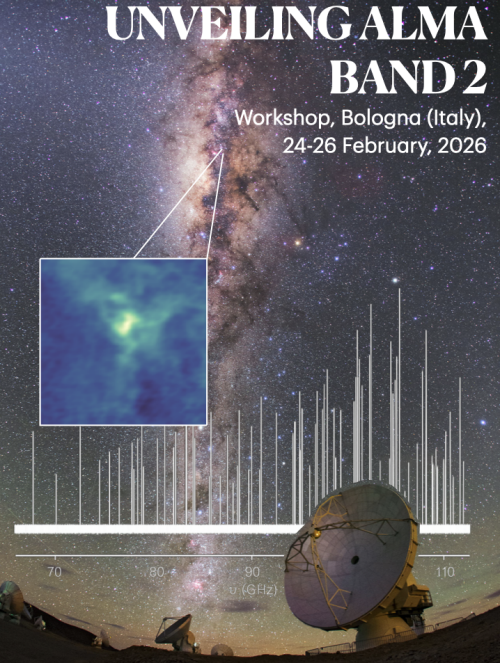
Installation and testing of the ALMA Band 2 receivers, covering 67 to 116 GHz, is currently underway. In anticipation of Band 2 being offered in the near future, the ALMA Band 2 workshop brings together astronomers and ALMA/ARC staff to discuss the new potential for various scientific fields. We plan to have a dedicated session focused on looking at the Band 2 Science Verification data. The workshop will be held in person on 24 - 26 February 2026, Bologna, Italy.
For more information, registration and abstract submission (abstract deadline October 31), please visit the workshop's website.
A white paper has been published summarising the outcomes of ADP2024 workshop on advanced data products. Advanced Data Products (ADPs) are increasingly central to enhancing the efficiency and scientific output of radio observatories. Designed to bridge the gap between raw observational data and science-ready results, ADPs reduce processing overhead, improve reproducibility, and enable a wider range of researchers to engage with complex datasets. The paper reviews current practices at major facilities including ALMA, SKAO, LOFAR, VLA, and ESO. Learning from current initiatives, it identifies critical issues and makes suggestions to address technical and organizational challenges.
Pinpointing the Origins of Far-Infrared Emission in Quasars with ALMA
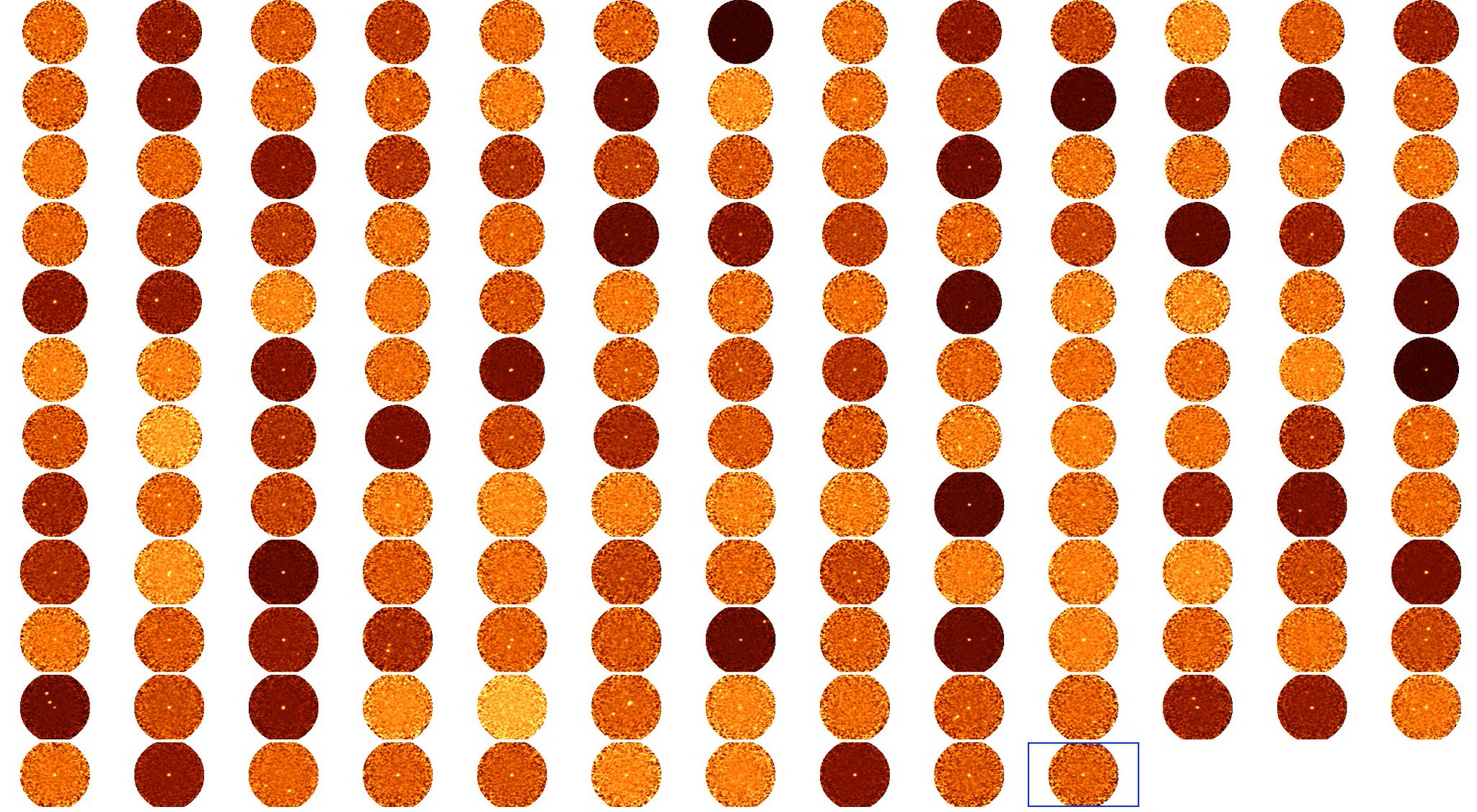
ALMA band 7 images of Stripe 82 quasars
Over the last 15 years, far-infrared (FIR) observations of quasars have revealed surprisingly high levels of emission from their host galaxies, implying star formation rates as high as several thousand solar masses per year. These extreme values, mostly derived from Herschel/SPIRE photometry, place these quasars among the most luminous star-forming systems known in the Universe. However, SPIRE's limited resolution makes it difficult to determine whether the FIR emission actually comes from the quasar host galaxy, nearby companions, or unrelated sources blended into the same beam.
To address this long-standing uncertainty, Hatziminaoglou et al. (2025) used ALMA Band 7 to observe a large sample of 152 FIR-bright SDSS quasars, all located within Stripe 82 and spanning redshifts from 1 to 4. These high-resolution (0.8 arcsec) observations allowed them to spatially resolve the sources contributing to the FIR emission, shedding new light on the role of mergers and environment in quasar activity and galaxy evolution.
In about 60% of cases, the submm emission originates from a single source, closely aligned with the optical position of the quasar. This suggests that, for the majority of these systems, the intense FIR emission likely does come from the quasar host galaxy itself. However, the fraction of quasars with multiple FIR-bright counterparts increases with redshift by a factor of ~2.5 between z~1 and z~2.5, indicating a growing role for complex environments or interactions at earlier cosmic times.
Interestingly, even in systems with multiple components, not all seem to be undergoing major mergers. This hints at alternative processes, beyond interactions, that can fuel both black hole growth and starburst-level star formation in isolated galaxies.
As a bonus, the observations also revealed several serendipitous spectral line detections: five quasars show emission from CO transitions (two CO(6-5) and three CO(7-6)), and one quasar at z = 1.67 shows possible H20 or HCN(10-9) emission. The lack of higher-J CO line detections in the broader sample may suggest that these quasar hosts do not excite their molecular gas to the levels seen in the most extreme starbursts.
These results offer one of the clearest views yet of the FIR environments of quasars and reinforce the value of ALMA's high resolving power in disentangling complex astrophysical systems.
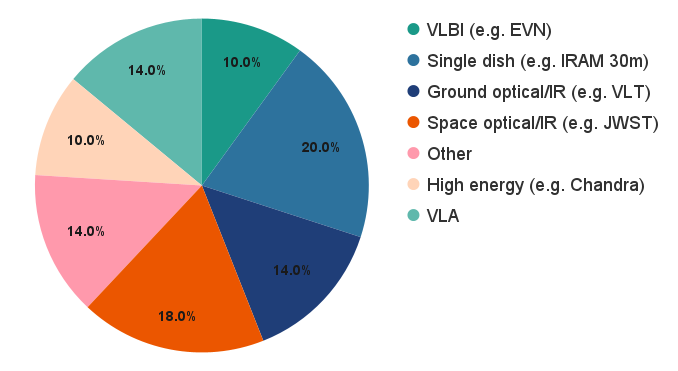
Results from last month's poll, "What telescope do you use most frequently, apart from ALMA?"
Did you know?
ALMA will be starting Cycle 12 observations in October. You can follow ALMA's current weather conditions and recently completed observations on the ALMA Status page.
If you would like to contribute an ALMA science highlight, please contact the newsletter editor at Hannah.Stacey@eso.org.