Welcome to the European ALMA Regional Centre Newsletter!
This monthly newsletter is a compilation of recent European ALMA Regional Centre news and announcements, showcasing an exciting ALMA science result by European colleagues. Every month, you can learn an interesting ALMA fact in "Did you know" and give your opinion about a particular ALMA matter in the "Poll of the month".
Apologies if you have recieved this newsletter twice!
Band 2 (67-116 GHz) is anticipated to be offered on the 12m Array from the start of Cycle 13 (October 2026). As with previous new band introductions (e.g. Band 1), the exact start date and number of available antennas may be subject to operational and technical constraints. Based on current receiver integration progress, up to 43 Band 2 receivers may be available at the start of the cycle.
The ESO ARC is looking for a scientist to support ALMA operations. Deadline for applications is on 25 March. More information can be found at this link.
The 2nd European ALMA school kicked off on Monday 26th January in Leiden. With almost 70 participants from 22 countries - and 20 tutors and lecturers from all the European ARC nodes - this is the largest ALMA-specific training event in Europe to date. Unusually for the Netherlands, Day 1 started with a low pwv and abundant sunshine. Over the next five days, we will cover a wide range of topics, from introduction to CASA to advanced data-processing techniques.
Many thanks to our sponsors: Dutch Research Council, LKBF, NOVA, and the Leiden University Funds.
ALMA has made information available to assist with early proposal planning for Cycle 13 (see Read More). Full details will be published in the Cycle 13 Call for Proposals.
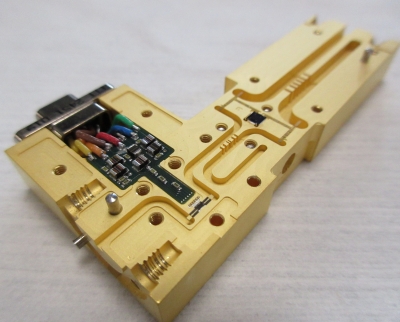
Progress in engineering at millimetre wavelengths and advances in semiconductor fabrication techniques offer low noise amplifier (LNA) based radioastronomy receivers which operate at higher temperatures and wider operational bandwidths, with reduced noise, higher pixel density, and more. The University of Manchester and STFC Rutherford Appleton Laboratory have recently completed ESO's ALMA development study, Towards ALMA System-on-Chip European Receivers (TASER). This two year project developed key technologies for compact integrated front end receivers for ALMA. The benefits of LNA receiver integration and miniaturisation are, among others, lower operational costs, reduced manufacturing and testing labour needs, and the potential for high density focal plane array/phased array feed technology. The results of the TASER study are important steps towards implementing the ALMA Development Roadmap, and beyond, with the aim of enhancing ALMA's status as a globally leading scientific tool.
The ALMA Science Archive (ASA) now allows you to visually search for images that are morphologically similar to a given ASA image (currently 259,126 continuum images and 196,322 peak-flux images of data-cubes) with the aim to help you find such images extremely rapidly within the vast ASA holdings. A description of the state-of-the-art deep learning method used to determine similar images - self-supervised contrastive affine-transformation-independent representation learning with a deep neural network - and the interface we have developed can be found in this ESO Messenger article.
An updated version of the uv coverage assessment tool "assess_ms" is now available here. The software will now run with NumPy 2 under the recently released CASA 6.6.6, the official CASA version for ALMA Cycle 12. Additional information can also be found here.
The international conference ALMA at 15 years: Science, Synergies and the Road Ahead will be held in person from Feb. 22–26, 2027, at Academia Sinica's Nangang campus in Taipei, Taiwan. The conference will highlight ALMA's latest results, especially since the last Pan-ALMA conference held in 2023 and identify exciting directions for future ALMA research. The program will feature invited and contributed science presentations, along with updates on the Wideband Sensitivity Upgrade (WSU), tutorial sessions on the archival and CARTA systems, and discussions of future ALMA prospects. Talks and posters presenting scientific work using ALMA and/or its synergies with other facilities across all areas of astronomy are welcome.
This UK ARC Node workshop will comprise two parts. The first part will provide an introduction to ALMA and working with ALMA data, suitable for new or less experience ALMA users. The second part will cover essential information for all ALMA users and will cover the planned current and future upgrade of ALMA, its impact on users and the new proposal submission tool.
People who are interested in any part of this webinar/workshop should sign up using the registration form. Registration will close on 15 February.
A new method for measuring the luminosity of embedded protostars in binary systems
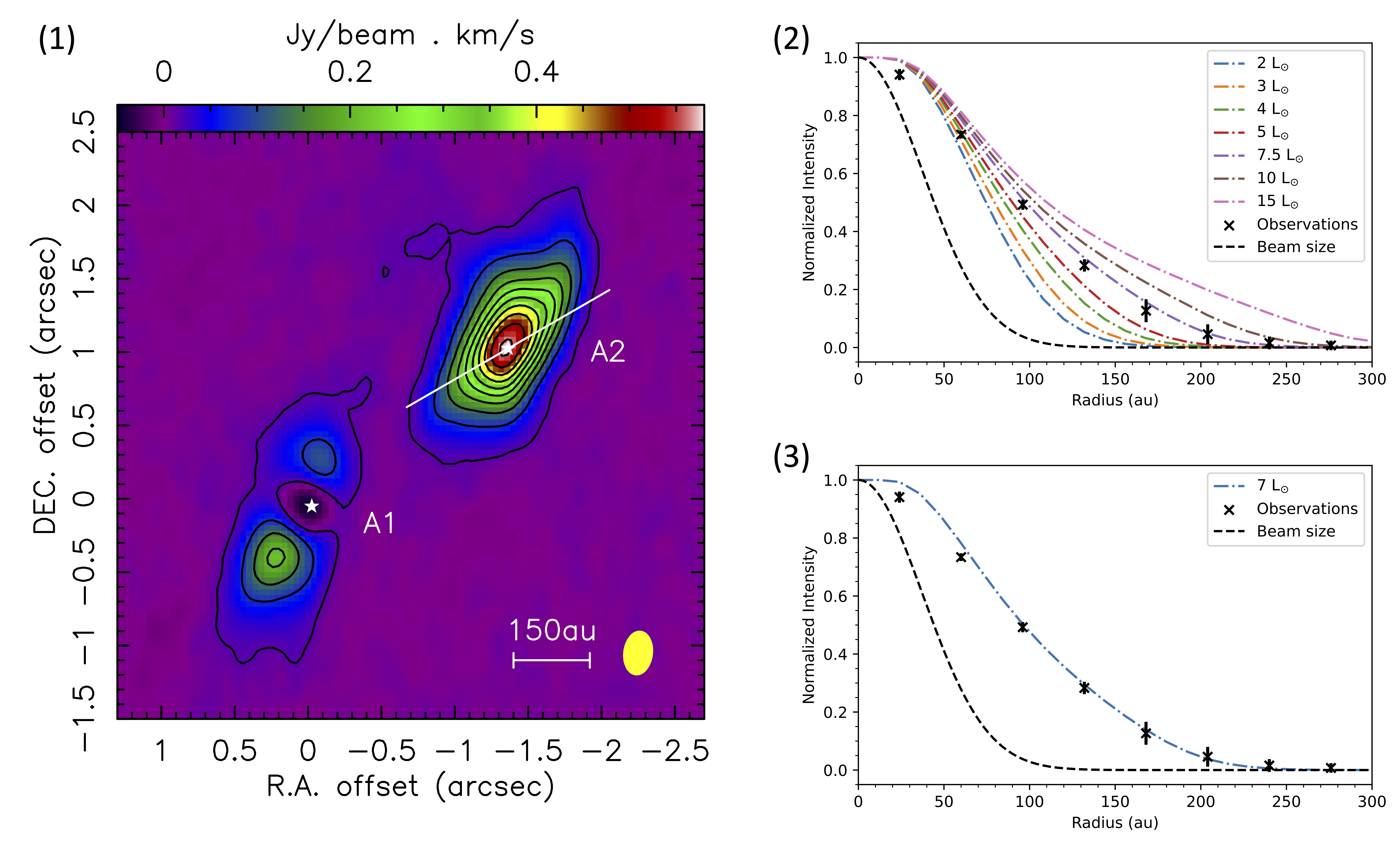
(1) Moment 0 emission of OCS(19-18) around the NGC1333 IRAS4A protobinary system with a spatial resolution of about 50 au. The white line marks the cut along which the molecular line's intensity profile was extracted.
(2) OCS(19-18) intensity as a function of distance from the central protostellar object in A2. Black dotted line: synthesized beam profile of the observations. Black crosses: Observed intensity profile along the cut depicted in (1). Colored lines: Theoretical intensity profiles for the corresponding luminosities.
(3) Same figure as (2) but with the best theoretical intensity fit on the observation points.
Measuring the luminosity of embedded protostars in binary (or multiple) systems has always be challenging. The most common method is to integrate the observed spectral energy distribution (SED) from millimeter to infrared wavelength observations. Unfortunately, it is not possible to obtain the complete SED for each component of close multiple systems due to the lack of telescopes able to spatially disentangle them at infrared wavelengths. In these cases, we can only estimate the total luminosity of the system through their SEDs.
Conscious of this limitation, Saury et al. recently proposed a novel method to measure the luminosity of each component of an embedded protostellar binary. The idea is conceptually simple: the more photons the protostar emits, the hotter the neighboring envelope will be. This will cause dust-grain ice mantles to start sublimating, releasing by thermal desorption molecules previously trapped on the grain surface. Thus, for a molecule formed on the grain surface, the measured gas phase abundance will depend on its desorption from the grain.
In order to put this idea into practice, the study used ALMA high-spatial-resolution (about 50 au) observations of the proto-binary system NGC1333 IRAS4A from the ALMA large programFAUST (Fifty AU STudy) to resolve the molecular emission around the protostars. The study focused on carbonyl sulfide (OCS) emission, which is a molecule mainly formed on the surface of dust grains. Since the molecule has a fairly low binding energy, it can be desorbed at low temperatures, therefore emitting in a relatively large area.
Using new quantum mechanical calculations of the OCS binding energy distribution also presented in the study, it was possible to obtain theoretical radial intensity profiles for different luminosity values based on an adsorption-desorption model of OCS to/from the grains. By comparing such profiles to the observed one, it was possible to estimate the best-fit luminosity of each the source. The study concluded that both protostars have similar luminosities.
These results, combined with the strong collaboration between astrophysics and chemists, were possible thanks to ALMA's high angular resolution capabilities.
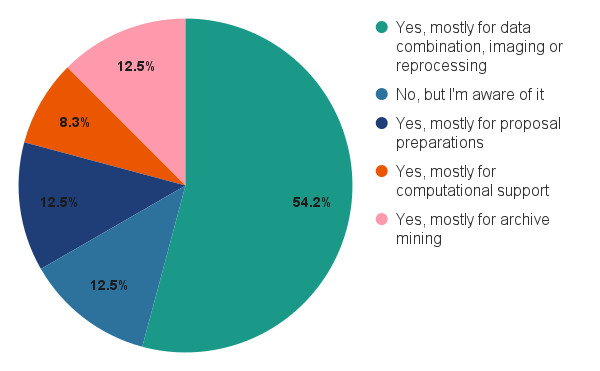
Results from last month's poll, "Have you ever obtained support from an ARC Node?"
Did you know?
The European ARC Network organizes I-TRAIN, a regular series of Interactive Training in Reduction and Analysis of INterferometric data. The sessions aim to help ALMA users gain expertise in working with interferometric data, such as self-calibration, u-v model fitting, and data combination. You can view previous I-TRAIN sessions here.
If you would like to contribute an ALMA science highlight, please contact the newsletter editor at Hannah.Stacey@eso.org.