Welcome to the European ALMA Regional Centre Newsletter!
This monthly newsletter is a compilation of recent European ALMA Regional Centre news and announcements, showcasing an exciting ALMA science result by European colleagues. Every month, you can learn an interesting ALMA fact in "Did you know" and give your opinion about a particular ALMA matter in the "Poll of the month".
New information for ALMA Principal Investigators (PIs) in Cycle 13: Starting with Cycle 13, Phase 2 information for approved programs will be shown to PIs through the Snooping Project Interface (SnooPI) after the Scheduling Blocks (SBs) have been created. SnooPI now provides field and spectral information for every science target in each SB (e.g., target coordinates and radial velocities, spectral window frequencies, and correlator setups). Additionally, spatial and spectral visualizers to facilitate displaying this information will also be available in SnooPI after 29 September, 2026. These capabilities are similar to what was previously provided through the Phase 2 Observing Tool (OT). More detailed information can be found in the SnooPI User Manual.
As a consequence, ALMA will no longer provide a Phase 2 version of the OT and PIs will need to check SB information through SnooPI.
ALMA has analysed the refereed ALMA publications in the period from 2012 to 2024. The study analyses publication statistics related to various aspects, e.g., science categories, geographical distribution, archival research, time to publication, publication fraction, and citations. Among other results, the analysis shows that about 70% of observed projects were used in at least one publication, and ALMA publications so far were written by more than 9400 unique authors. The median time to first publication since data delivery is 2.1 years, and about 40% of publications made use of archival data in 2024.
The publication evolution follows that of other high impact observatories as the Hubble Space Telescope and Very Large Telescope. In 2024, the impact factor for ALMA publications, defined as the total number of citations received in a given year stemming from publications of the previous two years, is larger than that of all other major astronomical facilities. Links to the full publication (Stoehr et al. 2026, PASP) can be found here.
The ALMA Science Archive has received substantial feature upgrades, some of which have been worked on for years.
The ALMA Science Archive Query Interface now allows users to search for lines that have been detected by ADMiT in the public ALMA data products. Users can not only search for molecules and transitions, but redshifts and source velocities or line intensities. Previews are also included for the detected lines. The Request Handler download interface has also received an upgrade - it now shows the hierarchy of the data structure in a modern, intelligently scrollable way where the displayed information can be easily expanded and collapsed. A new powerful search bar at the top allows users to filter the displayed rows by text-, unix-pattern or regular-expression search. The output can be sorted, and a quick-select menu allows users to perform the most-used selections.
On June 27th, ALMA and its scientific community reached a major scientific milestone with the publication of the 5000th refereed paper based on ALMA data. This achievement comes just 14 years after the start of Early Science operations and reflects ALMA’s extraordinary scientific impact. All of these ALMA publications and data are accessible through the ALMA Science Archive at almascience.org/aq.
ALMA would like to thank and congratulate the many scientific teams and individuals who have made excellent use of ALMA observations in these publications to advance the understanding of our cosmic origins. The scientific impact of ALMA continues to grow. Publications based on ALMA data have accumulated more than 210,000 citations, establishing ALMA as one of the most productive and scientifically impactful astronomical facilities in the world.
Since 2021, ALMA has used a distributed peer review model instead of traditional panel-based review. In a recent study, John Carpenter and Andrea Corvillon analysed more than 20,000 proposals and over 160,000 individual reviews over 13 ALMA cycles (Cycles 0–12) to examine whether the statistical patterns of proposal evaluation changed. Overall, the study finds that the outcomes of distributed peer review are statistically consistent with those of traditional panel review. You can read a summary of the result on the ALMA website and the paper accepted for publication in PNAS.
On 16 June 2026, ESO's ALMA Support Centre hosted the ALMA Band 2 Production Completion Event. 36 participants from the Band 2 consortium, contributing European institutes, industry partners, and the National Astronomical Observatory of Japan (NAOJ) travelled to ESO Garching to celebrate this important milestone for ALMA. Together with ESO staff, more than 70 people attended the associated workshop and celebration activities throughout the day.
Advanced data products (ADPs) are becoming increasingly important at modern radio observatories, helping transform complex observational datasets into more accessible, science-ready resources. Products such as enhanced images, spectral products, catalogs, or other higher-level derived datasets can reduce the effort required for scientific analysis and broaden access to archival data. To better understand how such products are currently used, and what additional capabilities may be most valuable to the community in the future, the Advanced Data Products Coordination Group (ADPCG), with members from various radio observatories and the broader community, is conducting a short survey on the usage and potential needs for advanced data products. We warmly encourage all members of the radio astronomy community to participate and share their perspective.
A detailed report of the Cycle 13 Proposal Submission Statistics is now available. The report provides a summary of items such as the number of submitted proposals and time requested, subscription rates, and comparisons with the number of hours requested in previous Cycles.
In Cycle 13, the number of proposals and requested time reached all-time highs. The European oversubscription rate also reached an all-time high of 10.2.
The ALMA Observatory has released data acquired in one of the Observatory Projects, 2024.A.00047.S. The data can be accessed through this link. ALMA Science Archive links for all the Observatory Projects can also be accessed from this main page for the Observatory Projects.
In preparation for the Wideband Sensitivity Upgrade (WSU) programme, a team lead by Faouzi Boussaha from the Instrumental Research and Development group at LUX – Paris Observatory (France) has started a new ALMA development study to contribute to the development of the next generation of SIS (Superconductor–Insulator–Superconductor) detectors for ALMA's Band 9. The goal of the study is to double the instantaneous IF bandwidth and significantly increase the sensitivity, requiring a new generation of ultra-sensitive detector elements known as SIS junctions. Specifically, the study plans to use the Aluminium Oxide technology but will investigate new substrates such as silicon on insulator.
The ALMA Cycle 13 Call for Proposals, which closed 23 April, received a record number of proposals and requested time. 1843 proposals were submitted, requesting a total of over 37,000 hours of 12m time. ALMA also received a record number of Large Proposals (48) and Joint Programmes (91), demonstrating the sustained growth in demand for ALMA observing time over the past 15 years.
On 13 April 2026, ESO held the kick-off meeting for the Feasibility Study for a new generation of European ALMA receivers covering the 125–211 GHz band (ESO-654032) at the INAF-OAS premises in Bologna, Italy. The meeting marked the formal start of a two-year study to explore the technical and scientific feasibility of a combined ALMA Band 4+5 receiver system covering the 125–211 GHz frequency range. This ALMA development study is relevant for the later stages of the Wideband Sensitivity Upgrade (WSU) programme.
Cycle 13 Call for Proposals has been released. Cycle 13 introduces two new developments: Band 2 (67–116 GHz) will be offered for the 12m array, and the new web-based Observing Tool (OT) will replace the desktop version. This cycle will offer long baseline configurations (C9 and C10). Further details of the capabilities offered can be found in the Proposer's Guide.
We particularly encourage proposals using long baselines at lower frequencies (Bands 1-4), high-frequency observations (Bands 8-10) and stand-alone ACA.
As always, users are strongly encouraged to submit their proposals early, especially in view of the introduction of the new web-based OT. The Emergency Helpdesk will be open for the 3 days leading up to the proposal deadline.
The European ALMA Regional Centre (ARC) network is organising virtual and in-person proposal preparation events related to the Cycle 13 Call for Proposals across Europe.
An overview of the activities and information about participating can be found here.
ALMA is pleased to announce that a web-based interface of the ALMA Observing Tool (OT) will replace the previously used desktop-based OT for the Cycle 13 Call for Proposals. The web-based OT was developed by ESO and replaces the previous desktop Java version. It offers the same functionality as the desktop-based OT, but offers a modernized and optimized view while retaining the same familiar workflow and structure. Proposal drafts will now be automatically saved within the system, without the need to save local files.
In a recently concluded development study, a small team at ASTRON, The Netherlands Institute for Radio Astronomy, investigated the concept of Streaming Visibility Processing (SVP) for ALMA. The key idea behind the SVP concept is to stream the visibilities produced by the ALMA correlator into the (initial) data processing stages without storing them first. SVP performs initial visibility processing in real-time up to the point where the data is reduced to more tractable rates without detrimental effects on the scientific quality of the end products. Further details are in the final report of the streaming visibility processing study and by following the 'read more' link.
We are delighted to announce that the pre-registration of the 13th IRAM Interferometry School is now open! The IRAM Interferometry School is offered every two years and it is intended for PhD students, post-docs and scientists who want to learn about interferometry and data reduction techniques at millimeter wavelengths, centred on the NOEMA interferometer and its new capabilities. A visit to the NOEMA Observatory will also be organised.
The IRAM headquarters in Grenoble will undergo significant renovations starting this summer. Therefore, unlike previous editions, the school this year will be held at the Hotel Mercure Grenoble Centre Porte des Alpes in Grenoble, in the week of 28 September - 3 October, 2026. Further information can be found at the school page here.
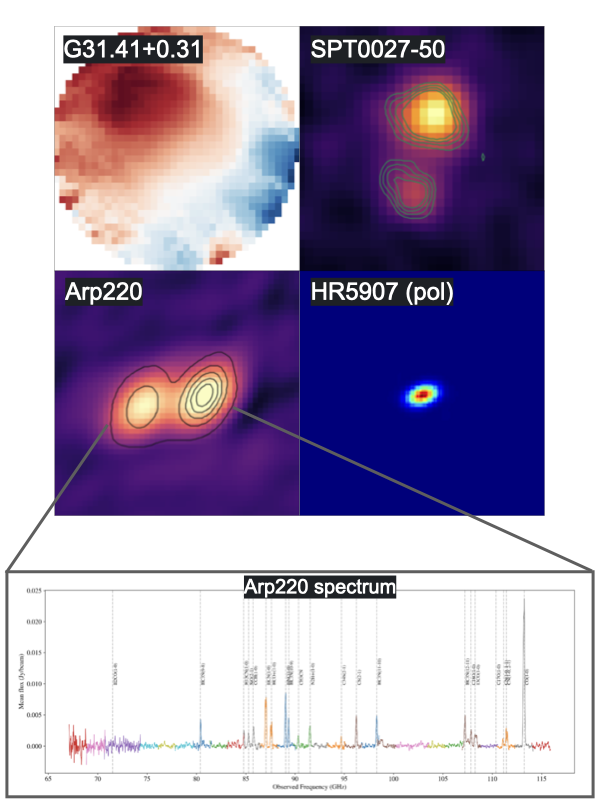
Images of band 2 science verification targets. Clockwise from top-left: velocity field of an isolated emission line from G31.41+0.31, a Galactic source; comparison of old and new continuum imaging of SPT0027-50, a strongly lensed star-forming galaxy; polarised intensity of star HR5907; comparison of old and new continuum imaging of Arp220, a nearby ultraluminous infrared galaxy. Bottom is an extracted spectrum of Arp220.
Band 2 (67–116 GHz) recievers have now been installed on ALMA antennas and will be offered in Cycle 13. Part of the process of approving new capabilities is science verification (SV) in which we demonstrate that ALMA is able to produce data of the quality required for scientific analysis. SV involves making observations of a small number of selected astronomical objects which are tested end-to-end - from observational setup in the OT through to data reduction and quality assurance.
Following is a summary of the four SV target observations. More details can be found by following the hyperlinks.
SPT 0027-50 (strongly lensed dusty star-forming galaxy at z = 3.444):
Demonstrates unique redshift identification at via more than one CO transition (spectral scan covering CO (4-3) and CO (3-2), plus HCN, HCO+, HNC and [CI] (1-0))
Arp 220 (nearby ultra-luminous infrared galaxy rich in line emission):
Demonstrates imaging capability and science capability of tracing CO (12CO, 13CO and C18O) and dense gas tracers HCN, HCO+ and HNC with the same band (10 km/s spectral scan)
G31.41+0.31 (chemically rich hot molecular core located outside the Galactic Center):
Demonstrates imaging capability for line forests and capability to detect complex organic molecules (1 km/s spectral scan)
HR 5907 (main sequence star with continuum circular polarization of 10%):
Demonstrates capability of detecting circular polarization and changes within the frequency range covered by Band 2 thanks to the increased fractional bandwidth
More information about the SV process can be found here.
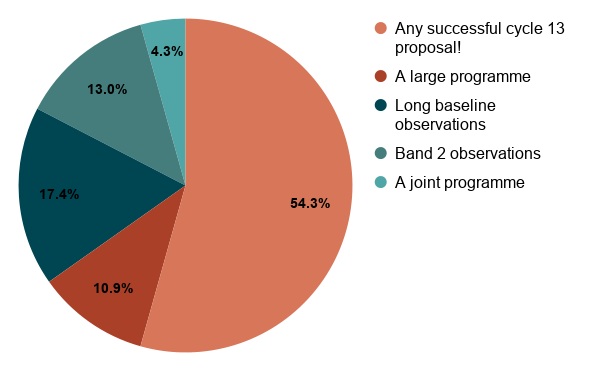
Results from last month's poll, "What are you most wishing for in 2026?"
Did you know?
Help preparing an ALMA proposal especially tailored for beginners can be found in the Proposing Guidance on the ALMA website or by contacting your local ARC Node.
If you would like to contribute an ALMA science highlight, please contact the newsletter editor at Hannah.Stacey@eso.org.