European
Southern
Observatory
ESO Science Newsletter November 2025
04 Nov 2025

This newsletter is a summary of recent ESO Science Announcement items. Follow the links or visit ESO Science Announcements to read more.


Science Announcements


VLT UT3 Recovery from Cooling Liquid Spillage

30 Oct 2025:

Due to a cooling liquid spillage, UT3 has been out of operations since October 23. The recovery of the affected systems is ongoing, please consult the LPO news page for updates. At the time of writing, the recovery sequence foresees to restart science operations first with SPHERE, then CRIRES and then X-Shooter. The restart with SPHERE and CRIRES is expected to take place in early November, while the X-Shooter recovery will take several more weeks. This is due to the contamination of X-Shooter with cooling liquid that requires careful cleaning and realignment of optical elements. 

Read more


The Future of UV Astronomy in the Age of HWO

28 Oct 2025:

Find out more about the Future of UV Astronomy in the Age of HWO meeting. Don't miss your chance to register - the deadline is 5 November 2025. Join the discussions shaping the future of UV science! The workshop will take place on 16 December 2025 at ESO, Garching bei München, extended to a consortium meeting (by invitation) on 15 & 17 December 2025 at the Carl von Siemens Foundation, München. 

Read more


Registration is now Open for the ESO Summer School 2026 on Scientific Communication

28 Oct 2025:

Given the success of its first edition, ESO is delighted to announce the second edition of its Summer School on Writing and Communicating your Science to be held in Garching, from 20-24 July 2026. 

Read more


Fifth and Final Data Release of the VST-ATLAS Public Survey

28 Oct 2025:

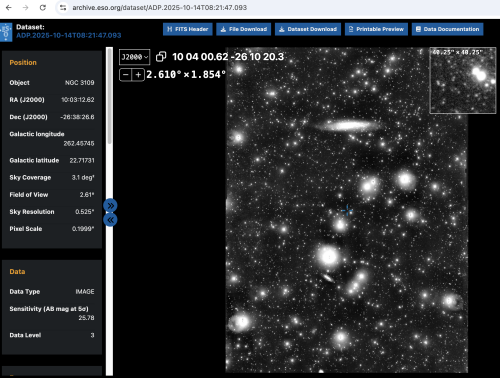
The data released in DR5 are the final VLT Survey Telescope (VST) ATLAS stacked images and associated source lists taken from observations by VST from October 2017 to the end of the survey in January 2021 under ESO program ID 177.A-3011. These new data mainly comprise the ATLAS NGC extension at Dec<-20 deg. DR5 presents new and updated CASU (Cambridge Astronomical Survey Unit) images and source lists and also a full re-release of multi-band catalogue data from the Wide Field Astronomy Unit (WFAU) at Edinburgh, representing the "best" data. Any other un-updated data is still available within DR4 and earlier releases. DR5 data also includes the final ATLAS global photometry calibration.

Read more


Record Number of Observing Hours in Cycle 11

28 Oct 2025:

The ALMA Observatory is delighted to announce that Cycle 11 has set a new all-time record in the number of science-quality observing hours (QA0 PASS observations) delivered across all three arrays. During Cycle 11, ALMA successfully acquired a total of 4,496 hours of science-quality data with the 12-m Array, surpassing for the first time the ambitious goal of 4,300 hours offered. In addition, 4,201 hours were delivered with the 7-m Array, and 3,240 hours with the Total Power Array.

Read more


Andreas Kaufer Appointed as Next ESO Director General

27 Oct 2025:

The Council of the European Southern Observatory (ESO) has appointed Andreas Kaufer to be the new ESO Director General. Kaufer, who is currently ESO Director of Operations, will succeed Xavier Barcons, who will remain as Director General until the end of August 2026.

Read more


4MOST First Light

22 Oct 2025:

On 18 October 2025, the 4-metre Multi-Object Spectroscopic Telescope (4MOST) facility, installed on the VISTA telescope at the Paranal Observatory, obtained its first light. This is a crucial milestone towards the start of scientific observations with this new spectroscopic facility. The First Light observations exemplify the unique capabilities of 4MOST. They covered an area of the sky containing the Sculptor Galaxy and the NGC288 star cluster showing 4MOST ability to observe a very large field of view and its capability to get spectra for many very different objects and science cases simultaneously.

Read more


ESO Period 117 Proposal Submission Statistics

22 Oct 2025:

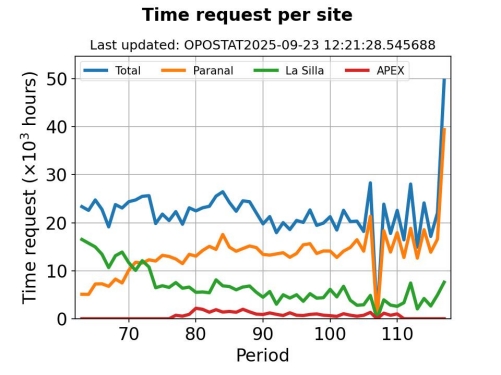
ESO received 1285 valid proposals for observations in Period 117 (1 May 2026 - 30 April 2027). The deadline for proposal submission was 23 September 2025. The time request (in hours) on ESO Proposals (blue), for Paranal (VLT/I) (orange), La Silla (green), APEX (red) is shown in the figure above. The time request in P117 has roughly doubled with respect to previous Periods, while the number of proposals increased by about 40%. On the VLT, the most demanded ESO instrument was ESPRESSO with a request of 5846 hours, followed by MUSE (5519 hours), and XSHOOTER (5086) hours. HARPS/NIRPS on the ESO 3.6 metre telescope was the most demanded instrument at La Silla, with a combined request of 4985 hours.

Read more


Second Release of VST-OMEGACAM Imaging Products from the Collaboration with INAF

17 Oct 2025:

The VLT Survey Telescope (VST) at Paranal is now owned and operated by INAF, which is responsible for processing the data and releasing them via the ESO Archive. The imaging data included in the current DR2 were obtained using the wide-field camera OmegaCAM with the g, r, i, and z filters and belong to the projects "Pre-supernova Outbursts in Galactic Red Supergiants: Predicting the Next Galactic SN Event" (GALRSG, P.I. F. Bocchino, PROG_ID: 113.26YN.001) and "VST Survey of Mass Assembly and Structural Hierarchy" (VST-SMASH, P.I. C. Tortora, PROG_ID: 110.25AA.001)

Read more


Release of Continuum, CO, and Water Vapour Maps of the Orion Nebula - First Millimetre Spectral Imaging with APEX/CONCERTO

17 Oct 2025:

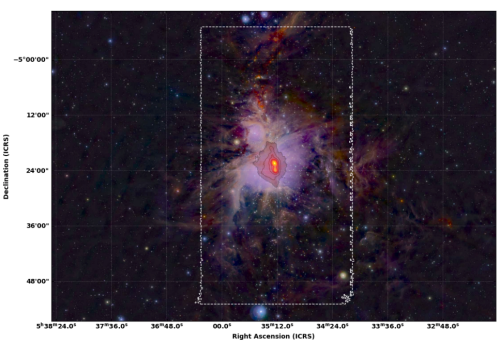
This data release presents the first millimetre spectroscopic imaging of the Orion Nebula obtained with the CONCERTO instrument on the APEX telescope. The observations were carried out on 24 August 2022 under ESO programme 110.A-4194 (110.23NK; PI Désert) in excellent atmospheric conditions (pwv ≈ 0.4 mm). The dataset covers 0.5 deg² centred on the Orion Nebula (M42), spanning the frequency range 130–310 GHz (0.97–2.3 mm) at a typical angular resolution of 27″ and a spectral resolution of 6 GHz (sampled at 3 GHz). 

Read more


Release of the SEDIGISM Survey

25 Sep 2025:

This data release presents the first instalment of the SEDIGISM (Structure, Excitation and Dynamics of the Inner Galactic Interstellar Medium) survey, a large spectroscopic programme mapping molecular gas across the inner Milky Way. The survey was conducted with the APEX 12-m telescope between 2013 and 2017 and covers approximately 84 deg² of the southern Galactic plane, with continuous coverage from −60° ≤ l ≤ +17° at |b| ≤ 0.5°. Additional regions extend the latitude coverage (e.g. towards the Central Molecular Zone, RCW 120, and the Nessie filament) and include a dedicated 2 deg² field around W43 for cross-comparison with northern surveys.

Read more


Upcoming ESO or ESO-related workshops


Understanding how giant and rocky planets form and evolve, their internal structure and that of their atmosphere, represents one of the major challenges of modern astronomy, which is directly linked to the ultimate search for life by 2040. At the Horizon 2028-2030, the Extremely Large Telescope (ELT) will shine its first light on the sky. The high angular resolution and the great collecting capacity associated with the extreme sensitivity of the instruments will allow unprecedented observations of the regions of planetary formation and exoplanetary systems. In this perspective, the ESO community has developed a key expertise on the study of the initial conditions of planetary formation, the search for exoplanets, the atmospheric characterisation of giant and rocky exoplanets, and the search for biomarkers. This community includes various international laboratories and scientists who are also heavily involved at a technical and scientific level in the construction, scientific preparation and operation of the ELT instruments, and who have the opportunity to play a key role in ensuring a global return and shared success in the exploitation of the ELT.


The fifth edition of the "Why Galaxies Care About AGB Stars" conference series will bring together researchers working on Asymptotic giant branch (AGB) stars, stellar populations, and galaxy evolution to foster collaboration and advance our understanding of the role of AGB stars in the Universe. This workshop will be a unique opportunity to discuss the latest observational and theoretical developments, featuring among others recent results from high-resolution imaging, spectroscopic studies, and advanced simulations. Topics will range from AGB stellar physics and dust formation to their impact on unresolved stellar populations and galaxy evolution. In addition, we will brainstorm the role and potential breakthroughs of AGB star research in the E-ELT and beyond era, ensuring that future observational and theoretical efforts align with the next generation of astronomical facilities.


Active galactic nuclei (AGN) are among the most dynamic and powerful sources in the universe, powered by supermassive black holes (SMBHs) through mass accretion. The accretion rate influences many AGN properties, with high accretion rates playing a key role in growing black holes and launching outflows that may shape the host galaxy's growth. Highly accreting AGN, particularly at low redshift, offer a benchmark to understand the rapid growth of the first SMBHs in the early Universe, which remains a mystery to be solved. Significant theoretical and observational advancements have been made in understanding fast-accreting systems, thanks to long-running observatories like VLT, ALMA, JVLA, Chandra, XMM, HST, and NuSTAR, as well as the recently launched JWST, Euclid, and IXPE. With the first light of the ELT on the horizon and the recent results from JWST on the growth of SMBH at high redshift, now is the ideal time to convene and share insights on highly accreting SMBHs. The workshop will gather astronomers to summarize the field’s current status, bridging the accretion history from the early to the local Universe, and explore the mechanisms driving their growth and impact on the Universe.


ESO aims to maintain the VLT and VLTI at the science forefront of astrophysical research in the ELT era. The development of the facilities follows planning that is discussed with the ESO governing bodies to derive the best synergies amongst the facilities. As part of this process, ESO is organising a conference in Garching near Munich (Germany) in January 2026. The meeting will review science topics, emerging technologies and expanding parameter spaces relevant for the VLT/I in the next decade and beyond. The goal of the meeting is to reach a broad community by covering topics and through contributed talks across scientific topics, new technologies, facilities landscapes, operational opportunities. ESO will issue a call for white papers for new projects/instruments for VLT/I during the conference with a deadline a year later, in January 2027, marking the start of the assessment phase.


Given the success of its first edition, ESO is delighted to announce the second edition of its Summer School on Writing and Communicating your Science to be held in Garching, from 20-24 July 2026. The school will cover important topics such as how to write compelling papers and proposals and how to give convincing talks. Dedicated sessions will further guide you through the process of preparing successful proposals, understand the publication landscape and the refereeing process, write professional job applications, and be prepared for a successful career. The school comprises many hands-on and fun activities to make it an unforgettable experience.