 mirror sites:
PL (internal link)
HQ
[?]
mirror sites:
PL (internal link)
HQ
[?]
Quality Control and
Data Processing
|
 |
Pipeline
Pipelines are used at ESO to process both calibration data and science data and to retrieve quality information. There is a dedicated pipeline for each VLT and VLTI instrument. Find general information about ESO reduction pipelines here. The main functionalities of the pipelines are:
For selected instrument modes, we offer science-grade data products processed with the pipelines.
There are two instances of the data reduction pipelines:
The optimized mode is the mode, which uses all data of a night, including the daytime calibrations. The calibration data are sorted and grouped according to their dependencies. Master calibration data are created. Their quality is checked.
The FORS pipeline is publicly available. It (since 2008-09-17) supports the reduction of imaging and spectroscopic data (LSS , MOS, and MXU mode). However, the HIT mode data are not supported. Since 2015-04-22 new, significantly modified FORS2 pipeline version v.5 has been adopted. Master calibrations created by previous pipeline versions are not compatible any more and the pipeline requires modified static calibrations. Find the description of FORS2 data processing and pipeline recipes for calibrations here and for science data here.
 Data format
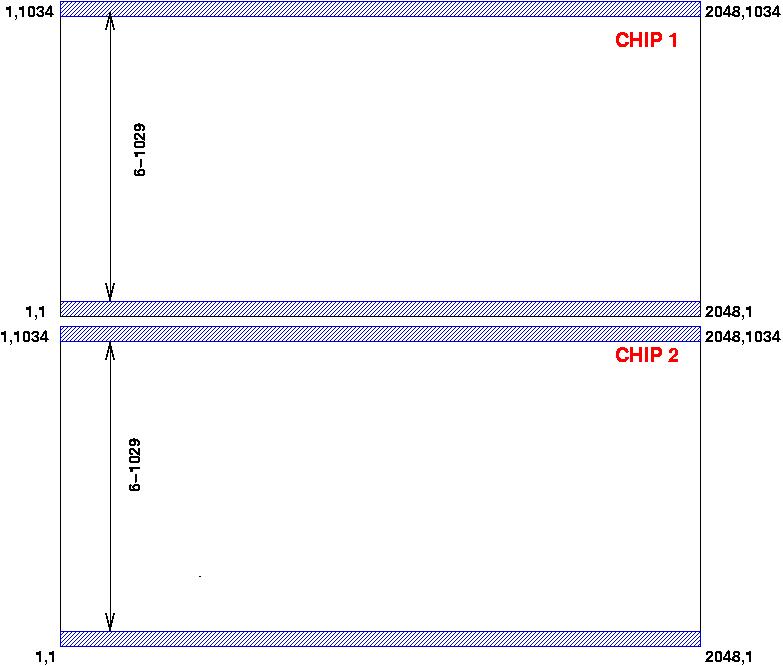
During the FORS2 detector upgrade on March 22, 2002, the old CCD has been replaced by a mosaic of two red/IR-optimized CCDs. The upper CCD is referenced as Chip1 (also called master), while the lower CCD is referenced as Chip2 (also called slave). Each FORS2 exposure is split into two files, one for each CCD. The CCD mosaic is mounted off-axis so that the target falls by default on Chip1 and gap between the two CCDs falls between two MOS slits. The raw FORS2 files in the standard CCD format (2x2 binning, no windowing) have 2048x1034 pixels. The field of view is limited by the MOS unit, therefore the field of Chip1 is larger than that of Chip2. Two pre/overscan regions are present in the CCD. For the standard CCD format (2x2 binning), these regions are 5 pixels wide (i.e. rows 1...5 for the prescan and 1030...1034 for the overscan). Graphical description of the detector sections:
Note that for presentation reason, the pre-scan regions have been artificially enlarged.
|
||||||||||||||||||||||||||||||||||||||||||||||||||||||||||||||||||||||||||||||||||||||||||||||||||||||||||||||||||||||||||||||||||||||||||||||||
| |
||||||||||||||||||||||||||||||||||||||||||||||||||||||||||||||||||||||||||||||||||||||||||||||||||||||||||||||||||||||||||||||||||||||||||||||||||
 |
|
|||||||||||||||||||||||||||||||||||||||||||||||||||||||||||||||||||||||||||||||||||||||||||||||||||||||||||||||||||||||||||||||||||||||||||||||||