Picture of the Week 2009 
Rendering of the E-ELT
A new architectural concept drawing of ESO’s planned European Extremely Large Telescope (E-ELT) shows the telescope at work, with its dome open and its record-setting 40-metre-class primary mirror pointed to the sky. In this illustration, clouds float over the valley overlooked by the E-ELT’s summit. The comparatively tiny pickup truck parked at the base of the E-ELT helps to give a sense of the scale of this massive telescope. The E-ELT dome will be similar in size to a football stadium, with a diameter at its base of over 100 m and a height of over 80 m.
Scheduled to begin operations early in the next decade, the E-ELT will help track down Earth-like planets around other stars in the “habitable zones” where life could exist — one of the Holy Grails of modern observational astronomy. The E-ELT will also make fundamental contributions to cosmology by measuring the properties of the first stars and galaxies and probing the nature of dark matter and dark energy.
The design for the E-ELT shown here was published in 2009 and is preliminary.
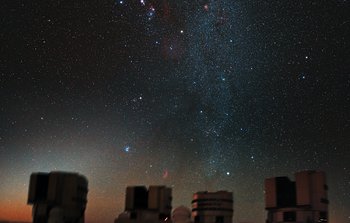
Telescope Domes Clustered at La Silla
This view of ESO’s La Silla Observatory reveals the splendour of the night sky and shows several of the domed telescopes located at the site. The glowing band of the plane of the Milky Way Galaxy slants through the sky from the upper left to the lower middle, where the now closed GPO (Grand Prism Objectif) dome, which also hosted the Marly 1-metre telescope, looms in the foreground, together with the Danish 1.54-metre telescope. The ghostly, bluish objects above the GPO’s dome are two galaxies belonging to the Milky Way’s close neighbourhood and known as the Large and Small Magellanic Clouds.
La Silla’s collection of domed telescopes also includes the ESO 3.6-metre telescope, home to HARPS (High Accuracy Radial velocity Planet Searcher), the world’s foremost exoplanet hunter, and the 3.58-metre New Technology Telescope, which broke new ground for telescope engineering and design, and was the first in the world to have a computer-controlled main mirror (active optics), a technology developed at ESO and now applied to most of the world’s current large telescopes. La Silla is one of the most scientifically productive ground-based facilities in the world after ESO’s Very Large Telescope (VLT) observatory, both of which are located in northern Chile’s Atacama Desert.
The European Extremely Large Telescope
The European Extremely Large Telescope (E-ELT), with a main mirror 39 metres in diameter, will be the world’s biggest eye on the sky when it becomes operational early in the next decade. The E-ELT will tackle the biggest scientific challenges of our time, and aim for a number of notable firsts, including tracking down Earth-like planets around other stars in the “habitable zones” where life could exist — one of the Holy Grails of modern observational astronomy.
The telescope design itself is revolutionary and is based on a novel five-mirror scheme that results in exceptional image quality. The primary mirror consists of almost 800 segments, each 1.4 metres wide, but only 50 mm thick. The optical design calls for an immense secondary mirror 4.2 metres in diameter, bigger than the primary mirrors of any of ESO's telescopes at La Silla.
Adaptive mirrors are incorporated into the optics of the telescope to compensate for the fuzziness in the stellar images introduced by atmospheric turbulence. One of these mirrors is supported by more than 6000 actuators that can distort its shape a thousand times per second.
The telescope will have several science instruments. It will be possible to switch from one instrument to another within minutes. The telescope and dome will also be able to change positions on the sky and start a new observation in a very short time.
The very detailed design for the E-ELT shown here is preliminary.
Transporting an Auxiliary Telescope
ESO astronomer Yuri Beletsky captured images of the transport of one of the 1.8-metre Auxiliary Telescopes (AT) that compose, together with their larger 8.2-metre companions, ESO’s Very Large Telescope (VLT) array. The AT was moved with the utmost care from the base camp, where it had been undergoing maintenance, including the recoating of its mirrors, back to the VLT platform on top of Cerro Paranal.
The ATs form part of the VLT Interferometer (VLTI), allowing this unique facility to operate every night. The ATs are mounted on tracks and can be moved between precisely defined observing positions, collecting light that is then combined in the VLTI. The ATs are very unusual telescopes, as they are self-contained in individual ultra-compact protective domes, and travel with their own electronics, ventilation, hydraulics and cooling systems. Each AT has a transporter that lifts the telescope and moves it from one position to the next. Although for the transfer down to base camp, ESO engineers and technicians rely on a more traditional means of transport, the truck.
GalileoMobile Completes Exciting Journey
After almost two months of life-changing experiences, bringing the excitement of astronomy to young children in Chile, Bolivia and Peru, the journey of the GalileoMobile Project has come to an end.
As illustrated in this image, the astronomers and educators in the Galilomobile team visited numerous schools and villages during their expedition, engaging young students in educational activities about astronomy and science, and offering amazing stargazing opportunities to the local communities, in a region with one of the clearest skies on Earth.
Last week the team visited ESO’s Very Large Telescope (VLT), then continued to Taltal, the closest town to the VLT’s home, Cerro Paranal. Around sunset on 26 November, the GalileoMobile team showed the community of Taltal the highlights of the whole voyage, a voyage that covered around 5,000 kilometres through the Andes. The GalileoMobile was received with great enthusiasm by the people of Taltal. Hundreds of students took part to a ceremony that took place in the main square in Taltal, led by Guillermo Hidalgo, the town’s Mayor. The event ended up with a massive star party, which marked the perfect closing of this Special Project of the International Year of Astronomy 2009.
The GalileoMobile is supported by the European Southern Observatory, whose host country is Chile, the Max Planck Society (MPG/MPE/MPA/MPS), NORDITA, Regione Molise and the Optical Society of America.
More information on the GalileoMobile project can be found in the ESO Press Release eso0937.
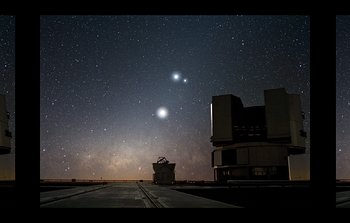
The Moon in Conjunction with Venus and Jupiter (artistic composition)
This dramatic triptych shows the Moon rise from left to right through the night sky over ESO’s Very Large Telescope (VLT) observatory at Paranal in northern Chile. Already aloft in the heavens and glowing in the centre of the image is Venus, Earth’s closest planetary neighbour. Shining to Venus’s right, the giant, though more distant planet, Jupiter appears as a small orb that seems to rotate around Venus as time passes. Such apparent celestial near misses — although the heavenly bodies are actually tens to hundreds of millions of kilometres apart — are called conjunctions.
Still other sights delight in the sky over Paranal. The radiant, reddish plane of the Milky Way smoulders on the horizon, with massive bands of dust giving this bright region a mottled complexion. On the ground, an 8.2-metre VLT Unit Telescope on the right and a 1.8-metre Auxiliary Telescope to the left silently witness the splendour above, while probing the sky to address some of astronomy’s remaining mysteries. The triptych is composed of three exposures of the Moon, Venus and Jupiter and one exposure of the Paranal telescopes.
Weather balloons on Paranal in support of the E-ELT
A probe was launched last Friday (13 November 2009) from ESO’s Paranal observatory in northern Chile — home of the Very Large Telescope (VLT) — aboard a weather balloon. Such probes, called radiosondes, measure various atmospheric parameters and transmit them to a receiver on the ground. Researchers from ESO, the University of Lethbridge (Canada) and Universidad de Valparaiso (Chile) are currently in the middle of a 12-day programme, during which they plan to launch 29 radiosondes. Each night, parallel observations with the VLT instruments UVES, CRIRES and VISIR are carefully orchestrated to coincide with two additional radiosonde launches, while an infrared radiometer provides continuous coverage. This powerful combination of instruments and methods will provide a better understanding of the distribution and amount of water vapour in the atmosphere above Paranal, which is highly relevant for astronomical observations. The knowledge gained from these data can be used to optimise science operations at the VLT and, in the future, at the European Extremely Large Telescope (E-ELT).
The team members are: Arlette Chacón, Lissette Cortes, and Lizett Illanes (Universidad de Valparaiso), Richard Querel and Greg Tompkins (University of Lethbridge), and Gerardo Avila, Gordon Gillet, Carlos Guirao, Reinhard Hanuschik, Florian Kerber, Gaspare LoCurto, Marc Sarazin, Alain Smette (ESO), Michel Cure (U Valparaiso) and David Naylor (U Lethbridge).
Rare 360-degree Panorama of the Southern Sky*
The Milky Way arches across this rare 360-degree panorama of the night sky above the Paranal platform, home of ESO’s Very Large Telescope. The image was made from 37 individual frames with a total exposure time of about 30 minutes, taken in the early morning hours. The Moon is just rising and the zodiacal light shines above it, while the Milky Way stretches across the sky opposite the observatory.
The open telescope domes of the world’s most advanced ground-based astronomical observatory are all visible in the image: the four smaller 1.8-metre Auxiliary Telescopes that can be used together in the interferometric mode, and the four giant 8.2-metre Unit Telescopes. To the right in the image and below the arc of the Milky Way, two of our galactic neighbours, the Small and Large Magellanic Clouds, can be seen.
An amazing interactive virtual tour is available here
Creating a Star
A laser beam shoots out of Yepun, the fourth Unit Telescope of Europe’s flagship observatory, ESO’s Very Large Telescope (VLT). This beam is used to create an artificial star above Paranal to assist the adaptive optics instruments on the VLT. Adaptive optics is a technique that allows astronomers to overcome the blurring effect of the atmosphere and obtain images almost as sharp as would be possible if the whole telescope were placed in space, above Earth's atmosphere.
Adaptive optics, however, requires a nearby reference star that has to be relatively bright, thereby limiting the area of the sky that can be surveyed. To overcome this difficulty, astronomers at Paranal use a powerful laser that creates an artificial star where and when they need it (see eso0607 and eso0727).
Launching such a powerful laser from a telescope is a state-of-the-art technology, whose set-up and operation is a continuous challenge. As seen from the image, this is, however, a technology now well mastered on Paranal. The image was taken from inside the dome of the telescope and reveals nicely how the laser is located on top of the 1.2-metre secondary mirror of the telescope.
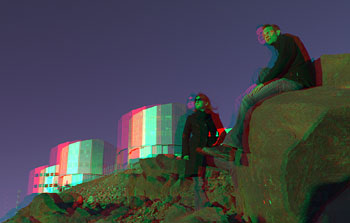
3D Glimpse into the Life of Two Astronomers
Sitting in the stunning environment surrounding ESO’s Very Large Telescope (VLT) on Cerro Paranal, Chile, are Joe Liske from ESO and Eva Noyola from the Max Planck Institute for Extraterrestrial Physics. The photo is a still image from the recently released 3D film, The EYE 3D — Life and Research on Cerro Paranal, directed by Nikolai Vialkowitsch.
The movie, starring the two young scientists, as well as other people involved in the exciting activities at the VLT, offers a brand new, three-dimensional take on the life and research of astronomers. It has been produced by parallax raumprojektion and fact&film, in close collaboration with ESO and other partners and will be coming soon in cinemas across Germany.
Don’t forget to wear red-cyan glasses to enjoy the spectacular 3D effect!
Links
- The movie's ESO web page
- The movie’s external web page: http://www.theeye3d.eu
- The EYE 3D, press kit (German, PDF format)
A Supernova Duet in NGC 1448
Portrayed in this beautiful image is the spiral galaxy NGC 1448, with a prominent disc of young and very bright stars surrounding its small, shining core. Located about 60 million light-years away from the Sun, this galaxy has recently been a prolific factory of supernovae, the dramatic explosions that mark the death of stars : after a first one observed in this galaxy in 1983, two more have been discovered during the past decade.
Visible as a red dot inside the disc, in the upper right part of the image, is the supernova observed in 2003 (SN 2003hn), whereas another one, detected in 2001 (SN 2001el), can be noticed as a tiny blue dot in the central part of the image, just below the galaxy’s core. If captured at the peak of the explosion, a supernova might be as bright as the whole galaxy that hosts it.
This image was obtained using the FORS instrument mounted on one of the 8.2-metre telescopes of ESO’s Very Large Telescope on top of Cerro Paranal, Chile. It combines exposures taken through three filters (B, V, R) on several occasions, between July 2002 and the end of November 2003. The field of view is 7 arcminutes.
Early Morning on Paranal*
This amazing panorama shows the observing platform of ESO’s Very Large Telescope (VLT) on Cerro Paranal, in Chile. Taken in the early morning, with the Moon still high in the sky, the air of peace and tranquility is in stark contrast to the frantic activity at the observatory. The four giant 8.2-metre Unit Telescopes of the VLT are all targeting specific celestial objects, helping astronomers in their daily quest to understand the mysteries of the Universe. A laser is fired from Unit Telescope 4, Yepun, to help the adaptive optics system of the telescope, and counteract the blurring effect of the atmosphere, allowing very sharp images to be obtained. Meanwhile, three of the four smaller 1.8-metre Auxiliary Telescopes are working together in interferometric mode to obtain an even more detailed view of a different cosmic object.
A QuickTime VR is also available on this link.
#L
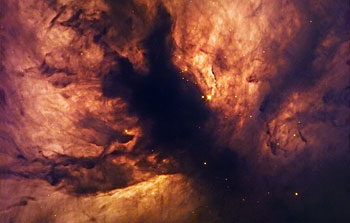
A Cosmic Flame
Sparkling at the edge of a giant cloud of gas and dust, the Flame Nebula, also referred to as NGC 2024, is in fact the hideout of a cluster of young, blue, massive stars, whose light sets the gas ablaze. Located 1,300 light-years away towards the constellation of Orion, the nebula owes its typical colour to the glow of hydrogen atoms, heated by the stars. The latter are obscured by a dark, forked dusty structure in the centre of the image and are only revealed by infrared observations.
This image is based on data acquired with the 1.5-metre Danish telescope at ESO’s La Silla Observatory in Chile, combining three exposures in the filters B (40 seconds), V (80 seconds) and R (40 seconds).
Diving into the Lagoon Nebula
Through three giant images, the GigaGalaxy Zoom project reveals the full sky as it appears with the unaided eye from one of the darkest deserts on Earth, then zooms in on a rich region of the Milky Way using an amateur telescope, and finally uses the power of a professional telescope to reveal the details of a famous nebula. In this way, the project links the sky we can all see with the deep, “hidden” cosmos that astronomers study on a daily basis and allows the viewers to take a breathtaking dive into our Milky Way. The wonderful quality of the images is a testament to the splendour of the night sky at ESO’s sites in Chile, which are the most productive astronomical observatories in the world.
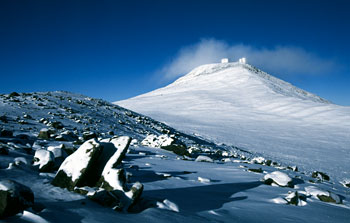
Paranal under snow
Cerro Paranal, in the Chilean Atacama Desert, is considered one of the best astronomical observing sites in the world. It is home to ESO’s Very Large Telescope (VLT), the flagship facility for European ground-based astronomy.
The humidity at Paranal is generally below five percent and the overall precipitation is only 4 mm per year — a rather dry place indeed. It does, on very rare occasions, snow on this 2600-metre-high peak as illustrated by this beautiful image taken in 2002. The snow-covered terrain gleams under a bright blue sky as the snow storm passes.
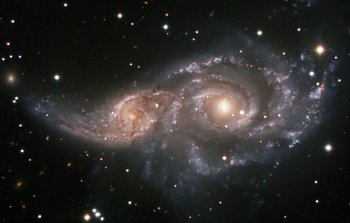
A Cosmic Embrace
In this image, two spiral galaxies, similar in looks to the Milky Way, are participating in a cosmic ballet, which, in a few billion years, will end up in a complete galactic merger — the two galaxies will become a single, bigger one.
Located about 150 million light-years away in the constellation of Canis Major (the Great Dog), NGC 2207 — the larger of the two — and its companion, IC 2163, form a magnificent pair. English astronomer John Herschel discovered them in 1835.
The fatal gravitational attraction of NGC 2207 is already wreaking havoc throughout its smaller partner, distorting IC 2163’s shape and flinging out stars and gas into long streamers that extend over 100,000 light-years. The space between the individual stars in a galaxy is so vast, however, that when these galaxies collide, virtually none of the stars in them will actually physically smash into each other.
This image was captured with the ESO Faint Object Spectrograph and Camera (EFOSC2) through three wide band filters (B, V, R). EFOSC2 has a 4.1 x 4.1 arcminute field of view and is attached to the 3.6-metre telescope at ESO’s La Silla Observatory in Chile.
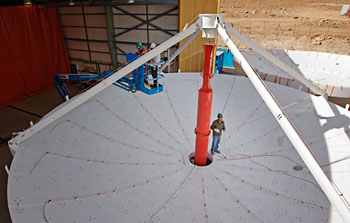
A European ALMA antenna takes shape
In this photograph taken on 18 August 2009, a European ALMA antenna takes shape at the observatory's Operations Support Facility (OSF). ALMA, the Atacama Large Millimeter/submillimeter Array, is a revolutionary astronomical telescope, comprising an array of 66 giant 12-metre and 7-metre diameter antennas observing at millimetre and submillimetre wavelengths. The telescope is being built on the breathtaking location of the Chajnantor plateau, at 5000 metres altitude in the Chilean Andes. The OSF, at which the antennas are being assembled and tested, is at an altitude of 2900 metres. ESO has contracted with the AEM (Alcatel Alenia Space France, Alcatel Alenia Space Italy, European Industrial Engineering S.r.L., MT Aerospace) Consortium for the supply of 25 of the 12-metre diameter ALMA antennas, with options to increase the number to 32. ALMA is a partnership of Europe, North America and East Asia in cooperation with the Republic of Chile.
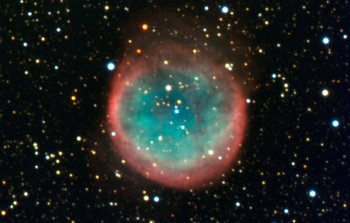
Cosmic Bubble NGC 6781
Stars such as our Sun do not contain enough mass to finish their lives in the glorious explosions known as supernovae. However, they are still able to salute their imminent demise into dense, Earth-sized embers called white dwarfs by first expelling colourful shells of gas known as planetary nebulae. This misnomer comes from the similarity in appearance of these spherical mass expulsions to giant planets when seen through small telescopes.
NGC 6781 is a nice representative of these cosmic bubbles. The planetary nebula lies a few thousand light-years away towards the constellation of Aquila (the Eagle) and is approximately two light-years across. Within NGC 6781, shells of gas blown off from the faint, but very hot, central star’s surface expand out into space. These shells shine under the harsh ultraviolet radiation from the progenitor star in intricate and beautiful patterns. The central star will steadily cool down and darken, eventually disappearing from view into cosmic oblivion.
This image was captured with the ESO Faint Object Spectrograph and Camera (EFOSC2) through three wide band filters (B, V, R) and two narrow-band ones (H-alpha, OIII). EFOSC2 is attached to the 3.6-metre telescope at ESO’s La Silla Observatory in Chile. EFOSC2 has a field of view of 4.1 x 4.1 arcminutes.
Orion above the VLT
The great hunter Orion hangs above ESO’s Very Large Telescope (VLT), in this stunning, previously unseen, image. As the VLT is in the Southern Hemisphere, Orion is seen here head down, as if plunging towards the Chilean Atacama Desert.
At night the four giant 8.2-metre Unit Telescopes of the VLT are all turned skywards to help astronomers in their quest to understand the Universe. The band of the Milky Way, crisscrossed by contrasting dark dust lanes, stretches up over the VLT’s Unit Telescope 3 (Melipal), with the bright star Capella glinting just above the telescope. Up and to the left, Orion’s belt and sword, containing the Orion Nebula, lie between the blue star Rigel and the orange Betelgeuse. The red Rosetta Nebula is seen in the middle part of the Milky Way, while Sirius, the brightest star in the night sky, hangs above the scene. The red patch just above the VLT Unit Telescope 2 (Kueyen) is the California Nebula, nicely offset by the blue of the beautiful Pleiades star cluster a little to the left and above.
The VLT platform on top of Cerro Paranal
This image shows the platform on the summit of Cerro Paranal, in Northern Chile that houses the ESO Very Large Telescope (VLT).
Three of the enclosures protecting the 8.2-metre diameter VLT Unit Telescopes (UTs) are shown and the photographer was on the top of the fourth one, about 35 metres above the platform. At night the huge doors in the enclosures slide open and the 275-tonne top parts of these buildings rotate so that the telescope can observe any part of the sky. The pick-up truck in front of the first UT helps give the scale of this 10-story high building. On the left of the image the rails on which the 1.8-metre Auxiliary Telescopes (ATs) can be moved to different observing stations are visible. Two of the four ATs are visible in the picture. The low building in the lower left corner houses the VLT Interferometer laboratory, where the light from several telescopes can be combined, a technique that reveals details much smaller than can be seen with a single telescope.
Behind the telescopes the desert hills surrounding Cerro Paranal stretch into the distance. Further away the cloud-covered Pacific Ocean can be seen: only 12 km away but 2.6 km lower down.
The Galactic Glory of NGC 2280
This new image of the galaxy NGC 2280 shows the extent of its massive spiral arms that reach far into the surrounding space. These star-filled tentacles taper off into wispy blue clouds of illuminated and glowing gas well away from the central, bright bulge of the galaxy. Found towards the constellation of Canis Major (the Greater Dog), NGC 2280 is thought to be similar in shape to our own Milky Way galaxy.
NGC 2280 whirls in the cosmos about 75 million light-years from us; this snapshot therefore shows the galaxy as it appeared when dinosaurs still roamed the Earth.
The very bright stars that sparkle like diamonds in the image, as well as the many other stars of various colours, are all in the foreground of our view, as they lie much closer to us than NGC 2280.
The image was captured with the ESO Faint Object Spectrograph and Camera (EFOSC2) through three filters (B, V, R). EFOSC2 was attached to the 3.6-metre telescope at ESO’s La Silla Observatory in Chile. EFOSC2 has a field of view of 4.1 x 4.1 arcminutes.
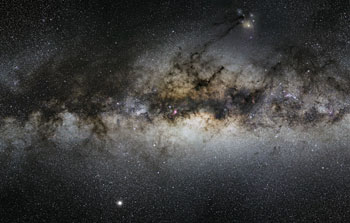
The Milky Way Shines on Paranal
The Milky Way blazes above the European Southern Observatory (ESO) facilities at Mount Paranal in northern Chile’s Atacama Desert. Paranal hosts the world’s most advanced ground-based astronomical observatory, the Very Large Telescope (VLT), and is home to two new telescopes for large imaging surveys currently under construction, the VLT Survey Telescope (VST) and the Visible and Infrared Survey Telescope for Astronomy (VISTA). Both are expected to “take up duty” in the 2009-2010 timeframe.
This photograph shows an edge-on view of the Milky Way’s glowing plane slicing across the night sky, laced by bands of dust and dark gas. Taken with a digital camera using a three-minute exposure, the photograph also reveals a bit of action on the ground. To the left, a vehicle with its parking lights on stops lets out a passenger. Though bathed by the light of the Milky Way, the high-altitude desert remains quite dark. To illuminate the rightward path to the underground entrance ramp of the ‘Residencia’, where staff and visitors stay, the passenger takes along a small flashlight, seen as a squiggly bright line. In the lower right, the glass dome on the Residencia’s roof reflects the starry sky overhead. One of our Milky Way’s galactic satellites, the Large Magellanic Cloud, is seen hanging above the Residencia in the lower right corner of the image.
ESO’s Very Large Telescope (VLT) Array Now in Google Earth
This image shows how ESO’s Very Large Telescope (VLT) facility looks through the eyes of Google Earth. This popular software allows users to see the world from above, ranging from a satellite to a bird’s eye view. Now, Google Earth users can swoop around detailed 3-D models of the massive structures housing the four 8.2-metre Unit Telescopes (UTs) atop Mount Paranal in the Chilean Atacama Desert. Also visible in this sample image are the four 1.8-metre movable Auxiliary Telescopes (ATs), the enclosure of the 2.4-metre VLT Survey Telescope (VST), and technical and support buildings. The models can be downloaded from ESO’s VLT page, and opened using Google Earth.
The European Extremely Large Telescope (Artist’s rendering)
This new artist’s impression shows the future European Extremely Large Telescope (E-ELT), which is currently being planned by ESO. This revolutionary new ground-based telescope will be the largest optical/near-infrared telescope ever conceived, and will serve as “the world’s biggest eye on the sky”.
The present concept is for a telescope with a mirror 39 metres in diameter, able to capture images of the sky about a tenth the size of the full Moon. The telescope will contain five mirrors, a novel configuration that results in exceptional image quality. The largest (primary) mirror will consist of almost 800 segments, each 1.4 metres wide but only 50 mm thick. The optical system’s design also calls for an immense secondary mirror measuring 4.2 metres in diameter, which is almost as large as the biggest primary mirrors used in today’s telescopes.
With the start of operations planned early in the next decade, the E-ELT will tackle the biggest scientific challenges of our time. The massive telescope will take aim at a number of notable astronomical firsts, including tracking down Earth-like planets orbiting other stars in the “habitable zones” where life could exist — one of the hottest topics of modern observational astronomy. It will also perform “stellar archaeology” in nearby galaxies and make fundamental contributions to cosmology by measuring the properties of the first stars and galaxies. In addition, the E-ELT will probe the nature of dark matter and dark energy. During these scientific quests, astronomers eagerly anticipate some unexpected twists — new and unforeseeable questions will surely arise from discoveries made with the E-ELT.
The design for the E-ELT shown here was published in 2009 and is preliminary.
Other E-ELT images are also available on this link.
The Visible and Infrared Survey Telescope — VISTA
This photograph from early 2009 shows the VISTA telescope, which is currently completing tests in its dome at Paranal in Chile. VISTA, along with the VST (VLT Survey Telescope) is one of two ESO survey telescopes about to start work surveying the southern skies.
VISTA has a main mirror that is 4.1 metres across and is by far the largest telescope in the world dedicated to surveying the sky at near-infrared wavelengths. It was conceived and developed by the United Kingdom and became an in-kind contribution to ESO as part of the UK's accession agreement, with the subscription paid by the UK Science and Technology Facilities Council (STFC). The main mirror is the most highly curved mirror of its size ever made and at the heart of VISTA is a 3-tonne camera containing 16 special detectors sensitive to infrared light with a combined total of 67 megapixels. It will have widest coverage of any astronomical near-infrared camera.
Observing at wavelengths longer than those visible to the human eye will allow VISTA to study objects that may be almost impossible to see in visible light because they are cool, obscured by dust clouds or because their light has been stretched towards redder wavelengths by the expansion of space during the light’s long journey from the early Universe.
VISTA will be able to detect and catalogue objects over the whole southern sky with a sensitivity that is 40 times greater than achieved with earlier infrared sky surveys such as the highly successful Two Micron All-Sky Survey. The start of VISTA surveys is planned for early in 2010.
This view looks down the stubby tube of VISTA. The white tubular structure in the foreground is the support for the secondary mirror and, just below the centre of the picture the top of the camera can be seen, complete with a light blue optical window. The dark blue structure either side of the tube is the telescope's fork mount.
Start of construction of new ALMA Chile headquarters
Excavation work has just begun for construction of the Santiago Central Office (SCO) building of the Atacama Large Millimeter/submillimeter Array (ALMA) project.
The building, in the Vitacura district of the Chilean capital, will be adjacent to the Santiago offices of the European Southern Observatory (ESO), which is the European partner in the global ALMA project, and which is responsible for constructing the ALMA SCO.
The SCO building will have a size of almost 7,000 square metres over two storeys, with underground parking for 130 cars, which will allow some of the existing above-ground parking spaces to be moved underground and replaced with green areas. For the construction, eleven old trees were moved to a new location at ESO, in a meticulous operation led by experts.
ALMA, the largest astronomical project in existence, is a revolutionary astronomical telescope, comprising an array of 66 giant 12-metre and 7-metre diameter antennas observing at millimetre and submillimetre wavelengths. The facility is currently under construction on the 5000m high plateau of Chajnantor in the Chilean Andes. The construction of the ALMA Santiago Central Office is scheduled for completion in 2010. ALMA is a partnership of Europe, North America and East Asia in cooperation with the Republic of Chile.
The future ALMA array on Chajnantor (artist’s rendering)
The Atacama Large Millimeter/submillimeter Array (ALMA) is the largest astronomical project in existence. It is a revolutionary astronomical telescope, comprising an array of 66 giant 12-metre and 7-metre diameter antennas observing at millimetre and submillimetre wavelengths. It is being built on the breathtaking location of the Chajnantor plateau, at 5000 metres altitude in the Chilean Andes, and will start scientific observations in 2011.
In this artist’s rendering, the ALMA array is seen on the Chajnantor plateau in an extended configuration. The antennas, which each weigh over 100 tons, can be moved to different positions with custom-built transporter vehicles in order to reconfigure the array.
ALMA is the most powerful telescope for observing the cool Universe — molecular gas and dust as well as the relic radiation of the Big Bang. It will study the building blocks of stars, planetary systems, galaxies and life itself.
ALMA, an international astronomy facility, is a partnership of Europe, North America and East Asia in cooperation with the Republic of Chile. ESO is the European partner in ALMA.
Panorama of the Chilean night sky
This Quicktime interactive panorama movie shows the night sky over ESO’s Paranal Observatory in Chile and reveals its incredible richness and beauty.
To launch the panorama please click the link on the right under QuickTime VR.
To navigate this dual landscape and starscape, left-click on the image and continue pressing the button as you drag the mouse in the direction you would like to see. To zoom in and out, press "shift" or "ctrl".
Moving towards the right, the panorama shows the Milky Way band blazing over the horizon. Ascending the mountain that comes into view, one sees ESO’s Very Large Telescope array and the red beam of its Laser Guide Star. Still further right, the VISTA peak rises, with the lingering Gegenschein aglow above it. Other sights in the sky over Paranal include the Andromeda Galaxy, the Pleiades and the Hyades star clusters, the constellation of Orion, and the brightest star in the sky Sirius, seen low on the horizon. The Milky Way’s galactic neighbours, the Large and the Small Magellanic Clouds, also shine brightly overhead.
Another interactive panorama also taken from Paranal on a different night and with the constellations highlighted is available at: http://www.astrosurf.com/sguisard/Anim-astro/Paranal-ZL-MW/SGU-Paranal-Zodiacal_Light-MW-const_names.html
Happy viewing.
A Milky Way cousin
NGC 2613 is a rarely imaged spiral galaxy located about 60 million light years away towards the southern constellation of Pyxis (the mariner’s compass). It is thought to resemble our own Milky Way. This image is based on data acquired with the 1.5-metre Danish telescope at ESO’s La Silla Observatory in Chile, through three filters (B, V, R).
Ready for the night
Three of the four Unit Telescopes of ESO’s Very Large Telescope (VLT) are shown here getting ready for another exceptional night of observations on top of Cerro Paranal, in Chile. Prior to every night, the engineers in charge go through a routine of manoeuvres to prepare the flagship facility of European astronomy. The VLT is the world’s most advanced optical instrument, consisting of four Unit Telescopes with main mirrors of 8.2-metre diameter and four movable 1.8-metre diameter Auxiliary Telescopes. One of the Auxiliary Telescopes is shown on the right of the image.
A Giant Galaxy
Centaurus A is our nearest giant galaxy, at a distance of about 13 million light-years in the southern constellation of Centaurus, and as such, it is one of the most extensively studied objects in the southern sky. It is an elliptical galaxy, currently merging with a companion spiral galaxy, resulting in areas of intense star formation and making it one of the most spectacular objects in the sky. Centaurus A hosts a very active and highly luminous central region, caused by the presence of a supermassive black hole with a mass of about 100 million solar masses (see eso0109), and is the source of strong radio and X-ray emission. Thick dust layers almost completely obscure the galaxy's centre. This image is based on data acquired with the 1.5-metre Danish telescope at ESO’s La Silla Observatory in Chile, through three filters (B, V, R).
A VLT Unit Telescope and the Moon
The Moon is normally much too large and bright to be a target for the 8.2-metre Unit Telescopes (UTs) that make up ESO’s Very Large Telescope, whose sheer power is best reserved for much fainter and much more distant astronomical objects, such as exoplanets or exploding stars located at the edge of the visible Universe. But back in 2002, one of the UTs was not yet equipped with an instrument at one of its Nasmyth platforms (located on the side of the telescope), and astronomers and engineers could have an unusual view of our natural satellite. In this case, the Moon's image was projected onto a sandblasted glass plate. Since then, the Very Large Telescope has been equipped with no less than 14 instruments, including three for interferometry, making it truly the world’s most advanced observatory.
The Southern Pinwheel
Located about 15 million light-years away towards the Hydra (the sea serpent) constellation, Messier 83 is a nearby face-on barred spiral with a classic grand design form. It is the main member of a small galactic group including NGC 5253 and about 9 dwarf galaxies. Messier 83 stretches over 40,000 light-years, making it roughly 2.5 times smaller than our own Milky Way. However, in some respects, Messier 83 is quite similar to our own galaxy. Both the Milky Way and Messier 83 possess a bar across their galactic nucleus, the dense spherical conglomeration of stars seen at the centre of the galaxies.
Messier 83 has been a prolific producer of supernovae, with six observed in the past century. This is indicative of an exceptionally high rate of star formation coinciding with its classification as a starburst galaxy. Despite its symmetric appearance, the central 1,000 light-years of the galaxy shows an unusually high level of complexity, containing both a double nucleus and a double circumnuclear starburst ring. The nature of the double nucleus is uncertain but the off centre nucleus could be a remnant core of a small galaxy that merged with Messier 83 in the past. The star clusters in the nuclear starburst rings are mostly young stars between 5 and 10 million years old. This image is based on data acquired with the 1.5-metre Danish telescope at ESO’s La Silla Observatory in Chile, through three filters (B, V, R).
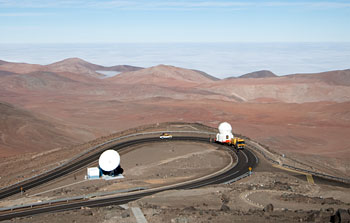
ALMA Antennas at OSF
View from inside the main building of the 2,900 metre high ALMA Operation Support Facility. Three antennas currently being tested are seen outside. On 30 April, scientists and engineers working on the world’s largest astronomical project, the Atacama Large Millimeter/submillimeter Array (ALMA), have achieved the successful linking of two ALMA astronomical antennas, synchronised with a precision of one millionth of a millionth of a second, to observe the planet Mars. The observations demonstrate ALMA’s full hardware functionality and connectivity. When completed around 2012, ALMA will comprise an array of 66 giant 12-metre and 7-metre diameter antennas observing at millimetre and submillimetre wavelengths.
Read more about this milestone in eso0918.
The Observing Platform as the Crow Flies *
This aerial shot of ESO’s Very Large Telescope array on top of the 2600-metre-high Cerro Paranal in the Chilean Atacama Desert beautifully shows the various stations for the mobile Auxiliary Telescopes. The largest structures are the enclosures of the four 8.2-metre Unit Telescopes of the VLT. In the middle lies the VLT Interferometer (VLTI) laboratory.
Contrary to other large astronomical telescopes, the VLT was designed from the beginning with the use of interferometry as a major goal. The VLTI combines light captured by two or three 8.2-metre VLT Unit Telescopes, dramatically increasing the spatial resolution and showing fine details of a large variety of celestial objects. However, most of the time, the large telescopes are used for other research purposes. They are therefore only available for interferometric observations during a limited number of nights every year. Thus, in order to exploit the VLTI each night and to achieve the full potential of this unique setup, some other smaller, 1.8-metre dedicated telescopes were included into the overall VLT concept. These telescopes, known as the VLTI Auxiliary Telescopes (ATs), are mounted on tracks and can be placed at precisely defined “parking” observing positions on the observatory platform (seen along the lines in the image). From these positions, their light beams are fed into the VLTI laboratory via a complex system of reflecting mirrors mounted in an underground system of tunnels.
Taken in 2005, this photo shows only two of the four ATs that are currently in operation. The enclosure on the upper right of the image will soon host the VLT Survey Telescope (VST).
Distorted galaxy NGC 2442
The distorted galaxy NGC 2442, also known as the Meathook Galaxy, is located some 50 million light-years away in the constellation of Volans (the Flying Fish). The galaxy is 75,000 light-years wide and features two dusty spiral arms extending from a pronounced central bar that give it a hook-like appearance, hence its nickname. The galaxy’s distorted shape is most likely the result of a close encounter with a smaller, unseen galaxy. This image is based on data acquired with the 1.5-metre Danish telescope at ESO’s La Silla Observatory in Chile, through three filters (B: 250 s, V: 187 s, R: 150 s).
Lord Drayson opens JENAM 2009
Today, 20 April 2009, was the opening of the European Week of Astronomy and Space Science (JENAM 2009), which takes place at the University of Hertfordshire, UK. Lord Drayson, the British Minister of State for Science and Innovation, addressed the many attendees to this conference, expressing the importance of astronomy and space science for today’s society. He also visited the ESO stand where he was introduced to ESO’s flagship astronomical facility, the Very Large Telescope, by Tim de Zeeuw, the ESO Director General, and Patrick Roche, UK member of the ESO Council. Tim de Zeeuw also explained about the European Extremely Large Telescope, a project which the minister showed great interest for.
Paranal Observatory and the Volcano Llullaillaco*
This marvellous aerial photograph of the home of ESO’s Very Large Telescope (VLT), fully demonstrates the superb quality of the observing site. In the foreground we see the Paranal Observatory, located at an altitude of 2,600 metres on mount Paranal in Chile. In the background we can see the snow-capped, 6,720 meter-high volcano Llullaillaco, located a mind-boggling 190 km further East on the Argentinean border. This image is a testimony of the magnificent quality of the air and the ideal conditions for observing at this remote site.
Clearly visible in the image are the domes of the four giant 8.2-metre Unit Telescopes of the VLT, with the Control Building, where astronomers carry out the observations, in the foreground. Taken several years ago, this photograph does not show the Auxiliary Telescopes nor the dome of the soon to come VST Survey Telescope.
#L
Messier 100 and Supernova SN 2006X
Similar in appearance to our own Milky Way, Messier 100 is a grand spiral galaxy that presents an intricate structure, with a bright core and two prominent arms. The galaxy harbours numerous young and hot massive stars as well as extremely hot regions of ionised hydrogen. Two smaller arms are seen emerging from the centre and reaching towards the larger spiral arms. The galaxy, located 60 million light-years away, is slightly larger than the Milky Way, with a diameter of about 120,000 light-years. A supernova was discovered in M100 on 4 February 2006. Named SN 2006X, it is the 5th supernova to have been found in M100 since 1900. This image is based on data acquired with the 1.5 m Danish telescope at the ESO La Silla Observatory in Chile, through three filters (B: 1390 s, V: 480 s, R: 245 s). The supernova is the brighter of the two stars seen just to the lower right of the galaxy centre.
The Paranal Residencia at Night
Night view of the Paranal Observatory, obtained on 21 March 2009. The Residencia — the place where staff can eat and sleep — is visible in the foreground, while one can distinguish the 8.2-metre Unit Telescopes of ESO’s Very Large Telescope in the higher background. Yepun, the Unit Telescope no. 4, is seen using the laser guide star to assist the adaptive optics instruments on the VLT. This allows astronomers to obtain images free from the blurring effect of the atmosphere, regardless of the brightness and location on the sky of the observed target. The image shows the great value of the dark night sky above Paranal. The band of the Milky Way is running through the image vertically. Orion and the Orion Nebula can be seen in the upper left corner along with a number of other interesting deep-sky objects in Auriga, the Charioteer. Tremendous efforts are being put into preventing light pollution from the Residencia and surrounding cities. Only long exposures with sensitive digital cameras are able to reveal the dim lights from the residencia rooms.
The Tarantula Nebula
Located inside the Large Magellanic Cloud (LMC) – one of our closest galaxies – in what some describe as a frightening sight, the Tarantula nebula is worth looking at in detail. Also known as 30 Doradus or NGC 2070, the nebula owes its name to the arrangement of its bright patches that somewhat resemble the legs of a tarantula. Taking the name of one of the biggest spiders on Earth is very fitting in view of the gigantic proportions of this celestial nebula — it measures nearly 1,000 light years across ! Its proximity, the favourable inclination of the LMC, and the absence of intervening dust make this nebula one of the best laboratories to better understand the formation of massive stars. This spectacular nebula is energised by an exceptionally high concentration of massive stars, often referred to as super star clusters. This image is based on data acquired with the 1.5 m Danish telescope at the ESO La Silla Observatory in Chile, through three filters (B: 80 s, V: 60 s, R: 50 s).
First Light for the Active Phasing Experiment — a step towards the E-ELT
The 40-metre-class primary mirror of the European Extremely Large Telescope (E-ELT) will be composed of 984 individual segments, which must be aligned with incredible precision.
The position of the individual hexagonal mirrors needs to be controlled with nanometre precision (1 nanometre is 1 millionth of a mm). This can only be achieved with the help of new technologies and a prototype component for this high-tech alignment of segmented mirrors is seen in this image.
The so-called Active Phasing Experiment achieved its First Light during the night of 6 December 2008 on the visitor focus of Melipal, one of the 8.2 m Unit Telescopes of ESO’s Very Large Telescope at Paranal. Made in collaboration with several European partners, the current active segmented mirror is composed of 61 hexagonal segments.
You can move around the experiment in this Quicktime VTR animation.
The Sombrero Galaxy
One of most famous spiral galaxies is Messier 104, widely known as the "Sombrero" (the Mexican hat) because of its particular shape. It is located towards the constellation Virgo (the ‘virgin’), at a distance of about 30 million light-years and is the 104th object in the famous catalogue of deep-sky objects by French astronomer Charles Messier (1730 - 1817).
This luminous and massive galaxy has a total mass of about 800 billion suns, and is notable for its dominant nuclear bulge, composed mainly of mature stars, and its nearly edge-on disc composed of stars, gas, and dust. The complexity of this dust is apparent directly in front of the bright nucleus, but is also evident in the dark absorbing lanes throughout the disc. A large number of small, diffuse objects can be seen as a swarm in the halo of Messier 104. Most of these are globular clusters, similar to those found in our own Milky Way, but Messier 104 has a much larger number of them. This galaxy also appears to host a supermassive black hole of about 1 billion solar masses, one of the most massive black holes measured in any nearby galaxy, and 250 times larger than the black hole in the Milky Way. Despite having such a massive black hole at its centre, the galaxy is rather quiet, implying that the black hole is on a very stringent diet.
This image is based on data acquired with the 1.5 m Danish telescope at the ESO La Silla Observatory in Chile, through three filters (B: 120 s, V: 100 s, R: 100 s).
Startrails over Cerro Paranal in 1987
Cosmic Butterfly
The Bug Nebula, NGC 6302, is one of the brightest and most extreme planetary nebulae known. It is located about 4,000 light-years away, towards the Scorpius constellation (the Scorpion). The nebula is the swansong of a dying solar-like star lying at its centre. At about 250,000 degrees Celsius and smothered in a blanket of hailstones, the star itself has never been observed as it is surrounded by a dense disc of gas and dust, opaque to light. This dense disc may be the origin of the hourglass structure of the nebula.
This colour image, which nicely highlights the complex structure of the nebula, is a composite of three exposures through blue, green and red filters. It was made using the 1.5-metre Danish telescope at the ESO La Silla Observatory, Chile.
Beautiful Sky over Paranal *
This image, taken an early morning two weeks ago, shows with great clarity the amazing sky over Paranal, the home of ESO’s Very Large Telescope (VLT) in Chile.
The wonderful landscape of the Milky Way hangs in all its glory above three of the four 1.8-metre VLT Auxiliary Telescopes (ATs). They observe simultaneously, using interferometry to get a vision as sharp as if they used a telescope with a diameter equal to the largest distance between the telescopes, in this case, 48 metres. Because the larger 8.2-metre Unit Telescopes of the VLT are usually used individually, the four ATs have been added to the system to make full use of the interferometric laboratory.
Facing the East, the remarkable photo shows the constellations Ophiuchus (the ‘snake-holder’), Sagittarius (the ‘archer’), Scorpius (the ‘scorpion’), and Triangulum Australe (the ‘southern triangle’). The Centre of the Milky Way is just below the centre of the image.
This image is available as a mounted image in the ESOshop.
Ballet of Interacting Galaxies
The pair of galaxies NGC 1531/2, engaged in a spirited waltz, is located about 70 million light-years away towards the southern constellation Eridanus (The River). The deformed foreground spiral galaxy laced with dust lanes NGC 1532 is so close to its companion — the background galaxy with a bright core just above the centre of NGC 1532 — that it gets distorted: one of its spiral arms is warped and plumes of dust and gas are visible above its disc. The cosmic dance leads to another dramatic effect: a whole new generation of massive stars were born in NGC 1532 because of the interaction. They are visible as the purple objects in the spiral arms.
This exquisite image was made using the 1.5-metre Danish telescope at the ESO La Silla Observatory, Chile. It is based on data obtained through three different filters: B, V and R. The field of view is 12 x 12 arcmin.
Cleaning a VLT mirror
The 8.2m diameter main mirror of Antu, the first Unit Telescope of ESO's Very Large Telescope, is being cleaned using carbon dioxide snow.
While the telescope enclosure is maintained extremely clean, the mirrors are exposed to the elements during the observations. Consequently, dust from the desert slowly accumulates over the surface of the mirror, making it less reflective over time.
The mirror's surface is so delicate that normal cleaners used for household mirrors are not appropriate for telescopes. Observatories have developed other methods, such as this one using carbon dioxide snow. The tiny CO2 snowflakes in the white plume have a temperature of almost minus 80 degrees Celsius; when they land on the mirror, which is at room temperature, they cause minuscule 'explosions' that detach the dust grains from the surface. The dust then floats away, leaving the mirror clean. The process is nevertheless very delicate: should Alain Gilliotte, the optician performing the cleaning, let the CO2 device touch the mirror, the fragile reflective Aluminium coating would be scratched. Also, hair or cloth lint should stay away from the mirror, which is why the optician is wearing a white suit made of special plastic.
The Trapezium Cluster
The Orion Nebula is arguably the finest of all nebulae within the Milky Way visible from the Northern Hemisphere. With a gaseous repository of 10,000 suns, and illuminated by a cluster of hot young stars, the clouds of Messier 42 — as it is also known — glow with fantastic colours and shapes, giving us a bird’s eye view of one of the greatest star forming nurseries in our part of the Milky Way. Messier 42 is a complex of glowing gas, mostly hydrogen but also helium, carbon, nitrogen, and oxygen in decreasing amounts, located 1,500 light-years away. At its very heart, we find the Trapezium, a group of four very hot stars that illuminate the nebula. They are the brightest of an extended cluster of several thousand young stars many of which lie unseen within the opaque gas and dust. Amazingly, whilst the Orion Nebula is easy to identify with the unaided eye, there is apparently no written record of its existence before the 17th century.
This image is based on data acquired with the 1.5 m Danish telescope at the ESO La Silla Observatory in Chile, through three filters (B: 60 s, V: 30 s, R: 21 s). East is at the upper right corner and North is at the lower right.