Picture of the Week 
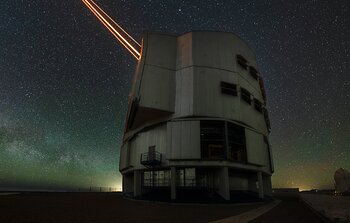
The Comet and the Laser
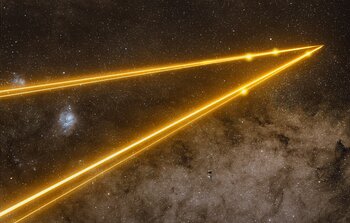
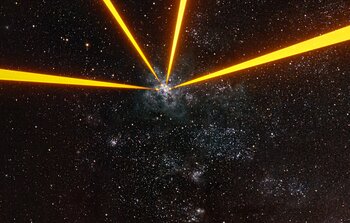
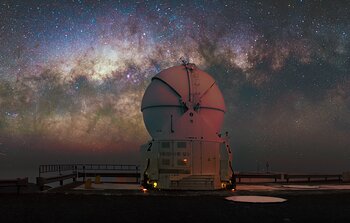
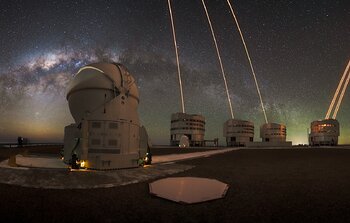
Gerhard Hüdepohl, one of the ESO Photo Ambassadors, captured this spectacular image of ESO’s Very Large Telescope (VLT) during the testing of a new laser for the VLT 14 February 2013. It will be used as a vital part of the Laser Guide Star Facility (LGSF), which allows astronomers to correct for most of the disturbances caused by the constant movement of the atmosphere in order to create much sharper images. Nevertheless, is hard not to think of it as a futuristic laser cannon being pointed towards some kind of distant space invader.
As well as the amazing view of the Milky Way seen over the telescope, there is another feature making this picture even more special. To the right of the centre of the image, just below the Small Magellanic Cloud and almost hidden among the myriad stars seen in the dark Chilean sky, there is a green dot with a faint tail stretching to its left. This is the recently discovered and brighter-than-expected Comet Lemmon, which is currently moving slowly through the southern skies.
Super-thin Mirror Under Test at ESO
This remarkable deformable thin-shell mirror has been delivered to ESO at Garching, Germany and is shown undergoing tests. It is 1120 millimetres across but just 2 millimetres thick, making it much thinner than most glass windows. The mirror is very thin so that it is flexible enough for magnetic forces applied to it to alter the shape of its reflective surface. When in use, the mirror's surface will be constantly changed by tiny amounts to correct for the blurring effects of the Earth’s atmosphere and so create much sharper images.
The new deformable secondary mirror (DSM) will replace the current secondary in one of the VLT’s four Unit Telescopes. The entire secondary structure includes a set of 1170 actuators that apply a force on 1170 magnets glued to the back face of the thin shell. Sophisticated special-purpose electronics control the behaviour of the thin shell mirror. The reflecting surface can be deformed up to a thousand times per second by the action of the actuators.
The complete DSM system was delivered to ESO by the Italian companies Microgate and ADS in December 2012 and concludes eight years of sustained development efforts and manufacturing. This is the largest deformable mirror ever produced for astronomical purposes and is the latest of a long line of such mirrors. The extensive experience of these contractors shows in the high performance of the system and its reliability. The installation on the VLT is scheduled to start in 2015.
The shell mirror (ann12015) itself was manufactured by the French company REOSC. It is a sheet of ceramic material that has been polished to a very accurate shape. The manufacturing process starts with a block of Zerodur ceramic, provided by Schott Glass (Germany) that is more than 70 millimetres thick. Most of this material is ground away to create the final thin shell that must be carefully supported at all times as it is extremely fragile.
Links
- The Adaptive Optics Department at ESO
- Booklet on the Adaptive Optics Facility (AOF) at ESO (PDF file)
- Microgate
- ADS
- REOSC
- Schott Glass
Laser and Light Painting
On a clear night in Bavaria, ESO staff attended the filming of an ESOcast episode focusing on ESO’s new compact laser guide star unit, seen here in action at the Allgäu Public Observatory in Ottobeuren, Germany. Using the glow from their mobile phones, staff took advantage of the long-exposure photograph to draw the letters “ESO” in light, while standing in front of the observatory. Just left of the vertical laser beam, the Milky Way can be seen. Just above the horizon over the observatory, the dotted tracks of aircraft can be seen in the distance. The laser has a powerful beam of 20 watts, and to protect pilots and passengers a no-fly zone around the observatory was created by the Deutsche Flugsicherung (responsible for air traffic control in Germany) during the nighttime observing hours.
Laser guide stars are artificial stars created in the Earth’s atmosphere using a laser beam. The laser makes the sodium atoms in a layer 90 kilometres up in the atmosphere glow and so creates an artificial star in the sky that can be observed by a telescope. Using measurements of the artificial star, adaptive optics instruments can then correct the blurring effect of the atmosphere in the observations.
ESO’s innovative concept uses a powerful laser whose beam is launched with a small telescope, combined into a single modular unit which can be mounted directly on a large telescope. The concept, which has been patented and licensed by ESO, will be used to provide the Very Large Telescope (VLT) with four similar laser units. It will also play a key role in the units that will equip the future European Extremely Large Telescope (E-ELT).
At the time of filming, the unit was undergoing testing before being shipped to the ESO Paranal Observatory in Chile, home of the VLT.
Links
- ESOcast episode on Laser Guide Stars
- More about the ESO Wendelstein Laser Guide Star unit
- More about the Allgäu Public Observatory
Sunset at Paranal Observatory
Babak Tafreshi, an ESO Photo Ambassador, has captured a beautiful image of ESO’s Paranal Observatory illuminated by the sunset. The beautifully clear sky hints at the exceptional atmospheric conditions here; one major reason why ESO chose Paranal as the site of the Very Large Telescope (VLT), its flagship facility.
The VLT — which can be seen on Cerro Paranal, the highest peak in the image, with an altitude of 2600 metres — is the world’s most advanced visible-light astronomical observatory. It consists of four Unit Telescopes, each with a primary mirror 8.2 metres across, and four 1.8-metre Auxiliary Telescope.. The VLT operates at visible and infrared wavelengths and among the pioneering observations carried out using the VLT have been the first direct image of an exoplanet (see eso0515) and the tracking of stars orbiting the Milky Way’s central black hole (see eso0846 and eso1151).
Also on Cerro Paranal is the VLT Survey Telescope (VST). Its smaller enclosure can just be made out in front of one of the larger VLT Unit Telescope enclosures on the mountaintop. The VST is the most recent addition to Paranal, with the first images released in 2011 (see eso1119). It sports a primary mirror 2.6 metres across, which makes it the largest telescope in the world designed for surveying the sky in visible light.
Another survey telescope at the Paranal Observatory is VISTA, the Visible and Infrared Survey Telescope for Astronomy, which can be seen on another peak, in the foreground of Cerro Paranal. VISTA is the world’s largest survey telescope, with a 4.1-metre mirror, and operates at near-infrared wavelengths. The telescope started work in 2009 (see eso0949).
Links
- More about the Very Large Telescope
- More about the survey telescopes at Paranal
- ESO Photo Ambassadors
An Intergalactic Heavyweight
This deep-field image shows what is known as a supercluster of galaxies — a giant group of galaxy clusters which are themselves clustered together. This one, known as Abell 901/902, comprises three separate main clusters and a number of filaments of galaxies, typical of such super-structures. One cluster, Abell 901a, can be seen above and just to the right of the prominent red foreground star near the middle of the image. Another, Abell 901b, is further to the right of Abell 901a, and slightly lower. Finally, the cluster Abell 902 is directly below the red star, towards the bottom of the image.
The Abell 901/902 supercluster is located a little over two billion light-years from Earth, and contains hundreds of galaxies in a region about 16 million light-years across. For comparison, the Local Group of galaxies — which contains our Milky Way among more than 50 others — measures roughly ten million light-years across.
This image was taken by the Wide Field Imager (WFI) camera on the MPG/ESO 2.2-metre telescope, located at the La Silla Observatory in Chile. Using data from the WFI and from the NASA/ESA Hubble Space Telescope, in 2008 astronomers were able to precisely map the distribution of dark matter in the supercluster, showing that the clusters and individual galaxies which comprise the super-structure reside within vast clumps of dark matter. To do this, astronomers looked at how the light from 60 000 faraway galaxies located behind the supercluster was being distorted by the gravitational influence of the dark matter it contains, thus revealing its distribution. The mass of the four main dark matter clumps of Abell 901/902 is thought to be around ten trillion times that of the Sun.
The observations shown here are part of the COMBO-17 survey, a survey of the sky undertaken in 17 different optical filters using the WFI camera. The COMBO-17 project has so far found over 25 000 galaxies.
Links
- The COMBO-17 survey at the Max-Planck-Institut für Astronomie, Heidelberg
- A wider-field view of the area around the Abell 901/902 supercluster
APEX Under the Moon
Another starry night on the Chajnantor Plateau in the Chilean Andes. The first quarter Moon glows brightly in this exposure, outshining the surrounding celestial objects. However, for radio telescopes such as APEX (the Atacama Pathfinder Experiment), seen here, the brightness of the Moon is not a problem for observations. In fact, since the Sun itself is not too bright at radio wavelengths, and these wavelengths do not brighten the sky in the same way, this telescope can even be used during the daytime, as long as it is not pointed towards the Sun.
APEX is a 12-metre-diameter telescope that observes light at millimetre and submillimetre wavelengths. Astronomers observing with APEX can see phenomena which would be invisible at the shorter wavelengths of infrared or visible light. For instance, APEX can peer through dense interstellar clouds of gas and cosmic dust, revealing hidden regions of ongoing star formation which glow brightly at these wavelengths, but which may be obscured and dark in visible and infrared light. Some of the earliest and most distant galaxies are also excellent targets for APEX. Due to the expansion of the Universe over many billions of years, their light has been redshifted into APEX’s millimetre and submillimetre range.
APEX is a collaboration between the Max Planck Institute for Radio Astronomy (MPIfR), the Onsala Space Observatory (OSO) and ESO. Operation of APEX at Chajnantor is entrusted to ESO.
This stunning picture was taken by ESO Photo Ambassador Babak Tafreshi. It is part of a larger panorama, which is also available cropped in a different way.
Links
ALMA Dwarfed by Mountain Peaks
At first glance, this panoramic view shows the mountainous scenery of Chile’s Chajnantor Plateau, with snow and ice scattered over the barren terrain. The main peaks from right to left are Cerro Chajnantor, Cerro Toco, Juriques, and the distinctive conical volcano Licancabur (see potw1240) — impressive enough! However, the true stars of the picture are the tiny, barely visible structures in the very centre of the image — perceptible if you squint hard enough.
These structures, dwarfed by their mountainous neighbours, are the antennas that form the Atacama Large Millimeter/submillimeter Array (ALMA), a large radio telescope. While it may appear minute in this panorama, the array is actually composed of a collection of large 12- and 7-metre-diameter antennas, and when it’s complete, there will be a total of 66 of them, spread over distances of up to 16 kilometres across the plateau. Construction work for ALMA is expected to finish in 2013, but the telescope has begun the initial phase of Early Science observations, already returning incredible results (see for example eso1239). Since this photograph was taken, many more antennas have joined the array on the plateau.
ALMA, an international astronomy facility, is a partnership of Europe, North America and East Asia in cooperation with the Republic of Chile. ALMA construction and operations are led on behalf of Europe by ESO, on behalf of North America by the National Radio Astronomy Observatory (NRAO), and on behalf of East Asia by the National Astronomical Observatory of Japan (NAOJ). The Joint ALMA Observatory (JAO) provides the unified leadership and management of the construction, commissioning and operation of ALMA.
Links
Swirling Star Trails Over Yepun
This view shows one of the Unit Telescopes of ESO’s Very Large Telescope (VLT) sitting beneath bright star trails circling the south celestial pole, a point in the sky that lies in the southern constellation of Octans (The Octant). These trails are arcs of light that trace out a star’s observed movement across the sky as the Earth slowly rotates. To capture these star trails on camera, many exposures were taken over time and combined to give the final appearance of circular tracks.
Illuminated by moonlight, the telescope in the foreground is just one of the four Unit Telescopes (UTs) that make up the VLT at Paranal, Chile. Following the inauguration of the Paranal site in 1999, each UT was named in the language of the native Mapuche tribe. The names of the UTs — Antu, Kueyen, Melipal, and Yepun — represent four prominent and beautiful features of the sky: the Sun, the Moon, the constellation of the Southern Cross, and Venus, respectively. The UT in this photograph is Yepun, also known as UT4.
This image was taken by ESO Photo Ambassador Farid Char. Char works at ESO’s La Silla–Paranal Observatory, and is a member of the site-testing team for the European Extremely Large Telescope (E-ELT), a new ground-based telescope that will be the largest optical/near-infrared telescope in the world when it is completed in the early 2020s.
Links
Whirling Southern Star Trails over ALMA
Babak Tafreshi, one of the ESO Photo Ambassadors, has captured the antennas of the Atacama Large Millimeter/submillimeter Array (ALMA) under the southern sky in another breathtaking image.
The dramatic whorls of stars in the sky are reminiscent of van Gogh’s Starry Night, or — for science fiction fans — perhaps the view from a spacecraft about to enter hyperspace. In reality, though, they show the rotation of the Earth, revealed by the photograph’s long exposure. In the southern hemisphere, as the Earth turns, the stars appear to move in circles around the south celestial pole, which lies in the dim constellation of Octans (The Octant), between the more famous Southern Cross and the Magellanic Clouds. With a long enough exposure, the stars mark out circular trails as they move.
The photograph was taken on the Chajnantor Plateau, at an altitude of 5000 metres in the Chilean Andes. This is the site of the ALMA telescope, whose antennas can be seen in the foreground. ALMA is the most powerful telescope for observing the cool Universe — molecular gas and dust, as well as the relic radiation of the Big Bang. When ALMA construction is complete in 2013, the telescope will have 54 of these 12-metre-diameter antennas, and twelve 7-metre antennas. However, early scientific observations with a partial array already began in 2011. Even though it is not fully constructed, the telescope is already producing outstanding results, outperforming all other telescopes of its kind. Some of the antennas are blurred in the photograph, as the telescope was in operation and moving during the shot.
ALMA, an international astronomy facility, is a partnership of Europe, North America and East Asia in cooperation with the Republic of Chile. ALMA construction and operations are led on behalf of Europe by ESO, on behalf of North America by the National Radio Astronomy Observatory (NRAO), and on behalf of East Asia by the National Astronomical Observatory of Japan (NAOJ). The Joint ALMA Observatory (JAO) provides the unified leadership and management of the construction, commissioning and operation of ALMA.
Links
ALMA’s Solitude
This panoramic view of the Chajnantor Plateau shows the site of the Atacama Large Millimeter/submillimeter Array (ALMA), taken from near the peak of Cerro Chico. Babak Tafreshi, an ESO Photo Ambassador, has succeeded in capturing the feeling of solitude experienced at the ALMA site, 5000 metres above sea level in the Chilean Andes. Light and shadow paint the landscape, enhancing the otherworldly appearance of the terrain. In the foreground of the image, clustered ALMA antennas look like a crowd of strange, robotic visitors to the plateau. When the telescope is completed in 2013, there will be a total of 66 such antennas in the array, operating together.
ALMA is already revolutionising how astronomers study the Universe at millimetre and submillimetre wavelengths. Even with a partial array of antennas, ALMA is more powerful than any previous telescope at these wavelengths, giving astronomers an unprecedented capability to study the cool Universe — molecular gas and dust as well as the relic radiation of the Big Bang. ALMA studies the building blocks of stars, planetary systems, galaxies, and life itself. By providing scientists with detailed images of stars and planets being born in gas clouds near the Solar System, and detecting distant galaxies forming at the edge of the observable Universe, which we see as they were roughly ten billion years ago, it will let astronomers address some of the deepest questions of our cosmic origins.
ALMA, an international astronomy facility, is a partnership of Europe, North America and East Asia in cooperation with the Republic of Chile. ALMA construction and operations are led on behalf of Europe by ESO, on behalf of North America by the National Radio Astronomy Observatory (NRAO), and on behalf of East Asia by the National Astronomical Observatory of Japan (NAOJ). The Joint ALMA Observatory (JAO) provides the unified leadership and management of the construction, commissioning and operation of ALMA.
Links
Paranal and the Shadow of the Earth
ESO Photo Ambassador, Babak Tafreshi has taken another outstanding panoramic photograph of ESO’s Paranal Observatory.
In the foreground is the dramatic, mountainous landscape of the Atacama Desert. On the left, on the highest peak, is the ESO Very Large Telescope (VLT), and in front of it, on a slightly lower peak, is the VISTA telescope (Visible and Infrared Survey Telescope for Astronomy).
In the background, the sunrise colours Paranal’s sky with a beautiful pastel palette. Extending beyond the horizon, the sea of clouds over the Pacific Ocean — which lies only 12 kilometres from Paranal — is visible.
Above the horizon, where the sea of clouds meets the sky, a dark band can be seen. This dark band is the Earth’s shadow, cast by the planet onto its atmosphere. This phenomenon can sometimes be seen around the times of sunset and sunrise, if the sky is clear and the horizon is unobstructed — conditions that are certainly met in Paranal Observatory. Above the Earth’s shadow is a pinkish glow known as the Belt of Venus. It is caused by light from the rising (in this case) or setting Sun being scattered by the Earth’s atmosphere.
Links
The Stars Streak Overhead
Although this image might at first look like abstract modern art, it is in fact the result of a long camera exposure of the night sky over the Chajnantor Plateau in the Chilean Andes. As the Earth rotates towards another day, the stars of the Milky Way above the desert stretch into colourful streaks. The high-tech telescope in the foreground, meanwhile, takes on a dreamlike quality.
This mesmerising photo was taken 5000 metres above sea level on the Chajnantor Plateau, home of the Atacama Pathfinder Experiment (APEX) telescope, which is seen here. APEX is a 12-metre-diameter telescope which collects light with wavelengths in the millimetre and submillimetre range. Astronomers use APEX to study objects ranging from the cold clouds of gas and cosmic dust where new stars are being born, to some of the earliest and most distant galaxies in the Universe.
APEX is a pathfinder for the Atacama Large Millimeter/submillimeter Array (ALMA), a revolutionary telescope that ESO, together with its international partners, is building and operating, also on the Chajnantor Plateau. When ALMA is completed in 2013, it will be an array of 54 antennas with 12-metre diameters, and an additional 12 antennas with 7-metre diameters. The two telescopes are complementary: thanks to its larger field of view, APEX can find many targets across wide areas of sky, which ALMA will study in great detail due to its far higher angular resolution. APEX and ALMA are both important tools to help astronomers find out more about the workings of our Universe, such as the formation of the stars seen wheeling overhead in this image.
ESO Photo Ambassador Babak Tafreshi took this picture. He is also founder of The World At Night, a programme to create and exhibit a collection of stunning photographs and time-lapse videos of the world’s most beautiful and historic sites against a nighttime backdrop of stars, planets and celestial events.
APEX is a collaboration between the Max Planck Institute for Radio Astronomy (MPIfR), the Onsala Space Observatory (OSO) and ESO. Operation of APEX at Chajnantor is entrusted to ESO. ALMA is an international astronomy facility, and a partnership of Europe, North America and East Asia in cooperation with the Republic of Chile. ESO is the European partner in ALMA.
Links
From Antu to Yepun — The Construction of the VLT
ESO turns fifty this year, and to celebrate this important anniversary, we are showing you glimpses into our history. Once a month during 2012, a special Then and Now comparison Picture of the Week shows how things have changed over the decades at the La Silla and Paranal Observatory sites, the ESO facilities in Santiago de Chile, and the Headquarters in Garching bei München, Germany.
The Very Large Telescope (VLT), ESO’s flagship facility on Cerro Paranal in Chile, is made up of four giant Unit Telescopes (UTs), each sporting a mirror of 8.2-metre diameter, and four movable 1.8-metre Auxiliary Telescopes. Our pair of photographs this month shows a Unit Telescope under construction, and one in the present day.
Early work on the first Unit Telescope (UT1) enclosure can be seen in the historical image, taken in late October 1995. The concrete foundations were complete and the lower, stationary part of the enclosure’s metal structure had been fixed to them. The first pieces of the rotating part of the telescope enclosure were also in place — the beginnings of the wide slit through which the telescope would observe and the heavy, horizontal structure that would support the sliding doors can be seen towards the camera. This Unit Telescope saw its first light on 25 May 1998 (see eso9820).
At the inauguration of Paranal in 1999 (see eso9921), each UT was given a name in the language of the native Mapuche tribe. The names — Antu, Kueyen, Melipal, and Yepun for UTs one to four in order — represent four prominent and beautiful features of the sky: the Sun, the Moon, the constellation of the Southern Cross, and Venus [1], respectively.
The modern-day photograph is of UT4, Yepun, which saw its first light in September 2000 (see eso0028). However, it serves just as well as its sibling UT1 to show the completed construction of the VLT, because all four UTs were designed to be identical. They differ only in the sets of instruments available on each, which give astronomers a wider range of tools to study the Universe. The yellow frame-like structure in front of Yepun is the M1 lifting platform, which can be moved between the UTs, and is used when their giant 8.2-metre primary mirrors are periodically removed and recoated.
In the years since the historical photograph was taken, the first of the UTs has gained a name — Antu — and a family, as the other telescopes have joined it on the mountaintop. Today, the VLT is the world’s most advanced visible-light astronomical telescope, and Antu, Yepun, and the other telescopes on Paranal have played a major role in making ESO the world’s most productive ground-based observatory by far!
Notes
[1] Yepun had been translated as “Sirius” at the time of the Paranal inauguration (see eso9921), but subsequent investigation showed that its correct translation is “Venus”.
Links
- The historical image
- The present-day image
- Side-by-side composite of the historical and present-day images
- More about the ESO Very Large Telescope
Two Planet-hunters Snapped at La Silla
For centuries, philosophers and scientists have wondered about the possibility of habitable planets outside the Solar System. Today, this idea is more than speculation: many hundreds of exoplanets have been discovered over the last couple of decades, by astronomers all over the world. Various different techniques are used in this search for new worlds. In this unusual photograph, telescopes using two of these methods, the ESO 3.6-metre telescope with the HARPS spectrograph, and the space telescope CoRoT, have been captured in the same shot. The photograph was taken by Alexandre Santerne, an astronomer who studies exoplanets himself.
The High Accuracy Radial velocity Planetary Search (HARPS) spectrograph, the world’s foremost exoplanet hunter, is an instrument on ESO’s 3.6-metre telescope. The open dome of this telescope can be seen on the left of this image, behind the angular enclosure of the New Technology Telescope. HARPS finds exoplanets by detecting small changes in the motion of a star as it wobbles slightly under the gravitational pull of the orbiting planet. This is known as the radial velocity technique for finding exoplanets.
The faint trail of light high in the sky in this 20-second exposure is not a meteor but CoRoT, the Convection Rotation and planetary Transits space telescope. CoRoT searches for planets by looking for the dimming of light from a star which occurs when a planet passes in front of it — the transit method. The space telescope’s location above the Earth’s atmosphere improves the accuracy of its observations by removing the twinkling of stars. Potential planets found by the transit method are confirmed using complementary techniques such as the radial velocity method. Indeed, on very the night that this photograph was taken, HARPS was being used to follow up exoplanet candidates detected by CoRoT!
In November 2012, CoRoT unfortunately suffered a computer problem, meaning that — although it is still functioning — it can no longer retrieve data from its telescope (see the news on the CoRoT website, or for example this Nature News article). The CoRoT team have not given up though, and are working to revive the systems. Whether or not CoRoT can be revived, there is certainly no doubt that the mission has already been a great success! The spacecraft has doubled its originally planned mission lifetime, and was the first spacecraft to discover an exoplanet using the transit method. CoRoT has made great contributions, both to the search for exoplanets, and to the study of the interiors of stars through the field of asteroseismology.
The search for exoplanets helps us understand our own planetary system, and may be the first step towards finding life beyond Earth. HARPS and CoRoT are just two of the many exciting instruments developed to assist astronomers with this search.
Alexandre submitted this photograph to the Your ESO Pictures Flickr group. The Flickr group is regularly reviewed and the best photos are selected to be featured in our popular Picture of the Week series, or in our gallery. In 2012, as part of ESO’s 50th anniversary year, we are also welcoming your historical ESO-related images. Since submitting the photo, Alexandre has also become an ESO Photo Ambassador.
Links
- This photograph, with annotations, on Alexandre Santerne’s Flickr photostream
- Alexandre Santerne’s Flickr photostream
- The “Your ESO Pictures” Flickr group
- The "Your ESO Pictures" announcement
- ESO Photo Ambassadors
APEX's Icy Companions
The Atacama Pathfinder Experiment (APEX) telescope — captured in this dramatic image taken by ESO Photo Ambassador Babak Tafreshi — is one of the tools used by ESO to peer beyond the realm of visible light. It is located on the Chajnantor Plateau at an altitude of 5000 metres.
Clusters of white penitentes can be seen in the foreground of the photograph. The penitentes (Spanish for penitents) are a curious natural phenomenon found in high altitude regions, typically more than 4000 metres above sea level. They are thin spikes of hardened snow or ice, with their blades pointing towards the Sun, attaining heights from a few centimetres up to several metres.
APEX is a 12-metre-diameter telescope that observes light at millimetre and submillimetre wavelengths. Astronomers observing with APEX can see phenomena which would be invisible at shorter wavelengths. The telescope enables them to study molecular clouds — the dense regions of gas and cosmic dust where new stars are being born — which are dark and obscured by dust in visible or infrared light, but which glow brightly at these relatively longer wavelengths. Astronomers use this light to study their chemical and physical conditions. This wavelength range is also ideal for studying some of the earliest and most distant galaxies in the Universe.
Just visible in the night sky above and to the left of APEX are, respectively, the faint smudges of the Small and Large Magellanic Clouds, neighbouring galaxies of our own Milky Way galaxy. The plane of the Milky Way itself can be seen as a hazy band across the sky, most prominently over the APEX control building on the right. Dark patches in the band are regions where light from distant stars is blocked by interstellar dust. Hidden behind these dark dust lanes, the centre of the Milky Way lies at a distance of about 27 000 light-years. Telescopes such as APEX are a crucial tool for astronomers to peer through the dust and study the centre of our galaxy in detail.
APEX is a collaboration between the Max Planck Institute for Radio Astronomy (MPIfR), the Onsala Space Observatory (OSO) and ESO. Operation of APEX at Chajnantor is entrusted to ESO.
Links
One Picture, Many Stories
ESO Photo Ambassador, Babak Tafreshi has captured an outstanding image of the sky over ESO’s Paranal Observatory, with a treasury of deep-sky objects.
The most obvious of these is the Carina Nebula, glowing intensely red in the middle of the image. The Carina Nebula lies in the constellation of Carina (The Keel), about 7500 light-years from Earth. This cloud of glowing gas and dust is the brightest nebula in the sky and contains several of the brightest and most massive stars known in the Milky Way, such as Eta Carinae. The Carina Nebula is a perfect test-bed for astronomers to unveil the mysteries of the violent birth and death of massive stars. For some beautiful recent images of the Carina Nebula from ESO, see eso1208, eso1145, and eso1031.
Below the Carina Nebula, we see the Wishing Well Cluster (NGC 3532). This open cluster of young stars was named because, through a telescope’s eyepiece, it looks like a handful of silver coins twinkling at the bottom of a wishing well. Further to the right, we find the Lambda Centauri Nebula (IC 2944), a cloud of glowing hydrogen and newborn stars which is sometimes nicknamed the Running Chicken Nebula, from a bird-like shape that some people see in its brightest region (see eso1135). Above this nebula and slightly to the left we find the Southern Pleiades (IC 2632), an open cluster of stars that is similar to its more familiar northern namesake.
In the foreground, we see three of the four Auxiliary Telescopes (ATs) of the Very Large Telescope Interferometer (VLTI). Using the VLTI, the ATs — or the VLT’s 8.2-metre Unit Telescopes — can be used together as a single giant telescope which can see finer details than would be possible with the individual telescopes. The VLTI has been used for a broad range of research including the study of circumstellar discs around young stellar objects and of active galactic nuclei, one of the most energetic and mysterious phenomena in the Universe.
Links
Building the Paranal Residencia — From Turbulence to Tranquility
ESO turns fifty this year, and to celebrate this important anniversary, we are showing you glimpses into our history. Once a month during 2012, a special Then and Now comparison Picture of the Week shows how things have changed over the decades at the La Silla and Paranal Observatory sites, the ESO facilities in Santiago de Chile, and the Headquarters in Garching bei München, Germany.
In this month’s pair of photographs, taken at ESO’s Paranal Observatory in Chile’s Atacama Desert, we compare a bustling construction site, as seen in November 1999, with the end result in the present day: the observatory’s accommodation building, known as the Paranal Residencia. Imagine the change from then to now: the clanging of hammers and drills, and the noise of tractors and cranes, have given way to the peaceful calm of a desert building that complements its surroundings. Built using natural materials and colours, and nestled into an existing depression in the ground, the completed building blends into the landscape.
The Residencia was built as a refuge for astronomers and other staff working in one of the harshest landscapes imaginable, where the extreme dryness, intense ultraviolet radiation from the Sun, strong winds, and high altitude are part of everyday life. The contractors who built the Residencia, also working in these harsh conditions, have created a deeply appreciated oasis in the desert for the observatory’s staff to take shelter from the arid environment, and the finished building is a testament to all their hard work. The award-winning Residencia contains over 100 rooms, as well as a number of communal spaces including a canteen, lounge, swimming pool, fitness centre and library. It has spectacular views from its western facade across the desert in the direction of the Pacific Ocean and the sunset.
There is another feature that can be seen in both these photographs: behind the Residencia, 2600 metres above sea level on the summit of Cerro Paranal, is the ESO Very Large Telescope (VLT). It is the world’s most advanced visible-light astronomical observatory, and the reason why the Residencia, and all those who stay within its walls, are there at all!
Links
- The historical image
- The present-day image
- Side-by-side composite of the historical and present-day images
- More about the construction of the Residencia, in a press release from 1999
- The press release marking the opening of the Residencia, in 2002
A Place to Unveil the Mysteries of the Cold Universe
This beautiful panoramic picture taken by Babak Tafreshi, an ESO Photo Ambassador, shows the last rays of sunlight bathing the Chajnantor Plateau in Chile’s Atacama region. The plateau is the home of the Atacama Pathfinder Experiment (APEX) telescope, which can be seen on the left of the panorama. From this remote place on Earth, 5000 metres above sea level, APEX studies the “cold Universe”.
APEX is a 12-metre-diameter telescope that observes light at millimetre and submillimetre wavelengths. Astronomers observing with APEX can see phenomena which would be invisible at shorter wavelengths. The telescope enables them to study molecular clouds — the dense regions of gas and cosmic dust where new stars are being born — which are dark and obscured by dust in visible or infrared light, but which glow brightly at these relatively longer wavelengths. Astronomers use this light to study the chemical and physical conditions in the clouds. This wavelength range is also ideal for studying some of the earliest and most distant galaxies in the Universe.
Since it began operating in 2005, APEX has produced many important science results. For example, APEX teamed up with ESO’s Very Large Telescope to detect matter being torn apart by the black hole at the centre of the Milky Way (eso0841), a result counted among the ESO Top 10 Astronomical Discoveries.
Clusters of white penitentes can be seen on the ground around APEX. The penitentes (Spanish for penitents) are a curious natural phenomenon found in high-altitude regions, typically more than 4000 metres above sea level. They are thin spikes of hardened snow or ice, with their blades pointing towards the Sun, attaining heights from a few centimetres up to several metres.
APEX is a collaboration between the Max Planck Institute for Radio Astronomy (MPIfR), the Onsala Space Observatory (OSO) and ESO. Operation of APEX at Chajnantor is entrusted to ESO.
APEX’s 12-metre dish is based on a prototype antenna for another observatory on Chajnantor, the Atacama Large Millimeter/submillimeter Array (ALMA). ALMA will have an array of fifty-four 12-metre antennas and twelve 7-metre antennas, when it is completed in 2013. ESO is the European partner in this international astronomy facility, which is a partnership of Europe, North America and East Asia in cooperation with the Republic of Chile.
Links
Building VISTA, the World’s Largest Survey Telescope
ESO turns fifty this year, and to celebrate this important anniversary, we are showing you glimpses into our history. Once a month during 2012, a special Then and Now comparison Picture of the Week shows how things have changed over the decades at the La Silla and Paranal Observatory sites, the ESO facilities in Santiago de Chile, and the Headquarters in Garching bei München, Germany.
Since December 2009 the Visible and Infrared Survey Telescope for Astronomy (VISTA) has been mapping the southern sky from ESO’s Paranal Observatory in Chile. Our pair of photographs this month shows the VISTA telescope, during construction and in the present day.
The historical image, taken in mid-to-late 2004, shows the telescope’s building under construction. The skeleton of the telescope enclosure is visible on its circular base, surrounded by a temporary cage of scaffolding. VISTA sits on a peak about 1500 metres northeast of Cerro Paranal, the site of ESO’s Very Large Telescope. This peak was lowered by five metres to a height of 2518 metres, creating a 4000-square-metre platform for the necessary construction work.
The present-day picture shows the completed VISTA telescope. The telescope’s enclosure is a 20-metre-diameter building which protects the telescope from the environment. Two sliding doors form the slit through which the telescope observes, and a wind screen can be deployed to close part of the slit when needed. Additional doors in the enclosure provide ventilation to control airflow during the night. An auxiliary building, adjacent to the enclosure and visible in the foreground, contains maintenance equipment and a coating plant which is used to apply the thin reflective coating of silver to the telescope’s mirrors.
VISTA operates at near-infrared wavelengths, with a 3-tonne, 67-megapixel camera. Its large mirror, wide field of view and very sensitive infrared detectors make it the world’s largest survey telescope.
VISTA was conceived and developed by a consortium of 18 universities in the United Kingdom, led by Queen Mary, University of London and became an in-kind contribution to ESO as part of the UK's accession agreement. Project management for the telescope design and construction was undertaken by the Science and Technology Facilities Council‘s UK Astronomy Technology Centre (STFC, UK ATC).
Links
- The historical image
- The present-day image
- Side-by-side composite of the historical and present-day images
- More about VISTA
From Cosmic Spare Tyre to Ethereal Blossom
IC 5148 is a beautiful planetary nebula located some 3000 light-years away in the constellation of Grus (The Crane). The nebula has a diameter of a couple of light-years, and it is still growing at over 50 kilometres per second — one of the fastest expanding planetary nebulae known. The term “planetary nebula” arose in the 19th century, when the first observations of such objects — through the small telescopes available at the time — looked somewhat like giant planets. However, the true nature of planetary nebulae is quite different.
When a star with a mass similar to or a few times more than that of our Sun approaches the end of its life, its outer layers are thrown off into space. The expanding gas is illuminated by the hot remaining core of the star at the centre, forming the planetary nebula, which often takes on a beautiful, glowing shape.
When observed with a smaller amateur telescope, this particular planetary nebula shows up as a ring of material, with the star — which will cool to become a white dwarf — shining in the middle of the central hole. This appearance led astronomers to nickname IC 5148 the Spare Tyre Nebula.
The ESO Faint Object Spectrograph and Camera (EFOSC2) on the New Technology Telescope at La Silla gives a somewhat more elegant view of this object. Rather than looking like a spare tyre, the nebula resembles ethereal blossom with layered petals.
A VISTA Before Sunset
ESO’s Paranal Observatory — located in Chile’s Atacama region — is most well known for the Very Large Telescope (VLT), ESO’s flagship telescope facility. However, over the last few years, the site has also become home to two state-of-the-art survey telescopes. These new members of the Paranal family are designed to image large areas of the sky quickly and deeply.
One of them, the 4.1-metre Visible and Infrared Survey Telescope for Astronomy (VISTA), is located on a neighbouring peak not far from the Paranal summit. It is shown in this beautiful photograph taken from Paranal by ESO Photo Ambassador, Babak Tafreshi. VISTA is the world’s largest survey telescope, and has been operating since December 2009.
At the lower right corner of the image, VISTA’s enclosure appears in front of a seemingly endless mountain range, which stretches to the horizon. As sunset approaches, the mountains cast longer shadows, which slowly cover the brownish tones that colour the magnificent landscape that surrounds Paranal. Soon, the Sun will drop below the horizon, and all the telescopes at Paranal will start another night of observations.
VISTA is a wide-field telescope, designed to map the southern sky in infrared light with high sensitivity, allowing astronomers to detect extremely faint objects. The goal of these surveys is to create large catalogues of celestial objects for statistical studies and to identify new targets that can be studied in more detail by the VLT.
Links
Iconic, Conical Licancabur Watches Over Chajnantor
This impressive panoramic image depicts the Chajnantor Plateau — home of the Atacama Large Millimeter/submillimeter Array (ALMA) — with the majestic Licancabur volcano in the background. Watched over by Licancabur, a icy forest of penitentes (Spanish for “penitents”) cluster in the foreground. The penitentes are a curious natural phenomenon found in high-altitude regions. They are thin spikes of hardened snow or ice, with sharp edges pointing towards the Sun, reaching heights from a few centimetres up to several metres. You can read more about penitentes in a previous Picture of the Week (potw1221).
The Licancabur volcano, with an altitude of 5920 metres, is the most iconic volcano in the area of San Pedro de Atacama, Chile. Its conical shape makes it easily recognisable even from very far away. It is located on the southernmost part of the border between Chile and Bolivia. The volcano contains one of the world’s highest lakes in its summit crater. This lake has attracted the attention of biologists, who are interested on studying how microscopic organisms can survive in it, despite the very harsh environment of intense ultraviolet radiation, the thin atmosphere, and cold temperatures. The survival strategies of microscopic life in Licancabur Lake may even give us insights into the possibility of life on ancient Mars.
This photograph was taken by Babak Tafreshi, one of the ESO Photo Ambassadors, near the ALMA site.
ALMA, an international astronomy facility, is a partnership of Europe, North America and East Asia in cooperation with the Republic of Chile. ALMA construction and operations are led on behalf of Europe by ESO, on behalf of North America by the National Radio Astronomy Observatory (NRAO), and on behalf of East Asia by the National Astronomical Observatory of Japan (NAOJ). The Joint ALMA Observatory (JAO) provides the unified leadership and management of the construction, commissioning and operation of ALMA.
Links
A Hard Day's Night Ahead
Sunset is typically a sign that another working day is over. City lights are slowly switched on as people return home eager to enjoy the evening and a good night’s sleep. However, this does not apply to astronomers working at an observatory such as ESO’s Paranal Observatory in Chile. Observing starts as soon as the Sun has disappeared below the horizon. Everything needs to be ready before dusk.
This panoramic photograph captures the ESO Very Large Telescope (VLT) against a beautiful twilight on Cerro Paranal. The enclosures of the VLT stand out in the picture as the telescopes in them are readied for a night of studying the Universe. The VLT is the world’s most powerful advanced optical telescope, consisting of four Unit Telescopes with primary mirrors 8.2 metres in diameter and four movable 1.8-metre Auxiliary Telescopes (ATs), which can be seen in the left corner of the image.
The telescopes can also work together as a single giant telescope, the ESO Very Large Telescope Interferometer (VLTI), which allows astronomers to observe the finest possible detail. This configuration is only used for a limited number of nights per year. Most of the time, the 8.2-metre Unit Telescopes are used individually.
Over the past 13 years, the VLT has had a huge impact on observational astronomy. With the advent of the VLT, the European astronomical community has experienced a new age of discoveries, most notably, the tracking of the stars orbiting the Milky Way’s central black hole and the first image of an extrasolar planet, which are two of the top three of ESO’s Top 10 Astronomical Discoveries.
The VLT’s four Unit Telescopes are named after celestial objects in Mapuche, which is an ancient native language of the indigenous people of Chile and Argentina. From left to right, we have Antu (UT1; the Sun), Kueyen (UT2; the Moon), Melipal (UT3; the Southern Cross) and Yepun (UT4; Venus).
This photograph was taken by ESO Photo Ambassador, Babak Tafreshi.
This image is available as a Mounted Image in the ESOshop.
#L
ALMA and a Starry Night — a Joy to Behold
A crystal-clear sky on any night is always a joy to behold. But if you are on the Chajnantor Plateau, at 5000 metres altitude in the Chilean Andes and one of the best places in the world for astronomical observations, it could be an experience that you’ll remember for your whole life.
This panoramic view of Chajnantor shows the antennas of the Atacama Large Millimeter/submillimeter Array (ALMA) against a breathtaking starry night sky.
In the foreground, we can see some of ALMA’s antennas, working together. The plateau appears curved, because of the effect of the wide-angle lens used. ALMA is the world’s most powerful telescope for studying the Universe at submillimetre and millimetre wavelengths. Construction work for ALMA will be completed in 2013, and a total of 66 of these high-precision antennas will be operating on the site. At the moment, the telescope is in its initial phase of Early Science Observations. Even though it is not fully constructed, the telescope is already producing outstanding results, outperforming all other submillimetre arrays.
In the sky above the antennas, countless stars shine like distant jewels. Two other familiar celestial objects also stand out. First, the image is crowned by the Moon. Second, outshone by the glow of the Moon, it is possible to distinguish the Milky Way as a hazy stripe across the sky. Dark regions within the band are areas where the light from background stars is blocked by interstellar dust.
This photograph was taken by ESO Photo Ambassador, Babak Tafreshi. Babak is founder and leader of The World At Night, an international project to produce and exhibit a collection of stunning photographs and time-lapse videos of the world’s landmarks with a backdrop of the most beautiful celestial wonders.
ALMA, an international astronomy facility, is a partnership of Europe, North America and East Asia in cooperation with the Republic of Chile. ALMA construction and operations are led on behalf of Europe by ESO, on behalf of North America by the National Radio Astronomy Observatory (NRAO), and on behalf of East Asia by the National Astronomical Observatory of Japan (NAOJ). The Joint ALMA Observatory (JAO) provides the unified leadership and management of the construction, commissioning and operation of ALMA.
Links
A Timeless Sanctuary in Santiago — The ESO Guesthouse, Then and Now
ESO turns fifty this year, and to celebrate this important anniversary, we are showing you glimpses into our history. Once a month during 2012, a special Then and Now comparison Picture of the Week shows how things have changed over the decades at the La Silla and Paranal Observatory sites, the ESO facilities in Santiago de Chile, and the Headquarters in Garching bei München, Germany.
This month, we are showing a part of ESO that feels almost timeless. After a long intercontinental flight to Santiago, or the night-shifts of an observing run at the telescopes, what could be better than a comfortable staging post at which to recover and rest before the next part of the journey? From the organisation’s earliest years, ESO’s Guesthouse in Santiago has provided just this for visitors to the observatory’s sites in Chile. Our Then and Now photographs this month show the guesthouse lounge, in 1996 and the present day.
The guesthouse is a large villa in a quiet part of the Chilean capital. It is renowned among ESO staff and visiting astronomers as a welcome and inviting rest stop on the long journey between Europe and the remote observatory sites. Almost all European astronomers visiting La Silla, Paranal, or Chajnantor are likely to pass through the guesthouse. Here they can recover from the journey, converse with fellow astronomers, prepare for their observation run and — for newcomers — perhaps get their first glimpse of the southern night sky.
It was decided as early as 1964, with the ESO activity increasing in Santiago, to acquire a pied à terre in the city so that ESO would not have to rely on hotels. The purchase of the guesthouse was completed in March 1965, and it was originally used as an administration office as well as a lodge for visitors. However, in the early 1970s the official ESO offices were moved to the new building in Vitacura, a few kilometres away in the city, allowing the guesthouse to be used exclusively for the comfort and convenience of travel-weary astronomers and other staff.
As can be seen in these two photographs, the guesthouse has not changed much over the years. Wireless internet is now available, and a more modern coffee machine has been provided, but the guesthouse remains a relaxed and peaceful sanctuary. The perfect place to unwind and prepare for gruelling yet exciting nights of observations, and perhaps for the next big discovery.
Links
- The historical image
- The present-day image
- Side-by-side comparison of the historical and present-day images
A Surprising Superbubble
This colourful new view shows the star-forming region LHA 120-N44 [1] in the Large Magellanic Cloud, a small satellite galaxy of the Milky Way. This picture combines the view in visible light from the MPG/ESO 2.2-metre telescope at ESO’s La Silla Observatory in Chile with images in infrared light and X-rays from orbiting satellite observatories.
At the centre of this very rich region of gas, dust and young stars lies the star cluster NGC 1929. Its massive stars produce intense radiation, expel matter at high speeds as stellar winds, and race through their short but brilliant lives to explode as supernovae. The winds and supernova shock waves have carved out a huge cavity, called a superbubble, in the surrounding gas.
Observations with NASA's Chandra X-ray Observatory (shown here in blue) reveal hot regions created by these winds and shocks, while infrared data from NASA's Spitzer Space Telescope (shown in red) outline where the dust and cooler gas are found. The visible-light view from the MPG/ESO 2.2-metre telescope (in yellow) completes the picture and shows the hot young stars themselves as well as the glowing clouds of gas and dust that surround them.
Combining these different views of this dramatic region has allowed astronomers to solve a mystery: why are N44, and similar superbubbles, giving off such strong X-rays? The answer seems to be that there are two extra sources of bright X-ray emission: supernova shock waves striking the walls of the cavities, and hot material evaporating from the cavity walls. This X-ray emission from the edge of the superbubble shows up clearly in the picture.
Links
Notes
[1] The designation of this object indicates that it was included in the Catalogue of H-alpha emission stars and nebulae in the Magellanic Clouds, compiled and published in 1956 by American astronomer–astronaut Karl Henize (1926–1993). The letter “N” indicates that it is a nebula. The object is often called simply N44.
Night Comes to Paranal
Imagine that you have just watched a beautiful sunset from the top of Cerro Paranal. As the Atacama Desert silently fades into the night, ESO’s Very Large Telescope (VLT) opens its powerful eyes on the Universe. With this spectacular 360-degree panorama, you can imagine the view that you would have if you were standing there, near the southern edge of the VLT’s platform.
In the foreground, the fourth of the VLT’s Auxiliary Telescopes (AT4) is opening. To its left, the Sun has already set over the Pacific Ocean — covered by clouds below the altitude of Paranal, as usual. Across the rest of the platform, the other three Auxiliary Telescopes are seen in front of the large buildings of the four 8.2-metre Unit Telescopes. Finally, the Residencia and other basecamp facilities are also visible a little distance away, near the right-hand edge of the picture.
As the night begins, imagine that you are immersed in a deep silence, barely interrupted by the wind or by the smooth movement of these giant machines. It is hard to believe that intense activity is going on in the VLT Control Building, located on the slope of the mountain just below the level of the platform, in the direction of the setting Sun. There, astronomers and telescope operators are starting the first observations of the night.
Links
- This panorama, and others, can be seen as part of a stunning virtual tour of Paranal and Armazones, at: http://www.eso.org/public/outreach/products/virtualtours/armazones.html
- More ESO virtual tours are available at: http://www.eso.org/public/outreach/products/virtualtours/
Laser Guide Star Sweeps Across a Starry Sky
A powerful laser beam from ESO’s Very Large Telescope (VLT) paints the night sky over the Chilean Atacama Desert in this stunning image taken by Julien Girard. The Earth’s rotation during the 30-minute exposure — and the movement of the laser as it compensated for this — is why the beam appears to fan out. This is also why the stars are stretched into curved trails, revealing subtle differences in their colours.
The laser is used to create a point of light — an artificial star — by making sodium atoms 90 kilometres up in the Earth’s atmosphere glow. Measurements of this so-called guide star are used to correct for the blurring effect of the atmosphere in astronomical observations — a technique known as adaptive optics. While sufficiently bright natural stars are also used for adaptive optics, a laser guide star can be positioned wherever it is needed, meaning that adaptive optics can be used for targets across more of the sky.
The four large enclosures of the VLT’s 8.2-metre Unit Telescopes are visible in the photograph, with the smaller VLT Survey Telescope (VST) in the background. Julien is an ESO astronomer based in Chile, who works at the VLT. On the night this photo was taken, he was supporting observations on the rightmost Unit Telescope, and took the opportunity to set up his camera on a fixed tripod before returning to the control building to make the observations.
The movements of the telescope enclosures during the long exposure also appear as a blur, while faint trails of light, made by people walking across the platform between the telescopes, can also be seen.
Julien submitted this photograph to the Your ESO Pictures Flickr group. The Flickr group is regularly reviewed and the best photos are selected to be featured in our popular Picture of the Week series, or in our gallery. In 2012, as part of ESO’s 50th anniversary year, we are also welcoming your historical ESO-related images.
Links
- This photograph, with annotations, on Julien Girard’s Flickr photostream
- Julien Girard’s Flickr photostream
- The “Your ESO Pictures” Flickr group
- The "Your ESO Pictures" announcement
Orion Watching Over ALMA
Standing watch over the antennas of the Atacama Large Millimeter/submillimeter Array (ALMA), Orion, the Hunter, shines high in the Chilean night sky. With its distinctive hourglass shape and the three bright stars of Orion’s Belt in the centre, the constellation is easily recognisable. Taken from the southern hemisphere, this image shows Orion’s sword above the Belt. The sword is home to one of the most stunning features of the sky — the Orion Nebula — which appears as the middle “star” in the sword, its fuzzy nebulosity visible to the naked eye under good conditions.
The three ALMA antennas visible in the image represent only a small part of the complete ALMA array, which has a total of 66 antennas. ALMA combines the signals from its antennas, separated over distances of up to 16 kilometres, to form a single giant telescope, using a technique called interferometry. While construction is not due to be completed until 2013, early scientific observations began with a partial set of antennas late in 2011.
At 5000 metres altitude on the Chajnantor Plateau in the foothills of the Chilean Andes, in one of the most arid regions in the world, ALMA is guaranteed outstanding observing conditions. A high, dry site such as Chajnantor is needed because water vapour and oxygen in the Earth’s atmosphere strongly absorb the millimetre and submillimetre wavelengths of light at which ALMA is designed to observe.
In this photograph, the antennas were being tested at ALMA’s Operations Support Facility, located at the slightly lower altitude of 2900 metres. Once tested and fully equipped, they were transported up to the Chajnantor plateau to begin their work.
This image was taken by Adrian Russell, who submitted the photograph to the Your ESO Pictures Flickr group. The Flickr group is regularly reviewed and the best photos are selected to be featured in our popular Picture of the Week series, or in our gallery. In 2012, as part of ESO’s 50th anniversary year, we are also welcoming your historical ESO-related images.
ALMA, an international astronomy facility, is a partnership of Europe, North America and East Asia in cooperation with the Republic of Chile. ALMA construction and operations are led on behalf of Europe by ESO, on behalf of North America by the National Radio Astronomy Observatory (NRAO), and on behalf of East Asia by the National Astronomical Observatory of Japan (NAOJ). The Joint ALMA Observatory (JAO) provides the unified leadership and management of the construction, commissioning and operation of ALMA.
Links
- Adrian Russell’s Flickr photostream
- This photograph on Flickr
- The Your ESO Pictures Flickr group
- The Your ESO Pictures announcement
- More about ALMA at ESO
- The Joint ALMA Observatory
From a Dirt Track to the World’s Leading Observatory
ESO turns fifty this year, and to celebrate this important anniversary, we are showing you glimpses into our history. Once a month during 2012, a special Then and Now comparison Picture of the Week shows how things have changed over the decades at the La Silla and Paranal Observatory sites, the ESO offices in Santiago de Chile, and the Headquarters in Garching bei München, Germany.
This pair of pictures shows a view from the entrance of the Paranal Observatory site in northern Chile, looking towards the summit of Cerro Paranal, as seen in 1987 and in the present day.
The Cerro Paranal region was first scouted out as a possible site for the future Very Large Telescope (VLT) in 1983 by a team including ESO’s Director General at that time, Lodewijk Woltjer (see The Messenger, No. 64, pp 5–8 for more information). In 1987 a dirt road to the summit was constructed and a permanent station for monitoring the conditions was established. The historical picture shows the view at that time.
The site testing results were extremely good — the conditions were clearly better than either ESO’s La Silla Observatory or the other sites then under consideration. They led to the decision to site the VLT on Paranal, which was made by the ESO Council in December 1990 (see eso9015).
Much has changed at Paranal in the 25 years since the historical photograph was taken. The summit of the mountain was leveled and a high-quality road put in place, and of course the observatory’s telescopes themselves were constructed. The complete and fully operational observatory can be seen in the present day photograph. On the summit now stand the four 8.2-metre VLT Unit Telescopes, along with the four smaller 1.8-metre Auxiliary Telescopes, used for interferometry, as well as the 2.6-metre VLT Survey Telescope. At the gate many buildings forming the observatory’s basecamp have been erected. For a view from the opposite direction, looking down from the mountaintop over the basecamp, see the earlier Picture of the Week potw1230.
Links
- The historical image
- The present-day image
- Side-by-side comparison of the historical and present-day images
Red Cocoon Harbours Young Stars
On Earth, cocoons are associated with new life. There are “cocoons” in space too, but, rather than protecting pupae as they transform into moths, they are the birthplaces of new stars.
The red cloud seen in this image, taken with the EFOSC2 instrument on ESO’s New Technology Telescope, is a perfect example of one of these star-forming regions. This is a view of a cloud called RCW 88, which is located about ten thousand light-years away and is about nine light-years across. It is not made of silk, like a moth’s cocoon, but of glowing hydrogen gas that surrounds the recently formed stars. The new stars form from clouds of this hydrogen gas as they collapse under their own gravity. Some of the more developed stars, already shining brightly, can even be seen peering through the cloud.
These hot young stars are very energetic and emit large amounts of ultraviolet radiation, which strips the electrons from the hydrogen atoms in the cloud, leaving the positively charged nuclei — protons. As the electrons are recaptured by the protons, they can emit H-alpha light, which has a characteristic red glow.
Observing the sky through an H-alpha filter is the easiest way for astronomers to find these star-forming regions. A dedicated H-alpha filter was one of the four filters used to produce this image.
The Paranal basecamp from above
Looking down from a vantage point at the ESO Very Large Telescope on Cerro Paranal in the Chilean Atacama Desert, the observatory’s basecamp stretches out below. The Paranal Residencia, a haven for those working on the mountain, can be seen near the centre with the dome on its roof. To the left of the Residencia, on the other side of the road, is the basecamp’s gymnasium, and to the left of that is the Mirror Maintenance Building (MMB), where the giant VLT mirrors are periodically cleaned and recoated. Behind the MMB is the site’s power station, and further to the left is the mechanical workshop building. Winding up the mountainside in the foreground is the Star Track, a walking path from the Residencia to the summit.
The Sun had set about a quarter of an hour before this photograph was taken, leaving the basecamp bathed in beautiful orange light. This twilight creates gentle shadows which give the hills great depth. Such a sight at Paranal can only be seen during the so-called "golden hours" before sunrise or after sunset, as direct sunlight during the day results in unforgiving lighting contrasts.
This panoramic photograph was created by ESO Photo Ambassador Gerhard Hüdepohl.
Links
An ALMA Antenna on the Move
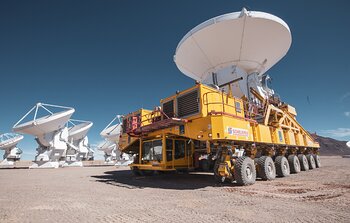
This photograph shows one of the 12-metre-diameter European antennas of the Atacama Large Millimeter/submillimeter Array (ALMA) being moved at the project’s Operations Support Facility. Since this photograph was taken, this antenna, and others like it, have been put into operation as ALMA has begun scientific observations with a partial array (see eso1137). Most recently, the Call for Proposals for ALMA’s next phase of observations closed on Thursday 12 July. Over 1100 proposals were received from astronomers around the world.
ALMA makes its observations on the Chajnantor plateau at an altitude of 5000 metres. Once construction is completed, ALMA will have an array of 66 high-precision 12-metre- and 7-metre-diameter antennas, spread over distances of up to 16 kilometres, working together as a single telescope at wavelengths of 0.32 to 3.6 millimetres. More than half of the 66 antennas are already on Chajnantor (see ann12035). Twenty-five ALMA antennas are being provided by ESO through a contract with the European AEM Consortium, 25 antennas are being provided by North America, and 16 by East Asia.
The antennas, each weighing about 100 tonnes, are assembled and tested at the Operations Support Facility, high in Chile’s Atacama region, at an altitude of 2900 metres. They are moved from there to the Chajnantor plateau, 5000 metres above sea level, with the help of two specially designed ALMA antenna transporters — huge vehicles that drive on 28 tyres, are 10 metres wide, 20 metres long and 6 metres high, weigh 130 tonnes, and have as much power as two Formula 1 engines. One of the transporters, named Otto, is being used in this photograph, which was taken when the first European antenna was handed over to the observatory in April 2011.
ALMA, an international astronomy facility, is a partnership of Europe, North America and East Asia in cooperation with the Republic of Chile. ALMA construction and operations are led on behalf of Europe by ESO, on behalf of North America by the National Radio Astronomy Observatory (NRAO), and on behalf of East Asia by the National Astronomical Observatory of Japan (NAOJ). The Joint ALMA Observatory (JAO) provides the unified leadership and management of the construction, commissioning and operation of ALMA.
The Cat's Paw Remastered
The Cat’s Paw Nebula is revisited in a combination of exposures from the MPG/ESO 2.2-metre telescope and expert amateur astronomers Robert Gendler and Ryan M. Hannahoe. The distinctive shape of the nebula is revealed in reddish puffy clouds of glowing gas against a dark sky dotted with stars.
The image was made by combining existing observations from the 2.2-metre MPG/ESO telescope of the La Silla Observatory in Chile (see ESO Photo Release eso1003) with 60 hours of exposures on a 0.4-metre telescope taken by Gendler and Hannahoe.
The resolution of the existing 2.2-metre MPG/ESO telescope observations was combined (by using their “luminance” or brightness) with the colour information from Gendler and Hannahoe’s observations to produce a beautiful combination of data from amateur and professional telescopes. For example, the additional colour information brings out the faint blue nebulosity in the central region, which is not seen in the original ESO image, while the ESO data contribute their finer detail. The result is an image that is much more than the sum of its parts.
The well-named Cat’s Paw Nebula (also known as NGC 6334) lies in the constellation of Scorpius (The Scorpion). Although it appears close to the centre of the Milky Way on the sky, it is relatively near to Earth, at a distance of about 5500 light-years. It is about 50 light-years across and is one of the most active star formation regions in our galaxy, containing massive, young brilliant blue stars, which have formed in the last few million years. It is host to possibly tens of thousands of stars in total, some of them visible and others still hidden in the clouds of gas and dust.
Links
An Oasis for Astronomers — ESO’s Paranal Residencia Then and Now
ESO turns fifty this year, and to celebrate this important anniversary, we are showing you glimpses into our history. Once a month during 2012, a special Then and Now comparison Picture of the Week shows how things have changed over the decades at the La Silla and Paranal Observatory sites, the ESO offices in Santiago de Chile, and the Headquarters in Garching bei München, Germany.
Since February 2002 (see eso0205), the Paranal Residencia has provided accommodation for people working shifts at ESO’s flagship observatory site. Paranal, in Chile’s Atacama Desert, is the home of ESO’s Very Large Telescope (VLT). This month, our Then and Now photographs — both taken by ESO Photo Ambassador Gerhard Hüdepohl — give us a unique view of how this oasis in the desert was built.
The historical photograph shows the Residencia under construction at the end of 2000. The building was designed by German architecture firm Auer+Weber, and is based around a subterranean L-shape. The building materials have the same colour as the desert, to help it blend into the landscape, and the partially completed central area of the Residencia is reminiscent of an amphitheatre, with stone tiers open to the cloudless sky.
Today, the Residencia looks quite different! Despite the subterranean location, the building’s distinctive design creates an interior with a feeling of open space. The central hall is protected by a 35-metre-wide glazed dome, which allows natural daylight into the building. The sterile amphitheatre of 2000 is reinvented as a lush tropical garden, with a pool at the bottom. Both the garden and the pool are designed to increase the humidity indoors, allowing staff some respite from the extremely arid conditions outside, in one of the driest places on Earth.
Thanks to the Residencia’s unique design, its fame has also spread beyond the astronomy community. For example, in 2008 the James Bond movie Quantum of Solace filmed key scenes here, with the Residencia playing the role of the “Perla de las Dunas” hotel [1]. In 2009, the Residencia was selected as one of the “top 10 buildings of the decade” by the UK’s Guardian newspaper (see ann0940), and in 2012, the Paranal Observatory, including the Residencia, was featured in Land Rover’s “Perfect Places” ad campaign (see ann12008).
Notes
[1] For more information about James Bond at Cerro Paranal see eso0807, eso0838, and http://www.eso.org/public/outreach/bond/BondatParanal.html
Links
- The historical image
- The present-day image
- Side-by-side composite of the historical and present-day images
- ESO Photo Ambassadors
Mars, 2099?
On a cold dark night on Mars, in the middle of an arid desert, a narrow road lit by artificial lights winds its way up to a lonely human outpost on the top of an old mountain. Or at least, that’s what a science fiction fan might make of this almost unearthly view.
The photograph actually shows ESO’s Paranal Observatory, home to the Very Large Telescope (VLT), on Earth. Nevertheless, it’s easy to imagine it as a future view of Mars, perhaps at the end of the century. Which is why Julien Girard, who took this photograph, calls it “Mars 2099”.
Located at 2600 metres altitude, ESO’s Paranal Observatory sits in one of the driest and most desolate areas on Earth, in Chile’s Atacama Desert. The landscape is so Martian, in fact, that the European Space Agency (ESA) and NASA test their Mars rovers in this region. For example, an ESA team recently tested the self-steering Seeker rover, as described in ann12048.
This image was taken at twilight, looking southwest towards the VLT, from the VISTA survey telescope on an adjacent peak. To the west lies the Pacific Ocean, only about 12 kilometres from Paranal. Rising up from the Paranal summit, the Milky Way can be seen, bearing the unmistakable mark of the southern sky — the asterism of the Southern Cross.
At Paranal, the skies can be so clear and dark on moonless nights, that the light from the Milky Way alone is enough to cast shadows. This is why ESO chose the site for the VLT, and why the observatory benefits from some of the best observing conditions in the world.
Julien Girard is an ESO astronomer based in Chile, who works at the VLT. He submitted this photograph to the Your ESO Pictures Flickr group. The Flickr group is regularly reviewed and the best photos are selected to be featured in our popular Picture of the Week series, or in our gallery. In 2012, as part of ESO’s 50th anniversary year, we are also welcoming your historical ESO-related images.
Links
- ESO announcement, “Self-steering Mars Rover tested at ESO’s Paranal Observatory”
- STFC press release, “Revolutionary navigation system for future Mars rovers”
- This photograph, with annotations, on Julien Girard’s Flickr photostream
- Julien Girard’s Flickr photostream
- The “Your ESO Pictures” Flickr group
- The "Your ESO Pictures" announcement
Yepun’s Laser and the Magellanic Clouds
One of the major enemies of astronomers is the Earth’s atmosphere, which makes celestial objects appear blurry when observed by ground-based telescopes. To counteract this, astronomers use a technique called adaptive optics, in which computer-controlled deformable mirrors are adjusted hundreds of times per second to correct for the distortion of the atmosphere.
This spectacular image shows Yepun [1], the fourth 8.2-metre Unit Telescope of ESO’s Very Large Telescope (VLT) facility, launching a powerful yellow laser beam into the sky. The beam creates a glowing spot — an artificial star — in the Earth’s atmosphere by exciting a layer of sodium atoms at an altitude of 90 km. This Laser Guide Star (LGS) is part of the VLT’s adaptive optics system. The light coming back from the artificial star is used as a reference to control the deformable mirrors and remove the effects of atmospheric distortions, producing astronomical images almost as sharp as if the telescope were in space.
Yepun’s laser is not the only thing glowing brightly in the sky. The Large and Small Magellanic Clouds can be seen, to the left and to the right of the laser beam, respectively. These nearby irregular dwarf galaxies are conspicuous objects in the southern hemisphere, and can be easily observed with the unaided eye. The prominent bright star to the left of the Large Magellanic Cloud is Canopus, the brightest star in the constellation Carina (The Keel), while the one towards the top-right of the image is Achernar, the brightest in the constellation Eridanus (The River).
This image was taken by Babak Tafreshi, an ESO Photo Ambassador.
Notes
[1] The VLT’s four Unit Telescopes are named after celestial objects in the indigenous Mapuche language, Mapudungun. The Unit Telescopes (UTs) are named: Antu (UT1, the Sun); Kueyen (UT2, the Moon); Melipal (UT3, the Southern Cross); and Yepun (UT4, Venus).
Links
#L
Cascading Milky Way
Many astronomical photographs capture stunning vistas of the skies, and this is no exception. However, there’s something unusual about this panorama. Behind ESO’s Very Large Telescope (VLT), two streams of stars seem to cascade down like waterfalls, or perhaps rise like smoke columns to the heavens. That’s because this panorama captures the entire dome of the sky, from the zenith down to the horizon, a full 360 degrees around. The two streams are in fact a single band: the plane of our galaxy, the Milky Way, as it arcs across the sky from horizon to horizon. As it passes overhead, it appears to spread out across the whole top edge of the panorama, due to the distortion needed to squeeze the full dome of the sky into a flat, rectangular image.
To understand the picture, imagine that the far left side is attached to the far right, creating a loop around you, and that the top edge is drawn together to a single point overhead. Thus, it encompasses the full dome of the sky above you.
On the left side of the image, the silhouette of the observatory’s windsock on its pole can be seen above the building. To the left of the windsock is the bright smudge of the Small Magellanic Cloud, a neighbouring galaxy of the Milky Way. To the right, in the plane of the Milky Way, is the reddish glow of the Carina Nebula. Above that is the darkness of the Coalsack Nebula, next to the Southern Cross, and slightly higher still are the two bright stars of Alpha and Beta Centauri. The four tall buildings in the image house the 8.2-metre-diameter Unit Telescopes (UTs) of the VLT. Between the two UTs on the right is the smaller building of the VLT Survey Telescope. On the right of the image, the planet Venus glows just above the horizon.
This panorama, which shows not only the VLT on the mountaintop of Cerro Paranal, but also the beautiful sky that the observatory studies, was created by ESO Photo Ambassador Serge Brunier. Just as the VLT’s state-of-the-art technology expands our view of the Universe, Serge has used the most advanced photographic techniques to capture an entire hemisphere of the sky in one image — far more than our eyes could see in a single view.
Links
Computing at ESO Through the Ages — The amazing advance of technology
ESO turns fifty this year, and to celebrate this important anniversary, we are showing you glimpses into our history. Once a month during 2012, a special Then and Now comparison Picture of the Week shows how things have changed over the decades at the La Silla and Paranal Observatory sites, the ESO offices in Santiago de Chile, and the Headquarters in Garching bei München, Germany.
Our pair of photographs this month show how the computing power used by ESO has changed dramatically over time. Both photographs show Austrian astronomer Rudi Albrecht in front of ESO’s computer systems, but on dates separated by decades.
In the historical image, taken in 1974 in the ESO offices in Santiago, Chile, we can see Albrecht, pencil in hand, poring over code in front of a teletype. He was working on software for the Spectrum Scanner attached to the ESO 1-metre telescope [1] located at the La Silla Observatory. The data were processed in Santiago using the Hewlett Packard 2116 minicomputer which can be seen behind the printer. This bulky computer, with one processor and a breathtaking 16 kilobytes of magnetic-core memory (!), stored the results on magnetic tape, ready for further processing by visiting astronomers on computers at their home institutes. To handle files on tape that were larger than the available memory, Albrecht developed a virtual memory system, which he contributed to the Hewlett Packard Software Center.
The present-day photograph shows Albrecht in the Data Centre at ESO Headquarters in Garching bei München, Germany, which archives and distributes data from ESO’s telescopes. He is in front of a rack containing a system with 40 processor cores, 138 terabytes of storage capacity and 83 gigabytes of RAM — over 5 million times more than the machine used by him back in 1974! Even the tablet computer he is holding far outperforms the older machine, and provides a modern alternative to pencil and paper.
Over the years, ESO’s computing systems have developed to handle the flood of scientific data from the observatory’s telescopes. Advances in telescope, detector, and computer technology mean that observatories now produce massive quantities of images, spectra, and catalogues. For instance, the two survey telescopes at Paranal, the VST and VISTA, together produce over 100 terabytes of data per year. It’s a far cry from the days of magnetic tape and 16 kilobytes of memory!
Notes
[1] The ESO 1-metre telescope was decommissioned in 1994.
The Southern Milky Way Above ALMA
ESO Photo Ambassador Babak Tafreshi snapped this remarkable image of the antennas of the Atacama Large Millimeter/submillimeter Array (ALMA), set against the splendour of the Milky Way. The richness of the sky in this picture attests to the unsurpassed conditions for astronomy on the 5000-metre-high Chajnantor plateau in Chile’s Atacama region.
This view shows the constellations of Carina (The Keel) and Vela (The Sails). The dark, wispy dust clouds of the Milky Way streak from middle top left to middle bottom right. The bright orange star in the upper left is Suhail in Vela, while the similarly orange star in the upper middle is Avior, in Carina. Of the three bright blue stars that form an “L” near these stars, the left two belong to Vela, and the right one to Carina. And exactly in the centre of the image below these stars gleams the pink glow of the Carina Nebula (eso1208).
ESO, the European partner in ALMA, is providing 25 of the 66 antennas that will make up the completed telescope. The two antennas closest to the camera, on which the careful viewer can find the markings “DA-43” and “DA-41”, are examples of these European antennas. Construction of the full ALMA array will be completed in 2013, but the telescope is already making scientific observations with a partial array of antennas.
Babak Tafreshi is founder of The World At Night, a programme to create and exhibit a collection of stunning photographs and time-lapse videos of the world’s most beautiful and historic sites against a night-time backdrop of stars, planets and celestial events.
ALMA, an international astronomy facility, is a partnership of Europe, North America and East Asia in cooperation with the Republic of Chile. ALMA construction and operations are led on behalf of Europe by ESO, on behalf of North America by the National Radio Astronomy Observatory (NRAO), and on behalf of East Asia by the National Astronomical Observatory of Japan (NAOJ). The Joint ALMA Observatory (JAO) provides the unified leadership and management of the construction, commissioning and operation of ALMA.
#L
Icy Penitents by Moonlight on Chajnantor
Babak Tafreshi, one of the ESO Photo Ambassadors, has captured a curious phenomenon on the Chajnantor plateau, the site of the Atacama Large Millimeter/submillimeter array (ALMA).
These bizarre ice and snow formations are known as penitentes (Spanish for “penitents”). They are illuminated by the light of the Moon, which is visible on the right on the photograph. On the left, higher in the sky, the Large and Small Magellanic Clouds can be faintly seen, while the reddish glow of the Carina Nebula appears close to the horizon on the far left.
The penitentes are natural marvels found in high-altitude regions, such as here in the Chilean Andes, typically more than about 4000 metres above sea level. They are thin spikes and blades of hardened snow or ice, which often form in clusters, with their blades pointing towards the Sun. They attain heights ranging from a few centimetres, resembling low grass, up to five metres, giving an impression of an ice forest in the middle of the desert.
The precise details of the mechanism that forms the penitentes are still not completely understood. For many years, people of the Andes believed the penitentes to be the result of strong winds prevalent in the Andes mountains. However, the strong winds have only a limited role in shaping these icy pinnacles. Nowadays, it is believed that they are the product of a combination of physical phenomena.
The process begins with sunlight shining on the surface of the snow. Due to the very dry conditions in these desert regions, the ice sublimes rather than melts — it goes from solid to gas without melting and passing through a liquid water phase. Surface depressions in the snow trap reflected light, leading to more sublimation and deeper troughs. Within these troughs, increased temperature and humidity means that melting can occur. This positive feedback accelerates the growth of the characteristic structure of the penitentes.
These icy statues are named after the spiked hats of the nazarenos, members of a brotherhood that participates in Easter processions around the world. It is not hard to picture them as an assembly of icy monks, congregating in the moonlight.
The image was taken by the side of the road that leads to ALMA. The observatory, which started Early Science operations on 30 September 2011, will eventually consist of 66 high-precision antennas operating together as a single giant telescope.
ALMA, an international astronomy facility, is a partnership of Europe, North America and East Asia in cooperation with the Republic of Chile. ALMA construction and operations are led on behalf of Europe by ESO, on behalf of North America by the National Radio Astronomy Observatory (NRAO), and on behalf of East Asia by the National Astronomical Observatory of Japan (NAOJ). The Joint ALMA Observatory (JAO) provides the unified leadership and management of the construction, commissioning and operation of ALMA.
Links
#L
Getting the VLT Ready for Even Sharper Images
This picture shows one of ESO’s Very Large Telescope (VLT) Unit Telescopes (UT4) whilst it was recently briefly held prisoner by ESO’s engineers. It was surrounded by a temporary cage of scaffolding as part of the preparations for the new Adaptive Optics Facility (AOF). This project will convert UT4 into a fully adaptive telescope. The AOF will correct for the blurring effects of the Earth’s atmosphere and will allow much sharper images to be achieved with the HAWK-I and MUSE instruments.
Many new components are being added to UT4 as part of the AOF. Among these is the deformable secondary mirror (DSM): a thin-shell mirror, 1.1 metres in diameter, but just 2 millimetres thick. This mirror is thin enough to be easily deformed by more than a thousand actuators, up to a thousand times per second in order to counteract the atmosphere’s distortions. The DSM is the largest adaptive mirror manufactured to date (ann12015). Another vital element is the four Laser Guide Star Facility (4LGSF) — four special telescopes that fire laser beams high into the atmosphere to create artificial stars [1] (ann12012). Finally, the GRAAL and GALACSI adaptive optics modules will be responsible for analysing the light coming back from the laser guide stars.
This picture shows an ESO engineer supervising the work performed on UT4. To allow full access to the telescope, the cell of the primary mirror has been temporarily removed. Cables and pipes have also been removed and new ones have been installed. Mounting brackets have been added in preparation for the installation of the 4LGSF electronic cabinets and launch telescopes.
Notes
[1] The laser beams excite a layer of sodium atoms at an altitude of 90 kilometres in the atmosphere, making them glow as artificial stars.
Three Very Different Telescopes at La Silla
ESO turns fifty this year, and to celebrate this important anniversary, we are showing you glimpses into its history. Once a month during 2012, a special Then and Now Picture of the Week shows how things have changed over the decades at the La Silla and Paranal observatory sites, the ESO offices in Santiago de Chile, and the Headquarters in Garching bei München, Germany.
These two photographs were taken on the highest peak of La Silla, a mountain with an altitude of 2400 metres, at the edge of the Chilean Atacama Desert. La Silla was ESO’s first observatory site. The historical photograph, taken in 1975, shows some of the trucks and other equipment used for the construction of the dome of the ESO 3.6-metre telescope, which was underway behind the photographer. On the left are the water tanks for the site.
In the modern-day photograph, three new telescopes have appeared, all looking very different from each other. To the right of the water tanks is the ESO New Technology Telescope (NTT), which had its first light on 23 March 1989. This 3.58-metre telescope was the first ever to have a computer-controlled main mirror, which could adjust its shape during observations to optimise image quality. The octagonal enclosure housing the NTT is another technological breakthrough, ventilated by a system of flaps that makes air flow smoothly across the mirror, reducing turbulence and leading to sharper images.
To the right of the NTT is the Swiss 1.2-metre Leonhard Euler Telescope, which has a more traditional dome-shaped enclosure. It is operated by the Geneva Observatory at the Université de Genève in Switzerland, and had its first light on 12 April 1998. It is used to search for exoplanets in the southern sky; with its first discovery being a planet in orbit around the star Gliese 86 (see eso9855). The telescope also observes variable stars, gamma-ray bursts and active galactic nuclei.
In the foreground on the right is a building nicknamed the sarcofago (sarcophagus). This houses the TAROT (Télescope à Action Rapide pour les Objets Transitoires, or Rapid Action Telescope for Transient Objects), which started work at La Silla on 15 September 2006. This fast moving, relatively tiny 25-centimetre robotic telescope reacts extremely quickly to alerts from satellites about gamma-ray bursts, to pinpoint the positions of these dramatic but fleeting events. Observing these cosmic explosions lets astronomers study the formation of black holes and the evolution of stars in the early Universe. TAROT is operated by a consortium led by Michel Boër from Observatoire de Haute Provence in France.
The NTT is operated by ESO, while the Leonhard Euler Telescope and TAROT are among the national and project telescopes hosted at La Silla. Even today, over 40 years after its inauguration, La Silla remains at the forefront of astronomy.
Links
- The historical image
- The present-day image
- Side-by-side composite of the historical and present-day images
- More about La Silla
- Press release on the occasion of the 40th anniversary, in 2009, of La Silla’s inauguration
- ESO timeline
Sun, Moon and Telescopes above the Desert
The otherworldly beauty of Chile’s Atacama Desert, home of ESO’s Very Large Telescope (VLT), stretches to the horizon in this panorama. On Cerro Paranal, the highest peak in the centre of this image, are the four giant Unit Telescopes of the VLT, each of which has a mirror with a diameter of 8.2 metres. On the peak to the left of Cerro Paranal is the VISTA survey telescope. This 4.1-metre telescope surveys broad swathes of the heavens, searching for interesting targets which the VLT, as well as other telescopes on the ground and in space, will study in greater detail.
This region offers some of the best conditions for viewing the night sky found anywhere on our planet. On the right of this 360-degree panorama, the Sun is setting over the Pacific Ocean, throwing long shadows across the mountainscape. On the left, the Moon gleams in the sky. Soon, the night’s observations will begin.
This wonderful panorama was made by Serge Brunier, an ESO Photo Ambassador. It is one of many awe-inspiring images in which he captures ESO’s observatories, their beautiful locations, and the splendour of the skies above them.
Links
The Moon and the Arc of the Milky Way
ESO Photo Ambassador Stéphane Guisard captured this astounding panorama from the site of ALMA, the Atacama Large Millimeter/submillimeter Array, in the Chilean Andes. The 5000-metre-high and extremely dry Chajnantor plateau offers the perfect place for this state-of-the-art telescope, which studies the Universe in millimetre- and submillimetre-wavelength light.
Numerous giant antennas dominate the centre of the image. When ALMA is complete, it will have a total of 54 of these 12-metre-diameter dishes. Above the array, the arc of the Milky Way serves as a resplendent backdrop. When the panorama was taken, the Moon was lying close to the centre of the Milky Way in the sky, its light bathing the antennas in an eerie night-time glow. The Large and Small Magellanic Clouds, the biggest of the Milky Way's dwarf satellite galaxies, appear as two luminous smudges in the sky on the left. A particularly bright meteor streak gleams near the Small Magellanic Cloud.
On the right, some of ALMA’s smaller 7-metre antennas — twelve of which will be used to form the Atacama Compact Array — can be seen. Still further on the right shine the lights of the Array Operations Site Technical Building. And finally, looming behind this building is the dark, mountainous peak of Cerro Chajnantor.
ALMA, an international astronomy facility, is a partnership of Europe, North America and East Asia in cooperation with the Republic of Chile. ALMA construction and operations are led on behalf of Europe by ESO, on behalf of North America by the National Radio Astronomy Observatory (NRAO), and on behalf of East Asia by the National Astronomical Observatory of Japan (NAOJ). The Joint ALMA Observatory (JAO) provides the unified leadership and management of the construction, commissioning and operation of ALMA.
Links
APEX Stands Sentry on Chajnantor
The Atacama Pathfinder Experiment (APEX) telescope looks skyward during a bright, moonlit night on Chajnantor, one of the highest and driest observatory sites in the world. Astronomical treasures fill the sky above the telescope, a testament to the excellent conditions offered by this site in Chile’s Atacama region.
On the left shine the stars that make up the tail of the constellation of Scorpius (The Scorpion). The scorpion’s “stinger” is represented by the two bright stars that are particularly close to each other. Reaching across the sky and looking like a band of faint, glowing clouds is the plane of the Milky Way.
Between Scorpius and the next constellation to the right, Sagittarius (The Archer), which looms over APEX’s dish, a sparkling cluster of stars can be clearly seen. This is the open cluster Messier 7, also known as Ptolemy’s Cluster. Below Messier 7 and slightly to the right is the Butterfly Cluster, Messier 6. Further to the right, just above the edge of APEX’s dish, is a faint cloud which looks like a bright smudge. This is the famous Lagoon Nebula (see eso0936 for a closer view).
With a primary dish diameter of 12 metres, APEX is the largest single-dish submillimetre-wavelength telescope operating in the southern hemisphere. As the telescope’s name suggests, it is blazing a trail for the biggest submillimetre observatory in the world, the Atacama Large Millimeter/submillimeter Array (ALMA), which will be completed in 2013 (eso1137). APEX will share space with the 66 antennas of ALMA on the 5000-metre-high Chajnantor plateau in Chile. The APEX telescope is based on a prototype antenna constructed for the ALMA project, and it will find many targets that ALMA will be able to study in great detail.
ESO Photo Ambassador Babak Tafreshi made this panorama using a telephoto lens. Babak is also the founder of The World At Night, a programme to create and exhibit a collection of stunning photographs and time-lapse videos of the world’s most beautiful and historic sites against a nighttime backdrop of stars, planets and celestial events.
More information
APEX is a collaboration between the Max-Planck-Institut für Radioastronomie (MPIfR), the Onsala Space Observatory (OSO), and ESO, with operations of the telescope entrusted to ESO.
ALMA, an international astronomy facility, is a partnership of Europe, North America and East Asia in cooperation with the Republic of Chile. ALMA construction and operations are led on behalf of Europe by ESO, on behalf of North America by the National Radio Astronomy Observatory (NRAO), and on behalf of East Asia by the National Astronomical Observatory of Japan (NAOJ). The Joint ALMA Observatory (JAO) provides the unified leadership and management of the construction, commissioning and operation of ALMA.
Links
#L
All Around Chajnantor — A 360-degree panorama
Although Cerro Chico reaches the remarkable altitude of 5300 metres above sea level, it is only a small mountain in the majestic landscape of the Andean plateaux. Indeed, its own name means simply “small mountain” in Spanish. However, due to its position on the plateau of Chajnantor, the top of Cerro Chico offers an excellent and relatively easy-to-reach vantage point from which to enjoy this stunning view.
This 360-degree panoramic picture is centred on the northeast, where the highest volcanoes — most of them above 5500 metres — are seen. In the centre is Cerro Chajnantor itself. To the right, on the plateau, is the Atacama Pathfinder Experiment (APEX) telescope with Cerro Chascon behind it. Further to the right, to the southeast, the Chajnantor plateau is almost fully visible. In addition to the APEX telescope, three Atacama Large Millimeter/submillimeter Array (ALMA) antennas can be seen, on the right. Many more have been added since this panorama was taken.
On the left of Cerro Chajnantor is Cerro Toco. Further to the left, in the northwest, we can see the distinctive conical shape of Licancabur volcano.
On the Chajnantor plateau, at 5000 metres altitude, the air is so thin and dry that it seems never to fill one’s lungs. Thanks to these extreme conditions, the millimetre and submillimetre radiation coming from the rest of the Universe can pass through what remains of the Earth’s atmosphere above the site, and can be detected from the ground with suitably sensitive telescopes such as ALMA and APEX.
APEX is a collaboration between the Max Planck Institute for Radio Astronomy (MPIfR), the Onsala Space Observatory (OSO) and ESO. The telescope is operated by ESO.
ALMA, an international astronomy facility, is a partnership of Europe, North America and East Asia in cooperation with the Republic of Chile. ALMA construction and operations are led on behalf of Europe by ESO, on behalf of North America by the National Radio Astronomy Observatory (NRAO), and on behalf of East Asia by the National Astronomical Observatory of Japan (NAOJ). The Joint ALMA Observatory (JAO) provides the unified leadership and management of the construction, commissioning and operation of ALMA.
Links
- This panorama, and others, can be seen as part of a stunning virtual tour of Chajnantor
- More ESO virtual tours
La Silla, the First Home for ESO’s Telescopes — ESO’s first observatory site Then and Now
ESO turns fifty this year, and to celebrate this important anniversary, we are showing you glimpses into our history. Once a month during 2012, a special Then and Now comparison Picture of the Week shows how things have changed over the decades at the La Silla and Paranal Observatory sites, the ESO offices in Santiago de Chile, and the Headquarters in Garching bei München, Germany.
This historical image was taken around 1970 from the La Silla dormitories, located lower on the mountain than the telescope domes. The photo looks up towards the highest point of the mountain, on the left. The metallic structure visible near the top of this peak is not a telescope, but a water tank for the site. The white dome in the centre of the image is that of the ESO 1-metre Schmidt telescope, which started work in February 1972. On the far right of the image is the ESO 1-metre telescope, just visible over the ridge, and to the left of that one can just see the top of the Grand Prisme Objectif telescope.
In the present-day photograph, the dormitory buildings remain, but more have been built over the decades. The most striking changes, though, are visible around La Silla’s peak on the left. At the highest point is the ESO 3.6-metre telescope, which started operating in November 1976 and is still in use today. The 3.6-metre is home to HARPS, the foremost exoplanet hunter (see eso1134 and eso1214 for some recent results). The 3.6-metre, planned from the inception of ESO, was to crown the La Silla Observatory as its biggest telescope, and was a major engineering feat of its time. The smaller dome visible in front of the 3.6-metre is the 1.4-metre Coudé Auxiliary Telescope, which complemented its bigger neighbour.
To the right of the 3.6-metre is the 3.58-metre New Technology Telescope (NTT), recognisable by the angular, metallic appearance of its enclosure. The NTT, which started operating in March 1989, was the first telescope in the world to use a computer-controlled mirror. It was used as a precursor for the Very Large Telescope, to test many new technologies that were then used in the later telescope.
Other new sights in the modern-day photograph are the workshop building below the water tanks, and the Differential Image Motion Monitor (DIMM), used to measure the atmospheric seeing, located on stilts between the workshop and the ESO 1-metre Schmidt telescope.
Even today, La Silla remains a very active observatory where important discoveries are made. Both the NTT and the 3.6-metre telescope provided vital data which led to the discovery of the accelerating expansion of the Universe — a discovery for which the 2011 Nobel Prize in Physics was awarded.
Links
- The historical image
- The present-day image
- Side-by-side composite of the historical and present-day images
- More about La Silla
- Press release on the occasion of the 40th anniversary, in 2009, of La Silla’s inauguration
- ESO timeline
Wish You Were Here?
French photographer Serge Brunier — one of ESO’s Photo Ambassadors — has created this seamless 360-degree panorama of the Chajnantor plateau in the Atacama Desert, where the Atacama Large Millimeter/submillimeter Array (ALMA) is under construction.
The panorama projection has slightly warped the shapes of the ALMA antennas, but it still gives a sense of what it would be like to stand in the middle of this impressive new observatory. The 360-degree view also demonstrates the complete isolation of the Chajnantor plateau; at an altitude of 5000 metres, the backdrop is almost featureless, except for a few mountain peaks and hilltops.
Although constructing such an ambitious telescope project in a remote and harsh environment is challenging, the high altitude location is perfect for submillimetre astronomy. That’s because water vapour in the atmosphere absorbs this type of radiation, but the air is much drier at high altitude sites such as Chajnantor.
ALMA started its first scientific observations on 30 September 2011 with a partial array of antennas. When the observatory is completed, the impressive sight of fifty 12-metre antennas — as well as a smaller array of four 12-metre and twelve 7-metre antennas, known as the Atacama Compact Array (ACA) — will make the isolated landscape seem slightly less empty. In the meantime, photographs like this one are documenting the progress of a new world-class telescope facility.
ALMA, an international astronomy facility, is a partnership of Europe, North America and East Asia in cooperation with the Republic of Chile. ALMA construction and operations are led on behalf of Europe by ESO, on behalf of North America by the National Radio Astronomy Observatory (NRAO), and on behalf of East Asia by the National Astronomical Observatory of Japan (NAOJ). The Joint ALMA Observatory (JAO) provides the unified leadership and management of the construction, commissioning and operation of ALMA.
Links
The VLT goes lion hunting
The Very Large Telescope has captured another member of the Leo I group of galaxies, in the constellation of Leo (The Lion). The galaxy Messier 95 stands boldly face-on, offering an ideal view of its spiral structure. The spiral arms form an almost perfect circle around the galactic centre before they spread out, creating a mane-like effect of which any lion would be proud.
Another, perhaps even more striking, feature of Messier 95 is its blazing golden core. It contains a nuclear star-forming ring, almost 2000 light-years across, where a large proportion of the galaxy’s star formation takes place. This phenomenon occurs mostly in barred spiral galaxies such as Messier 95 and our home, the Milky Way.
In the Leo I group, Messier 95 is outshone by its brother Messier 96 (see potw1143). Messier 96 is in fact the brightest member of the group and — as “leader of the pride” — also gives Leo I its alternative name of the M 96 group. Nevertheless, Messier 95 also makes for a spectacular image.
Stop press! By coincidence Messier 95 is the host of a probable supernova that was first spotted on 17 March 2012. Discovery details are here. And as another coincidence both supernova and galaxy are currently very close to the brilliant planet Mars amongst the stars of Leo. Please note that the observations used to make this Picture of the Week were taken before the supernova occurred, and therefore the supernova itself does not appear in this image.