La Silla Observatory
ESO's first observatory

ESO's La Silla Observatory is located on the outskirts of the Chilean Atacama Desert, 600 km north of Santiago de Chile and at an altitude of 2400 metres. Like other observatories in this geographical area, La Silla is located far from sources of light pollution and, like the Paranal Observatory, home to the Very Large Telescope, it has one of the darkest night skies on the Earth. La Silla has been an ESO stronghold since the 1960s. Here, ESO operates two of the most productive 4-metre class telescopes in the world.
The 3.58-metre New Technology Telescope (NTT) broke new ground for telescope engineering and design and was the first in the world to have a computer-controlled main mirror (active optics), technology developed at ESO and now applied to most of the world's current large telescopes.
The ESO 3.6-metre telescope is now home to the world's foremost extrasolar planet hunter: High Accuracy Radial velocity Planet Searcher (HARPS), a spectrograph with unrivalled precision.
The La Silla Observatory is the first world-class observatory to have been granted certification for the International Organization for Standardization (ISO) 9001 Quality Management System.
The infrastructure of La Silla is also used by many of the ESO Member States for targeted projects such as the BlackGEM and the ExTrA exoplanet searcher, as well as more established facilities such as the MPG/ESO 2.2-metre telescope. The 67-million pixel Wide Field Imager on the MPG/ESO 2.2-metre Telescope has taken many amazing images of celestial objects, some of which have now become icons in their own right.
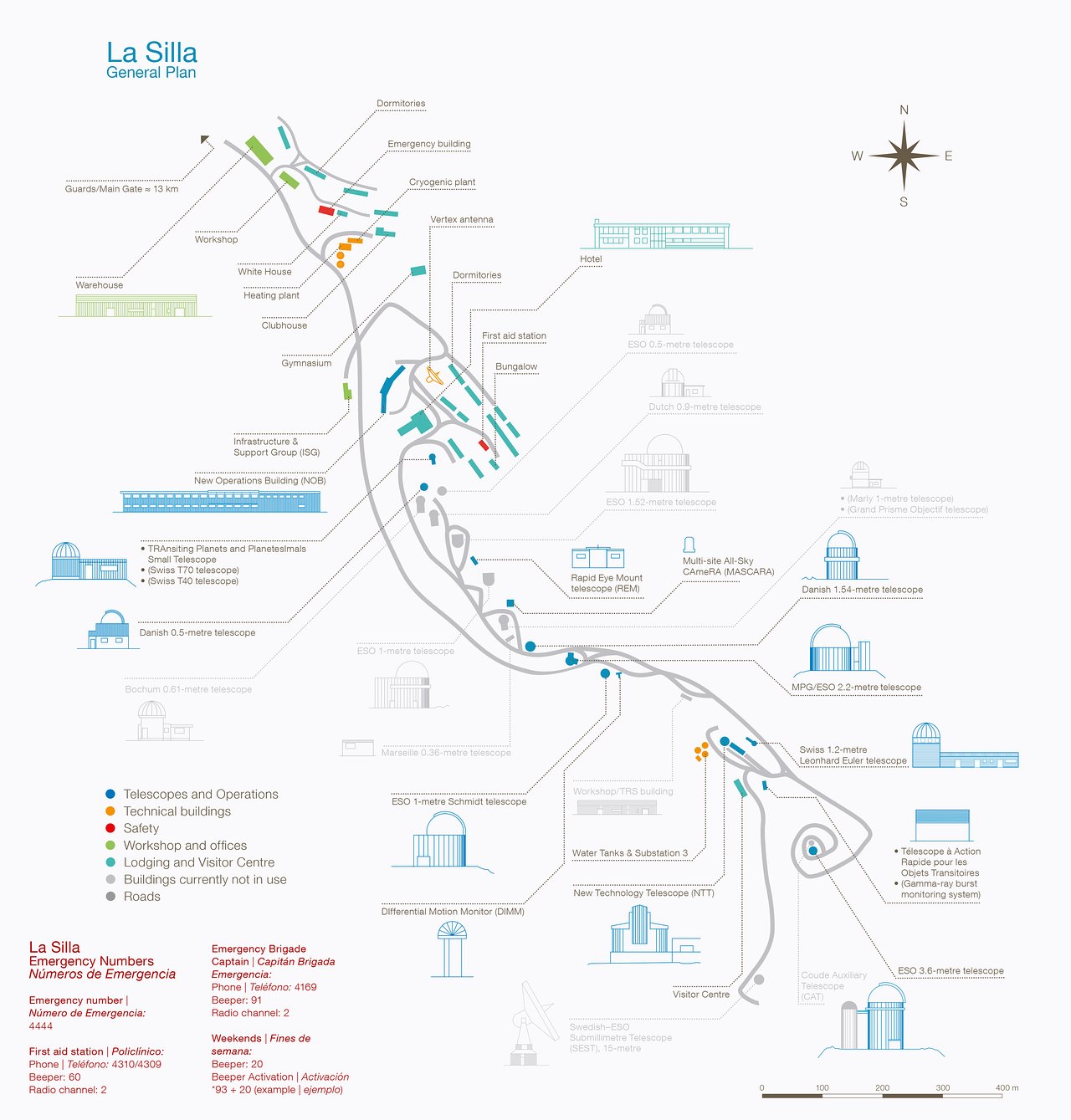
A tour of the La Silla Observatory
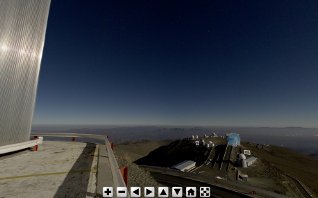
Click on the image to take a Virtual Tour in and nearby La Silla.
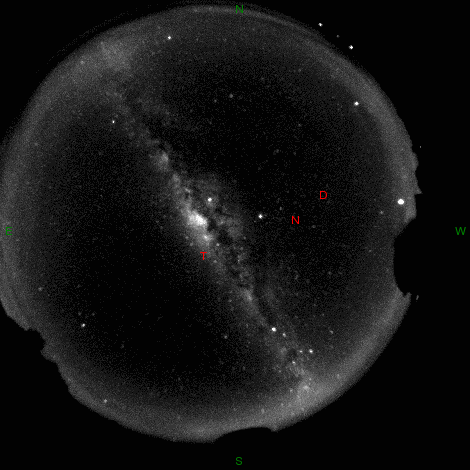
Chile night time only! During the day the webcam shows the last frame before sunrise. The red letters indicate telescopes that are observing right now (T—the ESO 3.6-metre telescope, N— New Technology Telescope and D—the MPG/ESO 2.2-metre telescope). Please, see more on La Silla - All Sky Camera.
Visit the La Silla Observatory
- Journalists, science writers and producers, please see Media Visits
- Tourist, students and lay people, please see the Weekend Visits page
Science with the Telescopes at La Silla
 Over the years, telescopes at La Silla have led to an enormous number of scientific discoveries, including several "firsts". The HARPS spectrograph, in particular, has made remarkable findings, including detecting the first rocky exoplanet in the habitable zone of its star and finding planets orbiting Proxima Centauri, the star closest to the Sun.
Several telescopes at La Silla played a crucial role in the field gamma-ray bursts — the most energetic explosions in the Universe since the Big Bang. Moreover, La Silla has played an important role in the study and follow-up of the nearest recent supernova, SN 1987A.
More about Science at La Silla
- Science with ESO Telescopes
- Some of the ESO Top 10 Astronomical Discoveries were done using telescopes on La Silla
More about La Silla Observatory
- More images and videos are available in the ESO multimedia archive.
- Exhibition panels for download
- For Scientists: for more detailed information, please see our technical pages
La Silla Observatory Timelapse
La Silla Compilation
Download the La Silla compilation in the video archive.
Telescopes currently operated by ESO
|
Decommissioned La Silla telescopes
|
Stars form in dense clouds of the interstellar medium, but even in these densest regions the pressure is comparable to the most tenuous vacuum created in a laboratory on Earth. In these clouds, the temperatures are below -200 degrees Celsius.