Picture of the Week 2013 
The Comet and the Laser
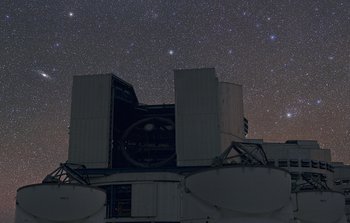
Gerhard Hüdepohl, one of the ESO Photo Ambassadors, captured this spectacular image of ESO’s Very Large Telescope (VLT) during the testing of a new laser for the VLT 14 February 2013. It will be used as a vital part of the Laser Guide Star Facility (LGSF), which allows astronomers to correct for most of the disturbances caused by the constant movement of the atmosphere in order to create much sharper images. Nevertheless, is hard not to think of it as a futuristic laser cannon being pointed towards some kind of distant space invader.
As well as the amazing view of the Milky Way seen over the telescope, there is another feature making this picture even more special. To the right of the centre of the image, just below the Small Magellanic Cloud and almost hidden among the myriad stars seen in the dark Chilean sky, there is a green dot with a faint tail stretching to its left. This is the recently discovered and brighter-than-expected Comet Lemmon, which is currently moving slowly through the southern skies.
Super-thin Mirror Under Test at ESO
This remarkable deformable thin-shell mirror has been delivered to ESO at Garching, Germany and is shown undergoing tests. It is 1120 millimetres across but just 2 millimetres thick, making it much thinner than most glass windows. The mirror is very thin so that it is flexible enough for magnetic forces applied to it to alter the shape of its reflective surface. When in use, the mirror's surface will be constantly changed by tiny amounts to correct for the blurring effects of the Earth’s atmosphere and so create much sharper images.
The new deformable secondary mirror (DSM) will replace the current secondary in one of the VLT’s four Unit Telescopes. The entire secondary structure includes a set of 1170 actuators that apply a force on 1170 magnets glued to the back face of the thin shell. Sophisticated special-purpose electronics control the behaviour of the thin shell mirror. The reflecting surface can be deformed up to a thousand times per second by the action of the actuators.
The complete DSM system was delivered to ESO by the Italian companies Microgate and ADS in December 2012 and concludes eight years of sustained development efforts and manufacturing. This is the largest deformable mirror ever produced for astronomical purposes and is the latest of a long line of such mirrors. The extensive experience of these contractors shows in the high performance of the system and its reliability. The installation on the VLT is scheduled to start in 2015.
The shell mirror (ann12015) itself was manufactured by the French company REOSC. It is a sheet of ceramic material that has been polished to a very accurate shape. The manufacturing process starts with a block of Zerodur ceramic, provided by Schott Glass (Germany) that is more than 70 millimetres thick. Most of this material is ground away to create the final thin shell that must be carefully supported at all times as it is extremely fragile.
Links
- The Adaptive Optics Department at ESO
- Booklet on the Adaptive Optics Facility (AOF) at ESO (PDF file)
- Microgate
- ADS
- REOSC
- Schott Glass
Laser and Light Painting
On a clear night in Bavaria, ESO staff attended the filming of an ESOcast episode focusing on ESO’s new compact laser guide star unit, seen here in action at the Allgäu Public Observatory in Ottobeuren, Germany. Using the glow from their mobile phones, staff took advantage of the long-exposure photograph to draw the letters “ESO” in light, while standing in front of the observatory. Just left of the vertical laser beam, the Milky Way can be seen. Just above the horizon over the observatory, the dotted tracks of aircraft can be seen in the distance. The laser has a powerful beam of 20 watts, and to protect pilots and passengers a no-fly zone around the observatory was created by the Deutsche Flugsicherung (responsible for air traffic control in Germany) during the nighttime observing hours.
Laser guide stars are artificial stars created in the Earth’s atmosphere using a laser beam. The laser makes the sodium atoms in a layer 90 kilometres up in the atmosphere glow and so creates an artificial star in the sky that can be observed by a telescope. Using measurements of the artificial star, adaptive optics instruments can then correct the blurring effect of the atmosphere in the observations.
ESO’s innovative concept uses a powerful laser whose beam is launched with a small telescope, combined into a single modular unit which can be mounted directly on a large telescope. The concept, which has been patented and licensed by ESO, will be used to provide the Very Large Telescope (VLT) with four similar laser units. It will also play a key role in the units that will equip the future European Extremely Large Telescope (E-ELT).
At the time of filming, the unit was undergoing testing before being shipped to the ESO Paranal Observatory in Chile, home of the VLT.
Links
- ESOcast episode on Laser Guide Stars
- More about the ESO Wendelstein Laser Guide Star unit
- More about the Allgäu Public Observatory
Sunset at Paranal Observatory
Babak Tafreshi, an ESO Photo Ambassador, has captured a beautiful image of ESO’s Paranal Observatory illuminated by the sunset. The beautifully clear sky hints at the exceptional atmospheric conditions here; one major reason why ESO chose Paranal as the site of the Very Large Telescope (VLT), its flagship facility.
The VLT — which can be seen on Cerro Paranal, the highest peak in the image, with an altitude of 2600 metres — is the world’s most advanced visible-light astronomical observatory. It consists of four Unit Telescopes, each with a primary mirror 8.2 metres across, and four 1.8-metre Auxiliary Telescope.. The VLT operates at visible and infrared wavelengths and among the pioneering observations carried out using the VLT have been the first direct image of an exoplanet (see eso0515) and the tracking of stars orbiting the Milky Way’s central black hole (see eso0846 and eso1151).
Also on Cerro Paranal is the VLT Survey Telescope (VST). Its smaller enclosure can just be made out in front of one of the larger VLT Unit Telescope enclosures on the mountaintop. The VST is the most recent addition to Paranal, with the first images released in 2011 (see eso1119). It sports a primary mirror 2.6 metres across, which makes it the largest telescope in the world designed for surveying the sky in visible light.
Another survey telescope at the Paranal Observatory is VISTA, the Visible and Infrared Survey Telescope for Astronomy, which can be seen on another peak, in the foreground of Cerro Paranal. VISTA is the world’s largest survey telescope, with a 4.1-metre mirror, and operates at near-infrared wavelengths. The telescope started work in 2009 (see eso0949).
Links
- More about the Very Large Telescope
- More about the survey telescopes at Paranal
- ESO Photo Ambassadors
An Intergalactic Heavyweight
This deep-field image shows what is known as a supercluster of galaxies — a giant group of galaxy clusters which are themselves clustered together. This one, known as Abell 901/902, comprises three separate main clusters and a number of filaments of galaxies, typical of such super-structures. One cluster, Abell 901a, can be seen above and just to the right of the prominent red foreground star near the middle of the image. Another, Abell 901b, is further to the right of Abell 901a, and slightly lower. Finally, the cluster Abell 902 is directly below the red star, towards the bottom of the image.
The Abell 901/902 supercluster is located a little over two billion light-years from Earth, and contains hundreds of galaxies in a region about 16 million light-years across. For comparison, the Local Group of galaxies — which contains our Milky Way among more than 50 others — measures roughly ten million light-years across.
This image was taken by the Wide Field Imager (WFI) camera on the MPG/ESO 2.2-metre telescope, located at the La Silla Observatory in Chile. Using data from the WFI and from the NASA/ESA Hubble Space Telescope, in 2008 astronomers were able to precisely map the distribution of dark matter in the supercluster, showing that the clusters and individual galaxies which comprise the super-structure reside within vast clumps of dark matter. To do this, astronomers looked at how the light from 60 000 faraway galaxies located behind the supercluster was being distorted by the gravitational influence of the dark matter it contains, thus revealing its distribution. The mass of the four main dark matter clumps of Abell 901/902 is thought to be around ten trillion times that of the Sun.
The observations shown here are part of the COMBO-17 survey, a survey of the sky undertaken in 17 different optical filters using the WFI camera. The COMBO-17 project has so far found over 25 000 galaxies.
Links
- The COMBO-17 survey at the Max-Planck-Institut für Astronomie, Heidelberg
- A wider-field view of the area around the Abell 901/902 supercluster
APEX Under the Moon
Another starry night on the Chajnantor Plateau in the Chilean Andes. The first quarter Moon glows brightly in this exposure, outshining the surrounding celestial objects. However, for radio telescopes such as APEX (the Atacama Pathfinder Experiment), seen here, the brightness of the Moon is not a problem for observations. In fact, since the Sun itself is not too bright at radio wavelengths, and these wavelengths do not brighten the sky in the same way, this telescope can even be used during the daytime, as long as it is not pointed towards the Sun.
APEX is a 12-metre-diameter telescope that observes light at millimetre and submillimetre wavelengths. Astronomers observing with APEX can see phenomena which would be invisible at the shorter wavelengths of infrared or visible light. For instance, APEX can peer through dense interstellar clouds of gas and cosmic dust, revealing hidden regions of ongoing star formation which glow brightly at these wavelengths, but which may be obscured and dark in visible and infrared light. Some of the earliest and most distant galaxies are also excellent targets for APEX. Due to the expansion of the Universe over many billions of years, their light has been redshifted into APEX’s millimetre and submillimetre range.
APEX is a collaboration between the Max Planck Institute for Radio Astronomy (MPIfR), the Onsala Space Observatory (OSO) and ESO. Operation of APEX at Chajnantor is entrusted to ESO.
This stunning picture was taken by ESO Photo Ambassador Babak Tafreshi. It is part of a larger panorama, which is also available cropped in a different way.
Links
ALMA Dwarfed by Mountain Peaks
At first glance, this panoramic view shows the mountainous scenery of Chile’s Chajnantor Plateau, with snow and ice scattered over the barren terrain. The main peaks from right to left are Cerro Chajnantor, Cerro Toco, Juriques, and the distinctive conical volcano Licancabur (see potw1240) — impressive enough! However, the true stars of the picture are the tiny, barely visible structures in the very centre of the image — perceptible if you squint hard enough.
These structures, dwarfed by their mountainous neighbours, are the antennas that form the Atacama Large Millimeter/submillimeter Array (ALMA), a large radio telescope. While it may appear minute in this panorama, the array is actually composed of a collection of large 12- and 7-metre-diameter antennas, and when it’s complete, there will be a total of 66 of them, spread over distances of up to 16 kilometres across the plateau. Construction work for ALMA is expected to finish in 2013, but the telescope has begun the initial phase of Early Science observations, already returning incredible results (see for example eso1239). Since this photograph was taken, many more antennas have joined the array on the plateau.
ALMA, an international astronomy facility, is a partnership of Europe, North America and East Asia in cooperation with the Republic of Chile. ALMA construction and operations are led on behalf of Europe by ESO, on behalf of North America by the National Radio Astronomy Observatory (NRAO), and on behalf of East Asia by the National Astronomical Observatory of Japan (NAOJ). The Joint ALMA Observatory (JAO) provides the unified leadership and management of the construction, commissioning and operation of ALMA.
Links
Swirling Star Trails Over Yepun
This view shows one of the Unit Telescopes of ESO’s Very Large Telescope (VLT) sitting beneath bright star trails circling the south celestial pole, a point in the sky that lies in the southern constellation of Octans (The Octant). These trails are arcs of light that trace out a star’s observed movement across the sky as the Earth slowly rotates. To capture these star trails on camera, many exposures were taken over time and combined to give the final appearance of circular tracks.
Illuminated by moonlight, the telescope in the foreground is just one of the four Unit Telescopes (UTs) that make up the VLT at Paranal, Chile. Following the inauguration of the Paranal site in 1999, each UT was named in the language of the native Mapuche tribe. The names of the UTs — Antu, Kueyen, Melipal, and Yepun — represent four prominent and beautiful features of the sky: the Sun, the Moon, the constellation of the Southern Cross, and Venus, respectively. The UT in this photograph is Yepun, also known as UT4.
This image was taken by ESO Photo Ambassador Farid Char. Char works at ESO’s La Silla–Paranal Observatory, and is a member of the site-testing team for the European Extremely Large Telescope (E-ELT), a new ground-based telescope that will be the largest optical/near-infrared telescope in the world when it is completed in the early 2020s.