ESO Press Releases and Photos 2007

 
Season's Greetings
A Happy New Year!
More ...
ESO 55/07 (21 December 2007) - Press Photo
Anatomy of a Bird
Using ESO's Very Large Telescope, an international team of astronomers has discovered a stunning rare case of a triple merger of galaxies. This system, which astronomers have dubbed 'The Bird' - albeit it also bears resemblance with a cosmic Tinker Bell - is composed of two massive spiral galaxies and a third irregular galaxy. More ...
ESO 54/07 (20 December 2007) - Organisation Release
2009 to be the International Year of Astronomy
Today, the 62nd General Assembly of the United Nations has proclaimed 2009 the International Year of Astronomy, with the aim of increasing awareness among the public of the importance of astronomical sciences and of promoting widespread access to new knowledge and experiences of astronomical observation. More ...
ESO 53/07 (19 December 2007) - Science Release
Speedy Mic's Photograph
Using observations from ESO's VLT, astronomers were able for the first time to reconstruct the site of a flare on a solar-like star located 150 light years away. The study of this young star, nicknamed 'Speedy Mic' because of its fast rotation, will help scientists better understand the youth of our Sun. More ...
ESO 52/07 (28 November 2007) - Science Release
Discovering Teenage Galaxies
Staring for the equivalent of every night for two weeks at the same little patch of sky with ESO's Very Large Telescope, an international team of astronomers has found the extremely faint light from teenage galaxies billions of light years away. These galaxies, which the research team believes are the building blocks of normal galaxies like our Milky Way, had eluded detection for three decades, despite intensive searches. More ...
ESO 51/07 (23 November 2007) - Organisation Release
ESO Helps Antofagasta Region after the Earthquake
In an act of solidarity with the local community and its authorities, ESO announced, following the major earthquake, a donation of 30 millions Chilean pesos (around 40,000 euros) to Antofagasta's Regional Government to support reconstruction in the Region II. More ...
ESO 50/07 (22 November 2007) - ALMA Release
Close to the Sky
Today, a new ALMA outreach and educational book was publicly presented to city officials of San Pedro de Atacama in Chile, as part of the celebrations of the anniversary of the Andean village. More ...
ESO 49/07 (9 November 2007) - Press Photo
A Galaxy for Science and Research
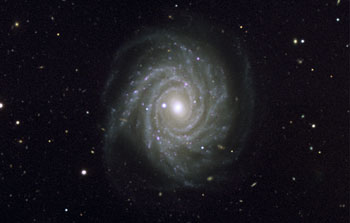
During his visit to ESO's Very Large Telescope at Paranal, the European Commissioner for Science and Research, Janez Potočnik, participated in an sequence and took images of a beautiful spiral galaxy. More ...
ESO 48/07 (29 October 2007) - Organisation Release
Commissioner Potočnik at Paranal Observatory
As part of his first official trip to Brazil and Chile, the European Science and Research Commissioner, Janez Potočnik, visited Europe's flagship for ground-based astronomy, the ESO Paranal Observatory. More ...
 
ESO 47/07 (11 October 2007) - Science Release
Drizzly Mornings on Xanadu
Noted for its bizarre hydrocarbon lakes and frozen methane clouds, Saturn's largest moon, Titan, also appears to have widespread drizzles of methane. New near-infrared images from ESO's Very Large Telescope in Chile and the W. M. Keck Observatory in Hawaii show for the first time a nearly global cloud cover at high elevations and, dreary as it may seem, a widespread and persistent morning drizzle of methane over the western foothills of Titan's major continent, Xanadu. More ...
 
ESO 46/07 (5 October 2007) - Organisation Release
Catch a Star 2008!
ESO and the European Association for Astronomy Education have just launched the 2008 edition of 'Catch a Star', their international astronomy competition for school students. Now in its sixth year, the competition offers students the chance to win a once-in-a-lifetime trip to ESO's flagship observatory in Chile, as well as many other prizes. More ...
 
ESO 45/07 (5 October 2007) - ALMA Release
A Colossus Gets its Name
Today, the first of the two ALMA antenna transporters was given its name at a ceremony on the compounds of the manufacturer, the heavy-vehicle specialist Scheuerle Fahrzeugfabrik GmbH, in Baden-Württemberg. The colossus, 10 metres wide, 20 metres long and 6 metres high, will be shipped to Chile by the end of the month. The second one will follow in a few weeks. More ...
 
ESO 44/07 (28 September 2007) - ASTRONET Release
A Grand Vision for European Astronomy
Today, and for the first time, astronomers share their global Science Vision for European Astronomy in the next two decades. This two-year long effort by the ASTRONET network of funding agencies, underscores Europe's ascension to world leadership in astronomy and its will to maintain that position. More ...
 
ESO 43/07 (27 September 2007) - Science Release
Into the Chrysalis
A team of European astronomers has used ESO's Very Large Telescope Interferometer and its razor-sharp eyes to discover a reservoir of dust trapped in a disc that surrounds an elderly star. The discovery provides additional clues about the shaping of planetary nebulae. More ...
 
ESO 42/07 (27 September 2007) - Science Release
The Frugal Cosmic Ant
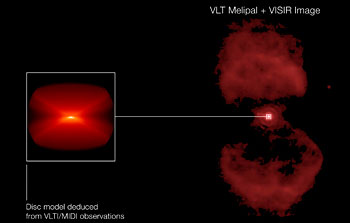
Using ESO's Very Large Telescope Interferometer and its unique ability to see small details, astronomers have uncovered a flat, nearly edge-on disc of silicates in the heart of the magnificent Ant Nebula. The disc seems, however, too 'skinny' to explain how the nebula got its intriguing ant-like shape. More ...
 
ESO 41/07 (18 September 2007) - Science Release
A Warm South Pole? Yes, on Neptune!
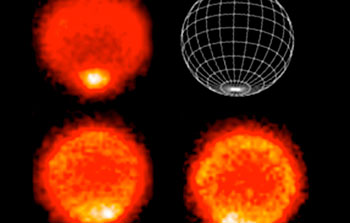
An international team of astronomers using ESO's Very Large Telescope has discovered that the south pole of Neptune is much hotter than the rest of the planet. This is consistent with the fact that it is late southern summer and this region has been in sunlight for about 40 years. More ...
 
ESO 40/07 (14 September 2007) - Science Release
Galaxy 'Hunting' Made Easy
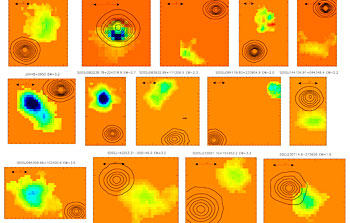
Astronomers using ESO's Very Large Telescope have discovered in a single pass about a dozen otherwise invisible galaxies halfway across the Universe. The discovery, based on a technique that exploits a first-class instrument, represents a major breakthrough in the field of galaxy 'hunting'. More ...
 
ESO 39/07 (3 September 2007) - Press Photo
Stellar Firework in a Whirlwind
In July 2006, ESO's Very Large Telescope took images of a stellar firework in the spiral galaxy NGC 1288. The supernova - designated SN 2006dr - was at its peak brightness, shining as bright as the entire galaxy itself, bearing witness to the amount of energy released. More ...
 
ESO 38/07 (3 September 2007) - Web Release
Professor Tim de Zeeuw Takes Up Duty as New ESO Director General
On 1 September, Tim de Zeeuw became the new ESO Director General, succeeding Catherine Cesarsky. In his first day in office, he kindly agreed to answer a few questions. More ...
 
ESO 37/07 (23 August 2007) - Press Photo
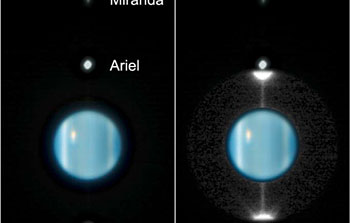
Edge-on!
As Uranus coasts through a brief window of time when its rings are edge-on to Earth - a view of the planet we get only once every 42 years - astronomers peering at the rings with ESO's Very Large Telescope and other space or ground-based telescopes are getting an unprecedented view of the fine dust in the system, free from the glare of the bright rocky rings. They may even find a new moon or two. More ...
 
ESO 36/07 (22 August 2007) - Instrument Release
HAWK-I Takes Off
Europe's flagship ground-based astronomical facility, the ESO VLT, has been equipped with a new 'eye' to study the Universe. Working in the near-infrared, the new instrument - dubbed HAWK-I - covers about 1/10th the area of the Full Moon in a single exposure. It is uniquely suited to the discovery and study of faint objects, such as distant galaxies or small stars and planets. More ...
 
ESO 35/07 (4 August 2007) - Instrument Release
First Light for World's Largest 'Thermometer Camera'
The world's largest bolometer camera for submillimetre astronomy is now in service at the 12-m APEX telescope, located on the 5100m high Chajnantor plateau in the Chilean Andes. LABOCA was specifically designed for the study of extremely cold astronomical objects and, with its large field of view and very high sensitivity, will open new vistas in our knowledge of how stars form and how the first galaxies emerged from the Big Bang. More ...
 
ESO 34/07 (3 August 2007) - Science Release
Star Caught Smoking
Using ESO's Very Large Telescope Interferometer, astronomers from France and Brazil have detected a huge cloud of dust around a star. This observation is further evidence for the theory that such stellar puffs are the cause of the repeated extreme dimming of the star. More ...
 
ESO 33/07 (2 August 2007) - Press Photo
The Planet, the Galaxy and the Laser
On the night of 21 July, ESO astronomer Yuri Beletsky took images of the night sky above Paranal, the 2600m high mountain in the Chilean Atacama Desert home to ESO's Very Large Telescope. The amazing images bear witness to the unique quality of the sky, revealing not only the Milky Way in all its splendour but also the planet Jupiter and the laser beam used at Yepun, one of the 8.2-m telescopes that make up this extraordinary facility. More ...
 
ESO 32/07 (30 July 2007) - ALMA Release
Birth of a Colossus on Wheels
The first of two spectacular vehicles for the ALMA (Atacama Large Millimeter/submillimeter Array) Observatory rolled out of its hangar and passed successfully a series of tests. This vehicle, the ALMA antenna transporter, is a rather exceptional 'lorry' driving on 28 tyres. It is 10m wide, 20m long and 6m high, weighs 130 tons and has as much power as two Formula 1 engines. This colossus will be able to transport a 115-ton antenna and set it down on a concrete pad within millimetres of a prescribed position. More ...
 
ESO 31/07 (12 July 2007) - Science Release
The Gobbling Dwarf that Exploded
A unique set of observations, obtained with ESO's VLT, has allowed astronomers to find direct evidence for the material that surrounded a star before it exploded as a Type Ia supernova. This strongly supports the scenario in which the explosion occurred in a system where a white dwarf is fed by a red giant. More ...
 
ESO 30/07 (6 July 2007) - Instrument Release
GROND Takes Off
A new instrument has seen First Light at the ESO La Silla Observatory. Equipping the 2.2-m MPI/ESO telescope, GROND takes images simultaneously in seven colours. It will be mostly used to determine distances of gamma-ray bursts. More ...
 
ESO 29/07 (6 July 2007) - Science Release
Star Surface Polluted by Planetary Debris
Looking at the chemical composition of stars that host planets, astronomers have found that while dwarf stars often show iron enrichment on their surface, giant stars do not. The astronomers think that the planetary debris falling onto the outer layer of the star produces a detectable effect in a dwarf star, but this pollution is diluted by the giant star and mixed into its interior. More ...
 
ESO 28/07 (19 June 2007) - Science Release
Back on Track
Observing the image of a faint object that lies close to a star is a demanding task as the object is generally hidden in the glare of the star. Characterising this object, by taking spectra, is an even harder challenge. Still, thanks to ingenious scientists and a new ESO imaging spectrograph, this is now feasible, paving the way to an eldorado of many new thrilling discoveries. More ...
 
ESO 27/07 (13 June 2007) - Instrument Release
Free from the Atmosphere
An artificial, laser-fed star now shines regularly over the sky of Paranal, home of ESO's Very Large Telescope, one of the world's most advanced large ground-based telescopes. This system provides assistance for the adaptive optics instruments on the VLT and so allows astronomers to obtain images free from the blurring effect of the atmosphere, regardless of the brightness and the location on the sky of the observed target. Now that it is routinely offered by the observatory, the skies seem much sharper to astronomers. More ...
 
ESO 26/07 (12 June 2007) - Science Release
Matter Flashed at Ultra Speed
Using a robotic telescope at the ESO La Silla Observatory, astronomers have for the first time measured the velocity of the explosions known as gamma-ray bursts. The material is travelling at the extraordinary speed of more than 99.999% of the velocity of light, the maximum speed limit in the Universe. More ...
 
ESO 25/07 (31 May 2007) - Science Release
Chronicle of a Death Foretold
Using ESO's VLTI on Cerro Paranal and the VLBA facility operated by NRAO, an international team of astronomers has made what is arguably the most detailed study of the environment of a pulsating red giant star, leading to significant progress in our understanding of the mechanism of how, b efore dying, evolved stars lose mass and return it to the interstellar medium. More ...
 
ESO 24/07 (23 May 2007) - Science Release
A Brown Dwarf Joins the Jet-Set
Jets of matter have been discovered around a very low mass 'failed star', mimicking a process seen in young stars. This suggests that these 'brown dwarfs' form in a similar manner to normal stars but also that outflows are driven out by objects as massive as hundreds of millions of solar masses down to Jupiter-sized objects. More ...
 
ESO 23/07 (10 May 2007) - Science Release
A Galactic Fossil
How old are the oldest stars? Using ESO's VLT, astronomers recently measured the age of a star located in our Galaxy. The star, a real fossil, is found to be 13.2 billion years old, not very far from the 13.7 billion years age of the Universe. The star, HE 1523-0901, was clearly born at the dawn of time. More ...
 
ESO 22/07 (25 April 2007) - Science Release
Astronomers Find First Earth-like Planet in Habitable Zone
Astronomers have discovered the most Earth-like planet outside our Solar System to date, an exoplanet with a radius only 50% larger than the Earth and capable of having liquid water. Using the ESO 3.6-m telescope, a team of Swiss, French and Portuguese scientists discovered a super-Earth about 5 times the mass of the Earth that orbits a red dwarf, already known to harbour a Neptune-mass planet. The astronomers have also strong evidence for the presence of a third planet with a mass about 8 Earth masses.   More...
 
ESO 21/07 (13 April 2007) - Organisation News
School students "Catch a Star"!
School students from across Europe and beyond have won prizes in an astronomy competition, including the trip of a lifetime to one of the world's most powerful astronomical observatories, on a mountaintop in Chile. ESO, the European Organisation for Astronomical Research in the Southern Hemisphere, together with the European Association for Astronomy Education (EAAE), has just announced the winners of the 2007 "Catch a Star!" competition.   More...
 
ESO 20/07 (3 April 2007) - ALMA Release
ALMA to Help Solving Acute Mountain Sickness Mystery
The Atacama Large Millimeter/submillimeter Array (ALMA) astronomical project will not only enlarge our knowledge of the vast Universe beyond the imaginable. It will also help scientists learn more about the human body.   More...
 
ESO 19/07 (30 March 2007) - Instrument Release
New Adaptive Optics Technique Demonstrated
On the evening of 25 March 2007, the Multi-Conjugate Adaptive Optics Demonstrator (MAD) achieved First Light at the Visitor Focus of Melipal, the third Unit Telescope of the Very Large Telescope (VLT). MAD allowed the scientists to obtain images corrected for the blurring effect of atmospheric turbulence over the full 2x2 arcminute field of view. This world premiere shows the promises of a crucial technology for Extremely Large Telescopes.   More...
 
ESO 18/07 (29 March 2007) - Science Release
The Impossible Siblings
Combining precise observations obtained by ESO's Very Large Telescope with those gathered by a network of smaller telescopes, astronomers have described in unprecedented detail the double asteroid Antiope, which is shown to be a pair of rubble-pile chunks of material, of about the same size, whirling around one another in a perpetual pas de deux. The two components are egg-shaped despite their very small sizes.   More...
 
ESO 17/07 (28 March 2007) - Science Release
Controlled by Distant Explosions
At 11:08 pm on 17 April 2006, an alarm rang in the Control Room of ESO's Very Large Telescope on Paranal, Chile. Fortunately, it did not announce any catastrophe on the mountain, nor with one of the world's largest telescopes. Instead, it signalled the doom of a massive star, 9.3 billion light-years away, whose final scream of agony - a powerful burst of gamma rays - had been recorded by the Swift satellite only two minutes earlier. The alarm was triggered by the activation of the VLT Rapid Response Mode, a novel system that allows for robotic observations without any human intervention, except for the alignment of the spectrograph slit.   More...
 
ESO 16/07 (27 March 2007) - Press Photo
The Purple Rose of Virgo
Until now NGC 5584 was just one galaxy among many others, located to the West of the Virgo Cluster. Known only as a number in galaxy surveys, its sheer beauty is now revealed in all its glory in a new VLT image. Since 1 March, this purple cosmic rose also holds the brightest stellar explosion of the year, known as SN 2007af.   More...
 
ESO 15/07 (22 March 2007) - Science Release
Fingerprinting the Milky Way
Using ESO's Very Large Telescope, an international team of astronomers has shown how to use the chemical composition of stars in clusters to shed light on the formation of our Milky Way. This discovery is a fundamental test for the development of a new chemical tagging technique uncovering the birth and growth of our Galactic cradle.   More...
 
ESO 14/07 (15 March 2007) - EIROforum Release
Waking-up to Science!
How is Europe to tackle its shortage of scientists? The EIROforum Science on Stage festival aims to give European teachers some of the answers they need to take up this urgent challenge. This unique event, showcasing the very best of today's science education, will feature science demonstrations, a science teaching fair with some 66 stands, and a Round Table discussion with the participation of the European Commissioner for Science and Research, Janez Potočnik.   More...
 
ESO 13/07 (14 March 2007) - ALMA Release
A Roof for ALMA
On 10 March, an official ceremony took place on the 2,900m high site of the Atacama Large Millimeter/submillimeter Array (ALMA) Operations Support Facility, from where the ALMA antennas will be remotely controlled. The ceremony marked the completion of the structural works, while the building itself will be finished by the end of the year. This will become the operational centre of one of the most important ground-based astronomical facilities on Earth.   More...
 
ESO 12/07 (13 March 2007) - Science Release
Star Family Seen Through Dusty Fog
Images made with ESO's New Technology Telescope at La Silla by a team of German astronomers reveal a rich circular cluster of stars in the inner parts of our Galaxy. Located 30,000 light-years away, this previously unknown closely-packed group of about 100,000 stars is most likely a new globular cluster.   More...
 
ESO 11/07 (7 March 2007) - Science Release
Solar Power at Play
For the very first time, astronomers have witnessed the speeding up of an asteroid's rotation, and have shown that it is due to a theoretical effect predicted but never seen before. The international team of scientists used an armada of telescopes to discover that the asteroid's rotation period currently decreases by 1 millisecond every year, as a consequence of the heating of the asteroid's surface by the Sun. Eventually it may spin faster than any known asteroid in the solar system and even break apart.   More...
 
ESO 10/07 (7 March 2007) - ALMA Release
The Antenna Bride and Bridegroom
The Atacama Large Millimeter/submillimeter Array (ALMA), an international telescope project, reached a major milestone on 2 March, when two 12-m ALMA prototype antennas were first linked together as an integrated system to observe an astronomical object.   More...
 
ESO 09/07 (7 March 2007) - Press Photo
The Giant that Turned Out to be a Dwarf
New data obtained on the apparent celestial couple, NGC 5011 B and C, taken with the 3.6-m ESO telescope, reveal that the two galaxies are not at the same distance, as was believed for the past 23 years. The observations show that NGC 5011C is not a giant but a dwarf galaxy, an overlooked member of a group of galaxies in the vicinity of the Milky Way.   More...
 
ESO 08/07 (24 February 2007) - Science Release
SN1987A's Twentieth Anniversary
Today, it is exactly twenty years since the explosion of Supernova 1987A in the Large Magellanic Cloud was first observed, at a distance of 163,000 light-years. It was the first naked-eye supernova to be seen for 383 years. Few events in modern astronomy have met with such an enthusiastic response by the scientists and now, after 20 years, it continues to be an extremely exciting object that is further studied by astronomers around the world, in particular using ESO's telescopes.   More...
 
ESO 07/07 (23 February 2007) - Press Photo
The Celestial Whirligig
Comet McNaught, the Great Comet of 2007, has been delighting those who have seen it with the unaided eye as a spectacular display in the evening sky. Pushing ESO's New Technology Telescope to its limits, astronomers have obtained the first, and possibly unique, detailed observations of this object. Their images show spectacular jets of gas from the comet spiralling several thousands of kilometres into space, while the spectra reveal the presence of sodium in its atmosphere, something seen very rarely.  More...
 
ESO 06/07 (21 February 2007) - Instrument Release
The Sky Through Three Giant Eyes
The ESO Very Large Telescope Interferometer, which allows astronomers to scrutinise objects with a precision equivalent to that of a 130-m telescope, is proving itself an unequalled success every day. One of the latest instruments installed, AMBER, has led to a flurry of scientific results, an anthology of which is being published this week as special features in the research journal Astronomy & Astrophysics.   More...
 
ESO 05/07 (19 January 2007) - Press Photo
The Great Cometary Show
Comet McNaught, the Great Comet of 2007, is no more visible for observers in the Northern Hemisphere. It does put an impressive show in the South, however, and observers in Chile, in particular at the Paranal Observatory, were able to capture amazing images, including a display reminiscent of an aurora!   More...
 
ESO 04/07 (17 January 2007) - Instrument Release
Big Red Eye is Ready
The world's biggest infrared camera for Europe's newest telescope left the UK today for Chile. The 67 million pixel camera will equip VISTA - a UK provided survey telescope being constructed in Chile for ESO. VISTA will map the infrared sky faster than any previous telescope, studying areas of the Universe that are hard to see in the visible due to either their cool temperature, surrounding dust or high redshift.   More...
 
ESO 03/07 (11 January 2007) - Organisation Release
Tim de Zeeuw to Become the Next Director General of ESO
The ESO Council has just appointed Tim de Zeeuw, 50, as the next Director General of ESO, effective as of 1 September 2007, when the current Director General, Catherine Cesarsky, will complete her mandate.   More...
 
ESO 02/07 (8 January 2007) - Science Release
It Is No Mirage
Using ESO's Very Large Telescope and the W.M. Keck Observatory, astronomers at the Ecole Polytechnique Federale de Lausanne in Switzerland and the California Institute of Technology, USA, have discovered what appears to be the first known triplet of quasars. This close trio of supermassive black holes lies about 10.5 billion light-years away towards the Virgo (The Virgin) constellation.   More...
 
ESO 01/07 (3 January 2007) - Press Photo
ESO PR Highlights in 2006
Last year proved to be another exceptional year for the European organisation for ground-based astronomy.   More...