VLT Instruments
- 4LGSF (4 Laser Guide Star Facility) sends four laser beams into the skies to produce four artificial stars by exciting sodium atoms located in the atmosphere.
- AOF (Adaptive Optics Facility) is an upgrade of a 8-m Unit telescope of the Paranal Observatory with an Adaptive Secondary Mirror (DSM) to make this telescope an Adaptive Telescope providing turbulence corrected images at all focii, without the addition of adaptive modules and supplementary optics in front of the instruments.
- CRIRES (CRyogenic high-resolution InfraRed Echelle Spectrograph) provides a resolving power of up to 100 000 in the spectral range from 1 to 5 μm.
- ERIS (Enhanced Resolution Imager and Spectrograph) combines a general-use infrared imager and integral field spectrograph with the world-class adaptive optics installed on the VLT’s Unit Telescope 4 (Yepun).
- ESPRESSO (Echelle SPectrograph for Rocky Exoplanet and Stable Spectroscopic Observations) is a super-stable optical high-resolution spectrograph for the combined coudé focus of the VLT.
- FLAMES (Fibre Large Array Multi-Element Spectrograph) offers the unique capability to study simultaneously and at high spectral resolution hundreds of individual stars in nearby galaxies. It is also equipped for integral field spectroscopy.
- FORS2 (FOcal Reducer and Spectrograph) is a multi-mode instrument that can be used for imaging in the visible and for low-resolution spectroscopy.
- HAWK-I (High Acuity Wide field K-band Imager) is a near-infrared imager with a relatively large field of view.
- KMOS (K-band Multi Object Spectrograph) is a near-infrared spectrograph equipped with 24 positionable integral-field units.
- MAVIS (Multi-conjugate-adaptive-optics-Assisted Visible Imager and Spectrograph)
- MOONS (Multi-Object Optical and Near-infrared Spectrograph), equipped with ~1000 fibers deployable over ~500 square arcmin, feeds a broadband infrared and optical spectrograph.
- MUSE (Multi-Unit Spectroscopic Explorer) is a giant integral-field spectrograph, that can take spectra over its full field-of-view of about one square arcminute.
- SPHERE (Spectro-Polarimetric High-contrast Exoplanet REsearch) is an extreme adaptive optics system with advanced coronographs, designed to observe exoplanets.
- UVES (UltraViolet and Visible Echelle Spectrograph) is the high-dispersion spectrograph of the VLT, observing from 300 nm to 1100 nm, with a maximum spectral resolution of 110 000.
- X-shooter is a spectrograph covering a very wide range of wavelengths [UV to near infrared] simultaneously.
- 4MOST is a fibre-fed spectroscopic facility on the VISTA telescope with a large field-of-view to survey a significant fraction of the southern sky in a few years. 4MOST has a high multiplex being able to simultaneously obtain spectra for ~2400 objects.
Decommissioned instruments
- VISIR (VLT Imager and Spectrometer for mid-Infrared) studies the infrared light from celestial objects.
- AMBER is a near infrared Astronomical Multi-Beam combineR — an instrument for photometric and spectroscopic studies, which combines the light of three telescopes.
- ISAAC (Infrared Spectrometer And Array Camera) is an infrared imager and spectrograph, with an arm optimized for 1–2.5 μm and the other for 3–5 μm.
- NACO (NAos-COnica) is an Adaptive Optics facility producing images as sharp as if taken in space. It is also equipped with a spectrometer, polarimeter, coronographs, etc.
- FORS1 (FOcal Reducer and Spectrograph) is a multi-mode instrument, similar to FORS2.
- MAD is the ESO Multi-conjugate Adaptive optics Demonstrator.
- MIDI is a MID-infrared Interferometric instrument for photometry and spectroscopy
- SINFONI (Spectrograph for INtegral Field Observations in the Near Infrared) is a near-infrared (1 - 2.5 μm) integral field spectrograph fed by an adaptive optics module.
- VIMOS (VIsible Multi-Object Spectrograph), a four-channel multiobject spectrograph and imager, allows obtaining low-resolution spectra of up to 1000 galaxies at a time.
- VIRCAM (VISTA InfraRed CAMera), a wide-field imager for observations in the infrared domain.
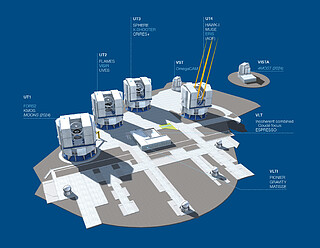
VLTI Instruments
- GRAVITY is a second generation instrument on the Very Large Telescope Interferometer (VLTI) and will represent a huge step forward for both interferometry and for the Very Large Telescope (VLT).
- MATISSE is a new spectro-interferometer, part of the second generation of instruments the Very Large Telescope Interferometer (VLTI).
- NAOMI, or the New Adaptive Optics Module for Interferometry, is about to put the Very Large Telescope Interferometer (VLTI) on steroids.
- PIONIER (Precision Integrated-Optics Near-infrared Imaging ExpeRiment) combines the light from 4 telescopes in the near-Infrared.
For detailed descriptions of these instruments, refer to the ESO instruments summary table. This also table lists which instruments currently in operation.
Many of these instruments have been built, in collaboration with ESO, by consortia of European laboratories. Further details are given on the individual instrument pages.