Software Context
This section describes the software context of OCM and DPM, focusing on provided and used software interfaces. Fig. 1 shows the components with their relations to interfaces which also specifies their dependencies. The individual interfaces are described in Table 2.
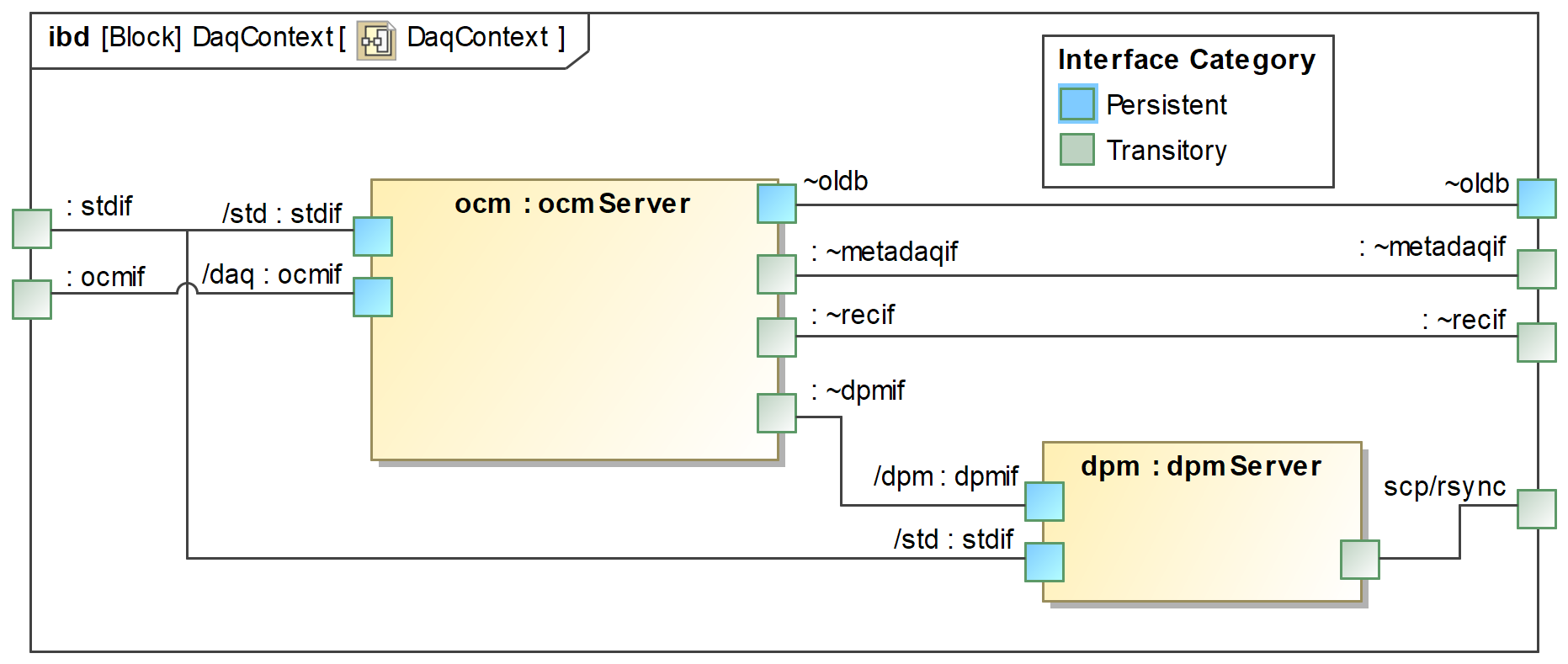
Fig. 1 Software context for OCM and DPM. The interface category refers to whether the interface is used (or provided) persistently or in a transitory manner e.g. because interface is used only for the duration of an operation. Non-conjugated ports (without ~) indicate that the interface is provided whereas conjugated ports (with ~) indicate a interface is used.
Interface |
Description |
|---|---|
|
Standard interface implemented and provided by OCM and DPM which enables operational life-cycle control and supervision. |
|
Interface implemented and provided by OCM to manage Data Acquisitions. |
|
OCM has a persistent dependency to the Online Database (redis-server) to update it with current configuration and application status. |
|
OCM use the metadaqif to acquire data from metadata sources for the duration of each Data Acquisition. |
|
OCM use the recif to acquire data from primary data sources for the duration of each Data Acquisition. |
|
If DPM is operational OCM will send commands to schedule the individual Data Acquisitions to be merged into Data Products. |
|
Interface provided by DPM for scheduling the individual Data Acquisitions to be merged into Data Products. |
Deployment
Reference
There is currently no reference deployment configuration.
Deployment Constraints
Software Context also show dependencies to neighbouring components or systems, as anonymous interfaces, as well as the temporal dimension with the interface category. If a dependency is transitory because it e.g. is only required to complete an operation, for the duration of the operation, this will also be noted below.
The following constraints needs to be taken into consideration when deploying each component:
- OCM
Apart from satisfying runtime dependencies and services enumerated in Table 2 there are no specific deployment constraints for OCM. The only persistent service used by OCM is the oldb (redis server).
To acquire data from a data source OCM requires request/reply access for the duration of
StateAcquiring. Once data has been acquired there is no connection or dependency towards any data source.- DPM
DPM is special in that it does not require an operational ICS to perform its function. To create data products from the individually created FITS files DPM requires access to the files using either locally mounted file system access or scp/rsync (TBD).