![[ ESO ]](/images/eso-logo.gif)
numbering scheme and mapping
| HOME | INDEX | SEARCH | HELP | NEWS |
|
|||||
|---|---|---|---|---|---|
| VIMOS IFU components: numbering scheme and mapping |
|||||
|
|
 |
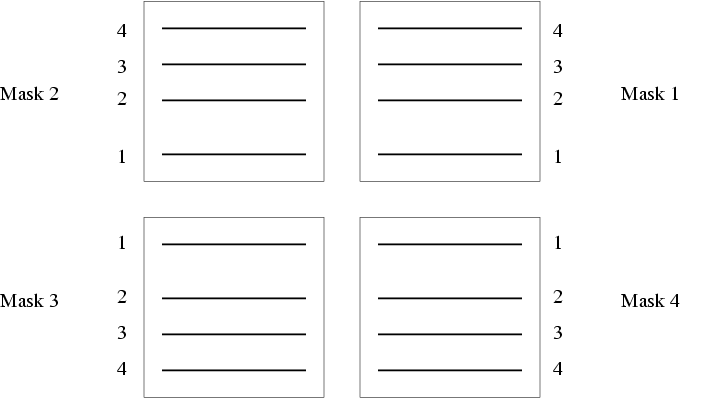
VIMOS has four IFU masks that are numbered as the VIMOS quadrants to which they correspond (i.e. counterclockwise, with the same convention used by the cartesian plane). Each mask hosts 4 IFU pseudo slits . They are numbered from 1 to 4 as shown in this figure:
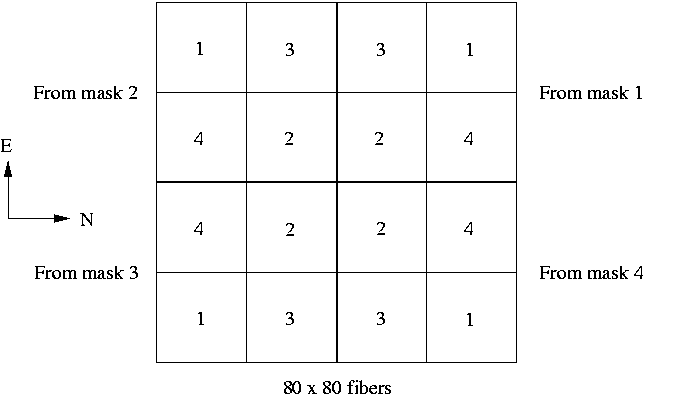
Each pseudo slit corresponds to a specific 20x20 region on the IFU head as shown in this figure:
Note on fibre visibility The theoretical number of 400 fibre spectra per pseudo slit is not reached. Two fibres in the middle of each block of 80 fibres are typically missing because they are vignetted by the IFU head shutter. There is also vignetting present at one border of each CCD. The actual number of lost fibres cannot be predicted since the positions of the fibres on the raw images vary within 2 to 5 pixels. Depending on the quadrant, 20 to 40 fibres are typically lost on each pseudo slit. The IFU pipeline recipes (vmifucalib, vmifustandard, and vmifuscience) work with one quadrant at the time and, in addition to other products, they produce images with extracted fibre spectra. Correspondence between fibre position in raw and extracted images: Raw spectra starting from the left side of each pseudo slits are extracted and stored successively in the product image starting from the bottom first row. In low resolution, where each quadrant frame contains 4 pseudo slits, the product images have 1600 rows with the 400 spectra from pseudo-slit1 at the bottom and the 400 spectra from pseudo-slit 4 at the top. In high and medium resolution, where each quadrant frame contains the spectra from one pseudo slit only, the product images have 400 rows. Redder wavelengths are towards the top in the raw images and towards the right in the product images. Correspondence between each row (i.e. each spectrum) of the extracted spectra
with the fibre positions on the IFU head: This is described
in the IFU tables:
There is one set of 4 IFU tables (one per-quadrant) for high and medium resolution and one set of 4 IFU tables for low resolution. The IFU tables can be downloaded here:
|
|||||||||||||||||||||||||||||||||||||||||||||||||||||||||||||||||||||||||||||||||||||||||||||||||||||||||||||||||||||||||||||||||||||||||||||||||||||||||||||||||||||
|
|
|||||||||||||||||||||||||||||||||||||||||||||||||||||||||||||||||||||||||||||||||||||||||||||||||||||||||||||||||||||||||||||||||||||||||||||||||||||||||||||||||||||||
![[ QC Home page ]](/qc/GIRAFFE/img/qc.gif) |
|
||||||||||||||||||||||||||||||||||||||||||||||||||||||||||||||||||||||||||||||||||||||||||||||||||||||||||||||||||||||||||||||||||||||||||||||||||||||||||||||||||||||
![[ESO]](/images/icon-home.gif)
![[Index]](/images/icon-index.gif)
![[Search]](/images/icon-search.gif)
![[Help]](/images/icon-help.gif)
![[News]](/images/icon-whatsnew.gif)