The European Southern Observatory (ESO) enables scientists worldwide to discover the secrets of the Universe for the benefit of all. We design, build and operate world-class observatories on the ground. Astronomers worldwide use our telescopes to tackle exciting questions and spread the fascination of astronomy: How did the Universe come into existence? What are black holes? Are we alone in the Universe?
We are an intergovernmental organisation established in 1962 supported by 16 Member States (Austria, Belgium, Czechia, Denmark, Finland, France, Germany, Ireland, Italy, the Netherlands, Poland, Portugal, Spain, Sweden, Switzerland and the United Kingdom), our host country Chile and strategic partners. ESO brings together over 750 staff from more than 30 countries, and countless more collaborators worldwide, all driven by the passion to build the best telescopes, serve the community and benefit society. We are honoured by the privilege to serve more than 22 000 users from over 130 different countries with excellent infrastructure, services, technologies and data.
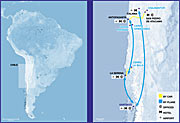
All our telescopes are currently located in the Chilean Atacama Desert, a marvelous place with unique conditions to observe the sky. ESO operates three observing sites in Chile: La Silla, Paranal and Chajnantor. In addition, we are building “the world’s biggest eye on the sky”—ESO’s Extremely Large Telescope, located on Cerro Armazones, which will be operated as part of the Paranal Observatory.
At La Silla, ESO’s first observatory, we operate two of the most productive 4-metre-class telescopes in the world. Paranal is the home of ESO’s Very Large Telescope (VLT), one of the most advanced optical telescopes in the world, and its unique Very Large Telescope Interferometer (VLTI), as well as survey telescopes such as VISTA. In the future, Paranal will also host and operate the Cherenkov Telescope Array Observatory (CTAO) South, the world’s largest and most sensitive gamma-ray observatory. Collaboratively with international partners, ESO operates ALMA on the Chajnantor plateau. ALMA allows scientists to investigate the Universe in the millimetre and submillimetre wavelength range of light.
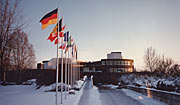
ESO’s Headquarters are located in Garching, close to Munich in Germany. Here we conceive and develop cutting-edge telescope technologies together with our industry partners, and educate both children and adults in our visitor centre and planetarium, the ESO Supernova. Our central offices in Santiago are the hub from which we support the organisational operations in the country and collaborate with our host and partner country, Chile, its authorities, scientific community and society.
"An almost unique level of international cooperation is achieved at ESO, and everything is done by those who can do it best, irrespective of their country or institution. This spirit of excellence is an example for all Europe."
ESO Headquarters
Sites in Chile
Our use of Cookies
We use cookies that are essential for accessing our websites and using our services. We also use cookies to analyse, measure and improve our websites’ performance, to enable content sharing via social media and to display media content hosted on third-party platforms.
You can manage your cookie preferences and find out more by visiting 'Cookie Settings and Policy'.
ESO Cookies Policy
The European Organisation for Astronomical Research in the Southern Hemisphere (ESO) is the pre-eminent intergovernmental science and technology organisation in astronomy. It carries out an ambitious programme focused on the design, construction and operation of powerful ground-based observing facilities for astronomy.
This Cookies Policy is intended to provide clarity by outlining the cookies used on the ESO public websites, their functions, the options you have for controlling them, and the ways you can contact us for additional details.
What are cookies?
Cookies are small pieces of data stored on your device by websites you visit. They serve various purposes, such as remembering login credentials and preferences and enhance your browsing experience.
Categories of cookies we use
Essential cookies (always active): These cookies are strictly necessary for the proper functioning of our website. Without these cookies, the website cannot operate correctly, and certain services, such as logging in or accessing secure areas, may not be available; because they are essential for the website’s operation, they cannot be disabled.
Cookie ID/Name
Description/Purpose
Provider (1st party or 3rd party)
Browser session cookie or Stored cookie?
Duration
csrftoken
XSRF protection token. We use this cookie to protect against cross-site request forgery attacks.
1st party
Stored
1 year
user_privacy
Your privacy choices. We use this cookie to save your privacy preferences.
1st party
Stored
6 months
_grecaptcha
We use reCAPTCHA to protect our forms against spam and abuse. reCAPTCHA sets a necessary cookie when executed for the purpose of providing its risk analysis. We use www.recaptcha.net instead of www.google.com in order to avoid unnecessary cookies from Google.
3rd party
Stored
6 months
Functional Cookies: These cookies enhance your browsing experience by enabling additional features and personalization, such as remembering your preferences and settings. While not strictly necessary for the website to function, they improve usability and convenience; these cookies are only placed if you provide your consent.
Cookie ID/Name
Description/Purpose
Provider (1st party or 3rd party)
Browser session cookie or Stored cookie?
Duration
Settings
preferred_language
Language settings. We use this cookie to remember your preferred language settings.
1st party
Stored
1 year
ON | OFF
sessionid
ESO Shop. We use this cookie to store your session information on the ESO Shop. This is just an identifier which is used on the server in order to allow you to purchase items in our shop.
1st party
Stored
2 weeks
ON | OFF
Analytics cookies: These cookies collect information about how visitors interact with our website, such as which pages are visited most often and how users navigate the site. This data helps us improve website performance, optimize content, and enhance the user experience; these cookies are only placed if you provide your consent. We use the following analytics cookies.
Matomo Cookies:
This website uses Matomo (formerly Piwik), an open source software which enables the statistical analysis of website visits. Matomo uses cookies (text files) which are saved on your computer and which allow us to analyze how you use our website. The website user information generated by the cookies will only be saved on the servers of our IT Department. We use this information to analyze www.eso.org visits and to prepare reports on website activities. These data will not be disclosed to third parties.
On behalf of ESO, Matomo will use this information for the purpose of evaluating your use of the website, compiling reports on website activity and providing other services relating to website activity and internet usage.
ON | OFF
Matomo cookies settings:
Cookie ID/Name
Description/Purpose
Provider (1st party or 3rd party)
Browser session cookie or Stored cookie?
Duration
Settings
_pk_id
Stores a unique visitor ID.
1st party
Stored
13 months
_pk_ses
Session cookie temporarily stores data for the visit.
1st party
Stored
30 minutes
_pk_ref
Stores attribution information (the referrer that brought the visitor to the website).
1st party
Stored
6 months
_pk_testcookie
Temporary cookie to check if a visitor’s browser supports cookies (set in Internet Explorer only).
1st party
Stored
Temporary cookie that expires almost immediately after being set.
Additional Third-party cookies on ESO websites: some of our pages display content from external providers, e.g. YouTube.
Such third-party services are outside of ESO control and may, at any time, change their terms of service, use of cookies, etc.
YouTube: Some videos on the ESO website are embedded from ESO’s official YouTube channel. We have enabled YouTube’s privacy-enhanced mode, meaning that no cookies are set unless the user actively clicks on the video to play it. Additionally, in this mode, YouTube does not store any personally identifiable cookie data for embedded video playbacks. For more details, please refer to YouTube’s embedding videos information page.
Cookies can also be classified based on the following elements.
Regarding the domain, there are:
First-party cookies, set by the website you are currently visiting. They are stored by the same domain that you are browsing and are used to enhance your experience on that site;
Third-party cookies, set by a domain other than the one you are currently visiting.
As for their duration, cookies can be:
Browser-session cookies, which are deleted when the user closes the browser;
Stored cookies, which stay on the user's device for a predetermined period of time.
How to manage cookies
Cookie settings: You can modify your cookie choices for the ESO webpages at any time by clicking on the link Cookie settings at the bottom of any page.
In your browser: If you wish to delete cookies or instruct your browser to delete or block cookies by default, please visit the help pages of your browser:
Please be aware that if you delete or decline cookies, certain functionalities of our website may be not be available and your browsing experience may be affected.
You can set most browsers to prevent any cookies being placed on your device, but you may then have to manually adjust some preferences every time you visit a site/page. And some services and functionalities may not work properly at all (e.g. profile logging-in, shop check out).
Updates to the ESO Cookies Policy
The ESO Cookies Policy may be subject to future updates, which will be made available on this page.
Additional information
For any queries related to cookies, please contact: pdprATesoDOTorg.
As ESO public webpages are managed by our Department of Communication, your questions will be dealt with the support of the said Department.