![[ ESO ]](/images/eso-logo.gif)
General Information
| HOME | INDEX | SEARCH | HELP | NEWS |
|
FORS1 Pipeline General Information |
||||
|---|---|---|---|---|---|
|
|
 |
This page provides information about pipeline processing and data types. Raw data are selected, associated and inserted into a reduction mechanism which produces calibration products, science products and quality control information. This mechanism is the data processing pipeline. There is one such pipeline for each VLT and VLTI instrument.
The main functionalities of the pipelines are:
QC Garching creates master calibration data from all raw calibration data. The raw data are stored in the ESO Archive and are public. They are quality-checked and used for data reduction and for trending. Before October 2011 QC Garching processed science data, using the best available, quality-checked master calibration data. As of October 2011 this service is not offered anymore. There are two instances of the data reduction pipelines:
The automatic mode is used for quick look purposes and for on-site quality control. It processes all raw data sequentially, as they arrive from the instrument. If calibration products ("master calibrations") are required for processing science data, these are taken from a database with standard, pre-manufactured calibration products. The automatic mode is not tuned to obtain the best possible results. The optimized mode is the mode, which uses all data of a night, including the daytime calibrations. The calibration data are sorted and grouped according to their dependencies. Master calibration data are created. Their quality is checked.
The FORS pipeline is publicly available. It currently (2008-09-17) supports the reduction of imaging and spectroscopic data (LSS and MOS), but not polarimetric data. Information on the imaging pipeline used until 2008-03-31 can be found here.
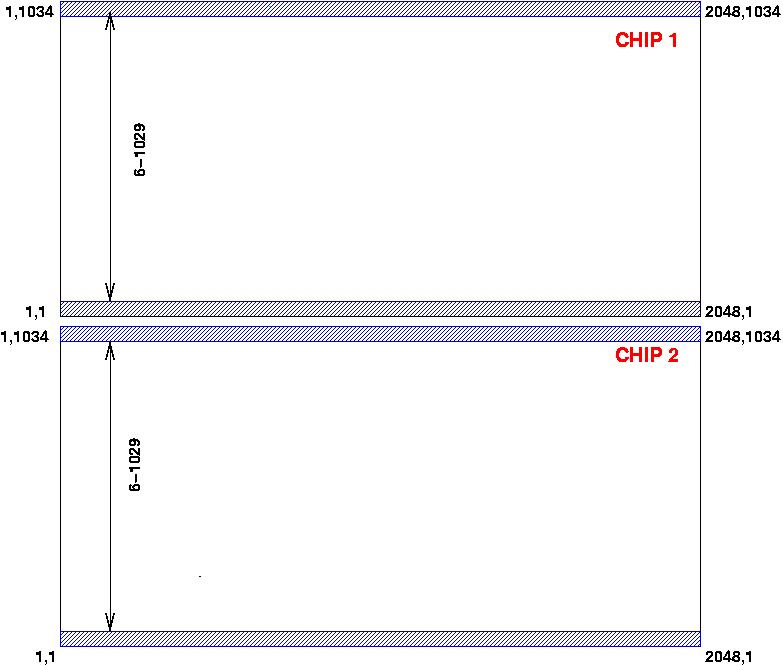
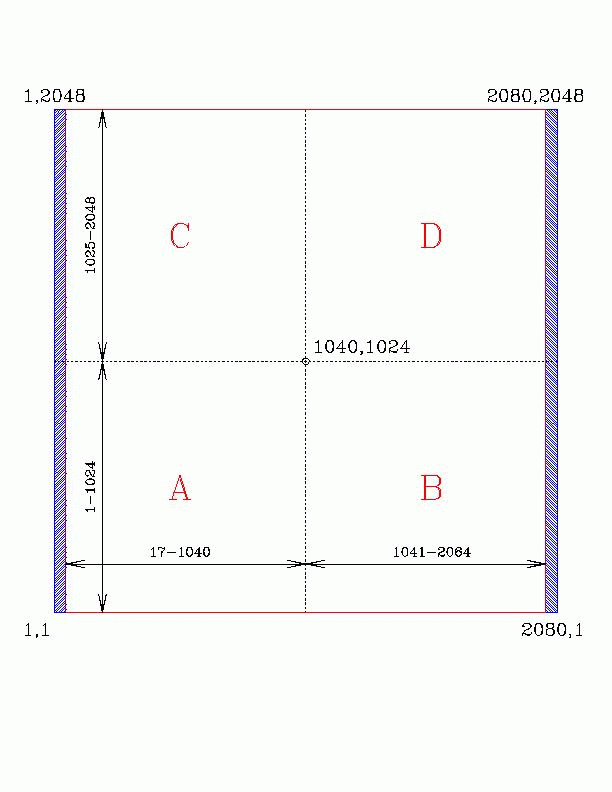
During the FORS1 detector upgrade on March 28, 2007, the old CCD has been replaced by a mosaic of two blue/UV-optimized CCDs. The upper CCD is referenced as Chip1 (also called master), while the lower CCD is referenced as Chip2 (also called slave). Each FORS2 exposure is split into two files, one for each CCD. The raw FORS1 files in the standard CCD format (2x2 binning, no windowing) have 2048x1034 pixels. The field of view is limited by the MOS unit, therefore the field of Chip1 is larger than that of Chip2. Two pre/overscan regions are present in the CCD. For the standard CCD format (2x2 binning), these regions are 5 pixels wide (i.e. rows 1...5 for the prescan and 1030...1034 for the overscan). For a graphical description of the detector sections, have a look here (pre-view) or here (ps file). Note that for presentation reason, the pre-scan regions have been artificially enlarged. Old CCD Until March 25, 2007 FORS1 was equipped with one CCD. The raw FORS1 files in the standard CCD format (1x1 binning, no windowing) had 2080x2048 pixels. Two readout modes were used: single port (left) and 4 port (right).
Two pre/overscan regions were present in the CCD. For the standard CCD format (1x1 binning), these regions were 16 pixels wide (i.e. columns 1...16 for the prescan and 2065...2080 for the overscan). For a graphical description of the detector sections, have a look here (pre-view) or here (ps file). Note that for presentation reason, the pre-scan regions have been artificially enlarged. |
||||||||||||||||||||||||||||||||||||||||||||||||||||||||||||||||||
|
|
||||||||||||||||||||||||||||||||||||||||||||||||||||||||||||||||||||
 |
|
|||||||||||||||||||||||||||||||||||||||||||||||||||||||||||||||||||
 Find general information about ESO reduction pipelines
![[FORS1 QC]](/images/icon-up.gif)
![[Observing Facilities and Operations]](/images/icon-observing.gif)
![[ESO]](/images/icon-home.gif)
![[Index]](/images/icon-index.gif)
![[Search]](/images/icon-search.gif)
![[Help]](/images/icon-help.gif)
![[News]](/images/icon-whatsnew.gif)