 mirror sites:
PL (internal link)
HQ
[?]
mirror sites:
PL (internal link)
HQ
[?]
Quality Control and
Data Processing
|
 |
NACO: Calibration recipes
DPR.CATG = CALIB, DPR.TYPE = DARK
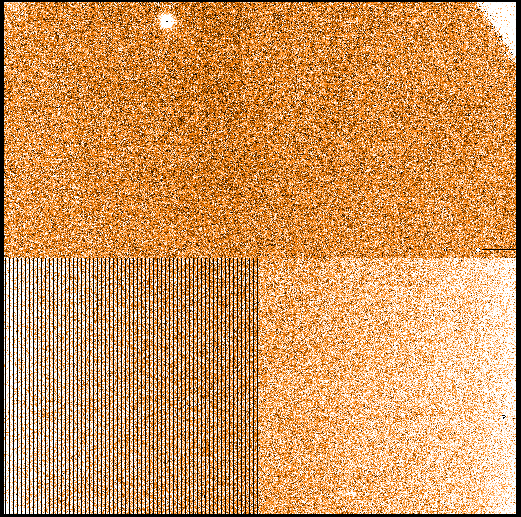
Dark frames are measured to monitor the status of the detector. They come in stacks of 3 raw frames. They are routinely measured every night when NACO is operational. They are all processed into master Dark frames of different discrete integration times and read modes and are quality-checked on the mountain and by QC Garching. They are not stable, hence all master dark products are stored in the calibration archive and individually delivered.
The pipeline recipe naco_img_dark takes a stack of frames observed with the NACO_all_cal_Darks template, sorts the stack by means of different DITS, averages the three raw frames and determines the RON (read-out noise) of the full array. The output are master darks of several DIT . No median filter or median stacking is applied, hence no cosmetic correction concerning hot pixels and cosmic events is applied: The recipe produces in addition a hot pixel map (all pixels above 5 sigma), a cold pixel map (all pixel above 3 sigma), and a deviant pixel map.
As part of the QC1 checks the following parameters are monitored: RON (read-out noise, more precisely: the statistical noise normalized to NDIT=1) for each of the four quadrants, median and mean of the whole product image. These values are accessible via the trending page. Other internal checks include the monitoring of the fixed pattern noise and the reset anomaly behaviour.
 twilight flat and sky flat frames: naco_img_twflat
DPR.CATG = CALIB, DPR.TYPE = SKY,FLAT
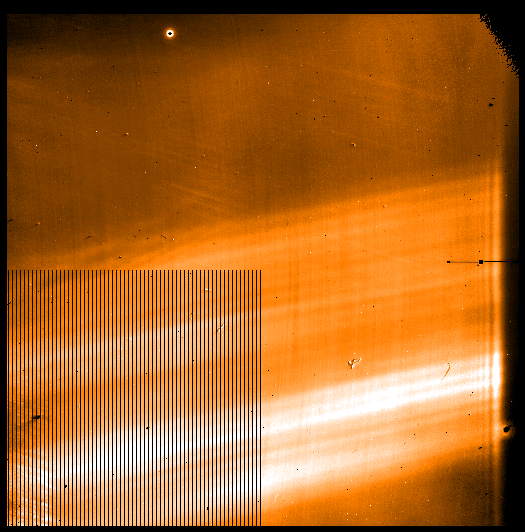
The master twilight flats show the relative sensitivity (the gain) of the array pixels. Twilight flats can be observed in two different ways: a) a sequence of raw files all having the same filter, b) a sequence of files with four alternating filters. The telescope is in 'STANDBY' modus and pointing to zenith during twflat observations. Possible bright stars which are jittered out anyway appear in the errmap file as a wide trace. The Differences between TwFlats and SkyFlats are :
The naco cpl pipeline recipe naco_img_twflat is used. Since the exposure level is strongly increasing or decreasing during twilight, the raw frames can be used to derive the detector linearity and the gain map in one. twflat is able to sorting out the alternating filter sequence and handles each stack separately. The recipe fits a linear regression to each pixel. If a master dark frame is submitted twflat substitutes the 'a' in F=a+b *flux by the dark and the 'b' is stored as the flat frame. The errors are given in the errmap and would contain star trails. The interception file contains the 'a' in case no dark frame is submitted to the recipe. The closest in time recorded dark frame is supplied with the same DET.DIT, DET.NCORRS.NAME, and DET.MODE.NAME as the raw twilight flat frames and is included in the sof file: No instrument specific properties are extracted from the twilight flats.
lamp flat frames: naco_img_lampflat
DPR.CATG = CALIB, DPR.TYPE = LAMP,FLAT
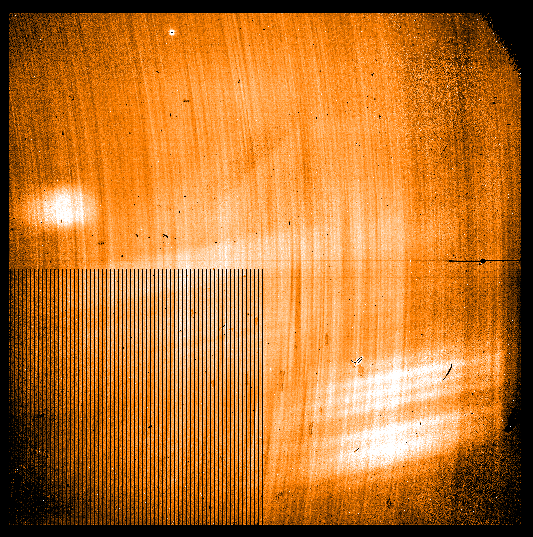
The master lamp flats show the relative sensitivity (the gain) of the array pixels. They become important when the science imaging used a different read out mode than the twilight flats (their read out modes are fixed). The lamp flat template generates three LAMP=ON and three LAMP=OFF frames in an alternating order.
The naco pipeline recipe esorex naco_img_lampflat uses the OFF frames as darks; they are subtracted from the ON frames. The recipe determines the gain, the fixed pattern noise and the lamp flux for quality control reasons. No instrument specific properties are extracted from the lamp flats flats.
STD frames: naco_img_zpoint
DPR.CATG = CALIB, DPR.TYPE = STD
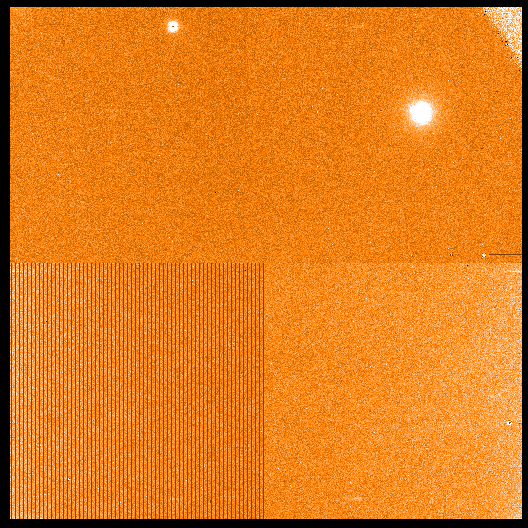
Photometric standard stars are observed in four filters: J, H, Ks, and L_prime whenever possible, preferably in clear and photometric nights at low airmasses. This kind of exposure provides a fundamental parameter: the total sensitivity of the telescope and the instrument.
The naco_img_zpoint recipe reads a stack of jittered standard star images. The frames are subtracted from each other, which makes dark correction unnecessary, and each difference frame is evaluated individually. The subtraction pattern is: #1-#2, #2-#1, #2-#3, #3-#2, #3-#4, #4-3, #4-#5, #5-#4. In current calibration scheme no flat field correction is applied. The recipe provides the median instrumental magnitude (not corrected for extinction and color-terms) that is also written in the PAF. In addition the Strehl ratio is measured. The photometric zeropoint and the peak counts of the PSF is monitored, to check that the observation is recorded in the non-linear regime of the detector dynamic range.
PSF-CALIBRATOR frames: naco_img_strehl
DPR.CATG = CALIB, DPR.TYPE = PSF-CALIBRATOR
Seeing as an observation constraint is available before launching an observation block, Strehl ratio not, hence two Strehl ratio frames are taken optionally before the start of science OBs to check the requested Strehl ratio against the specified value.
The esorex naco_img_strehl recipe reads two raw frames with DPR.TYPE=PSF-CALIBRATOR, determines the Strehl ratio from the difference and writes the results in the fits product. The Strehl ratio is retrieved.
|
|||||||||||||||||||||||||||||||||||||||||||||||||||||||||||||||||||||||||||||||||||||||||||||||||||||||||||||||||||||||||||||||||||||||||||||||||||||||||||||||||||||||||||||||||||||||||||||||||||||||
| |
|||||||||||||||||||||||||||||||||||||||||||||||||||||||||||||||||||||||||||||||||||||||||||||||||||||||||||||||||||||||||||||||||||||||||||||||||||||||||||||||||||||||||||||||||||||||||||||||||||||||||
 |
|
||||||||||||||||||||||||||||||||||||||||||||||||||||||||||||||||||||||||||||||||||||||||||||||||||||||||||||||||||||||||||||||||||||||||||||||||||||||||||||||||||||||||||||||||||||||||||||||||||||||||