European
Southern
Observatory
ESO Science Newsletter December 2025
18 Dec 2025

This newsletter is a summary of recent ESO Science Announcement items. Follow the links or visit ESO Science Announcements to read more.


Science Announcements


Message from the Director General

17 Dec 2025:

Dear colleagues,

After 63 years since its establishment on the basis of international cooperation, ESO is now de facto evolving "from world-class to world-leading", in light of the huge progress within its strategy for the 2020s. Let me share with you some achievements and challenges that developed during 2025.

Read more


ESO Summer Research Programme 2026

16 Dec 2025:

After the great success of the program in the last seven editions, ESO is delighted to announce that the call for applications for the 8th ESO Summer Research Programme is now open. This fully funded program is available to students in STEM fields who have not yet started a Ph.D. program and have completed at least two years of their degree.

Read more


CMF2IMF? The Origin of the Stellar Initial Mass Function, 8-12 June, ESO Garching

12 Dec 2025:

The stellar 'Initial Mass Function' (IMF) is a fundamental observable and a crucial component for the understanding of a vast range of astrophysical processes. It is suspected to have its roots in the mass distribution of dense molecular cloud cores resulting from molecular cloud fragmentation, but what shapes this 'Core Mass Function' (CMF) and how core masses really relate to stellar masses, remains unclear. This ESO workshop will summarize and discuss recent observational and theoretical progress on these questions and explore ways forward with ongoing progress in instrumentation (e.g., ALMA upgrade, ELT(s)).

Read more


MOSAIC: Signature of the Agreement for Construction

12 Dec 2025:

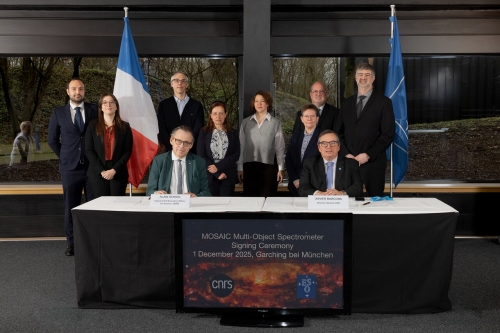
On December 1st, 2025, ESO signed an agreement with a large international consortium for the design and construction of MOSAIC, a Multi-Object Spectrograph for ESO's Extremely Large Telescope (ELT). The consortium is lead by the Principal Investigator Roser Pelló from Marseille Astrophysics Laboratory and includes partners from 14 countries across Europe and beyond. MOSAIC will have complementary capabilities in terms of multiplex, wavelength coverage and spectral resolution compared to the the other instruments under construction for the ELT. 

Read more


Registration and Abstract Submission are Now Open for the ESO Workshop “AGN Feedback Across All Scales and Time”

11 Dec 2025:

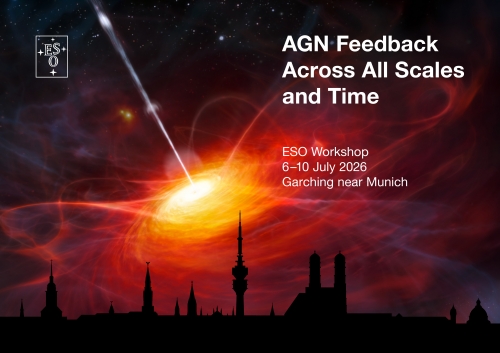
AGN feedback has become a key element in understanding how galaxies evolve. The time is ripe to discuss what has been learned and plan future lines of research also in the context of upcoming facilities. The workshop will take place on July 6-10, 2026, at the ESO Headquarters in Garching near Munich. Do not miss the chance to present your work and participate in shaping the future of this exciting scientific area! The deadline for abstracts is January 15, 2026.

Read more


Approved: UT3 to Gain Adaptive Optics Capabilities with New Deformable Secondary Mirror

11 Dec 2025:

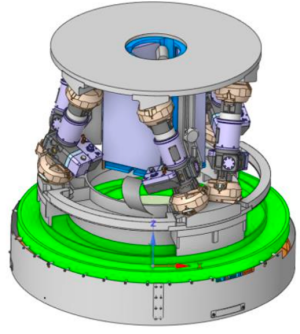
The expansion of adaptive optics (AO) from an "instrument" concept to a "facility" concept, like the AO Facility (AOF) on UT4, has been a huge success. AO is now routinely used on UT4, enabling exquisite science on the smallest spatial scales while providing more stable image quality during longer exposures. This success, however, has led to a large imbalance in telescope pressure factors in the past few periods with many users wanting to benefit from these assets. To address this hurdle and ensure more highly-rated community proposals get scheduled, ESO is launching several key actions. One of these initiatives is the "Second Generation Deformable Secondary Mirror" project (2GDSM).

Read more


The Multi Object Optical and Near-infrared Spectrograph for the VLT (MOONS) on its Way to Paranal

11 Dec 2025:

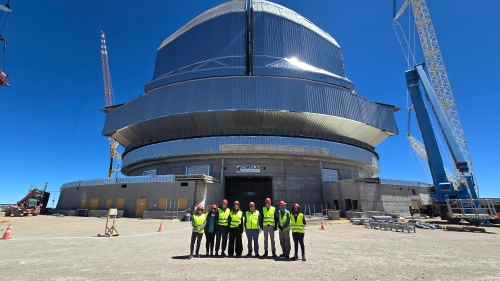
After extensive assembly and testing work at the UK Astronomy Technology Centre (UK ATC) in Edinburgh, ESO and the MOONS team are happy to announce that the instrument is ready for shipping. The testing included not only pure performance aspects, but also of operability in Paranal and safety (among others). MOONS will provide exquisite simultaneous optical to near-infrared spectra for close to 1000 locations at a time (either in high or low resolution mode, R=6000 and R=18000 for the H band, respectively). The instrument will be located at UT1 and will be able to reach objects in the whole 25 arcmin diameter field of view of the telescope. Tools have been produced by the consortium and, in collaboration with ESO, embedded in the ESO "ecosystem" to help the community exploit at maximum the capabilities of MOONS, from highly reddened corners of the milky way to the deepest extragalactic fields. 

Read more


Issue 195 of The Messenger is Available Online

21 Nov 2025:

The latest edition of ESO's Science and Technology Journal, The Messenger, is now available online. This issue 195 focuses on Expanding Horizons, which is the process that ESO has established to define its next major undertaking after the Extremely Large Telescope. Expanding Horizons is an open and inclusive process, in which the whole ESO community is invited to participate. This issue also features an article describing the status of telescopes and instruments that ESO will be providing to the community in the 2030s.

Read more


Upcoming ESO or ESO-related workshops


ESO aims to maintain the VLT and VLTI at the science forefront of astrophysical research in the ELT era. The development of the facilities follows planning that is discussed with the ESO governing bodies to derive the best synergies amongst the facilities. As part of this process, ESO is organising a conference in Garching near Munich (Germany) in January 2026. The meeting will review science topics, emerging technologies and expanding parameter spaces relevant for the VLT/I in the next decade and beyond. The goal of the meeting is to reach a broad community by covering topics and through contributed talks across scientific topics, new technologies, facilities landscapes, operational opportunities. ESO will issue a call for white papers for new projects/instruments for VLT/I during the conference with a deadline a year later, in January 2027, marking the start of the assessment phase.


The stellar 'Initial Mass Function' (IMF) is a fundamental observable and a crucial component for the understanding of a vast range of astrophysical processes. It is suspected to have its roots in the mass distribution of dense molecular cloud cores resulting from molecular cloud fragmentation, but what shapes this 'Core Mass Function' (CMF) and how core masses really relate to stellar masses, remains unclear. This ESO workshop will summarize and discuss recent observational and theoretical progress on these questions and explore ways forward with ongoing progress in instrumentation (e.g., ALMA upgrade, ELT(s))


AGN feedback has become a key element in understanding how galaxies evolve. The time is ripe to discuss what has been learned and plan future lines of research also in the context of upcoming facilities. The workshop will take place on July 6-10, 2026, at the ESO Headquarters in Garching near Munich. Do not miss the chance to present your work and participate in shaping the future of this exciting scientific area! 


Given the success of its first edition, ESO is delighted to announce the second edition of its Summer School on Writing and Communicating your Science to be held in Garching, from 20-24 July 2026. The school will cover important topics such as how to write compelling papers and proposals and how to give convincing talks. Dedicated sessions will further guide you through the process of preparing successful proposals, understand the publication landscape and the refereeing process, write professional job applications, and be prepared for a successful career. The school comprises many hands-on and fun activities to make it an unforgettable experience.