


On December 1st, 2025, ESO signed an agreement with a large international consortium for the design and construction of MOSAIC, a Multi-Object Spectrograph for ESO's Extremely Large Telescope (ELT). The consortium is lead by the Principal Investigator Roser Pelló from Marseille Astrophysics Laboratory and includes partners from 14 countries across Europe and beyond. MOSAIC will have complementary capabilities in terms of multiplex, wavelength coverage and spectral resolution compared to the the other instruments under construction for the ELT.
MOSAIC: Signature of the Agreement for Construction
Published: 12 Dec 2025
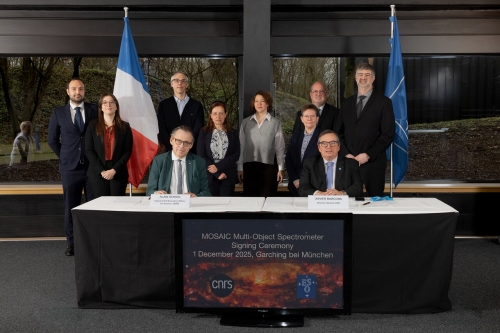
MOSAIC is conceived as a multi-pupose instrument, covering the visible (VIS) and near-infrared (NIR) bandwidth (0.39-1.8 mm) with two different observing modes: spatially resolved spectroscopy thanks to 8 integral field units (IFUs) in the NIR, and multi-object spectroscopy by the simultaneous observation of 180 objects in the NIR and 140 object in the VIS. The instrument will have two different spectral resolutions in both the VIS and the NIR, a low-resolution (R~4000) and a high-resolution (R~18000) mode. MOSAIC is designed to take full advantage of the widest possible field of view provided by the ELT (~40 arcmin2).
MOSAIC is optimized to achieve the best possible signal-to-noise ratio on the faintest sources, from stars in our Galaxy to galaxies at the epoch of reionization. It will cover a wide range of scientific topics including: perform precise measuramente of the ionization state of the intergalactic medium during the first Gyr of the Universe to understand how and when the Universe was re-ionized; conduct a direct inventory of matter in galaxies at z~3, including dark-matter profiles and all gas phases in the circum-galactic medium; perform resolved stellar populations studies in galaxies beyond the Local Group to trace and explore their star-formation and chemical enrichment histories; perform spectroscopic follow-up and populations studies of a wide range of explosive and transient events.