 mirror sites:
PL (internal link)
HQ
[?]
mirror sites:
PL (internal link)
HQ
[?]
Quality Control and
Data Processing
|
 |
Science data
The QC group processes a stream of science-grade data products for selected VLT instruments. They are created using certified pipelines and certified master calibrations. Find an overview of the current streams here.
For GIRAFFE Medusa1/2 modes, more than 1 million science-grade 1D spectral data products are available covering the entire data history. They are available on the phase3 archive interface.  Raw SCIENCE data types
GIRAFFE science data come in two main types: OzPoz (just the OBJECT and SKY fibres illuminated on the sky), and SimCal (with the additional SIMCAL fibres illuminated by the calibration unit). The data types are identified by the DPR TYPE keyword of the FITS headers. Find information about the general GIRAFFE data format and about its CCD here. The information contained in the simultaneous calibration fibres is applied by the pipeline since January 2008. The GIRAFFE science frames come per slit which can be MEDUSA1, MEDUSA2, IFU1, IFU2, or Argus. The SCIENCE varieties further split into two different gratings (HR and LR) with a set of central wavelengths (which are listed here). Note: It is not visible from the DPR TYPE if a FLAMES OB uses UVES and GIRAFFE at the same time, or just GIRAFFE stand-alone.
only science and sky observations; no simultaneous calibration fibre used
SCIENCE products
The GIRAFFE calibration scheme, including SCIENCE data reduction, is shown here.
Recipe giscience
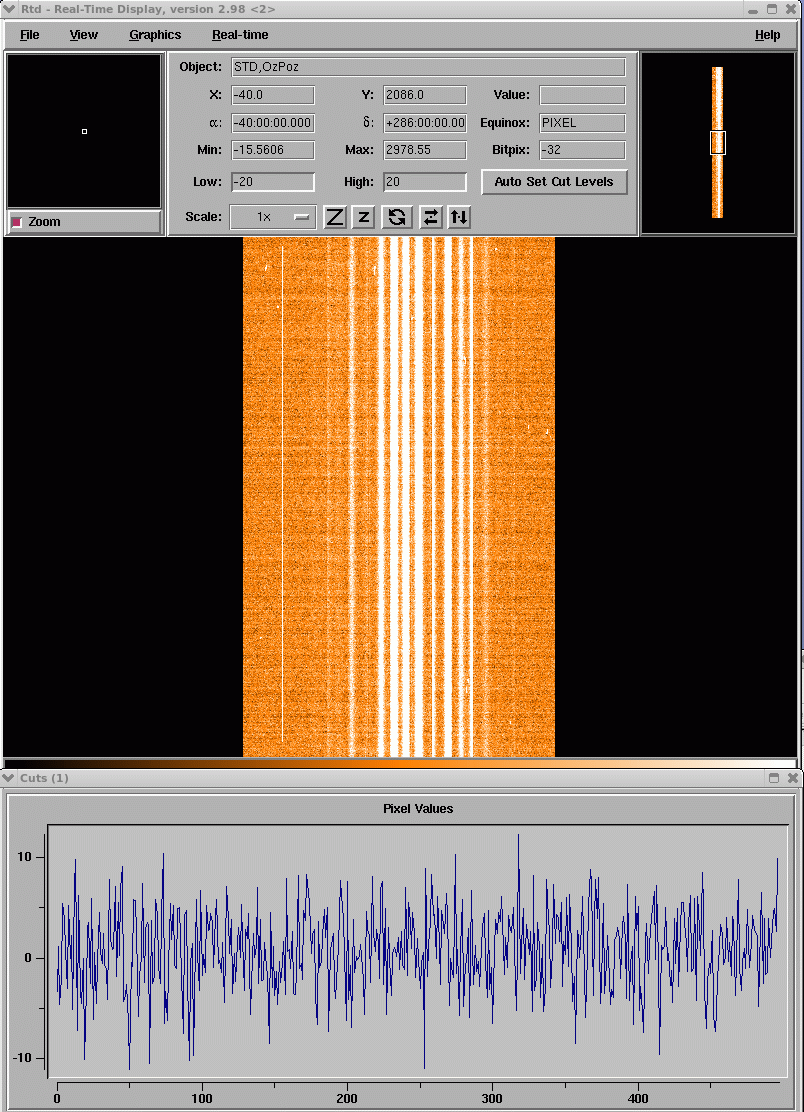
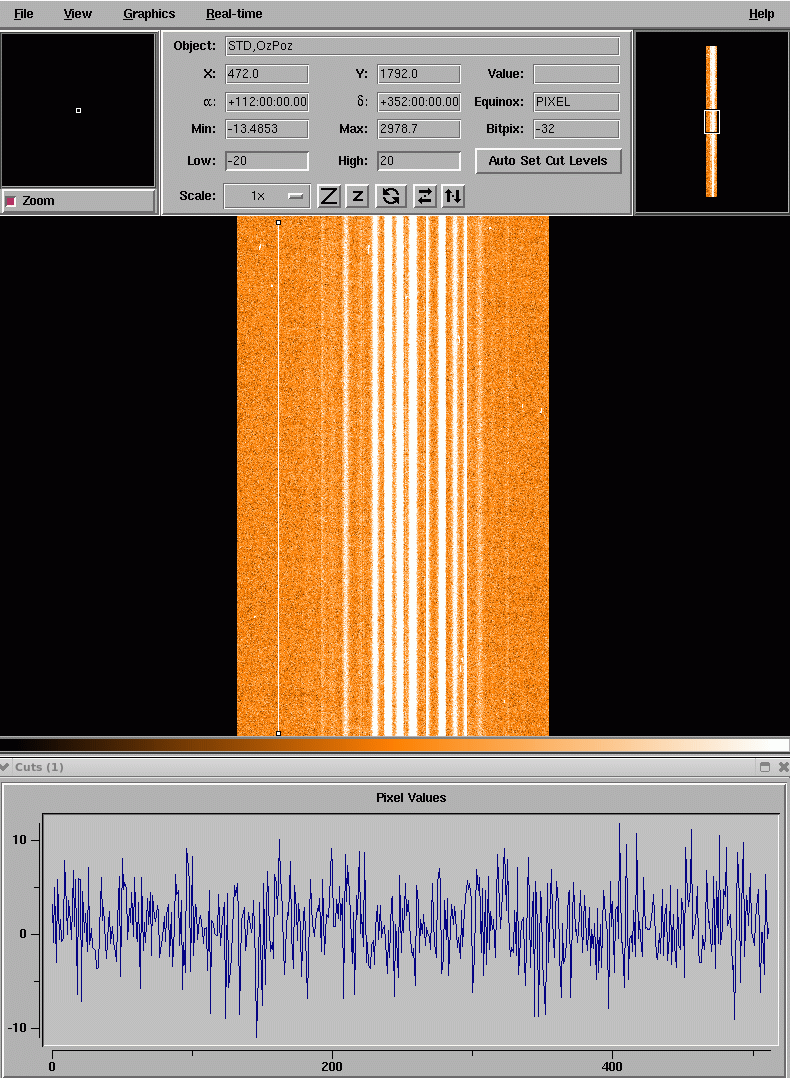
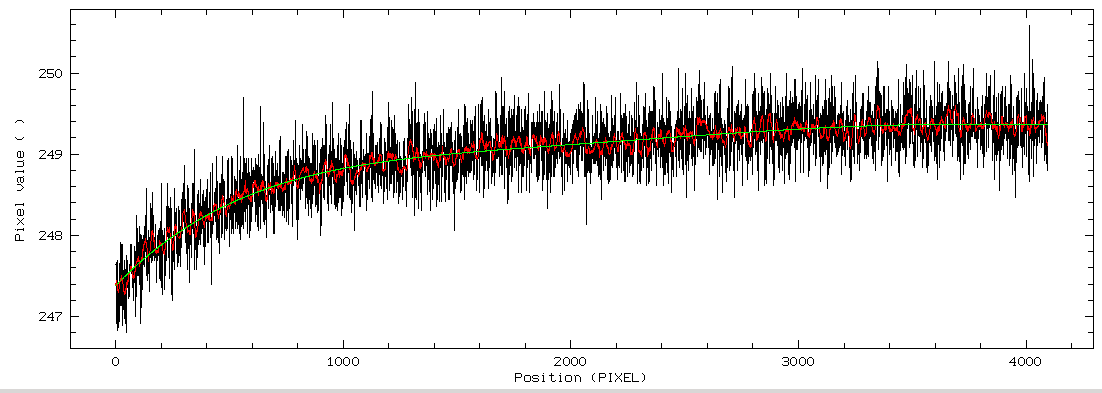
A science raw file is pipeline-processed by the pipeline recipe giscience. Data are corrected for bias. Optionally a bad pixel map can be used to correct for bad pixels. This step is recommended for the old CCD. The fibres are then extracted using the localization and width solutions from the flat field data. They are wavelength-calibrated using the dispersion-solution from the arc-lamp data. The spectra are then flat-fielded, to correct for overall efficiency, relative (fibre-to-fibre) efficiency, and fringing. For IFU and Argus data, a reconstructed image and a full 3D datacube are calculated. For the new CCD (since 2008-05-26), the bias is averaged from the overscan region (columns 1-50) into a 1D profile, and subtracted as a 2D expanded function. This method is called PROFILE (--bsremove-method=PROFILE). It has the advantage that the overall BIAS level is always correct, despite the small fluctuations observed to sometimes occur between BIAS calibration files and SCIENCE files. On the other hand, the overscan region has small residual fluctuations which are probably of random nature. To avoid propagating them as dark and bright stripes and bands into the products of the giscience recipe (and actually also the gistandard recipe), there is the method PROFILE+CURVE which applies a 5th order polynomial fit to the 1d profile before applying the result to the science data.
By default, the GIRAFFE pipeline sums up all pixels within the mask defined in the flat-field localization file (extraction method 'SUM'). An optimum extraction algorithm is also available. The scattered light is more an issue for the IFU modes than for the Medusa data. There is no automatic sky subtraction provided by the pipeline. The sky fibres (either the dedicated ones for IFU and Argus, or the user-defined ones for Medusa) are processed in exactly the same way as the target fibres. For the ESO-provided spectral products (Medusa), the set of reduced SKY fibres is delivered. The user then has to select the one appropriate for the science target (presumably the closest in space, or a suitable average sky). Differences of the fibre-to-fibre efficiency are corrected for by the flat-fielding step. The coefficients used for the correction are stored in the product binary table, column TRANSMISSION. Fringing is removed by the flat-fielding. Image reconstruction for IFU modes In the IFU modes (IFU and Argus), a reconstructed image is processed by the pipeline. It is obtained by collapsing the spectra in dispersion direction, and re-arrange the signal according to the X and Y sky coordinates as provided in the fibre table. There is also the full 3D datacube delivered for Argus (X,Y,wavelength).
|
||||||||||||||||||||||||||||||||||||||||||||||||||||||||||||||||||||||||||||||||||||||||||||||||||||||||||||||||||||||||||||||||||||||||||||||||||||||||||||||||||||||||||||||||||||||||||||||||||
| |
||||||||||||||||||||||||||||||||||||||||||||||||||||||||||||||||||||||||||||||||||||||||||||||||||||||||||||||||||||||||||||||||||||||||||||||||||||||||||||||||||||||||||||||||||||||||||||||||||||
 |
|
|||||||||||||||||||||||||||||||||||||||||||||||||||||||||||||||||||||||||||||||||||||||||||||||||||||||||||||||||||||||||||||||||||||||||||||||||||||||||||||||||||||||||||||||||||||||||||||||||||