ESO Science Outreach Network
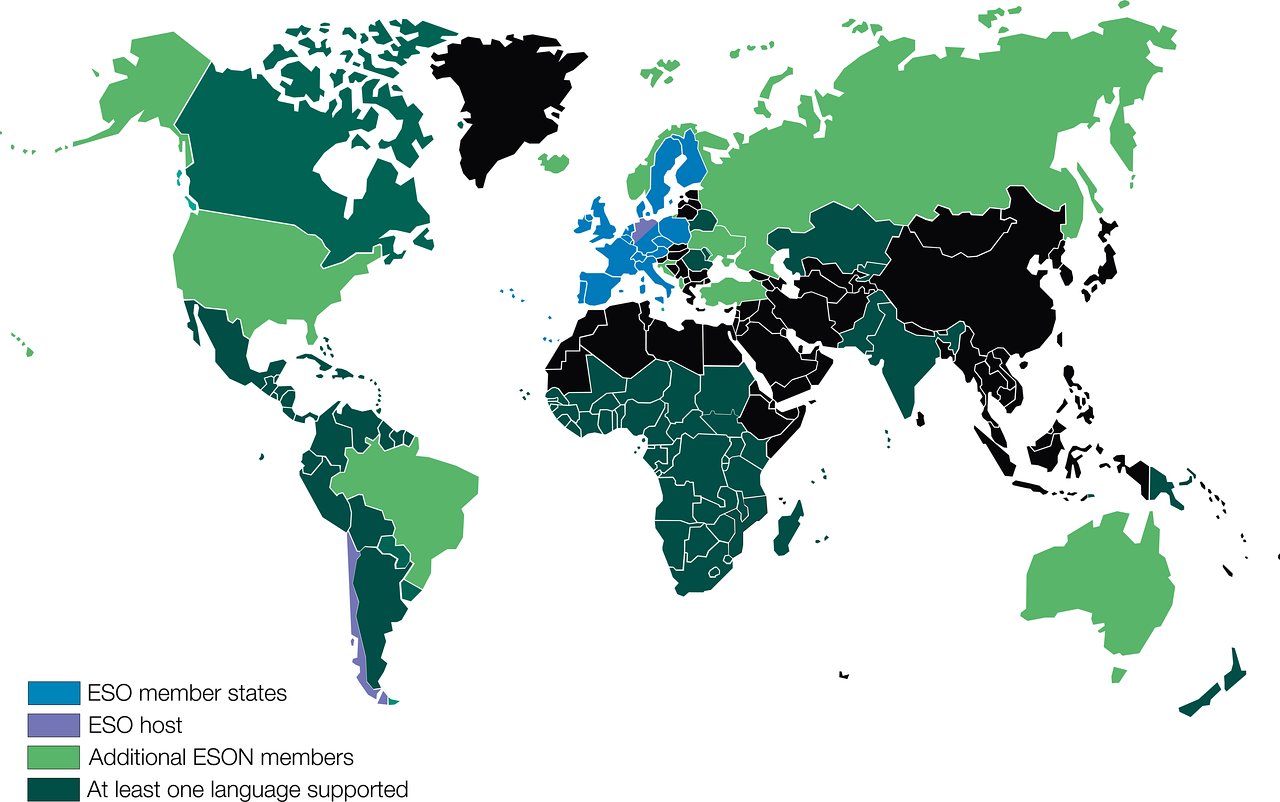
The ESO Department of Communication has established a network of contacts in the ESO Member states and other countries. The goal of this ESO Science Outreach Network (ESON) is to act locally as ESO's media and outreach representative, in order to promote ESO's mission and achievements, and demonstrate the many inspirational aspects of astronomy. The ESON contacts can also serve as interface between the local scientists and the media. The communication between the member states (at the official and scientific levels) and ESO, takes place through ESO's governing bodies, and not through ESON, which deals only with outreach matters.
The ESON members are science communicators who know the national media and stake-holders, and regularly interact with them. They have a strong interest in promoting ESO, and provide regular inputs and ideas for how to best reach the target groups in their area. The ESON nodes are also in charge of translating the ESO material in their national language.
Below is the list of ESON members. If your country is not represented, and if you or your organisation would be interested in acting as ESO's local outreach contact, contact us at information@eso.org.
ESON Countries
| Member States: | ||
| Non-Member States: | Host State: | |
ESON Coordinator
|
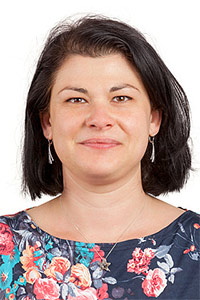 Dr Mariya Lyubenova
ESON Assistant
|
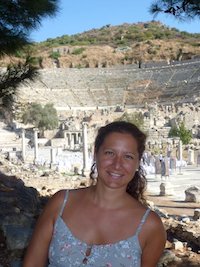 Susana Almagro García
ESO Member States — Contacts and Biographies
AustriaESO mini-site: http://www.eso.org/public/austria/
|
|
BelgiumESO mini-site: http://www.eso.org/public/belgium/
|
|
CzechiaESO mini-site: http://www.eso.org/public/czechrepublic/ 
Anežka SrbljanovićAstronomical Institute of the Czech Academy of Sciences Anežka Srbljanović is a PhD student at the Astronomical Institute of the Czech Academy of Sciences in Prague. Her astronomical journey began at ESO during her six-month internship as a master student in 2019. Since the beginning, she has been studying molecular gas in galaxies — first to see if supermassive black holes are destroying its reservoirs, and now, at the Astronomical Institute, to see if hot intergalactic matter is ripping it out of galaxy disks. Her favourite observatory is ALMA which she utilizes in the exploration of extended gaseous tails behind jellyfish galaxies to find its molecular component. In her spare time, she enjoys lifting weights, singing, hiking, and cooking. She also loves to talk about astronomy, which is why you can find her at open door days, science fairs and in the ESO Science Outreach Network. |
|
DenmarkESO mini-site: http://www.eso.org/public/denmark/ Ole J. KnudsenSAC/IDA, Institut for Fysik og Astronomi Ole J. Knudsen has a B.Sc. in astronomy and physics from University of Aarhus, Denmark and parallel to his work as planetarium manager at the Steno Museum in Aarhus from 1993 to 2014 he served the Danish public and media on all things astronomical and related to science and space research. He is also an experienced lecturer, radio and TV consultant, space expert, populariser and science writer. Ole is a fellow of the British Interplanetary Society and the International Planetarium Society. Hans KjeldsenSAC/IDA, Institut for Fysik og Astronomi |
|
FinlandESO mini-site: http://www.eso.org/public/finland/
|
|
FranceESO mini-site: http://www.eso.org/public/france/ 
Thierry BottiResponsable de la communication After a master’s degree in economics and additional studies in communication, Thierry’s interest in international cooperation took him to the French Ministry of Education and Research. He went on to work in the cooperation and international division of the Ministry, and subsequently for a new French agency called EduFrance (now named Campus France). In both cases he was in charge of promoting French higher education to foreign students. He specialised in Latin American countries, organising numerous events from Argentina to Mexico, via Brazil, Venezuela etc. After that, he decided to spend some years working in South America, taking a new professional direction as deputy director of the Alliance Française in Buenos Aires, which is not only an educational institution dedicated to teaching French, but also a cultural centre and an important media library, offering a large range of activities related to the French language and culture. He then chose once again to turn his knowledge in communication toward another field of activities and found a job at the French National Centre for Scientific Research (CNRS) in charge of the communication department of the Observatoire Astronomique de Marseille Provence. Here he manages many activities including outreach, press relations and public relations. A very exciting job. |
|
GermanyESO mini-site: http://www.eso.org/public/germany/ 
Dr Markus PösselHaus der Astronomie Markus Pössel obtained his diploma in physics from Hamburg University in 1997, staying on for a PhD in quantum gravity, which he completed in 2003. Research for this PhD was carried out at the Max-Planck Institute for Gravitational Physics (Albert Einstein Institute), where Markus also started his slow slide into science outreach, writing several books, editing a popular science website on relativity theory called Einstein Online, and co-curating part of the Einstein exhibition in Berlin in 2005, among other activities. In 2007, he moved to New York as Senior Science Advisor to the newly-founded World Science Festival. In 2009, he returned to Germany, where he is now managing scientist of the Haus der Astronomie (literally the House of Astronomy), a newly-founded Centre for Astronomy Education and Outreach in Heidelberg. In 2010 he became the chief public relations officer at the Max-Planck Institute for Astronomy. 
Dr Carolin LiefkeHaus der Astronomie Carolin has been an amateur astronomer since the impact of comet Shoemaker–Levi 9 on Jupiter in 1994, when she was thirteen years old. Two years later she bought her first real telescope, a three-inch refractor. Today she owns a total of four telescopes, the biggest one a 16-inch dobsonian. Carolin is a member of several astronomy associations and a moderator in the Astrotreff, one of the biggest German-speaking astronomy-related internet communities. Carolin studied physics at the University of Hamburg and worked on stellar activity and X-ray astronomy at the Hamburger Sternwarte for her PhD. Among the highlights of her scientific career were two visits to Paranal, where she observed flare stars with the UVES spectrograph at Kueyen, one of the VLT's 8-metre telescopes. For more than ten years, Carolin has been involved in astronomy education and outreach. In March 2010, she turned this passion into a profession and is now working at the Haus der Astronomie, the Centre for Astronomy Education and Outreach in Heidelberg, where she is responsible for teacher training in astronomy at the University of Heidelberg, astronomy-related projects for high-school students, and for the centre’s telescopes. Carolin is a big fan of science fiction and fantasy. In her spare time, she goes hiking and climbing in the Alps. 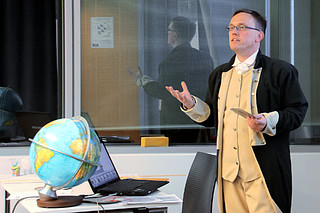
Dr Markus NielbockHaus der Astronomie Markus Nielbock has been fascinated by outer space since his childhood. He studied physics in Bochum and received his doctorate in astrophysics in 2001. He then moved to Chile as an ESO fellow to work on the largest single dish telescope so far based at any of the ESO observatories, the SEST. In 2003 he returned to Germany to intensify his research in the field of star formation. In 2006 he moved to the Max Planck Institute for Astronomy, where he worked for almost 10 years as an instrument scientist for the PACS camera of the Herschel Space Telescope. Since 2015 he has been involved in astronomical education and public outreach at the Haus der Astronomie. There he develops teaching materials, organises public events, gives lectures and workshops, supports the training of teachers and cultivates contacts to classical media such as the press, radio and television. He also acts as a contact person for topics relating to space flight. Since 2018 he has also been employed as a public information officer at the Max Planck Institute for Astronomy. For many years he has been enthusiastically involved in several astronomically oriented associations in Germany and Switzerland and has inspired people for space and astronomy. His passion is to bring the Universe closer to as many people as possible. Markus is a fan of Star Trek and Stanislaw Lem. His second major project is his daughter, who has been severely affected by an innate rare genetic defect. Through press activities and fundraising, he works to ensure that the disease BPAN becomes known and can be treated and finally cured through progress in medical research. |
|
IrelandESO mini-site: http://www.eso.org/public/ireland/ Rob O’Sullivan
|
|
ItalyESO mini-site: http://www.eso.org/public/italy/ 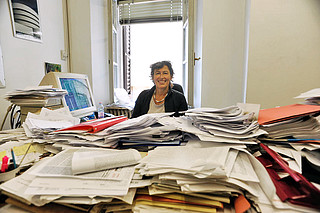
Anna WolterVia Brera, 28 Anna Wolter is an astrophysicist, and has been working at the INAF–Osservatorio Astronomico di Brera in Milan, Italy since 1991. After a physics degree in Milan she began her scientific career at the Harvard–Smithsonian Center for Astrophysics. There she helped to construct one of the best-exploited surveys of X-ray sources, serendipitously found in the Einstein Observatory images, the Extended Medium Sensitivity Survey (EMSS). She has dealt with all kinds of X-ray emitters, from stars to clusters of galaxies, but her main interest was with the class of the highly luminous and variable galaxy nuclei called BL Lacs. More recently she has moved from the point-like sources at the centres of galaxies to the diffuse/unresolved emission within them. She now devotes much of her time to the study of ultraluminous X-ray sources, a puzzling class of sources in external galaxies, which probably harbour heavy black holes, intermediate in mass between the light stellar ones and the supermassive nuclei at the centre of galaxies. Part of the time she focuses on the statistical analysis of complete samples, deriving luminosity functions, and for the remainder she studies in detail a few selected and complex objects, like galaxies, which have many different components that contribute to the overall emission. The main wavelength of interest is always X-ray, but Anna believes that a multiwavelength approach is important for a complete insight into an astronomical problem and so has worked with almost every energy band accessible. She is Principal Investigator of optical, radio, X-ray and gamma-ray observations of various celestial sources. She is author and co-author of about a hundred papers in refereed journals and about as many contributions to International meetings. In the last ten years she has devoted a significant fraction of her time to both teaching and outreach activities. She delivers lectures on key topics as part of the astrophysics curriculum at the Milan universities, and tutors Laurea and post-Laurea students. She delivers conferences and lectures for the public and for high school and middle school classes on various astrophysical topics. |
|
The NetherlandsESO mini-site: http://www.eso.org/public/netherlands/
|
|
PolandESO mini-site: http://www.eso.org/public/poland/ 
Dr Krzysztof CzartUrania – Postępy Astronomii Krzysztof Czart is an astronomer and science journalist. He graduated in astronomy at the Nicolas Copernicus University in Toruń, the city where Nicolas Copernicus was born. His main scientific interests are stellar spectroscopy, variable stars, massive stars, Wolf–Rayet stars and OB associations. He is a member of the Polish Astronomical Society and the author of hundreds of news articles about astronomy, astronautics and space research on internet portals, as well as many popular articles about astronomy in printed magazines. He created the English–Polish and Polish–English Astronomical Dictionary used by many internet dictionaries (including Onet.pl) as well as the Astronomical Dictionary of the Polish Astronomical Society. He has also worked for television, preparing data and texts about astronomy that were broadcasted every day by the TVN Meteo channel. He is co-author of the "Astronarium" television series in the Polish Television (TVP). He created Astronomia.pl — the Polish Astronomy Portal, which was the biggest and the most popular astronomical portal in Poland. He was Editor in Chief of the portal since its launch in 2001 until 2011. Krzysztof was also editor of the Kosmos – Tajemnice Wszechświata astronomy magazine. He collaborates with the science section of the Polish Press Agency and is editor of Urania – Postępy Astronomii astronomy magazine. While his main specialisation is communicating astronomy through written text and over the internet, he has taken part in many other activities, including leading guided tours at an astronomical observatory, giving lectures for school students and amateur astronomers, participating in science festivals and bringing exciting international projects in education and the communication of astronomy to Poland. |
|
PortugalESO mini-site: http://www.eso.org/public/portugal/ 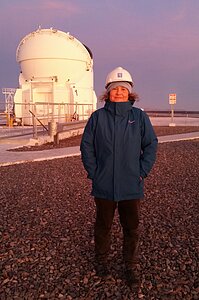
Dr. Margarida Serote RoosInstituto de Astrofísica e Ciências do Espaço Margarida Serote holds a PhD in astrophysics (University of Paris 7, 1996). Her main research field concerned extragalactic astronomy, namely the study of active galactic nuclei in terms of their stellar populations. She has also worked on large-scale structures, trying to understand the effects of redshift and environment in clusters of galaxies. For almost 14 years Margarida worked as a scientist at the Paris–Meudon Observatory, France, and afterwards at the Lisbon Observatory, Portugal. She has been actively promoting astronomy to the public ever since she started her undergraduate studies in 1986, by giving talks, courses, leading planetarium shows and writing popular articles. For four years she edited a monthly publication of the Lisbon Observatory, distributed on a national level to all secondary schools and was a founding member of the Portuguese Astronomical Society. More recently she has started working as a film producer. Together with her husband, she runs a small film company called Lightcurve Films. They have produced over 35 films, mostly on topics related to astrophysics, often with an educational angle and aimed at younger students and a general audience. Margarida also translates scientific books. |
|
SpainESO mini-site: http://www.eso.org/public/spain/
|
|
SwedenESO mini-site: http://www.eso.org/public/sweden/ 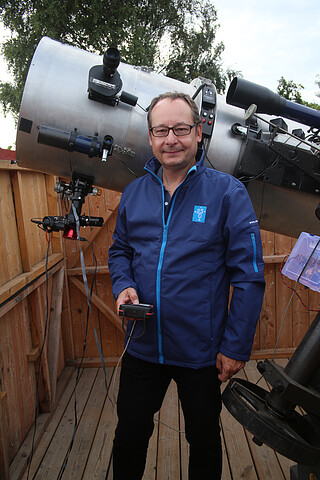
Dr. Johan WarellLindby 229 Johan has a lifelong interest in astronomy. He studied astronomy at Uppsala University and completed his PhD in 2003, after which he spent his post doc at the Lunar and Planetary Institute in Tucson and the Max-Planck Institut für Aeronomie in Katlenburg-Lindau. His main research focus was the mineralogy, light scattering and grain properties of the regoliths of Mercury, the Moon and minor bodies. As an assistant professor in Uppsala he managed the operations of the Westerlund Telescope and the public outreach activities at the Department of Astronomy and Space Physics. Since 2010 he has been the science and technology editor at Nationalencyklopedin in Malmö, working with digital encyclopedias and teaching services. He also writes and produces online primary and high school curriculum courses in physics and technology. His amateur astronomical interest started in the third grade when he learned from his school teacher that "light can travel seven times around the Earth in the same time you say 'bag'." Between 2003 and 2020 he was president of the Swedish Amateur Astronomical Society (www.saaf.se), and is now running the Remote Telescope Section and the society's telescope in southern Spain. He operates a private observatory with a home built 52 cm Newtonian, focusing on planets, comets, occultations and the deep sky. He shares his data with international organisations, participates in pro-am projects such as JunoCam for the Juno mission, and is assistant administrator for the COBS comet database. Johan lives with his family in rural Skåne in the southernmost part of Sweden. While not under the stars, he enjoys practical meteorology and science fiction, spending time in nature, playing squash and tinkering with home improvement and telescope projects. |
|
SwitzerlandESO mini-site: http://www.eso.org/public/switzerland Mr. Joerg GasserDorfstrasse 26 8556 Illhart Switzerland E-mail: eson-switzerland@eso.org Joerg's interest in astronomy took root in his youth, where he fostered his passion by crafting his own telescopes, enabling him to explore space from his backyard. As he grew, he furthered his involvement by becoming a demonstrator at his local public observatory, sharing his enthusiasm and knowledge with others. Despite his early passion, he pursued diverse academic interests, earning degrees in Economics, International Relations, and Arabic at the University of Zurich and the University of Damascus. After a decade of fieldwork in the Middle East, Joerg shifted his focus to the governmental sector, serving inter alia as Secretary of State of International Finance before assuming the role of CEO of the Swiss Bankers Association until 2023. Upon concluding his professional tenure, he devoted himself to astronomy, balancing his commitments as a consultant, entrepreneur, and board member with his celestial endeavours. Currently completing a master's degree in Astronomy at Swinburne Technical University in Melbourne, Joerg operates his own automated observatory in Eastern Switzerland, specializing in observing asteroids and calculating their orbits. He is member of the American Association of Variable Star Observers and of Dark Sky Switzerland. When not stargazing, Joerg enjoys spending time with his dogs & cats, camping, and tinkering with his observatory's equipment. His commitment to both scientific exploration and preserving the natural beauty of the night sky reflects his commitment to understanding the universe and to safeguarding the biosphere in its entirety. |
|
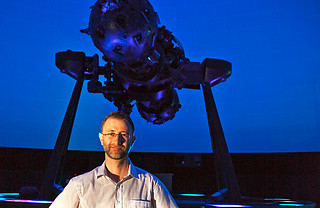
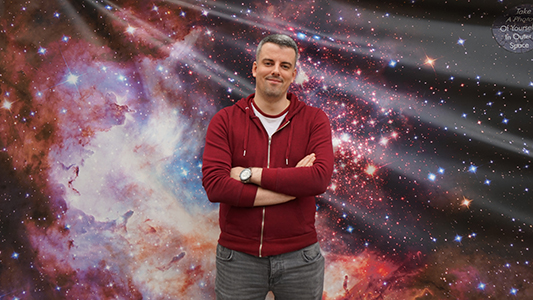
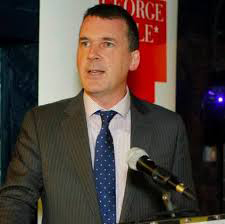
United KingdomESO mini-site: http://www.eso.org/public/unitedkingdom/ Alexander FyansInternational and Research Programme Media Manager Jake Gilmore
Co-Head of Communications |


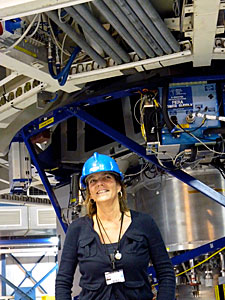


ChileESO mini-site: http://www.eso.org/public/chile/ Cristian SotoESO Santiago Office – |
|
AustraliaESO mini-site: http://www.eso.org/public/australia/ Dr. Stuart Ryder
Program Manager, Astronomy Australia Limited Phone: +61 3 9850 9372 (office) Stuart Ryder is based in Sydney, Australia and works for Astronomy Australia Ltd (AAL) as a Program Manager supporting Australia’s engagement with ESO. AAL is a not-for-profit company that aims to provide Australian astronomers with access to world-class national and international astronomy research infrastructure. Stuart holds a PhD in astrophysics from the Australian National University. His research focuses on the discovery and evolution of core-collapse supernovae, as well as identifying their progenitor stars. Before joining AAL in 2018, Stuart managed the Australian Astronomical Observatory’s International Telescopes Support Office, coordinating Australian access to telescopes including Gemini, Magellan, Keck, and Subaru. Stuart is also an Adjunct Fellow with Macquarie University. He regularly participates in outreach activities, and has led total solar eclipse viewing expeditions to Mexico, Chile, Mongolia, the Caribbean, Turkey, China, Australia, and the USA. Jim Fettes
Communications Manager, Astronomy Australia Limited Web: http://www.astronomyaustralia.org.au/ Jim Fettes is based in Melbourne, Australia and works as Communications Manager at Astronomy Australia Ltd (AAL). AAL is a not-for-profit company that aims to provide Australian astronomers with access to world-class national and international astronomy research infrastructure. Jim holds a Bachelor of Communication (Journalism) from RMIT University and worked as a journalist with Australia's national broadcaster in Melbourne and Canberra. Jim's foray into science communication began at Australia's national science agency, CSIRO, where he led communications for the agency's Space Research Program. He's also worked in not-for-profit and higher education public relations, and at the Australian Embassy in Bangkok. Jim is completing his Master of Science (Astronomy) at Swinburne University of Technology, with a particular interest in planetary science. |
|
Brazil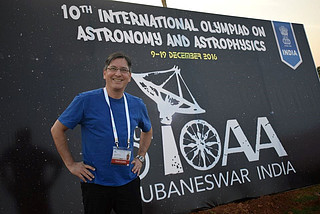
Dr Eugênio Reis NetoOlimpíada Brasileira de Astronomia e Astronáutica — Instituto de Física - UERJ (Universidade do Estado do Rio de Janeiro) Eugênio has a Master's degree in Astronomy and a PhD in Geophysics (2009) from the Observatório Nacional in Rio de Janeiro, having designed and developed a heliometer, a special solar telescope that accurately measures small variations in the diameter of the Sun's photosphere. In the last 5 years Eugênio has worked as a Coordinator of Science Education at the Museu de Astronomia e Ciências Afins (MAST) in Rio de Janeiro, working mainly in the following areas: lectures, seminars and workshops, with emphasis on dissemination and popularisation of science; organisation, coordination and realisation of scientific popularisation events in cities in the state of Rio de Janeiro; programs of continuing development for teachers and for graduate or undergraduate students; and the development of teaching materials specially designed for younger learners. Eugênio is the National Vice-coordinator of the Brazilian Astronomy and Astronautics Olympiad (OBA), a scientific Olympiad in which about 750,000 elementary and high schools students from all over Brazil participate. He is also responsible for the selection and training of the students for the Latin American Astronomy and Astronautics Olympiad (OLAA) and for the International Olympiad on Astronomy and Astrophysics (IOAA). |
|
HungaryRóbert Szabó
|
|
Iceland
Sævar Helgi BragasonCenter for Astrophysics and Cosmology Sævar was born on 17 April 1984 in Reykjavik, Iceland. Fascinated by astronomy for as long as he can remember, he became hooked when he saw Saturn through a telescope for the first time at a very young age. Sævar did not head straight to university after he finished high school, but became a high school teacher in physics and astronomy for two years. After that, he started undergraduate studies in geology at the University of Iceland, with the aim of becoming a planetary geologist, but he soon discovered that his heart belonged to astrophysics. Therefore, he decided to start studying astrophysics in Denmark in late 2011. He is mostly fascinated by observational astrophysics, and the search for exoplanets in particular. Along with his studies, Sævar works as a science communicator/Public Information Officer for the Centre of Astrophysics and Cosmology at the University of Iceland. He is also an editor of the Icelandic astronomy website http://www.stjornuskodun.is and chairman of the Amateur Astronomical Society. He runs a small company called Sjónaukar.is which specialises in selling telescopes and other equipment for stargazers. Other interests involve hiking, travelling, playing and watching football (a passionate Liverpool fan), photography and relaxing in front of his HDTV. He loves seeing the Universe with his own eyes, but his greatest joy is watching his son growing up. 31 December 2010 was the best day of his life — when he witnessed his fiancée give birth to their son. |
|
Norway
Maria HammerstrømUniversity of Oslo Maria has a Master’s Degree in Astrophysics from the University of Oslo, Norway. She is also an astronomy blogger and a graphic designer. Visit Maria’s personal web page. |
|
Russia
Dr. Kirill MaslennikovThe Central (Pulkovo) Astronomical Observatory of Russian Academy of Sciences |
|
Turkey
Arif SolmazUniversity of Cag |
|
United States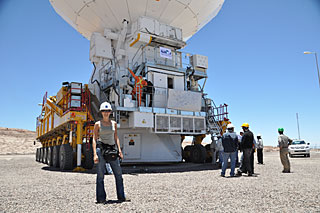
Dr. Paola RebuscoESO Science Outreach Network |