SINFONI SCIENCE data have been processed by the pipeline with the best available
calibration data. Please note that ESO is not assuming any responsibility in respect
to the usefulness of the reduced data. The adopted reduction strategy may not
be suitable for the scientific purpose of the observations.
Notes. The SINFONI science
recipe sinfo_rec_jitter provides several ways to subtract the sky spectrum
and to coadd individual cubes (PRO.CATG = OBS_OBJ) to a coadded cube (PRO.CATG
= COADD_OBJ). The strategy does not depend on the used template but on
the number of raw SCIENCE input frames and the number of frames with DPR.TYPE
= SKY_NODDING.
pipeline version 2.0.8:
In case the science raw file
stack contains SKY frames, the closest in times observed SKY frame is extracted
from each DPR.TYPE = OBJECT frame. The SKY subtracted OBJECT frames are coadded,
according to the information given in the CUMOFFSET fits header keys.
The offsets in pixel units are PixelX = -2 * CUMOFFSETX; PixelY = 2 * CUMOFFSETY
(this convention may change from Oct 1, P76 on).
In
case the science raw file stack does not contain any SKY frames, several strategies
are provided:
MEDIAN_STACKING: The parameter sinfo.objnod.autojitter_method=2 in the configuration file sinfo_rec_jitter. The median of each pixel is considered
to be SKY and is subtracted from each OBS_OBJ frame.
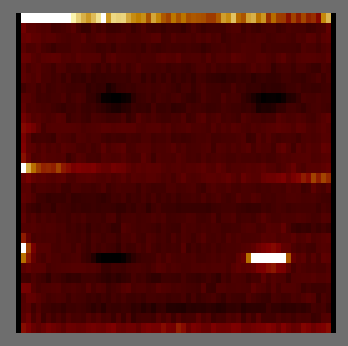
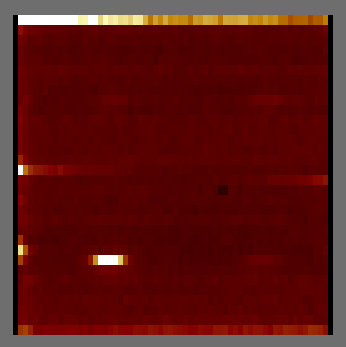
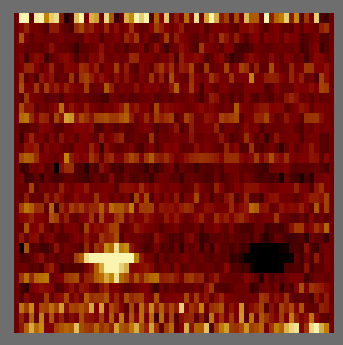
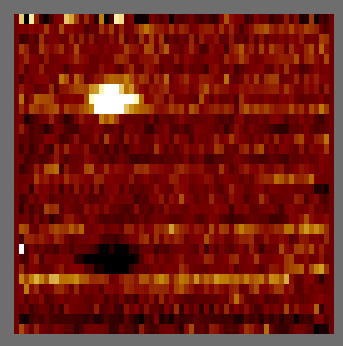
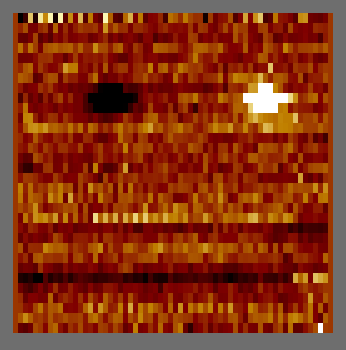
The following example
of four OBS_OBJ cubes (here the median collapsed in z is shown with 99%-cuts)
frame
1 minus frame 2
frame 2 minus frame 1
frame
3 minus frame 2
frame 4 minus frame 3
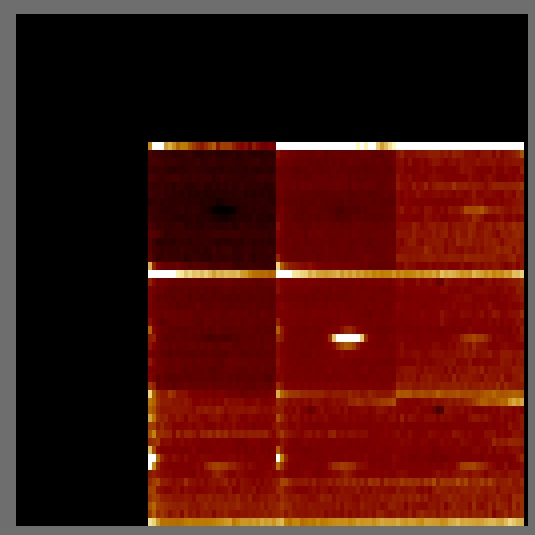
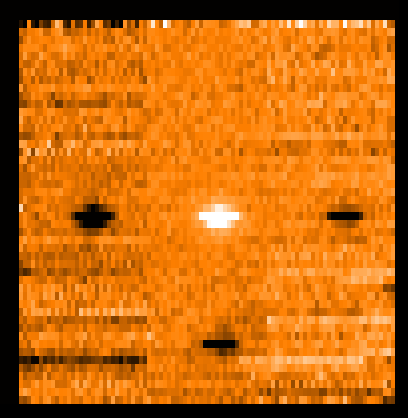
The
final coadded product (again median collapsed) looks like this: The
first sky subtracted cube appears in the center of the final COADD_OBJ cube. The three other cubes are coadded accordingly.
SKY_IS_NEXT: The
parameter sinfo.objnod.autojitter_method=1 in the configuration
file sinfo_rec_jitter. Pairs of consecutive OBS_OBJ frames are
generated, of which one is subtracted from the other as sky. Sources in the subtracted
frame appear as sources with negative flux in the final COADD_OBJ product.
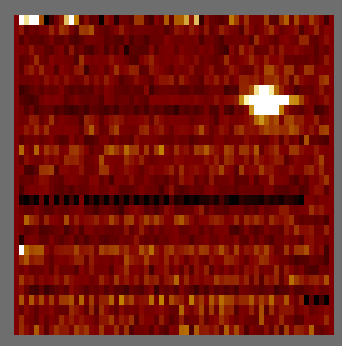
The
following example of four OBS_OBJ cubes (here the median collapsed in z
is shown with 99%-cuts)
frame
1 minus frame 2
frame 2 minus frame 1
frame
3 minus frame 2
frame 4 minus frame 3
The
left negative source is twice as strong, since it is frame 3 (subtracted from
frame 4) and frame 2 (subtracted from frame 1). The closest in time frame
of the stack is used as sky to be subtrcated.
It can be the previous or the next
frame of the science stack.
The final coadded product (again median collapsed)
looks like this:
The sinfo.objnod.autojitter_method=0 in the configuration file sinfo_rec_jitter. No sky is subtracted.
pipeline version 2.0.8 (used for date from ~2009-10-10 on),
as for 1.0.6, SKY frames are subtracted, in case they are part of the raw frame
stack. If there is no SKY frame given, then:
sinfo.objnod.autojitter_method=0 in
the configuration file sinfo_rec_jitter : No sky subtraction. This method
is also applied in case a single OBJECT raw frame is submitted (no SKY).
sinfo.objnod.autojitter_method=1 in
the configuration file sinfo_rec_jitter :
use SKY_IS_NEXT method
subtract the dummy sky from the OBJECT
each processed OBJECT frame is cube reconstructed (PRO.CATG = OBS_OBJ):
jitter_int = 1 : coadded cube is generated
scales_sky = TRUE : spatial median subtracted from each plane of the reconstructed
cube to take out temporal residuals of the sky
ks_clip = TRUE : kappa-sigma clipping applied to each pixel after cube aligning
(= in the set of co-aligned OBJECT frames), to mask cosmics and hot pixels.
sinfo.objnod.autojitter_method=2 in
the configuration file sinfo_rec_jitter: SKY_IS_NEXT method
sinfo.objnod.autojitter_method=3 in
the configuration file sinfo_rec_jitter: MEDIAN_STACKING method
In case science stacks contain embeded SKY frames, it
is assumed there are reasons for that observing strategy (e.g. filamenteous
background). In this case the SKY frames itself are used to correct OBJECT
frames.
pipeline version 1.0.9 (used for date from ~2005-07-06 on)
sinfo.objnod.autojitter_method=0 in
the configuration file sinfo_rec_jitter : No sky subtraction. This method
is also applied in case a single OBJECT raw frame is submitted (no SKY).
sinfo.objnod.autojitter_method=1 in the
configuration file sinfo_rec_jitter :
use SKY_IS_NEXT method
subtract the dummy sky from the OBJECT
sinfo.objnod.autojitter_method=2 in the
configuration file sinfo_rec_jitter: MEDIAN_STACKING method
sinfo.objnod.autojitter_method=0 : The
individual object cubes are not sky subtracted. SKY is subtracted as part
of the co-adding.
scales_sky = TRUE
ks_clip = TRUE
jitter_int = 1
Input
TPL.ID (one of)
SINFONI_ifu_obs_AutoJitterOffset
TPL.ID
SINFONI_ifu_obs_FixedSkyOffset
TPL.ID
SINFONI_ifu_obs_GenericOffset
TPL.ID
SINFINI_ifu_obs_AutoJitter
DPR.TYPE
OBJECT
DPR.TYPE
SKY (optional, but never for AutoJitter)
TAG
OBJECT_NODDING
TAG
SKY_NODDING (optional,
but never for AutoJitter)
required
master calibrations
MASTER_FLAT_LAMP (from mflat)
required
master calibrations
MASTER_BP_MAP (from mflat )
required
master calibrations
WAVE_MAP (from wavecal)
required
master calibrations
DISTORTION (from distortion)
required
master calibrations
SLITLES_DISTANCE (from distortion)
required
master calibrations
required
master calibrations
grouping
INS.SETUP.ID
= S1_J, S2_H, S3_K, S4_H+K
grouping
INS.OPTI1.NAME
= 0.025, 0.1, 0.25
grouping
OBS.ID,
OBS.PROG.ID
recipe/call
esorex sinfo_rec_jitter sof
recipe
configuration file
sinfo_rec_jitter.rc
Products.
PRO.CATG
contents
COADD_OBJ
coadded cube
MASK_COADD_OBJ
Integer cube mask, showing the weighting factors in units of integration
time in seconds.
OBJECT_NODDING_ STACKED
sky-subtracted
and distortion corrected intermediate products, not wavelength
calibrated, not cube reconstructed. There are several instances of this intermediate
product.
OBS_OBJ
as OBJECT_NODDING_STACKED, but cube reconstructed, not coadded. Scaling of
SKY and kappa-sigma clipping not yet applied; is part of the co-adding. There
are several instances of this intermediate product.
SKY_MED (to be verified)
median collapsed SKY cube intermediate product
SKY_STACJKED_DUMMY
constructed
sky frame. In case of method MEDIAN_STACKING, the first instance
is the second OBJECT frame. There are several instances of this intermediate product.
MED_COADD_OBJ
median collapsed COADD_OBJ
QC parameters
QC.FRMON.MEANFLUX
mean flux (ADU) of on-lamp frame
QC.FRMOFF.MEANFLUX
mean flux (ADU) of off-lamp frame
QC.FRMDIF.MEANFLUX
mean flux (ADU) of on-lamp - off-lamp frame
QC.FRMON.MAXFLUX
max flux (ADU) of on-lamp frame
QC.FRMOFF.MAXFLUX
max flux (ADU) of off-lamp frame
QC.FRMDIF.MAXFLUX
max flux (ADU) of on-lamp - off-lamp frame
QC.FRMON.NPIXSAT
number of saturated pixels in on-lamp frame
QC Reports for SCIENCE Frames.
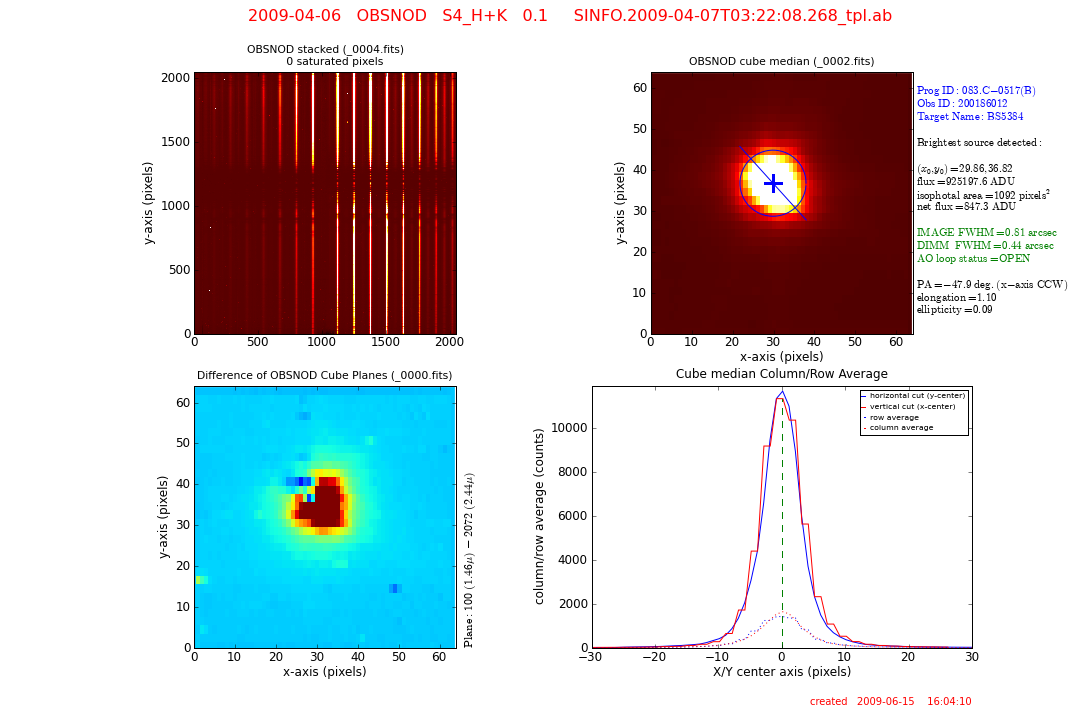
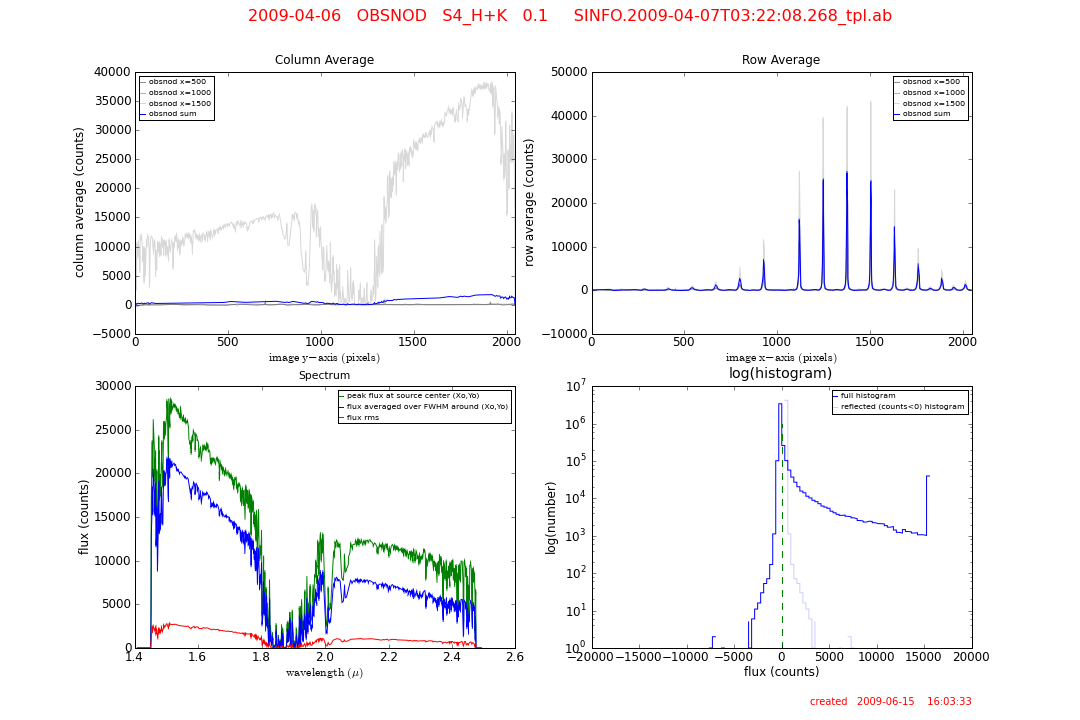
To aid in the assessment of the quality of a given science OB a number of QC plots are created. These plots are included in the Service Mode distribution.
QC Report 1QC Report 2
QC Report 1: UL: the OBJECT_NODDING_STACKED full detector intermediate science image with the number of saturated pixels listed. UR: the MED_COADD_OBJ median cube collapsed science image. A number of paramters are listed: the Program ID, the Obs ID, the target name, and for the brightest source detected:
source center (pixels), the integrated flux (within 3 sigma), the isophotal area (3 sigma), the net flux per pixel, the image FWHM (arcsec), the DIMM seeing corrected for the same airmass and filter used by this standard star, the status of the AO loop (OPEN or CLOSED), the position angle of the brightest source (degrees CCW from the x-axis), and its elongation and ellipticity.
The source center, its position angle, and its FWHM are marked on the image. NOTE: The conversion from pixels to arcsec for the image FWHM takes into account the fact that the reconstructed SINFONI cube has rectangular pixels. The reconstructed pixels are such that on-sky Delta_X = 0.5*Delta_Y. The correct conversion, in terms of the source position angle (PA), is:
pixel_scale is given by the keyword INS.OPTI1.NAME. LL: the (scaled) difference between two cube planes. Plane 100 - Plane 2072. The wavelengths of these planes are listed to the right of this image. LR: a horizontal (blue line) and vertical (red line) cut through the center of the brightest detected source of the MED_COADD_OBJ median cube collapsed science image. The respective averages through this center are shown as dotted lines.
QC Report 2: UL: three single column traces of the current product (OBJECT_NODDING_STACKED) through: x = 500 (dark grey), x = 1000 (middle grey), x = 1500 (light grey) and an averaged sum of all columns (blue). UR: three single row traces of the current product (OBJECT_NODDING_STACKED) through: x = 500 (dark grey), x = 1000 (middle grey), x = 1500 (light grey) and an averaged sum of all rows (blue). LL: the background-subtracted spectrum of the brightest science source. This spectrum is computed by the post-pipeline script QCsinfo_sci.py. The green line is the peak flux extracted from each cube plane at the position of the brightest source, whereas the blue line is the average flux over the FWHM measured for the brightest source. The red line is an estimate of the flux rms. LR: a logarithmic histogram of the OBJECT_NODDING_STACKED full detector image is shown as a dark blue line, while the reflection of the non-positive flux histogram is shown in light blue.
QC Report 3 (only created if an over-flux is detected!)
QC Report 3 TOP: a logarithmic histogram of the OBJECT_NODDING_STACKED full detector science image with the persistence critical region shown as a red dotted line. LL: the OBJECT_NODDING_STACKED full detector intermediate product image. LR: an estimate of the location of possible persistence critical pixels.
![[ ESO ]](/images/eso-logo.gif)






![[ESO]](/images/icon-home.gif)
![[Index]](/images/icon-index.gif)
![[Search]](/images/icon-search.gif)
![[Help]](/images/icon-help.gif)
![[News]](/images/icon-whatsnew.gif)