UVES sky emission spectrum
Note
Purpose
In any UVES exposure of sufficiently long integration time, the atmospheric
air glow imprints a spectrum in addition to the scientific target. This
spectrum is the combination of airglow emission lines, telluric absorption
lines and the solar spectrum due to scattered moonlight.
The solar spectrum as measured with UVES is available both as plots and
FITS file elsewhere. This page here
describes the UVES sky spectrum obtained under dark conditions, i.e. in
absence of contamination by moon light.
The primary purpose is to provide line identifications and positions
for checks of the stability of the wavelength scale. Furthermore, the
sky spectra may be useful as templates for reducting spectra from extended
objects. Also, the faint airglow emission lines in the blue range have
not yet been extensively monitored at all, in contrast to the much stronger
sky emission lines in the red. The airglow lines may be useful for non-astronomical
purposes as well, for instance in aeronomy.
Acquisition
The sky emission spectrum has been constructed from deep science exposures.
These data have been selected according to the following criteria:
- 2x2 binning
- exposure time 1 hr or more
- seeing 1 arcs or better
- moon contamination minimal (fractional lunar illumination less than
0.05).
All data have been obtained in Service Mode runs as science exposures.
The sky spectra are by-products of these data.
Most data have been collected around new moon of June 2001 (nights 2001-06-20...22).
Some spectra have been added from the new moon periods 2001-07 (nights
2001-07-18...2001-07-21) and 2001-08 (nights 2001-08-16...19). We have
evaluated the four standard settings 346_DI1, 437_DI2, 580_DI1 and 860_DI2
which cover together the whole wavelength range accessible to UVES, with
very small gaps in the extreme red (due to incomplete coverage of the
echelle orders by the CCDs). To cover the gaps at5800 A and 8600 A, we
have added short portions of spectra taken at central wavelengths 5640
and 8000. The slit width in all spectra has been 1.0 arcs.
| setting* |
range (A) |
number of spectra |
total exposure time (h) |
| 3460 DI1 2x2 |
3140 - 3760 |
7 (2001-06)+ 9 (2001-08) |
16.0
|
| 4370 DI2 2x2 |
3740 - 4940 |
9 (2001-06) + 3 (2001-07) |
13.2 |
| 5800 DI1 2x2 |
4800-5800,
5800 - 6760 |
7 (2001-06) |
7.0 |
| [5640 DI1 2x2 |
5700-5900 |
10 (2002-07 ... 2002-10) |
10] ** |
| 8600 DI2 2x2 |
6700 - 8560,
8600 - 10430 |
9 (2001-06) |
9.0 |
| [8000 DI2 2x2 |
8530-8630 |
8 (2003-09-22) |
8] ** |
|
* central wavelength, dichroic filter, binning
** this range has been added later, to fill the gaps at
5800 and 8600 A
Reduction
The spectra have been reduced with the UVES
pipeline. Two steps were necessary:
- All spectra per setting and per period have been combined and stacked,
in order to remove cosmic ray hits. This step has used the uves_cal_mkmaster
recipe which is usually employed to stack raw BIAS or FLAT data. Cosmic
ray removal has been very efficient.
- The stacked science data have then been used as input for the standard
uves_obs_scired
recipe. Extraction mode has been '2D', i.e. the data have been
de-biased, flattened, rebinned and merged, however not fully extracted
but resampled to a two-dimensional lambda-Y grid where Y is the vertical
slit coordinate.
The blue data come from two different epochs, with presumably two different
grating orientations. They have been co-added only after full reduction.
All data from within the same period (covering a few days) have been reduced
with the same wavelength calibration and flat field files.
The last step has been an extraction (collapse) into two sky windows
(SKY1 and SKY2) of 5 pixels width each, located at the upper and lower
boundaries, hence avoiding contamination from the signal source.
Since the results for the red settings were not fully satisfying at the
respective ends of the echelle orders, an AVG extraction was executed
in addition which provided readily extracted SKY windows.
The slit width of 1.0 arcs translates into resolving power R =
45,000 in the blue, and 43,000 in the red. Each resolution element is
covered by 3-4 pixels.
Flux calibration
| The sky emission line spectrum has been flux-calibrated. Find more
details |
here. |
Results
| Atlas.
The atlas is found |
here. |
The plots show the Paranal atmospheric night-sky spectrum as seen by
UVES. These are the deepest-ever high-resolution observations of the sky
emission.
The vertical scale is physical flux in 1e-16 erg / (s*A*cm^2*arcs^2)
and includes the continuum sky background. The data are extinction-free.
In the red spectra, the plotted spectrum is repeated on a compressed
scale (factor 5 or 10 as indicated in the plots, red curve).
The blue bars denote identifications from this data set (CENTER), see
below.
Emission line measurements
The fluxed sky spectra are dominated by faint emission lines in the blue,
and a rich emission line spectrum with both strong and faint lines in
the red. The line positions and strengths have been measured interactively.
For that purpose, both the 2D spectra, the extracted SKY1 and SKY2 spectra,
and their error (expressed as sqrt[difference**2]), have been compared.
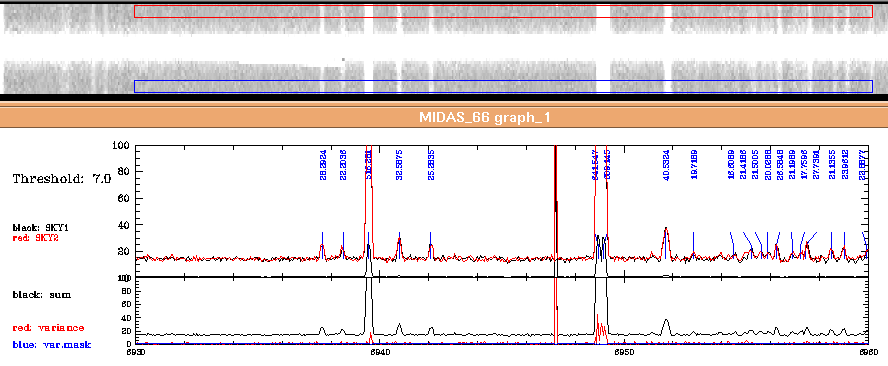
|
| Fig. 1: Extraction
and line identification. The upper display shows the pipeline-delivered
2D spectrum with slit coordinate in vertical direction. Blue and red
frames mark the lower and upper sky windows. Bright and faint sky
emission lines are readily visible. The lower graph has been used
to identify emission lines. The black and red lines mark the extracted
SKY windows. There is also a SKY plot at reduced intensity (factor
10) to show the brightest line profiles. The lowermost graph has the
combined signal (SKY1+SKY2) and the difference spectrum (abs[SKY1-SKY2]).
The difference (error) plot has been used to discriminate the extremely
bright feature at 6947 (being due to a residual cosmic). |
The following criteria for a line to be accepted for
the catalogue had to be satisfied:
- Ideally the emission line should be visible as vertical
bar in the 2D spectrum.This criterion is powerful for the distinction
between real emission and noise.
- The error file should not increase around a line candidate.
This criterion effectively means that a candidate line should be visible
in both extracted SKY spectra with about the same strength. This criterion
protects against misidentifications of residual cosmics and also in
noisy spectral regions. These are common at the beginning of each echelle
order. This criterion is very powerful, in particular when the first
criterion starts failing for faint features.
These two criteria in combination are very efficient for the detection
of sky emission lines which essentially should be monochromatic images
of the slit. E.g., those many peaks in the blue spectrum which do not
have an identification bar have clearly failed at least one criterion.
While the two above criteria were used to identify a line candidate,
technically the lines were then identified with the MIDAS command center/gauss.
Two cursor inputs per identifications
were needed to define the range within which MIDAS then fitted a Gaussian
to the sky emission line. Output parameters were the central wavelength
from the Gauss fit, the central intensity from the measured spectrum,
and the FWHM of the fit. These three parameters (called CENTER, INT_PEAK,
and FWHM) are listed in the result tables. Central intensity is in counts
(see above for correction into counts per hour) and includes the local
background. The approximate level of the background is indicated in the
line intensity plot (see below).
The REDU (red upper) CCD suffered from a leaking column causing broad
quasi-emission in the echelle order. These features have been easily recognized
due to their known position and atypical width. They are marked by squared
crosses in the plots.
Line blends which would be considered as resolved with a simple cursor-marked
approach are still a blend for the Gaussian fit procedure unless two peaks
are clearly separated. Hence some of the lines catalogued here are indeed
marginally resolved blends with a FWHM in excess of the resolution limit.
The list of measured lines is almost complete, at the level of the resoltuion
and SNR of the data. Those spectral regions corresponding to the beginning
of a new echelle order may still hide some features in noise. There are
also small spectral gaps between the redmost orders in the 860U settings.
Line tables. The line measurements are available as ASCII files,
listing measured wavelength (in air, CENTER), FWHM, and peak flux.
These measurements are solely based on the above-mentioned criteria,
i.e. they mark those emission lines which are considered as trustworthy
identifications. No attempt has been made to associate parent atoms or
molecules, nor transition designations.
Such are available from two external sources:
- the list of computed OH line transitions as provided by Rousselot
et al., 2000 (A&A, 354, 1134) and extended by
Lidman et al (2000). It has theoretical OH line positions and intensities
longward of 6138 A, and a compilation to sky emission lines as observed
with ISAAC@VLT and SOFI@NTT.
- the list of observed sky emission lines as provided by Osterbrock
et al. (PASP 108, 277 [1996] and PASP 109, 614 [1997]). These data are
based on HIRES@Keck spectra and cover the range redwards of 5200 A.
The computed OH line positions are marked in the plots by a blue cross.
The wavelengths have been transformed from vacuum to air using the Edlen
formula.
The observed Keck line positions are indicated as red filled circles.
Evaluation
The UVES sky emission spectrum starts at 3140 A and extends down to 10,400
A. There is a plethora of faint emission lines up to about 4400 A, up
to 100 lines per 100A interval. According to Meinel (1961), they are mostly
due to O2. There is a range between about 5000
and 5600 A with very little lines showing up. Above about 5800 A, the
spectrum gets richer and richer again and has a second population maximum
between 7000 and 8200 A, with typically 70 lines per 100 A interval. The
red spectra are dominated by OH emission lines, with telluric O2
absorption showing up as well. A total of 2810 emission lines has been
found.
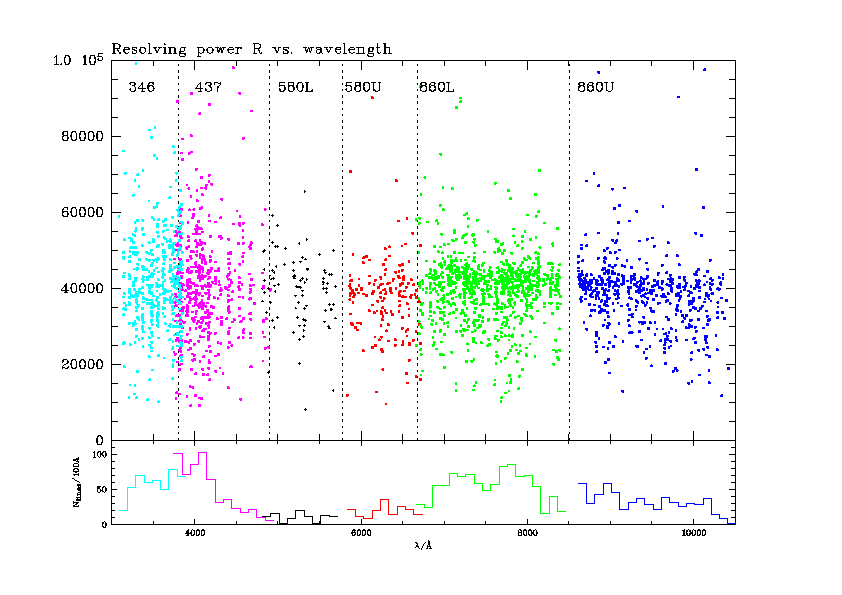
The resolving power plot (ps
version) has been obtained by dividing the wavelength of the line position
by the FWHM data. The large scatter in the blue part is due to the intrinsic
uncertainties of the Gaussian fit to faint lines. The red lines are better
defined in shape. Their resolving power numbers cluster around 42,000,
very close to the nominal value for a 1" slit (43,000). The histogram
has line number counts per 100A interval and clearly shows the two distribution
peaks in the blue and the red parts of the spectrum.
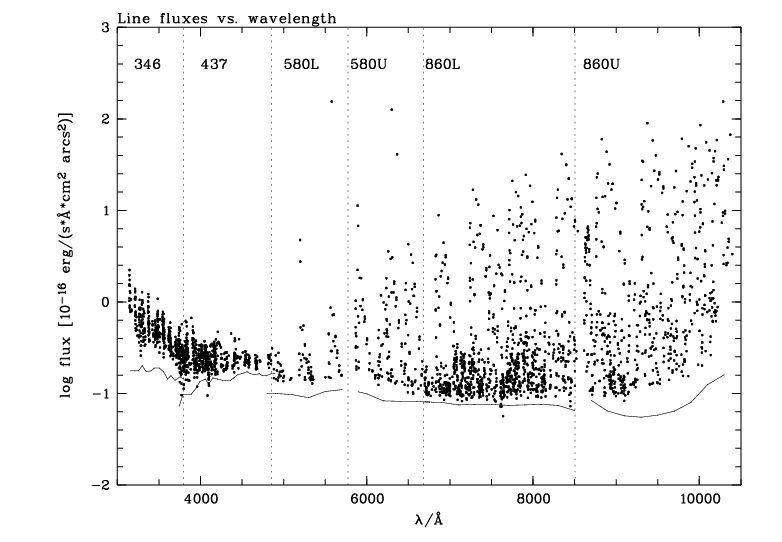
The line flux plot (ps
version) shows all line fluxes on a logarithmic scale. The continuous
line indicates the continuum emission. All blue sky emission lines are
faint, while among the red emission lines many strong ones are found.
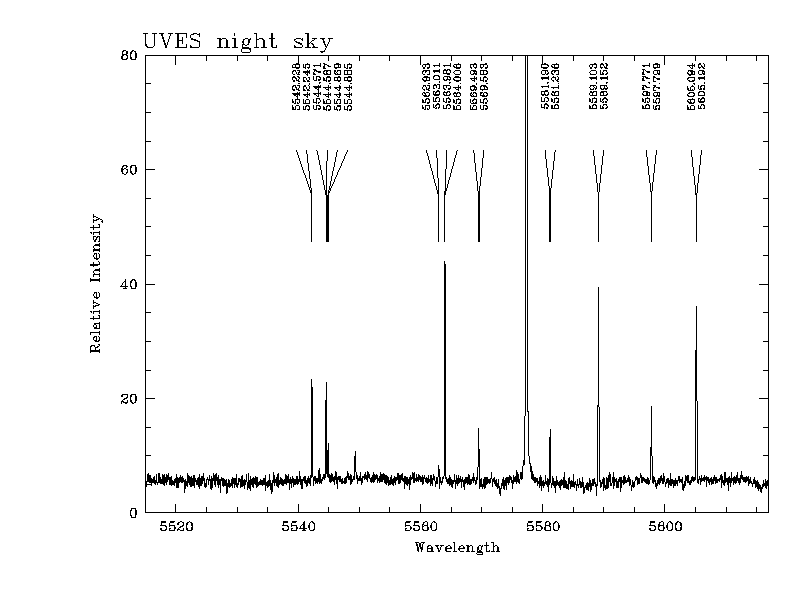
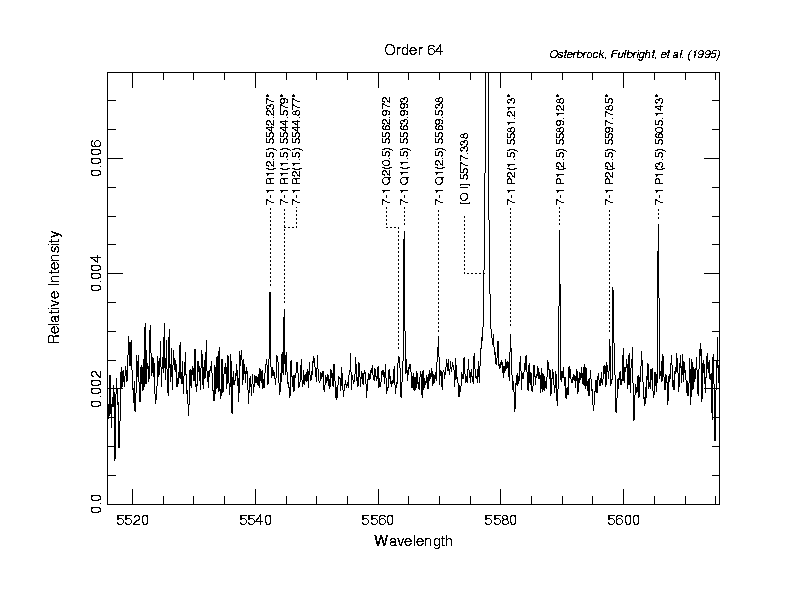
Look here for a comparison of the UVES spectra and the Keck data: UVES
| Keck
Light pollution. Osterbrock et al. (1996) list emission
lines tracing light pollution, as HgI 5461, 5770, 5791 and components
of the NaI 5890, 5896 lines indicative of both high-pressure and low-pressure
sodium lamps. As expected for a dark site like Paranal, there is definitely
no trace of 5461, 5770, or 5791 A pollution in the spectra. The same is
true for the sodium resonance lines.
Downloads
|
|
complete UVES sky emission spectrum [1.1 MB tarred
file, fits].
format is one-dimensional, with X coordinate in Angstroems, and
ordinate in 1e-16 erg/(s A cm^2 arcs^2).
|
|
|
complete set of plots [gif, 1.6 MB]
|
|
|
complete set of plots [ps, 1.3 MB]
|
|
|
complete set of tables [110 kB]
|
| a&a
|
Astron.Astrophys. 407, 1157 (2003) [600 kB, pdf]
|
Further links:
ISAAC OH atlas: under calibration
KECK HIRES SKY line atlas (PASP): Night-Sky High-Resolution Spectral Atlas of OH and O2 Emission Lines for Echelle Spectrograph Wavelength Calibration (PASP)
KECK HIRES SKY line atlas Catalog: VizieR Online Data Catalog: Keck/HIRES Sky Line Atlas (Osterbrock+ 1997)

|
 mirror sites:
PL (internal link)
HQ
[?]
mirror sites:
PL (internal link)
HQ
[?]