



Progress in engineering at millimetre wavelengths and advances in semiconductor fabrication techniques offer low noise amplifier (LNA) based radioastronomy receivers which operate at higher temperatures and wider operational bandwidths, with reduced noise, higher pixel density, and more. The University of Manchester and STFC Rutherford Appleton Laboratory have recently completed ESO's ALMA development study, Towards ALMA System-on-Chip European Receivers (TASER). This two year project developed key technologies for compact integrated front end receivers for ALMA. The benefits of LNA receiver integration and miniaturisation are, among others, lower operational costs, reduced manufacturing and testing labour needs, and the potential for high density focal plane array/phased array feed technology. The results of the TASER study are important steps towards implementing the ALMA Development Roadmap, and beyond, with the aim of enhancing ALMA's status as a globally leading scientific tool.
Completion of the TASER development study
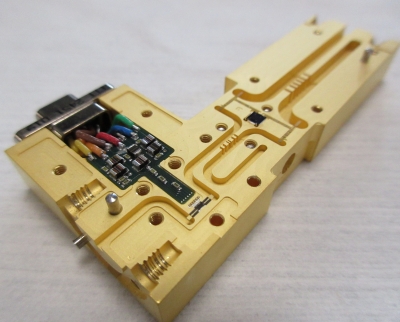
A photograph of the TASER receiver component
The TASER project demonstrated that integrating receiver components, both for single and multi‑pixel systems, is practical and beneficial. Two designs were realised and tested in the laboratory: an integrated ALMA Band 2 LNA + subharmonic image rejection mixer (SHIRM) and a Band 4-5 SHIRM. The integrated Band 2 units achieved excellent noise performance, adding <1.2 K to the noise temperature when combined with a representative first‑stage LNA, confirming that integration does not degrade receiver sensitivity. The Band 4-5 SHIRM also exhibited balanced sidebands and low local oscillator power needs, supporting plans for future integration with University of Manchester Band 4-5 LNAs. Overall, TASER has delivered high performance hardware and a clear roadmap toward compact, high‑performance, next‑generation receivers. Future work will prioritise chip pre‑selection, refined on‑chip techniques, balanced amplifier optimisation, and manufacturing improvements. Further details can be found in the final study report.
Contributed by Carlos de Breuck