



EFOSC2 Grisms
Note: Gr#13 has been repaired, Grisms #9, #12, and #15 have been replaced by Gr#18, Gr#16, and Gr#17 respectively. Gr#10 suffered a major damage and is no longer offered. (14/06/2007)
In case of questions, please contact ls-efosc@eso.org.
Content
Observing Issues
Grisms are mounted on the grism wheel in the parallel beam of EFOSC2 and so they do not introduce any wavelength dependent optical aberrations in the spectra.
Alignment
The slit and grism orientation is always such that the spectral dispersion is along the vertical axis (y-axis) of the CCD, with the longer wavelength further towards the top. The slits and grisms are aligned so as to have the spectrum aligned with the CCD y-axis to better than a tenth of a pixel. Important It takes 10-20 minutes to align the grism (and slits). So observers should not request grism/slit changes during the night. All such changes must be completed the previous day or latest by the afternoon before the start of observations.
Fringing
Some of the red grisms - notably Grism #16 - produce fringing beyond 8000 Ang. It has been noticed that afternoon dome flats do not always adequately remove all the fringing and this may be due to a CCD flexure with telescope pointing. One solution to this is to obtain a quartz lamp internal flat "on location" (i.e. in the same OB, immediately after the science exposures). At the NTT we have found that the flexures are larger than they were at the 3.6m, so internal flats are recommended where accurate removal of fringes at red wavelengths is required. For the same reason we also recommend taking arc exposures at the end of each science exposure when accurate wavelength calibration is required (e.g. for measuring RVs).
Ghosts
Helium - Argon arc spectra often show a variety of unwanted features including extra lines which are often highly curved, big splotches of light, etc. All of these are due to a combination of reflections in the optics, the very bright emission lines in the arc lamp spectra and possible higher order spectra. At first glance these features look quite terrible as they are displayed on the Real Time Display (RTD) but in fact they are quite faint and the problem is with the display cuts automatically selected by the RTD. These have never been a problem during actual observing where the spectral lines are much fainter and such features are much fainter than the noise.
2nd order effects
When observing bright blue objects (e.g. blue specphot standards) 2nd order contamination is seen for a number of the grisms. The table below lists the wavelengths above which the contamination has an effect. It is possible to use filters to cut off bluer wavelengths and remove the 2nd order. See this page for more details.
Volume-Phase Holographic Grisms
We recently added two new Volume-Phase Holographic grisms (numbers #19 and #20, which cover blue and red wavelength ranges respectively) which are considerably higher resolution than the other traditional grisms. See this report and this Messenger article for details. Note that the effective field of view is reduced when using the VPHGs.
The Optical Elements
Grisms
| Grisms | Range | Grating | Blaze angle | Dispersion 1 | Resolution 2 | Plots (PS Gzipped6 | Tables6 | Comments | |
|---|---|---|---|---|---|---|---|---|---|
| Name | [Å] | gr/mm | wavelengh [Å] | [Å/pixel] | FWHM [Å] * | Efficiency | Throughput [Å] | ||
| 3 >9280Å | |||||||||
| ps | 3 >9850Å | ||||||||
| 3 >6280Å | |||||||||
| html | 4 | ||||||||
| replaced by Gr#18 | |||||||||
| Gr#10 decommisioned | |||||||||
| replaced by Gr#16 | |||||||||
| 4 | |||||||||
| replaced by Gr#17 | |||||||||
| 3 >7170Å | |||||||||
| 3 >7000Å | |||||||||
| 5 | |||||||||
| 1070 | 3 >6900Å 5 | ||||||||
1The pixel mentioned in the dispersion column is the 0.12 arcsec unbinned pixel of CCD #40.
2The resolution depends on the slit used. Those quoted here are for a 1.0" slit.
32nd order contamination has been found for these grims at wavelengths longer than the indicated one.
4Grisms 7 and 14 are almost identical; see the manual (section 2.4.5) for a comparison.
5Grism Dispersion and Resolution measured using a 0.5" slit and 1x1 binning. In an independent test Vik Dhillon found Grism dispersions of 0. 287 Å/pixel and 0.480 Å/pixel for Gr#19 and Gr#20, respectively. The corresponding resolutions are: 1.08 Å (Gr#19) and 1.77 Å (Gr#20). This test was performed using a 0.5" slit.
6All the plots and tables linked from this table are still for EFOSC2 @ 3P6
Grism Response
All the efficiency and response funcion reported below are still for EFOSC2 @ 3P6
Efficiency curves for all grisms, 2004 (JPG 55 kb).
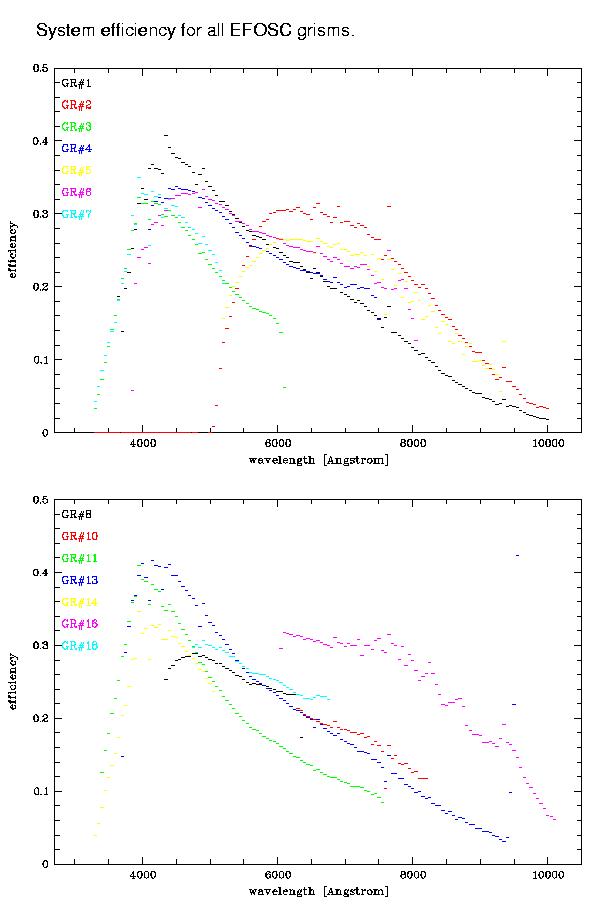
Response curves for all grisms, 2003 (PDF 36 kb).
Response curves for all grisms, 1999 (PS 162 kb).
Prisms
There are 2 low dispersion prisms available for spectroscopy. They do not show the zeroth order and so are useful for slitless spectroscopy, particularly for use with narrow-band filters. The resolution depends on the external seeing.