Thesis Topic: Quantifying the Impact of Dust Opacity on the Chemistry of Young Protostars
Thesis supervisor: Marta De Simone
Abstract
Understanding which molecules are inherited by newly forming planetary systems from their natal environment is one of the central goals of modern astrophysics. Young low-mass protostars host warm, chemically rich regions known as hot corinos, where complex organic molecules, some of which are considered key ingredients for prebiotic chemistry, are released into the gas phase and become observable. These molecules provide a unique window into the chemical reservoir available during the earliest stages of planet formation.
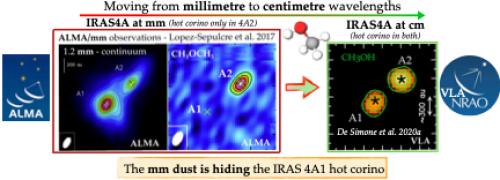
Recent observations revealed that dust obscuration can strongly affect our view of protostellar chemistry, potentially hiding chemically rich sources and biasing molecular abundance measurements (NRAO press release: https://public.nrao.edu/news/target-hiding-behind-dust/ ; De Simone et al. 2020, 2022; Frediani et al. 2025).
This raises a fundamental question: are we seeing the true chemical complexity of young planetary systems, or is part of it hidden behind an optically thick dust veil?
This observational PhD project will combine a unique set of recent ALMA and VLA observations to perform the first systematic assessment of dust obscuration in a representative sample of protostars. The student will characterize hidden hot corinos, quantify the impact of dust absorption on molecular abundances, and investigate how these effects influence our understanding of the chemistry inherited by forming planets.
The project is primarily observational and will provide training in state-of-the-art radio interferometric techniques, radiative-transfer modelling. Working within an international network of experts in astrochemistry, radio interferometry, and radiative-transfer modelling, the student will have early opportunities for impactful publications while developing independent scientific ideas and future observing proposals. The project addresses a timely and rapidly growing field and will place the student in an excellent position for the next generation of centimeter-wavelength facilities, including the ngVLA and SKA.
Figure 1: Obscuring dust. IRAS4A at mm (left, continuum + lines) and cm (right, lines) wavelengths. The optically thick mm dust obscures the 4A1 hot corino that pops up in the cm and absorb part of the emission lines in 4A2.