Thesis Topic: Understanding planet formation through the first population scale analysis of young giant exoplanets and their formation histories
Thesis supervisor: Jens Kammerer
Abstract
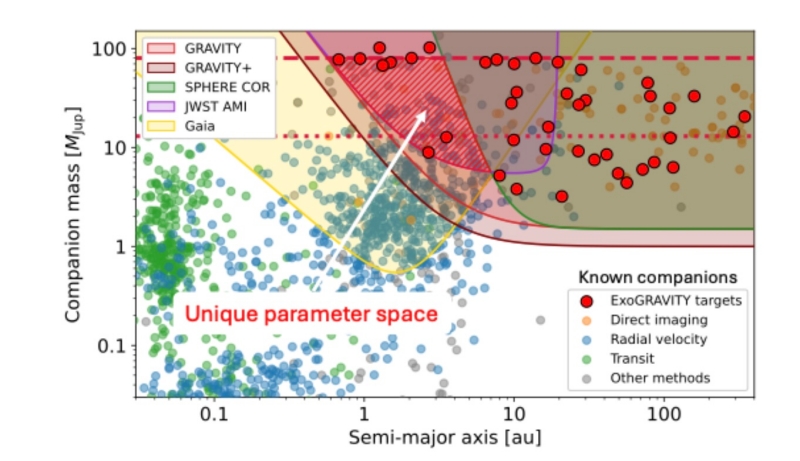
The question “How do giant planets form?” has been a central challenge in exoplanet science for decades. Yet, only limited observational constraints exist to test competing planet formation theories. The goal of this project is to address this lack of data by advancing the detection and characterisation of young giant exoplanets to the population scale. This will be achieved by developing new observational techniques and exploiting emerging synergies between ground-based telescopes and space missions to open a previously inaccessible parameter space of the giant planet population where these planets reside and form most frequently to observational studies. Opening this bulk of the giant planet population to direct characterisation will further enable an innovative approach of combining multiple independent planet formation markers – thermodynamic, chemical, and demographic – to establish the first coherent framework that links giant planets’ observed properties to their formation histories. The project will merge cutting-edge data from ESO/GRAVITY+, JWST, and Gaia through novel observational techniques to:
(1) directly detect giant planets whose existence is predicted from Gaia astrometry.
(2) constrain the post-formation entropy of these planets by measuring their luminosities and dynamical masses.
(3) characterise the bulk properties and atmospheric composition of these planets via spectroscopic observations.
(4) advance giant planet demographics to a new parameter space where these planets are most abundant.
The goal of this project is to provide critically needed observational tests for the competing planet formation theories (core accretion, disc instability, and cloud fragmentation) by comparing the results of (2)-(4) to the predictions from planet formation simulations.
Between 1-2 PhD positions will be offered as part of the ERC StG “GIANT-GEMS”. The positions will focus on the following topics (adaptable depending on the interest and expertise of the candidates):
Measuring dynamical masses and luminosities via targeted follow-up of Gaia giant planets with VLTI/GRAVITY and JWST, with the goal of constraining the formation heat and formation pathway. Collaborators: T. Winterhalder (Leiden University), W. Balmer (Northwestern University), Myriam Benisty (MPIA).
Characterising bulk properties and atmospheric abundances of giant planets observed with VLTI/GRAVITY+ complemented by archival data to increase the wavelength coverage. Linking inferred properties and abundances to predictions made by different formation models. Collaborators: T. Stolker (Leiden University), W. Balmer (Northwestern University), Paul Mollière (MPIA).
Giant planet demographics from VLTI/GRAVITY+ and JWST coronagraphic imaging surveys, with the goal of inferring formation pathways by comparing planet population synthesis simulations with observational data. Collaborators: C. Fontanive (University of Edinburgh), Sylvestre Lacour (Paris Observatory/ESO), Laurent Pueyo (STScI).
Possibility to get involved with ancillary projects such as (1) new VLTI/GRAVITY+ Dark Hole observing mode, (2) smaller VLTI/GRAVITY+ datasets on high-impact targets, (3) ELT/PCS & LIFE exoplanet yield studies
The successful candidate(s) will become part of the ExoGRAVITY Collaboration and will be able to benefit from collaborative networks in Europe, the US, and Australia. They will also become core members of the new GIANT-GEMS group at ESO which will be established through the ERC StG. There will also be ample opportunities to collaborate with other ESO Fellows and Staff Astronomers working on exoplanets and planet formation.