Thesis Topic: Bridging Protoplanetary Disks and Exoplanets through CO isotopologues
Thesis supervisor: Anna Miotello
Abstract
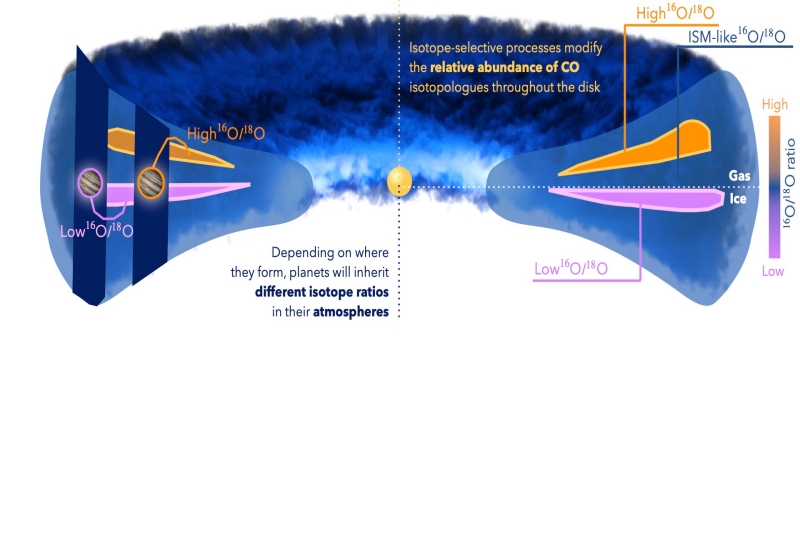
The chemical composition of exoplanet atmospheres encodes information about where and how planets formed within their natal protoplanetary disks. Recent observations have revealed unexpected carbon and oxygen isotope ratios in exoplanet atmospheres, suggesting that planets may inherit distinct isotopic signatures from the gas and ice reservoirs they accrete during formation. However, the disk-scale processes that shape these isotope ratios, and their connection to planet formation and migration, remain poorly understood.
This PhD project will investigate how isotope-selective chemical processes in protoplanetary disks influence the atmospheric composition of forming planets. Using state-of-the-art thermo-chemical disk models and planet formation simulations, in collaboration with Dr. Alex Cridland at USM the student will develop a framework that links the evolving distribution of CO isotopologues in disks to the isotopic composition of planetary atmospheres. The project will quantify how accretion and migration through different disk environments affect the carbon and oxygen isotope ratios ultimately observed in exoplanets.
The theoretical predictions will be tested using high-resolution ALMA observations of rare CO isotopologues, including new and archival datasets that probe the primordial isotopic inventory of planet-forming disks. In collaboration with experts in exoplanet atmosphere characterization, the student will further connect these results to current and future measurements of isotopic abundances in exoplanets. The project combines astrochemistry, planet formation theory, and sub-millimetre observations, providing training in numerical modelling, interferometric data analysis, and exoplanet science, while addressing one of the key challenges of modern astrophysics: linking the birth environments of planets to the diversity of exoplanet atmospheres.
Supervisory team: Dr. Anna Miotello (ESO), Dr. Alex Cridland (USM), Dr. Bibiana Prinoth (ESO)
Fig 1: Right: effects of isotope-selective processes on the disk composition in the gas (top) and ice (bottom) phase. Left: depending on the forming planet’s location and the material (gas or ice) they accrete, the isotopologue ratios in their atmospheres may deviate from the ISM standard