Thesis Topic: Unveiling the Galactic population of accreting white dwarfs
Thesis supervisor: Anna Francesca Pala
Abstract
Accreting white dwarfs, interacting binaries in which a white dwarf accretes mass from a Roche-lobe filling donor star, are powerful laboratories across different areas of astrophysics. Their ultimate fates are intimately connected to thermonuclear transients, including Type Ia Supernovae (SNe Ia). Furthermore, the most compact accreting white dwarfs (orbital periods shorter than 2 hours) are among the brightest low-frequency gravitational wave sources in the Milky Way. They will be detected within the first few weeks of operation by the LISA (Laser Interferometer Space Antenna) mission and used as verification binaries to assess the instrument capability in detecting gravitational waves. Finally, because accreting white dwarfs are relatively bright and numerous across the Galaxy, they serve as ideal testbeds for compact binary evolution models, which are driven by orbital angular momentum losses.
The main goal of this PhD project is to carry out the first uniform study of a statistically significant, volume-limited sample of accreting white dwarfs within 300 pc. The student will analyse state-of-the-art optical spectra obtained with VLT/X-shooter, GTC/OSIRIS, and 4MOST for all accreting white dwarfs in this volume, complemented by astrometric data, epoch light curves, and spectra from Gaia DR4, to address three overarching research questions:
How well do we know the Galactic population of accreting white dwarfs?
What mechanisms drive binary evolution?
How does the donor star respond to the ongoing mass-loss process?
Through this project, the student will become an active member of the White Dwarf Binary Survey (S11) within 4MOST and gain expertise in observational skills, including spectroscopic fitting, time-series analysis, and big data management. These technical skills will be complemented by hands-on theoretical modelling using the MESA (Modules for Experiments in Stellar Astrophysics) and BSE (Binary Stellar Evolution) codes, allowing the student to acquire a solid understanding of the theory of binary formation and evolution, as well as the principles of binary population synthesis.
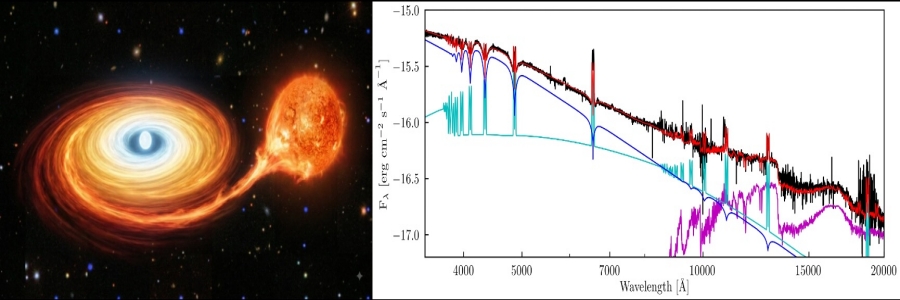
Figure 1. Left: schematics of an accreting white dwarf. The donor star is losing matter that, while falling onto the white dwarf, forms a disc around it. Right: X–shooter data (black, from Pala et al. 2019) of an accreting white dwarf, along with the best–fit model (red), which is composed of the sum of a white dwarf (blue), an accretion disc (cyan) and a late–type star (magenta).