The Very Large Telescope Interferometer
The Very Large Telescope Interferometer (VLTI) consists in the coherent combination of the four VLT Unit Telescopes and of the four moveable 1.8m Auxiliary Telescopes. Once fully operational, the VLTI will provide both a high sensitivity as well as milli-arcsec angular resolution using baselines of up to 200m length.
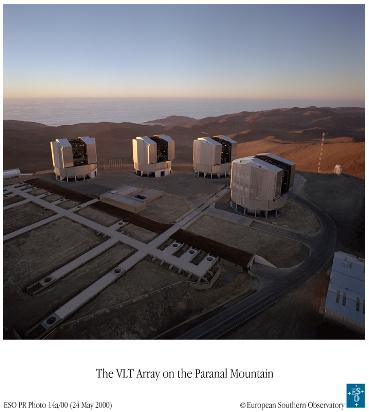
General Description
The four 8.2-m Unit Telescopes (UTs) and the four 1.8-m Auxiliary Telescopes (ATs) constitute the light collecting elements of the VLTI. The UTs are set on fixed locations while the ATs can be relocated on 30 different stations. The telescopes can be combined in groups of two or three. After the light beams have passed through a complex system of mirrors and the Delay lines, the combination at near- and mid-infrared is performed by the instruments AMBER and MIDI. A complex and high performance dual-feed system PRIMA that allows Phase Referenced Imaging and Micro Arcsecond Astrometry on the VLTI will be available soon.
Due to its characteristics, the VLTI has become a very attractive means for scientific research on various objects like many stars in the solar neighborhood or extragalactic objects such as active galactic nuclei.
News
Stay informed about the latest ESO news: ESO Top News- RSS .
Or take a look at a few press releases addressing some science topics covered by the VLTI:
Watching a 'New Star' Make the Universe Dusty
ESO 22/08 - Science Release - 24 July 2008
VLTI observes for the first time how dust forms around an erupting star
Using ESO's Very Large Telescope Interferometer, and its remarkable acuity, astronomers were able for the first time to witness the appearance of a shell of dusty gas around a star that had just erupted, and follow its evolution for more than 100 days. This provides the astronomers with a new way to estimate the distance of this object and obtain invaluable information on the operating mode of stellar vampires, dense stars that suck material from a companion.
The Behemoth Has a Thick Belt
ESO 15/08 - Science Release - 27 May 2008
Astronomers resolve torus around star in another galaxy
Talk about a diet! By resolving, for the first time, features of an individual star in a neighbouring galaxy, ESO's VLT has allowed astronomers to determine that it weighs almost half of what was previously thought, thereby solving the mystery of its existence. The behemoth star is found to be surrounded by a massive and thick torus of gas and dust, and is most likely experiencing unstable, violent mass loss.
Star Caught Smoking
ESO 34/07 - Science Release - 3 August 2007
VLTI Snapshots Dusty Puff Around Variable Star
Using ESO's Very Large Telescope Interferometer, astronomers from France and Brazil have detected a huge cloud of dust around a star. This observation is further evidence for the theory that such stellar puffs are the cause of the repeated extreme dimming of the star.
Chronicle of a Death Foretold
ESO 25/07 - Science Release - 31 May 2007
Two of the World's Largest Interferometric Facilities Team-up to Study a Red Giant Star
Using ESO's VLTI on Cerro Paranal and the VLBA facility operated by NRAO, an international team of astronomers has made what is arguably the most detailed study of the environment of a pulsating red giant star. They performed, for the first time, a series of coordinated observations of three separate layers within the star's tenuous outer envelope: the molecular shell, the dust shell, and the maser shell, leading to significant progress in our understanding of the mechanism of how, before dying, evolved stars lose mass and return it to the interstellar medium.
The Sky Through Three Giant Eyes
ESO 06/07 - Instrument Release - 23 February 2007
AMBER Instrument on VLT Delivers a Wealth of Results
The ESO Very Large Telescope Interferometer, which allows astronomers to scrutinise objects with a precision equivalent to that of a 130-m telescope, is proving itself an unequalled success every day. One of the latest instruments installed, AMBER, has led to a flurry of scientific results, an anthology of which is being published this week as special features in the research journal Astronomy & Astrophysics.
Cepheids and their 'Cocoons'
ESO 09/06 - Science Release
Interferometry Helps Discover Envelopes Around Supergiant Stars
Using ESO's Very Large Telescope Interferometer (VLTI) at Cerro Paranal, Chile, and the CHARA Interferometer at Mount Wilson, California, a team of French and North American astronomers has discovered envelopes around three Cepheids, including the Pole star. This is the first time that matter is found surrounding members of this important class of rare and very luminous stars whose luminosity varies in a very regular way. Cepheids play a crucial role in cosmology, being one of the first "steps" on the cosmic distance ladder.
