


The VLT Primary Mirror Cooling System
Overview
The Unit Telescope primary mirror (M1) can be actively cooled by theback plate cooling system. It is used to adjust the temperature ofthe mirror in order to minimize temperature differences with the ambient air and thus the mirror seeing. Due to the primary mirror large thermal time constant, the optimal control of its temperatureis not trivial.
Thermal Control
The strategy for using the back plate cooling system effectively isthe subject of model-based optimization implemented in the VLT controlsoftware. The system is especially useful when one expects large temperature drops during the night of observation.
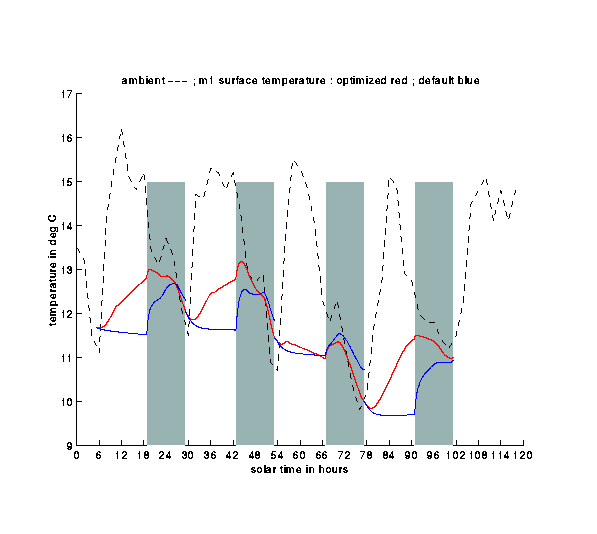
The following graph shows the result of the optimizationprocedure used to control the thermal behaviour of the VLT. Thecomputational technique, based on the VLT thermal model and numericalmethods, finds the optimal time histories for the air conditioningtemperature set point and the mirror back plate cooling system, inorder to minimize the expected nightly mirror seeing. The optimalresult (red curve) is compared to the "default" technique of settingthe air conditioning to the minimum of the previous night temperature record(blue curve). For clarity, the nights are shaded in the graph. The ambient profile (dashed line) is an actual record measured on Paranal in January 1994.
Characteristics and Purpose
The back plate cooling system has the following characteristics andpurposes:
- Cooling the rear side of M1 using a cold plate which is thermally insulated on its rear face. A glycol-water mixture flows inside tubes arranged over the plate upper surface. The arrangement is designed to suppress "horizontal" temperature inhomogeneities in the M1 and make the temperature gradient essentially monodimensional through its thickness. Heat is extracted from the primary mirror both by convective and radiative exchange
- Providing a cooling assistance by a group of small fans set in the air layer located between the M1 and the cold plate (the outer and inner sides of this space are also sealed). The cold air that tends to stagnate over the cold plate is thus transferred toward the M1 and this results in enhanced exchange;
- Collecting the power generated by the active optics actuators
An important point is that the back plate cooling system uses only radiative exchange to cool the mirror during observing. Indeed, thefans cannot be used then because of vibrations affecting image quality.
Table of Content
- The VLT 8.2-m Unit Telescope
- VLT Environmental Specifications
- The VLT primary mirrors
- The VLT Primary Mirror Cooling System
- The Secondary Mirror, M2 Unit
- The M1 Cell and M3 Tower
- The VLT Active Optics System
- The VLT Adapter-Rotators
- VLT Cassegrain Adapter-Rotators
- VLT Nasmyth Adapter-Rotator
- Very Large Telescope Enclosure
- VLT Technical CCD System
- Coating Unit
- Sky Accessibility
- UT Performance