
Persbericht
Grootste afbeelding in zijn soort toont verborgen chemie in het hart van de Melkweg
25 februari 2026
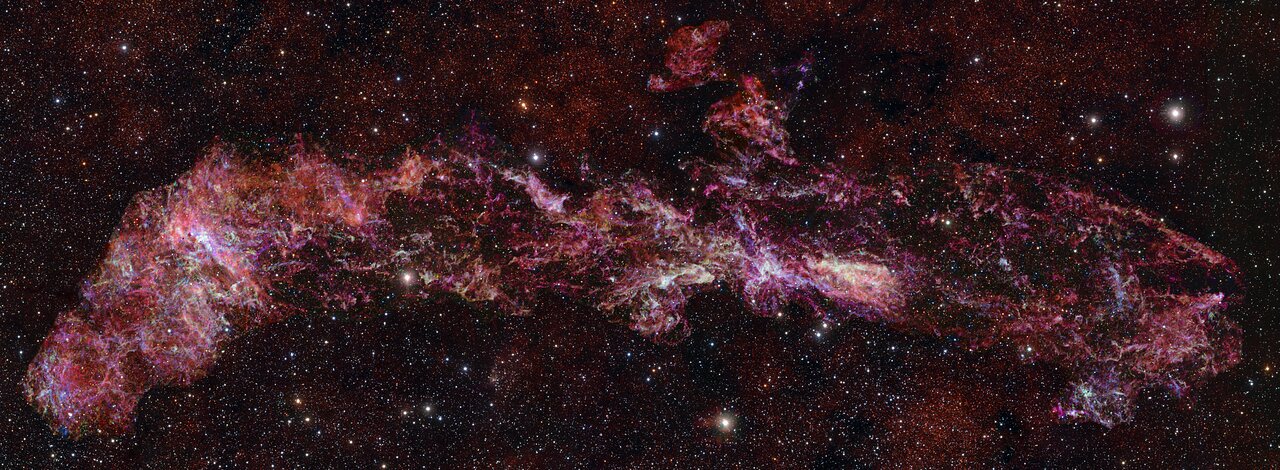
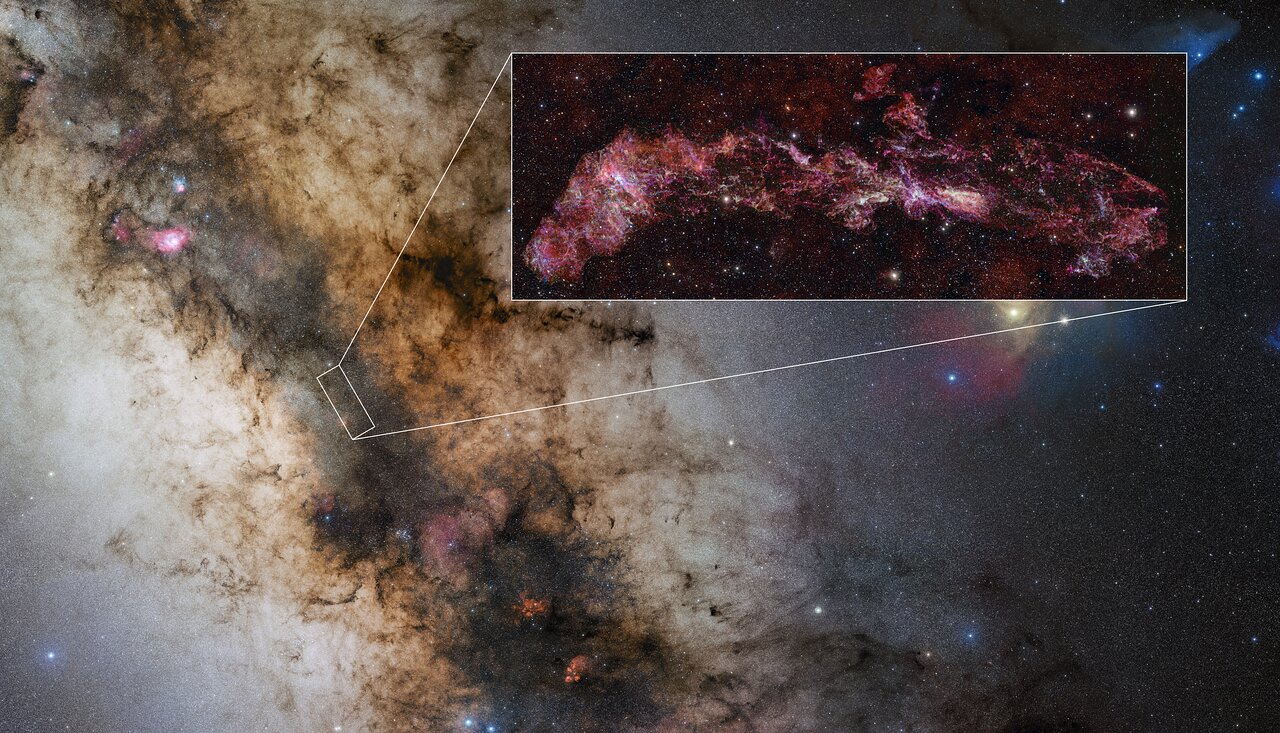
Astronomen hebben een nieuwe, ongekend detailrijke afbeelding gemaakt van het centrale deel van ons Melkwegstelsel. De foto, verkregen met de Atacama Large Millimeter/submillimeter Array (ALMA), stelt astronomen in staat om het leven van sterren in het meest extreme deel van ons Melkwegstelsel – de omgeving van het centrale superzware zwarte gat – te onderzoeken.
‘Het is een plek van extremen, onzichtbaar voor onze ogen, die buitengewoon gedetailleerd is onthuld’, zegt Ashley Barnes, astronoom bij de Europese Zuidelijke Sterrenwacht (ESO) in Duitsland, die deel uitmaakt van het team dat de nieuwe gegevens heeft verzameld. De waarnemingen geven een uniek beeld van het koude gas – de grondstof waaruit sterren ontstaan – in de zogeheten Centrale Moleculaire Zone (CMZ) van ons Melkwegstelsel. Het is voor het eerst dat het koude gas in deze hele regio zo gedetailleerd is onderzocht.
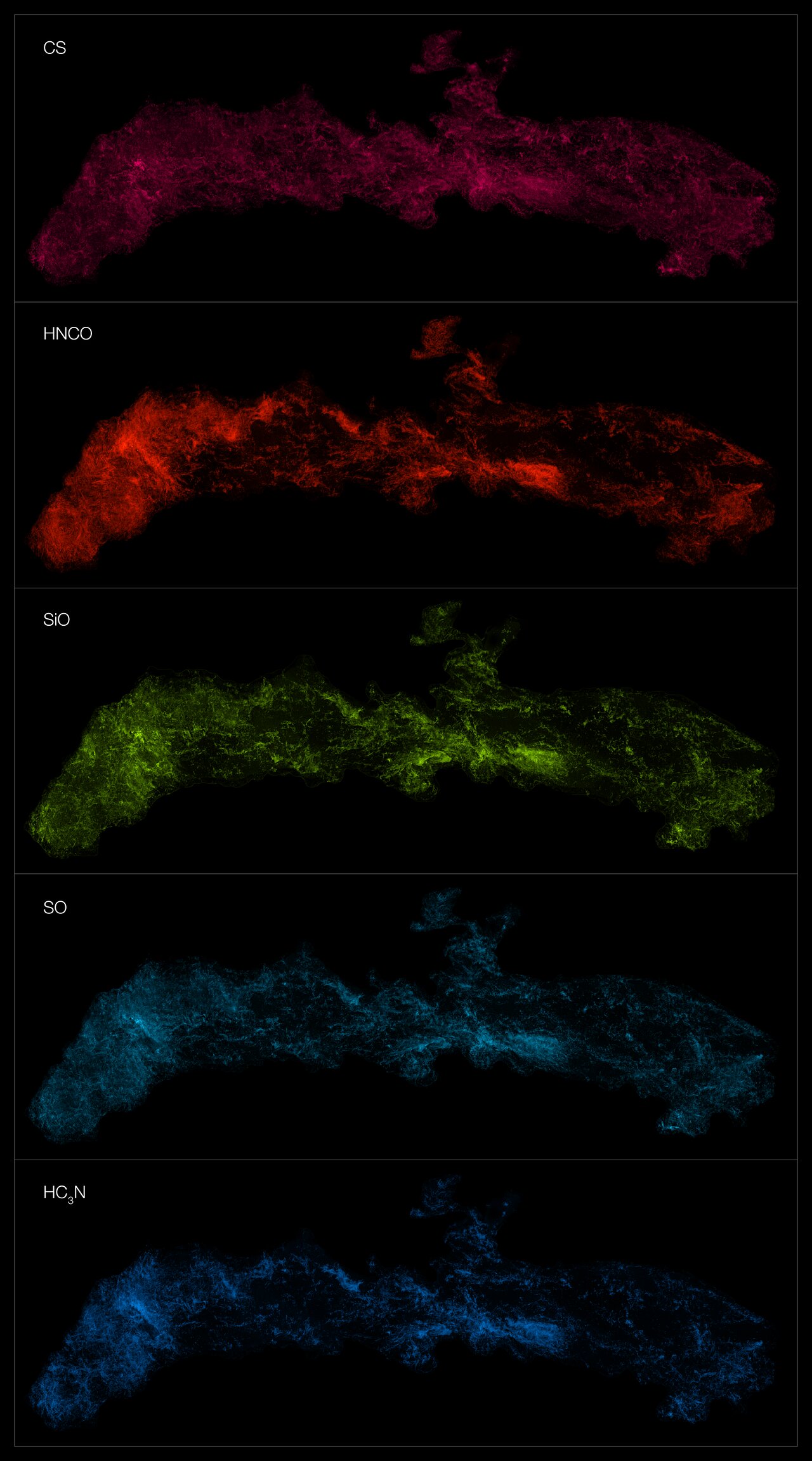
Het afgebeelde gebied strekt zich uit over meer dan 650 lichtjaar. Het bestaat uit dichte wolken van gas en stof die het superzware zwarte gat in het centrum van ons Melkwegstelsel omringen. ‘Het is de enige galactische kern die dicht genoeg bij de aarde staat om zich zo gedetailleerd te laten onderzoeken’, zegt Barnes. De dataset toont de CMZ als nooit tevoren, van gasstructuren met diameters van tientallen lichtjaren tot kleine gaswolken rond afzonderlijke sterren.
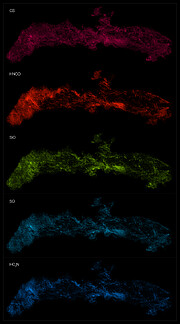
Het moleculaire gas dat ACES — de ALMA CMZ Exploration Survey — specifiek onderzoekt, is heel koud. Het onderzoek ontrafelt de ingewikkelde chemie van de CMZ en detecteert de daarin aanwezige moleculen, uiteenlopend het eenvoudige siliciummonoxide tot complexere organische moleculen zoals methanol, aceton en ethanol.
Koud moleculair gas stroomt langs filamenten die de klonten van materie voeden waaruit sterren kunnen ontstaan. We weten hoe dit proces verloopt in de buitenste delen van de Melkweg, maar in het centrumgebied zijn de gebeurtenissen veel extremer. ‘De CMZ bevat enkele van de zwaarste sterren die in ons Melkwegstelsel bekend zijn. Vele daarvan leiden een kort bestaan en beëindigen hun leven met krachtige supernova-explosies of zelfs hypernova’s’, zegt ACES-leider Steve Longmore, hoogleraar astrofysica aan de Liverpool John Moores University (VK). Met ACES hopen astronomen beter te begrijpen hoe deze verschijnselen de geboorte van sterren beïnvloeden en of onze theorieën over stervorming ook in extreme omgevingen standhouden.
‘Door te onderzoeken hoe sterren ontstaan in de CMZ, kunnen we ook een helderder beeld krijgen van hoe sterrenstelsels zijn gegroeid en geëvolueerd’, voegt Longmore daaraan toe. ‘We denken dat deze regio veel kenmerken gemeen heeft met sterrenstelsels in het vroege heelal, waar sterren ontstonden in chaotische, extreme omgevingen.’
Bij het verzamelen van de nieuwe dataset, hebben astronomen gebruik gemaakt van ALMA, die wordt beheerd door ESO en partners in de Atacama-woestijn in Chili. Het is voor het eerst dat zo’n omvangrijk gebied met deze faciliteit is gescand en daarmee is dit de grootste afbeelding die ALMA ooit heeft gemaakt. Het mozaïek – zo groot als drie volle manen naast elkaar – is verkregen door vele afzonderlijke waarnemingen als puzzelstukjes aan elkaar te plakken.
‘We hadden bij het opzetten van dit onderzoek al een hoog detailniveau verwacht, maar waren echt verrast door de complexiteit en rijkdom die het uiteindelijke mozaïek liet zien’, zegt Katharina Immer, ALMA-astronoom bij ESO die eveneens deel uitmaakt van het project. De gegevens van ACES worden gepresenteerd in vijf artikelen, die zijn geaccepteerd voor publicatie in de Monthly Notices of the Royal Astronomical Society.
‘Dankzij de komende ALMA Wideband Sensitivity Upgrade en de Extremely Large Telescope van ESO zullen we binnenkort nog dieper in dit gebied kunnen doordringen, fijnere structuren kunnen onderscheiden, complexere chemische processen kunnen volgen en de wisselwerking tussen sterren, gas en zwarte gaten met ongekend duidelijk kunnen onderzoeken’, aldus Barnes. ‘In veel opzichten is dit nog maar het begin.’
Meer informatie
De resultaten van dit onderzoek zijn te vinden in een reeks artikelen die in de Monthly Notices of the Royal Astronomical Society worden gepubliceerd.
Het internationale ACES-team bestaat uit meer dan 160 wetenschappers, van masterstudenten tot gepensioneerden, werkzaam bij meer dan zeventig instellingen in Europa, Noord- en Zuid-Amerika, Azië en Australië. Het project werd geïnitieerd en geleid door hoofdonderzoeker Steven Longmore (Liverpool John Moores University, VK), samen met co-onderzoekers Ashley Barnes (Europese Zuidelijke Sterrenwacht, Duitsland), Cara Battersby (University of Connecticut, VS [Connecticut]), John Bally (University of Colorado Boulder, VS), Laura Colzi (Centro de Astrobiología, Madrid, Spanje [CdA]), Adam Ginsburg (University of Florida, VS [Florida]), Jonathan Henshaw (Max-Planck Institut für Astronomie, Heidelberg, Duitsland), Paul Ho (Academia Sinica Institute of Astronomy and Astrophysics, Taiwan), Izaskun Jiménez-Serra (CdA), J.M. Diederik Kruijssen (COOL Research DAO), Elisabeth Mills (University of Kansas, VS), Maya Petkova (Chalmers University of Technology, Zweden), Mattia Sormani (Dipartimento di Scienza Applicata e Tecnologia (DiSAT), Universiteit van Insubria, Italië & Institut für Theoretische Astrophysik (ITA), Universität Heidelberg, Duitsland), Robin Tress (École Polytechnique Fédérale de Lausanne, Zwitserland & ITA, Universität Heidelberg, Duitsland), Daniel Walker (UK ALMA Regional Centre Node, Universiteit van Manchester, VK) en Jennifer Wallace (Connecticut).
Het datareductie-team binnen ACES – gecoördineerd door Adam Ginsburg, Daniel Walker en Ashley Barnes – bestaat uit Nazar Budaiev (Florida), Laura Colzi (CdA), Savannah Gramze (Florida), Pei-Ying Hsieh (National Astronomical Observatory of Japan, Mitaka, Tokio, Japan), Desmond Jeff (Florida), Xing Lu (Shanghai Astronomical Observatory, Chinese Academy of Sciences, China), Jaime Pineda (Max-Planck-Institut für extraterrestrische Physik, Duitsland), Marc Pound (University of Maryland, VS) en Álvaro Sánchez-Monge (Institut de Ciències de l’Espai, CSIC, Bellaterra, Spanje; Institut d’Estudis Espacials de Catalunya, Castelldefels, Spanje), met bijdragen van meer dan dertig andere teamleden.
De Atacama Large Millimeter/submillimeter Array (ALMA), een internationale astronomische faciliteit, is een samenwerkingsverband van ESO, de Amerikaanse National Science Foundation (NSF) en de National Institutes of Natural Sciences (NINS) van Japan, in samenwerking met de Republiek Chili. ALMA wordt gefinancierd door ESO (namens haar lidstaten), door de NSF in samenwerking met de National Research Council of Canada (NRC) en de National Science and Technology Council (NSTC) in Taiwan, en door NINS in samenwerking met de Academia Sinica (AS) in Taiwan en het Korea Astronomy and Space Science Institute (KASI). De bouw en het beheer van ALMA worden geleid door ESO (namens haar lidstaten); door het National Radio Astronomy Observatory (NRAO), dat namens Noord-Amerika wordt bestuurd door de Associated Universities, Inc. (AUI), en namens Oost-Azië door het National Astronomical Observatory of Japan (NAOJ). De overkoepelende leiding en het toezicht op bouw, ingebruikname en beheer van ALMA is in handen van het Joint ALMA Observatory (JAO).
De Europese Zuidelijke Sterrenwacht (ESO) stelt wetenschappers van over de hele wereld in staat om de geheimen van het heelal te ontdekken, ten bate van iedereen. Wij ontwerpen, bouwen en exploiteren observatoria van wereldklasse die door astronomen worden gebruikt om spannende vragen te beantwoorden en de fascinatie voor astronomie te verspreiden, en bevorderen internationale samenwerking op het gebied van de astronomie. ESO, in 1962 opgericht als intergouvernementele organisatie, wordt inmiddels gedragen door 16 lidstaten (België, Denemarken, Duitsland, Finland, Frankrijk, Ierland, Italië, Nederland, Oostenrijk, Polen, Portugal, Spanje, Tsjechië, het Verenigd Koninkrijk, Zweden en Zwitserland) en door het gastland Chili, met Australië als strategische partner. Het hoofdkwartier van de ESO en haar bezoekerscentrum en planetarium, de ESO Supernova, zijn gevestigd nabij München in Duitsland, maar onze telescopen staan opgesteld in de Chileense Atacama-woestijn – een prachtige plek met unieke omstandigheden voor het doen van hemelwaarnemingen. ESO exploiteert drie waarnemingslocaties: La Silla, Paranal en Chajnantor. Op Paranal staan ESO’s Very Large Telescope en Very Large Telescope Interferometer, evenals surveytelescopen zoals VISTA. Ook zal ESO op Paranal de Cherenkov Telescope Array South huisvesten en exploiteren – ’s werelds grootste en gevoeligste observatorium van gammastraling. Samen met internationale partners beheert ESO APEX en ALMA op Chajnantor, twee faciliteiten die de hemel waarnemen in het millimeter- en submillimetergebied. Op Cerro Armazones, nabij Paranal, bouwen wij ‘het grootste oog ter wereld’ – ESO’s Extremely Large Telescope. Vanuit onze kantoren in Santiago, Chili, ondersteunen wij onze activiteiten in het gastland en werken wij samen met Chileense partners en de Chileense samenleving.
Links
- Overzichtsartikel ACES
- Foto's van ALMA
- De ALMA Wideband Sensitivity Upgrade
- Kom meer te weten over ESO’s Extremely Large Telescope op onze speciale website en in de persmap
- Voor journalisten: abonneer je op onze persberichten onder embargo in je eigen taal
- Voor wetenschappers: heb je een verhaal? Promoot je onderzoek
Contact
Ashley Thomas Barnes
Astronomical Data Scientist, European Southern Observatory (ESO)
Garching bei München, Germany
Tel: +49 89 3200 6729
E-mail: Ashley.Barnes@eso.org
Steven Longmore
Professor of Astrophysics, Astrophysics Research Institute, Liverpool John Moores University
Liverpool, UK
Tel: +44 (0)151 231 2929
E-mail: S.N.Longmore@ljmu.ac.uk
Katharina Immer
ALMA Regional Centre Astronomer, European Southern Observatory (ESO)
Garching bei München, Germany
Tel: +49 89 3200 6471
E-mail: Katharina.Immer@eso.org
Adam Ginsburg
Associate Professor, Department of Astronomy, University of Florida
Gainesville, FL, USA
Tel: +1 352-294-1879
E-mail: adamginsburg@ufl.edu, adam.g.ginsburg@gmail.com
Daniel Walker
Astronomer, UK ALMA Regional Centre Node, University of Manchester
Manchester, UK
E-mail: daniel.walker-2@manchester.ac.uk
Pei-Ying Hsieh
Assistant Professor, National Astronomical Observatory of Japan, Tokyo, Japan
E-mail: pei-ying.hsieh@nao.ac.jp
Xing Lu
Professor, Shanghai Astronomical Observatory, Chinese Academy of Sciences
Shanghai, China
E-mail: xinglu@shao.ac.cn, xinglv.nju@gmail.com
Bárbara Ferreira
ESO Media Manager
Garching bei München, Germany
Tel: +49 89 3200 6670
Mob: +49 151 241 664 00
E-mail: press@eso.org
Rodrigo Alvarez (press contact België)
ESO Science Outreach Network
en Planetarium, Royal Observatory of Belgium
Tel: +32-2-474 70 50
E-mail: eson-belgië@eso.org
Over dit bericht
| Persberichten nr.: | eso2603nl-be |
| Naam: | Central Molecular Zone |
| Type: | Milky Way : Galaxy : Component : Center/Core |
| Facility: | Atacama Large Millimeter/submillimeter Array |
Afbeeldingen
Alleen in het Engels
Video's

Our use of Cookies
We use cookies that are essential for accessing our websites and using our services. We also use cookies to analyse, measure and improve our websites’ performance, to enable content sharing via social media and to display media content hosted on third-party platforms.
ESO Cookies Policy
The European Organisation for Astronomical Research in the Southern Hemisphere (ESO) is the pre-eminent intergovernmental science and technology organisation in astronomy. It carries out an ambitious programme focused on the design, construction and operation of powerful ground-based observing facilities for astronomy.
This Cookies Policy is intended to provide clarity by outlining the cookies used on the ESO public websites, their functions, the options you have for controlling them, and the ways you can contact us for additional details.
What are cookies?
Cookies are small pieces of data stored on your device by websites you visit. They serve various purposes, such as remembering login credentials and preferences and enhance your browsing experience.
Categories of cookies we use
Essential cookies (always active): These cookies are strictly necessary for the proper functioning of our website. Without these cookies, the website cannot operate correctly, and certain services, such as logging in or accessing secure areas, may not be available; because they are essential for the website’s operation, they cannot be disabled.
Functional Cookies: These cookies enhance your browsing experience by enabling additional features and personalization, such as remembering your preferences and settings. While not strictly necessary for the website to function, they improve usability and convenience; these cookies are only placed if you provide your consent.
Analytics cookies: These cookies collect information about how visitors interact with our website, such as which pages are visited most often and how users navigate the site. This data helps us improve website performance, optimize content, and enhance the user experience; these cookies are only placed if you provide your consent. We use the following analytics cookies.
Matomo Cookies:
This website uses Matomo (formerly Piwik), an open source software which enables the statistical analysis of website visits. Matomo uses cookies (text files) which are saved on your computer and which allow us to analyze how you use our website. The website user information generated by the cookies will only be saved on the servers of our IT Department. We use this information to analyze www.eso.org visits and to prepare reports on website activities. These data will not be disclosed to third parties.
On behalf of ESO, Matomo will use this information for the purpose of evaluating your use of the website, compiling reports on website activity and providing other services relating to website activity and internet usage.
Matomo cookies settings:
Additional Third-party cookies on ESO websites: some of our pages display content from external providers, e.g. YouTube.
Such third-party services are outside of ESO control and may, at any time, change their terms of service, use of cookies, etc.
YouTube: Some videos on the ESO website are embedded from ESO’s official YouTube channel. We have enabled YouTube’s privacy-enhanced mode, meaning that no cookies are set unless the user actively clicks on the video to play it. Additionally, in this mode, YouTube does not store any personally identifiable cookie data for embedded video playbacks. For more details, please refer to YouTube’s embedding videos information page.
Cookies can also be classified based on the following elements.
Regarding the domain, there are:
- First-party cookies, set by the website you are currently visiting. They are stored by the same domain that you are browsing and are used to enhance your experience on that site;
- Third-party cookies, set by a domain other than the one you are currently visiting.
As for their duration, cookies can be:
- Browser-session cookies, which are deleted when the user closes the browser;
- Stored cookies, which stay on the user's device for a predetermined period of time.
How to manage cookies
Cookie settings: You can modify your cookie choices for the ESO webpages at any time by clicking on the link Cookie settings at the bottom of any page.
In your browser: If you wish to delete cookies or instruct your browser to delete or block cookies by default, please visit the help pages of your browser:
Please be aware that if you delete or decline cookies, certain functionalities of our website may be not be available and your browsing experience may be affected.
You can set most browsers to prevent any cookies being placed on your device, but you may then have to manually adjust some preferences every time you visit a site/page. And some services and functionalities may not work properly at all (e.g. profile logging-in, shop check out).
Updates to the ESO Cookies Policy
The ESO Cookies Policy may be subject to future updates, which will be made available on this page.
Additional information
For any queries related to cookies, please contact: pdprATesoDOTorg.
As ESO public webpages are managed by our Department of Communication, your questions will be dealt with the support of the said Department.