
Persbericht
Astronomen vinden het tot nu toe sterkste bewijs dat Betelgeuze een metgezel heeft
‘het einde van een honderd jaar durende zoektocht’
28 juli 2026
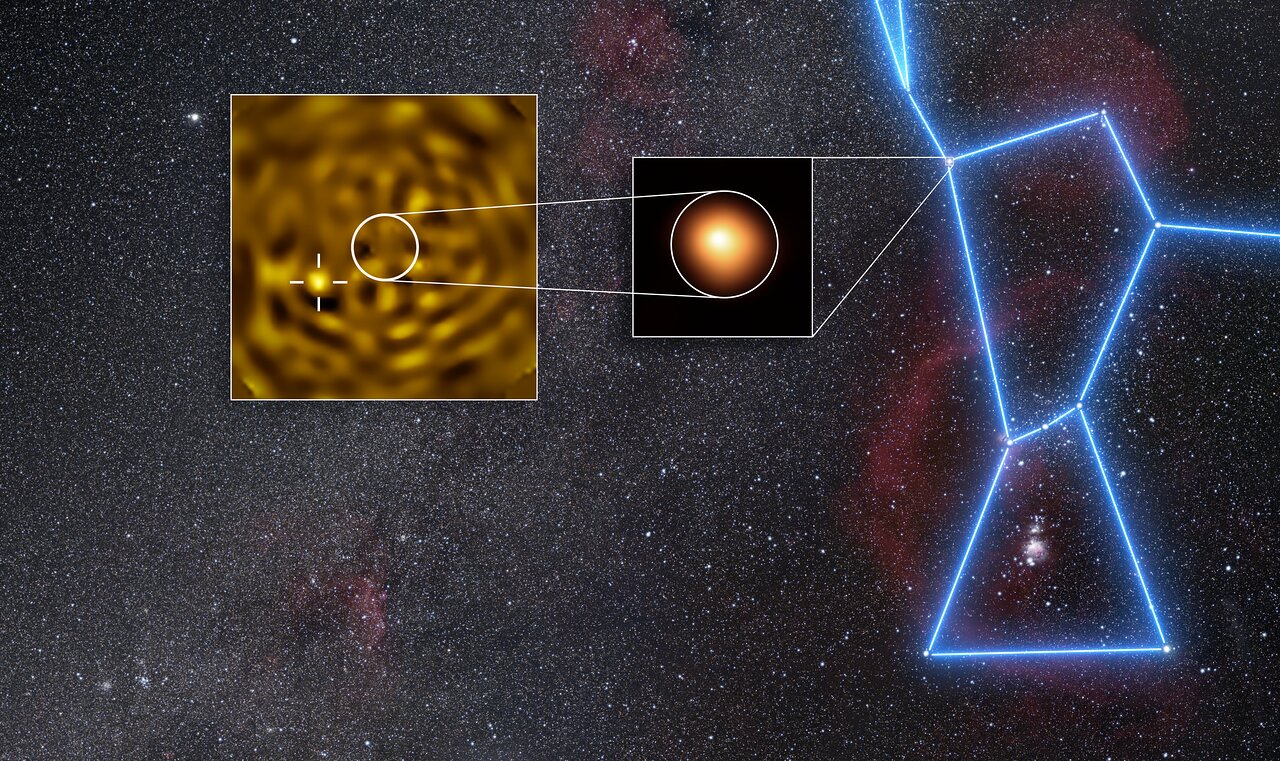
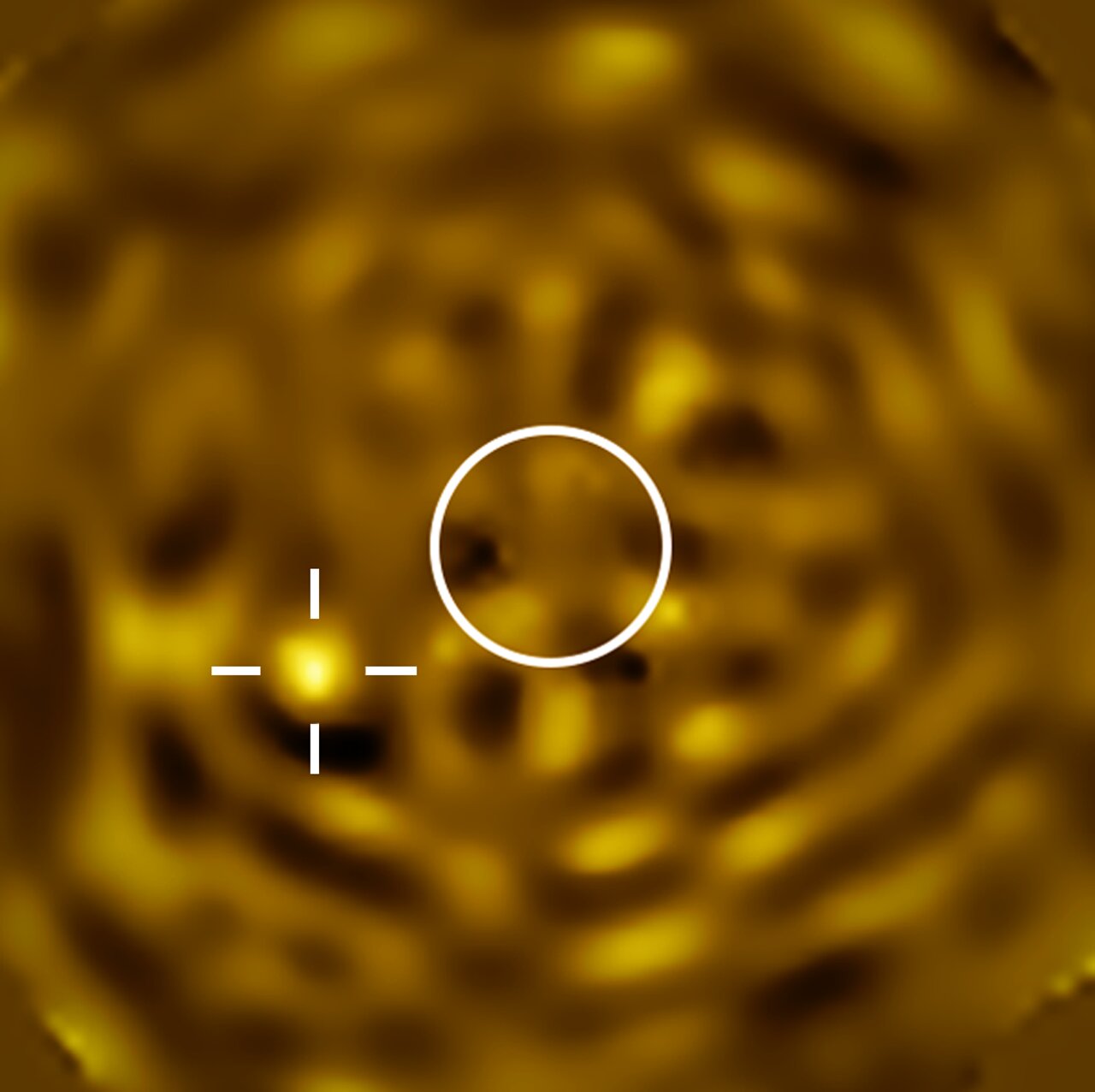
Eindelijk hebben astronomen overtuigend bewijs gevonden dat Betelgeuze – een van de bekendste sterren aan de nachthemel, niet alleen is. Met behulp van de Very Large Telescope (VLT) van de Europese Zuidelijke Sterrenwacht (ESO) heeft een team onder leiding van de Franse onderzoeker Miguel Montargès de scherpste opname ooit gemaakt van wat waarschijnlijk Betelgeuze B is – een ster die om Betelgeuze draait. ‘Dit is de afsluiting van een zoektocht die een eeuw heeft geduurd’, aldus Montargès.
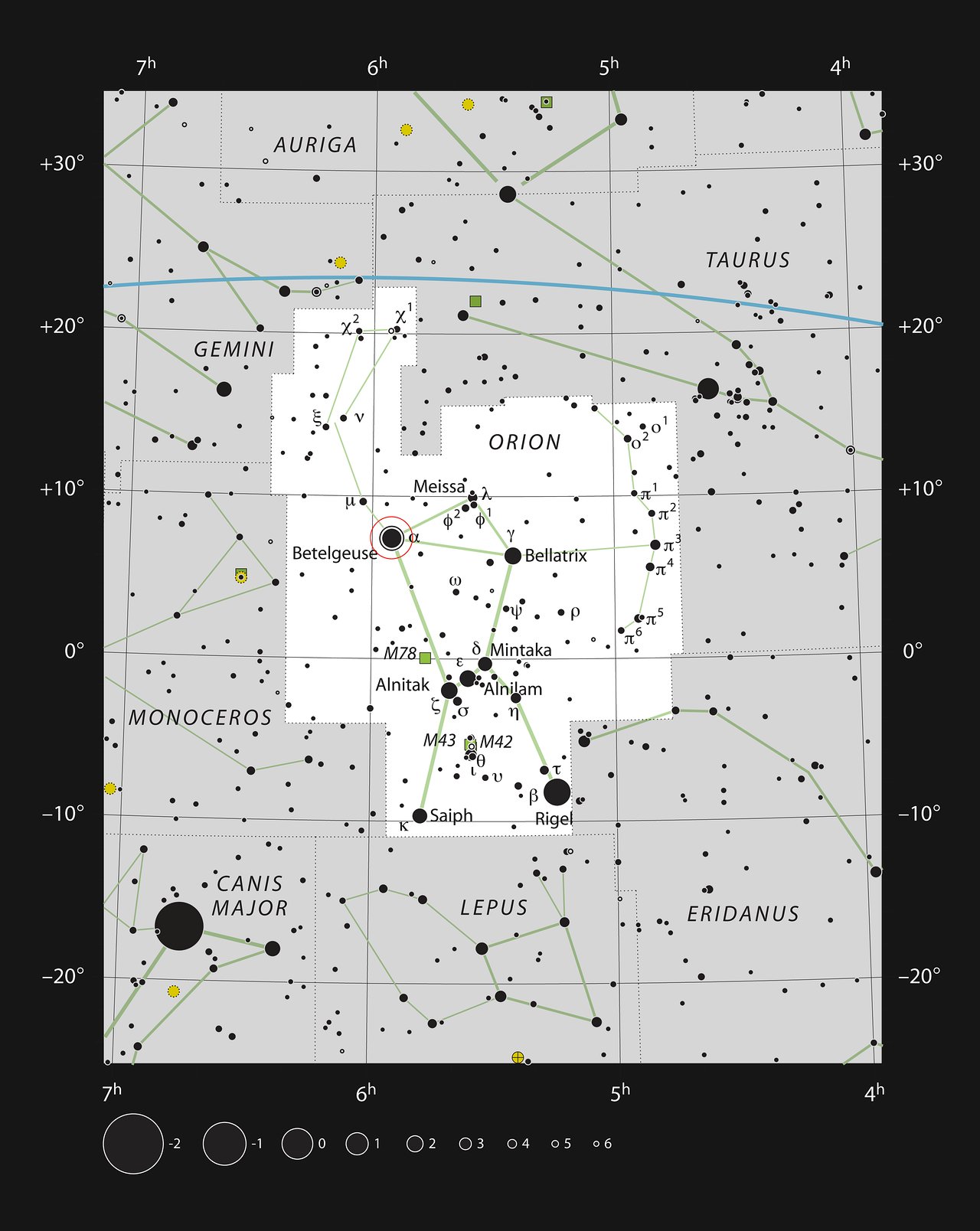
‘We hebben aangetoond dat Betelgeuze wordt vergezeld door een zwakke metgezel,’ zegt Montargès, astronoom aan de Sterrenwacht van Parijs (PSL) in Frankrijk en hoofdauteur van het onderzoek dat vandaag in Astronomy & Astrophysics is gepubliceerd. Betelgeuze – een roodachtige ster in het sterrenbeeld Orion die gemakkelijk met het blote oog te zien is en waarvan bekend is dat zijn helderheid varieert – wordt al duizenden jaren waargenomen. Toch blijft de ster astronomen verrassen.
‘Ik sprong omhoog van mijn stoel toen ik de bewerkte beelden zag’, herinnert Montargès zich. Astronomen zijn al bijna een eeuw op zoek naar de mogelijke begeleider, die oorspronkelijk werd voorgesteld om de helderheidsveranderingen van Betelgeuze te verklaren, maar zonder succes. Twee in 2024 gepubliceerde studies voorspelden met grote zekerheid dat de begeleidende ster in december van dat jaar het verst van Betelgeuze verwijderd was en daardoor gemakkelijker waarneembaar zou moeten zijn. Montargès en zijn team namen de uitdaging aan en observeerden de ster in december 2024 met de VLT van ESO, om vervolgens enkele maanden aan de verwerking van de gegevens te besteden.
‘Eerlijk gezegd had ik niet het idee dat de VLT in staat zou zijn om Betelgeuze B op zijn voorspelde positie te detecteren,’ legt Montargès uit. ‘Maar omdat de ster zwaarder bleek dan voorspeld, is het toch gelukt!’ Oorspronkelijk werd aangenomen dat Betelgeuze B ongeveer net zo zwaar is als onze zon, maar uit de nieuwe waarnemingen blijkt dat hij ongeveer twee tot drie keer zoveel massa heeft. ‘Het feit dat we rond zo’n goed bestudeerde ster nog steeds een nabije begeleider kunnen opsporen die zwaarder en helderder is dan de zon, is opmerkelijk,’ zegt Montargès. ‘Zulke nieuwe, onverwachte ontdekkingen zijn de mooiste momenten in de wetenschap’.
Betelgeuze B is rechtstreeks in beeld gebracht met het SPHERE-instrument op ESO’s VLT in de Atacama-woestijn in Chili. Hoewel er al aanwijzingen waren voor het bestaan van deze begeleidende ster, waaronder een mogelijke directe waarneming met de Gemini North-telescoop op Hawaï (VS), is dit het sterkste bewijs voor, en de duidelijkste afbeelding tot nu toe, van Betelgeuze B. ‘Het is opmerkelijk om te zien hoe SPHERE en geavanceerde nabewerkingstechnieken – oorspronkelijk ontwikkeld voor het opsporen van exoplaneten – ook uitstekend presteren bij het opsporen van een begeleidende ster rond een zware, geëvolueerde ster als Betelgeuze,’ zegt coauteur Anthony Boccaletti, eveneens astronoom aan de Sterrenwacht van Parijs.
‘Om er zeker van te zijn dat de begeleidende ster echt bestaat, moeten we hem over een jaar nog aan de andere kant van de Betelgeuze waarnemen, maar er is nauwelijks nog ruimte voor twijfel,’ voegt Montargès toe.
Enkele jaren geleden stond Betelgeuze in de belangstelling van zowel astronomen als leken toen de ster zichtbaar zwakker werd. Als geëvolueerde superreus zal Betelgeuze naar verwachting uiteindelijk een supernova-explosie ondergaan, en het ‘dimmen’ van de ster deed sommigen vermoeden dat de ster op het punt stond te exploderen. Een groep astronomen onder leiding van Montargès heeft de ster toen met ESO’s VLT onderzocht en daarbij vastgesteld dat deze in werkelijkheid werd verduisterd door een wolk van stof.
De mogelijke ontdekking van Betelgeuze B zal astronomen ertoe aanzetten om te onderzoeken hoe deze begeleidende ster de verwachte supernova-explosie van Betelgeuze zou kunnen beïnvloeden. ‘De vraag of deze begeleider ster invloed zal hebben op de ontwikkeling van de rode superreus is nu echt aan de orde’, concludeert Montargès.
Meer informatie
De resultaten van dit onderzoek zijn te vinden het artikel ‘VLT/SPHERE images the candidate companion of Betelgeuse’ dat in Astronomy & Astrophysics verschijnt.
Het onderzoeksteam bestaat uit M. Montargès (Laboratoire d'Instrumentation et de Recherche en Astrophysique, Sterrenwacht van Parijs, Universiteit van Parijs (Sorbonne Université, Université Paris Cité, CY Cergy Paris Université, CNRS, Frankrijk [LIRA]), A. Boccaletti (LIRA), O. Flasseur (Universiteit Claude Bernard Lyon 1, Centre de Recherche Astrophysique de Lyon UMR5574, ENS de Lyon, CNRS, Frankrijk), A. de Koter (Universiteit van Amsterdam, Anton Pannekoek Instituut voor Astronomie, Nederland), J. Milli (Universiteit Grenoble Alpes, CNRS, IPAG, Frankrijk), P. Kervella (Frans-Chileens Laboratorium voor Astronomie, IRL 3386, CNRS en Universiteit van Chili, Chili en LIRA), S. Ridgway (National Optical Astronomy Observatory, VS), E. Bordier (I. Physikalisches Institut der Universität zu Köln, Duitsland), E. Lagadec (Université Côte d’Azur, Observatoire de la Côte d’Azur, CNRS, Laboratoire Lagrange, Frankrijk), A.K. Dupree (Center for Astrophysics – Harvard & Smithsonian, VS), F. Backs (Instituut voor Astronomie, KU Leuven, België), T. Calderwood (American Association of Variable Star Observers, VS [AAVSO]), en P. Morgan (AAVSO).
Links
• Foto’s van de VLT: http://www.eso.org/public/images/archive/category/paranal/
• Voor journalisten: abonneer je op persberichten onder embargo in je eigen taa
• Voor wetenschappers: heb je een verhaal? Promoot je onderzoek
Contact
Miguel Montargès
LIRA, Observatoire de Paris, PSL University
Paris, France
Tel: +33 (0)1 45 07 76 95
E-mail: miguel.montarges@observatoiredeparis.psl.eu
Anthony Boccaletti
LIRA, Observatoire de Paris, PSL University
Paris, France
E-mail: anthony.boccaletti@observatoiredeparis.psl.eu
Bárbara Ferreira
ESO Media Manager
Garching bei München, Germany
Tel: +49 89 3200 6670
Mob: +49 151 241 664 00
E-mail: press@eso.org
Rodrigo Alvarez (press contact België)
ESO Science Outreach Network
en Planetarium, Royal Observatory of Belgium
Tel: +32-2-474 70 50
E-mail: eson-belgië@eso.org
Over dit bericht
| Persberichten nr.: | eso2611nl-be |
| Naam: | Betelgeuse, Betelgeuse B |
| Type: | Milky Way : Star : Grouping : Binary |
| Facility: | Very Large Telescope |
| Instruments: | SPHERE |
| Science data: | 2026A&A...711L..12M |
Afbeeldingen


Video's


Our use of Cookies
We use cookies that are essential for accessing our websites and using our services. We also use cookies to analyse, measure and improve our websites’ performance, to enable content sharing via social media and to display media content hosted on third-party platforms.
ESO Cookies Policy
The European Organisation for Astronomical Research in the Southern Hemisphere (ESO) is the pre-eminent intergovernmental science and technology organisation in astronomy. It carries out an ambitious programme focused on the design, construction and operation of powerful ground-based observing facilities for astronomy.
This Cookies Policy is intended to provide clarity by outlining the cookies used on the ESO public websites, their functions, the options you have for controlling them, and the ways you can contact us for additional details.
What are cookies?
Cookies are small pieces of data stored on your device by websites you visit. They serve various purposes, such as remembering login credentials and preferences and enhance your browsing experience.
Categories of cookies we use
Essential cookies (always active): These cookies are strictly necessary for the proper functioning of our website. Without these cookies, the website cannot operate correctly, and certain services, such as logging in or accessing secure areas, may not be available; because they are essential for the website’s operation, they cannot be disabled.
Functional Cookies: These cookies enhance your browsing experience by enabling additional features and personalization, such as remembering your preferences and settings. While not strictly necessary for the website to function, they improve usability and convenience; these cookies are only placed if you provide your consent.
Analytics cookies: These cookies collect information about how visitors interact with our website, such as which pages are visited most often and how users navigate the site. This data helps us improve website performance, optimize content, and enhance the user experience; these cookies are only placed if you provide your consent. We use the following analytics cookies.
Matomo Cookies:
This website uses Matomo (formerly Piwik), an open source software which enables the statistical analysis of website visits. Matomo uses cookies (text files) which are saved on your computer and which allow us to analyze how you use our website. The website user information generated by the cookies will only be saved on the servers of our IT Department. We use this information to analyze www.eso.org visits and to prepare reports on website activities. These data will not be disclosed to third parties.
On behalf of ESO, Matomo will use this information for the purpose of evaluating your use of the website, compiling reports on website activity and providing other services relating to website activity and internet usage.
Matomo cookies settings:
Additional Third-party cookies on ESO websites: some of our pages display content from external providers, e.g. YouTube.
Such third-party services are outside of ESO control and may, at any time, change their terms of service, use of cookies, etc.
YouTube: Some videos on the ESO website are embedded from ESO’s official YouTube channel. We have enabled YouTube’s privacy-enhanced mode, meaning that no cookies are set unless the user actively clicks on the video to play it. Additionally, in this mode, YouTube does not store any personally identifiable cookie data for embedded video playbacks. For more details, please refer to YouTube’s embedding videos information page.
Cookies can also be classified based on the following elements.
Regarding the domain, there are:
- First-party cookies, set by the website you are currently visiting. They are stored by the same domain that you are browsing and are used to enhance your experience on that site;
- Third-party cookies, set by a domain other than the one you are currently visiting.
As for their duration, cookies can be:
- Browser-session cookies, which are deleted when the user closes the browser;
- Stored cookies, which stay on the user's device for a predetermined period of time.
How to manage cookies
Cookie settings: You can modify your cookie choices for the ESO webpages at any time by clicking on the link Cookie settings at the bottom of any page.
In your browser: If you wish to delete cookies or instruct your browser to delete or block cookies by default, please visit the help pages of your browser:
Please be aware that if you delete or decline cookies, certain functionalities of our website may be not be available and your browsing experience may be affected.
You can set most browsers to prevent any cookies being placed on your device, but you may then have to manually adjust some preferences every time you visit a site/page. And some services and functionalities may not work properly at all (e.g. profile logging-in, shop check out).
Updates to the ESO Cookies Policy
The ESO Cookies Policy may be subject to future updates, which will be made available on this page.
Additional information
For any queries related to cookies, please contact: pdprATesoDOTorg.
As ESO public webpages are managed by our Department of Communication, your questions will be dealt with the support of the said Department.