Meddelelse
Two large gamma-ray telescopes to join CTAO’s southern site at Paranal
19. november 2026
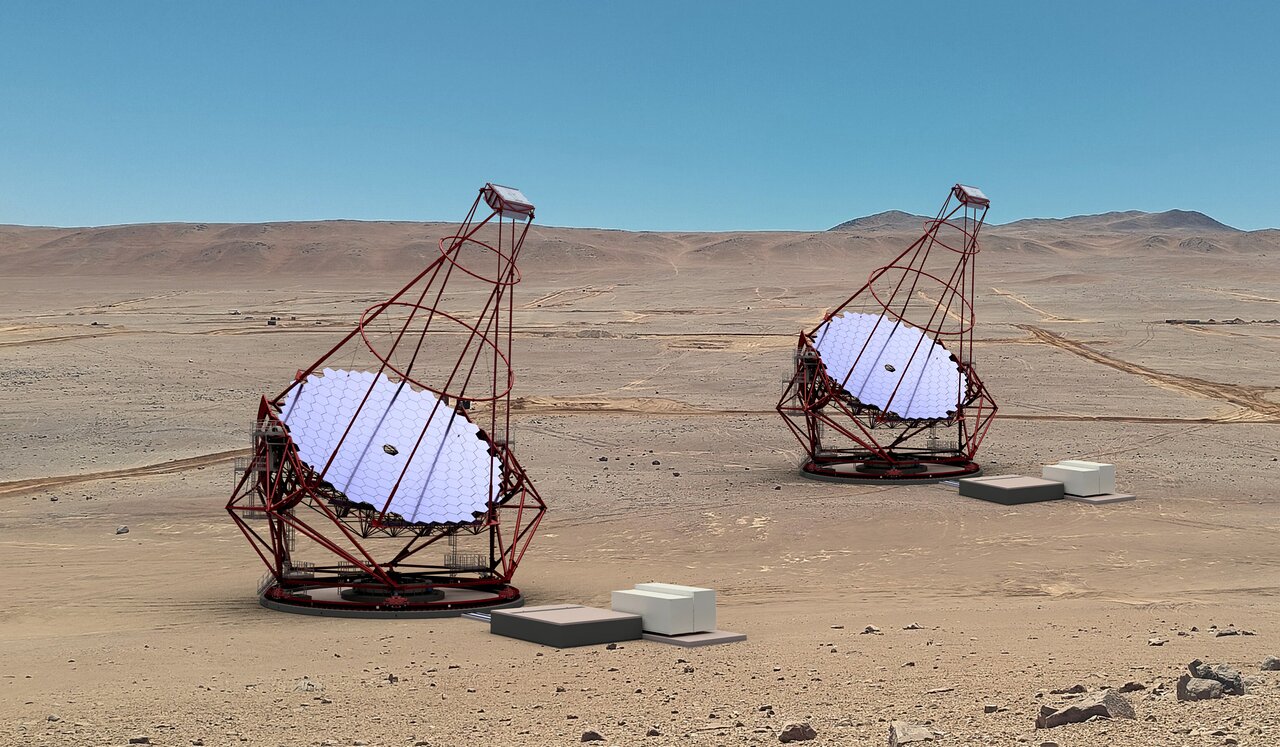
The southern site of the Cherenkov Telescope Array Observatory (CTAO), the first gamma-ray observatory in Chile, will be more powerful than originally planned. Hosted by ESO at its Paranal Observatory, the site will now have two Large-Sized Telescopes (LSTs), in addition to multiple, previously planned, Small- and Medium-Sized Telescopes. This change, which brings the total number of telescopes at the site to 53, will extend the site’s coverage to lower energies and boost its discovery potential. Spread over two sites — CTAO-North on La Palma, Spain and CTAO-South in Chile’s Atacama Desert — CTAO will be the largest gamma-ray observatory in the world.
CTAO telescopes detect flashes of light produced as gamma rays from the cosmos hit Earth’s atmosphere, with different sized telescopes needed to detect flashes coming from gamma rays at different energies. Low-energy gamma rays produce the faintest flashes, which only the largest mirrors can collect, so the LSTs capture the lowest energies, while smaller telescopes cover the higher ones. Put together, the different telescopes at the CTAO sites will cover energies from 20 GeV to 300 TeV, billions of times more energetic than visible light.
Until now, only CTAO-North was planned to have LSTs. Under the new layout, known as the Beta Configuration, CTAO-South will get two of its own, allowing it to cover the observatory’s full energy range and host all three different types of CTAO telescopes. The southern LSTs will not simply be copies of those at CTAO-North. Their design, coordinated by the Italian National Institute for Astrophysics (INAF), has been optimised for the environmental conditions of the Chilean Atacama Desert.
While very high-energy gamma rays are often absorbed as they travel through space, lower-energy gamma rays can reach us from much further away. Thus, thanks to their low-energy threshold, the LSTs will allow scientists to probe sources at greater distances and look further back into cosmic history. Moreover, despite their considerable weight and size, the LSTs are incredibly fast, capable of repositioning to anywhere in the sky in under 30 seconds. This rapid response makes them the perfect instruments for catching transient, elusive cosmic events, such as gamma-ray bursts, before they fade.
The new configuration will also enhance the CTAO-South array’s sensitivity by a factor of two between 50 and 80 GeV and provide an approximate 25% improvement between 80 and 300 GeV.
The CTAO-South site’s development is well underway, with key preparation work already completed, including the construction of 17 kilometres of roads, and the foundations for both Small and Medium-Sized Telescopes. On-site preparations for the LSTs are already underway, and foundation construction is expected to be completed by the end of the year.
More Information
The European Commission established the CTAO as a European Research Infrastructure Consortium (ERIC) in January 2025. Its founding members are Austria, Croatia, the Czech Republic, ESO, France, Germany, Italy, Poland, Slovenia, Spain, and Switzerland. The Netherlands is also part of the CTAO ERIC as Observer. The CTAO headquarters is in Bologna, Italy, hosted by INAF, and the Science Data Management Centre is located at DESY campus in Zeuthen, Germany. CTAO-North is located at the Roque de los Muchachos Observatory on La Palma, hosted by the Instituto de Astrofísica de Canarias (IAC), while CTAO-South is operated by ESO at its Paranal Observatory.
The additional LSTs for CTAO-South are made possible to a major extent by the “PNRR-CTA+” project, funded by the Italian Ministry of University and Research (MUR). The project is coordinated by INAF in close partnership with the National Institute for Nuclear Physics (INFN), several Italian universities, and international contributors from the CTAO LST Collaboration.
Links
Kontakter
Bárbara Ferreira
ESO Media Manager
Garching bei München, Germany
Tel: +49 89 3200 6670
Email: press@eso.org
Om meddelelsen
| Id: | ann26010 |
Billeder


Our use of Cookies
We use cookies that are essential for accessing our websites and using our services. We also use cookies to analyse, measure and improve our websites’ performance, to enable content sharing via social media and to display media content hosted on third-party platforms.
ESO Cookies Policy
The European Organisation for Astronomical Research in the Southern Hemisphere (ESO) is the pre-eminent intergovernmental science and technology organisation in astronomy. It carries out an ambitious programme focused on the design, construction and operation of powerful ground-based observing facilities for astronomy.
This Cookies Policy is intended to provide clarity by outlining the cookies used on the ESO public websites, their functions, the options you have for controlling them, and the ways you can contact us for additional details.
What are cookies?
Cookies are small pieces of data stored on your device by websites you visit. They serve various purposes, such as remembering login credentials and preferences and enhance your browsing experience.
Categories of cookies we use
Essential cookies (always active): These cookies are strictly necessary for the proper functioning of our website. Without these cookies, the website cannot operate correctly, and certain services, such as logging in or accessing secure areas, may not be available; because they are essential for the website’s operation, they cannot be disabled.
Functional Cookies: These cookies enhance your browsing experience by enabling additional features and personalization, such as remembering your preferences and settings. While not strictly necessary for the website to function, they improve usability and convenience; these cookies are only placed if you provide your consent.
Analytics cookies: These cookies collect information about how visitors interact with our website, such as which pages are visited most often and how users navigate the site. This data helps us improve website performance, optimize content, and enhance the user experience; these cookies are only placed if you provide your consent. We use the following analytics cookies.
Matomo Cookies:
This website uses Matomo (formerly Piwik), an open source software which enables the statistical analysis of website visits. Matomo uses cookies (text files) which are saved on your computer and which allow us to analyze how you use our website. The website user information generated by the cookies will only be saved on the servers of our IT Department. We use this information to analyze www.eso.org visits and to prepare reports on website activities. These data will not be disclosed to third parties.
On behalf of ESO, Matomo will use this information for the purpose of evaluating your use of the website, compiling reports on website activity and providing other services relating to website activity and internet usage.
Matomo cookies settings:
Additional Third-party cookies on ESO websites: some of our pages display content from external providers, e.g. YouTube.
Such third-party services are outside of ESO control and may, at any time, change their terms of service, use of cookies, etc.
YouTube: Some videos on the ESO website are embedded from ESO’s official YouTube channel. We have enabled YouTube’s privacy-enhanced mode, meaning that no cookies are set unless the user actively clicks on the video to play it. Additionally, in this mode, YouTube does not store any personally identifiable cookie data for embedded video playbacks. For more details, please refer to YouTube’s embedding videos information page.
Cookies can also be classified based on the following elements.
Regarding the domain, there are:
- First-party cookies, set by the website you are currently visiting. They are stored by the same domain that you are browsing and are used to enhance your experience on that site;
- Third-party cookies, set by a domain other than the one you are currently visiting.
As for their duration, cookies can be:
- Browser-session cookies, which are deleted when the user closes the browser;
- Stored cookies, which stay on the user's device for a predetermined period of time.
How to manage cookies
Cookie settings: You can modify your cookie choices for the ESO webpages at any time by clicking on the link Cookie settings at the bottom of any page.
In your browser: If you wish to delete cookies or instruct your browser to delete or block cookies by default, please visit the help pages of your browser:
Please be aware that if you delete or decline cookies, certain functionalities of our website may be not be available and your browsing experience may be affected.
You can set most browsers to prevent any cookies being placed on your device, but you may then have to manually adjust some preferences every time you visit a site/page. And some services and functionalities may not work properly at all (e.g. profile logging-in, shop check out).
Updates to the ESO Cookies Policy
The ESO Cookies Policy may be subject to future updates, which will be made available on this page.
Additional information
For any queries related to cookies, please contact: pdprATesoDOTorg.
As ESO public webpages are managed by our Department of Communication, your questions will be dealt with the support of the said Department.