Tiedote
ESO on allekirjoittanut sopimuksen ELT:n MOSAIC-instrumentista
1. joulukuuta 2025
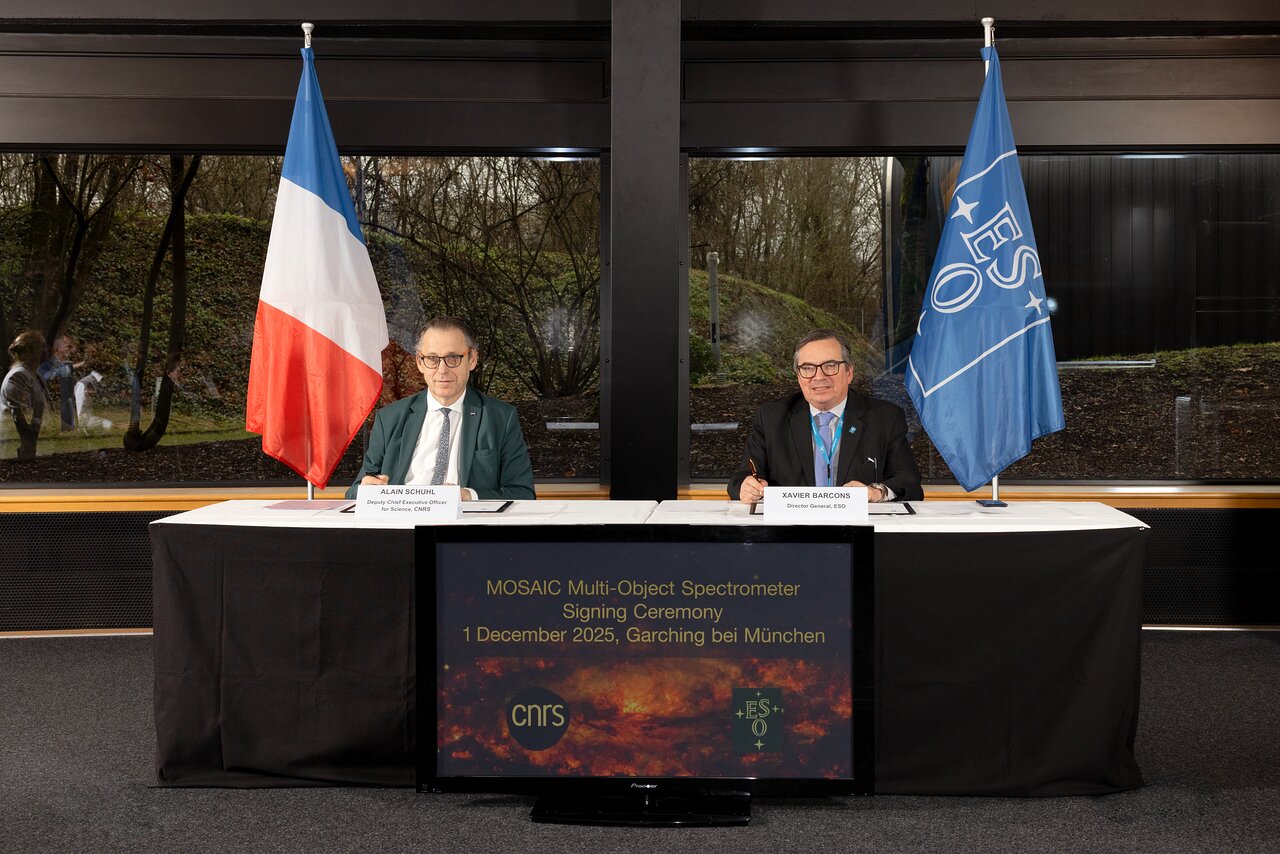
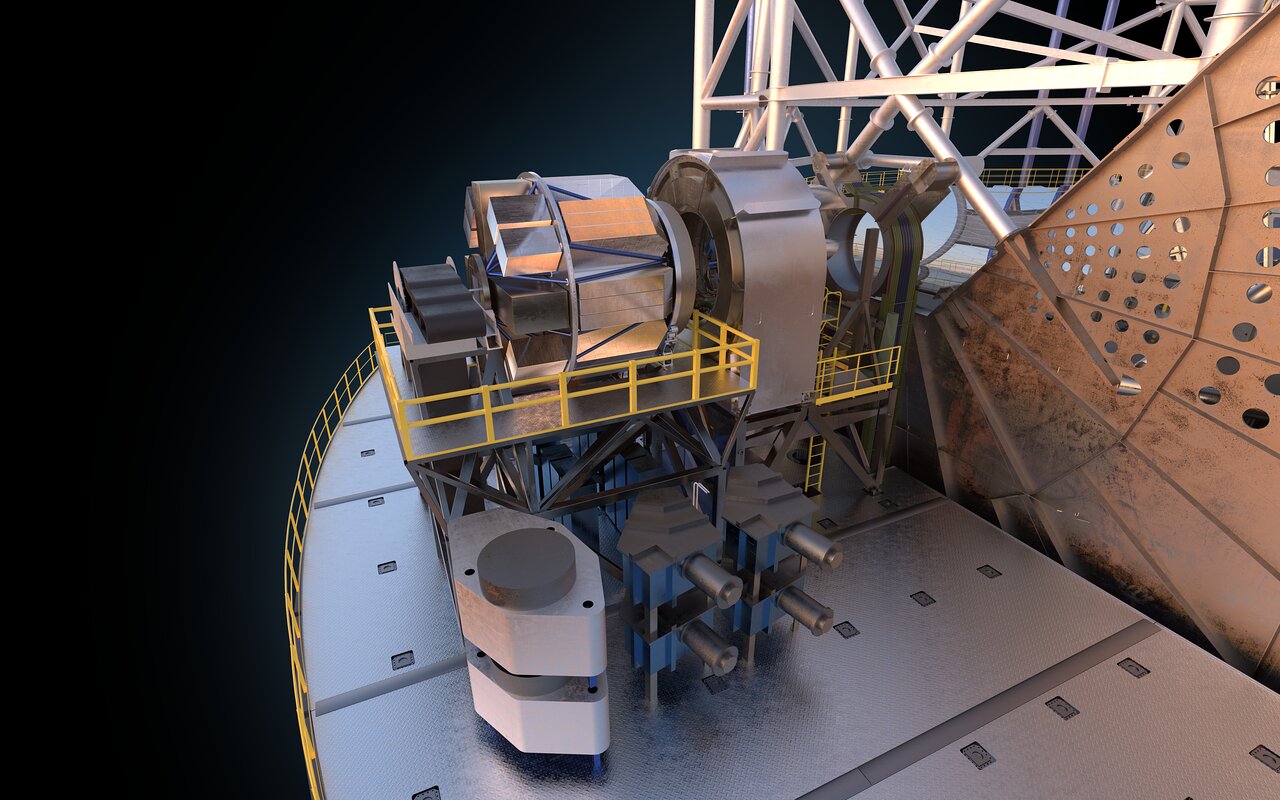
ESO on tänään allekirjoittanut sopimuksen laajan kansainvälisen konsortion kanssa Multi-Object Spectrograph, eli MOSAIC-instrumentin suunnittelusta ja rakentamisesta ESO:n Extremely Large Telescope, eli ELT-kaukoputkeen. MOSAIC kykenee keräämään samanaikaisesti valoa yli kahdesta sadasta kohteesta, ja sen avulla pystytään seuraamaan galaksien kehitystä, sekä aineen jakautumista maailmankaikkeudessa aina alkuräjähdyksestä nykyhetkeen.
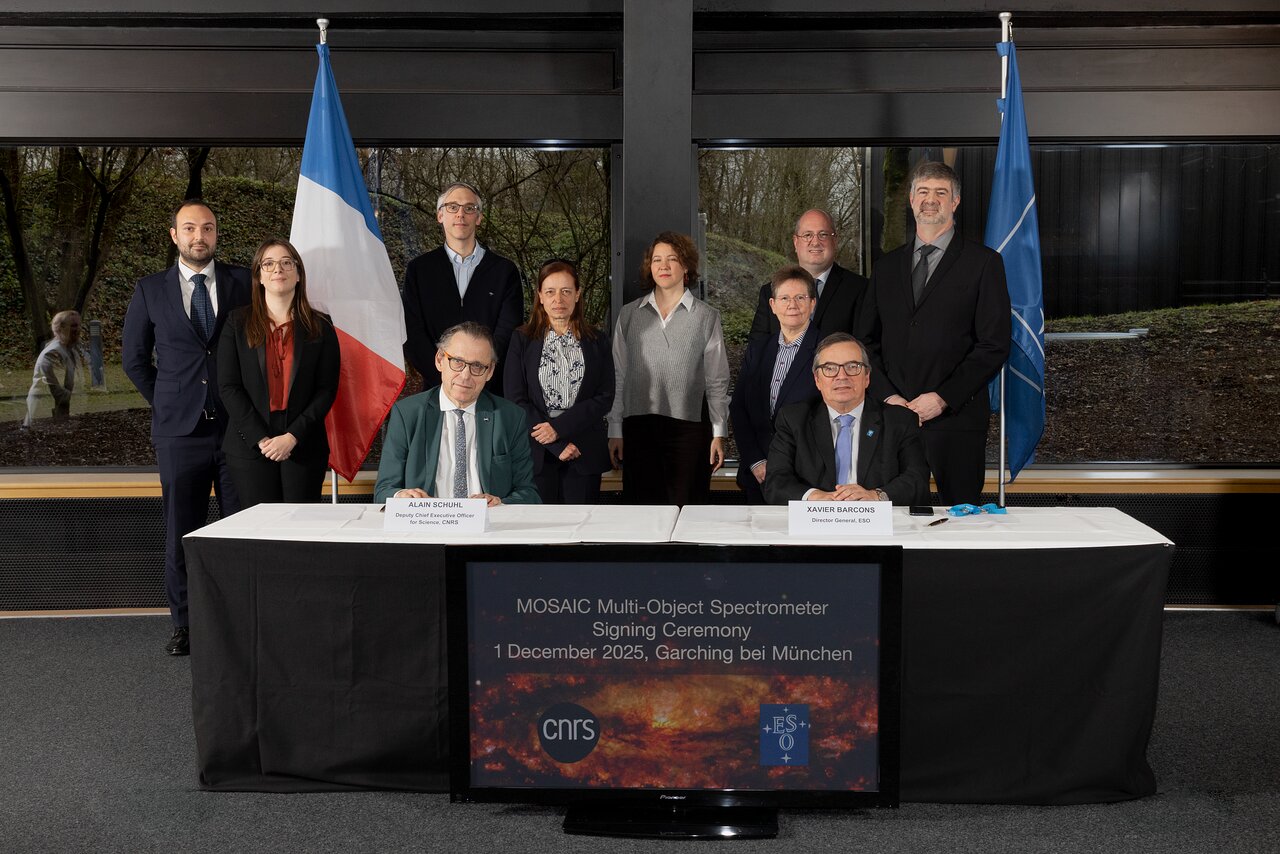
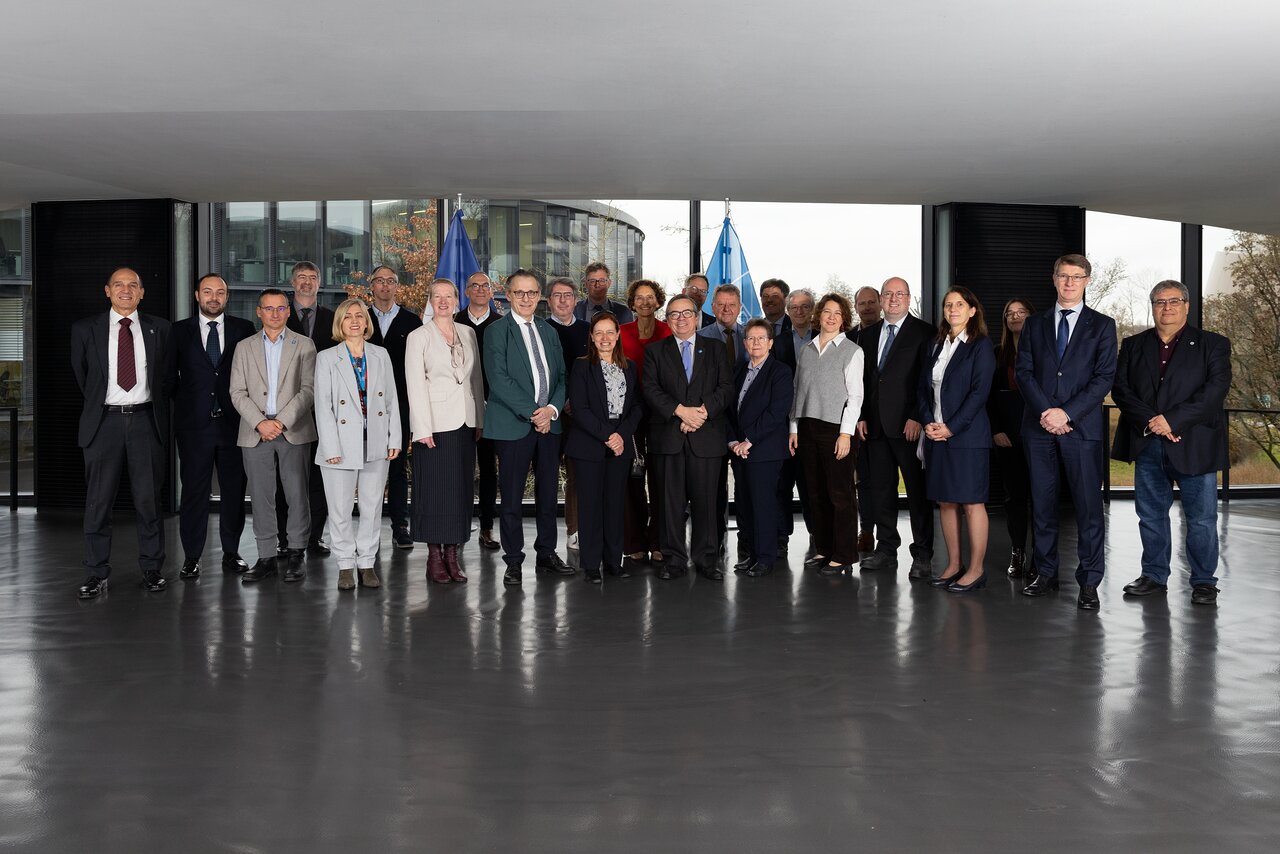
Sopimuksen allekirjoittivat ESO:n pääjohtaja Xavier Barcons ja Alain Schuhl, Ranskan kansallisen tiedekeskuksen (Science at the French National Centre for Scientific Research, CNRS) varatoimitusjohtaja. CNRS johtaa MOSAIC-konsortiota. Paikalla olivat myös MOSAIC-hankkeen päätutkija (Principal Investigator) Roser Pello Marseillen astrofysiikan laboratoriosta ja apulaispäätutkija Mathieu Puech Pariisin observatoriosta. Paikalla oli lisäksi muita ESO:n, CNRS:n ja MOSAIC-konsortion edustajia [1]. Allekirjoitustapahtuma järjestettiin ESO:n pääkonttorissa Garchingissa, Saksassa.
MOSAIC on tehokas spektrografi, eli instrumentti, joka hajottaa valon eri aallonpituuksiin. Sen avulla tähtitieteilijät pystyvät määrittämään tähtitieteen kohteiden tärkeitä ominaisuuksia, kuten niiden kemiallisen koostumuksen tai lämpötilan. Instrumentti käyttää ELT:n mahdollistamaa mahdollisimman laajaa näkökenttää, toimii sekä näkyvässä että lähi-infrapunavalossa, ja pystyy analysoimaan valoa yli kahdestakymmenestä kohteesta samanaikaisesti.
MOSAIC tulee tekemään ensimmäisen kattavan varhaisen maailmankaikkeuden aineen kartoituksen paljastaen samalla, miten aine on jakautunut galaksien sisällä ja niiden välissä. MOSAIC tulee merkittävästi parantamaan ymmärrystämme siitä, miten nykyhetken galaksit ovat muodostuneet ja kehittyneet. Sen avulla pystytään myös tutkimaan tarkasti galakseja ympäröivää kaasua ja tunnistamaan sen sisältämät alkuaineet.
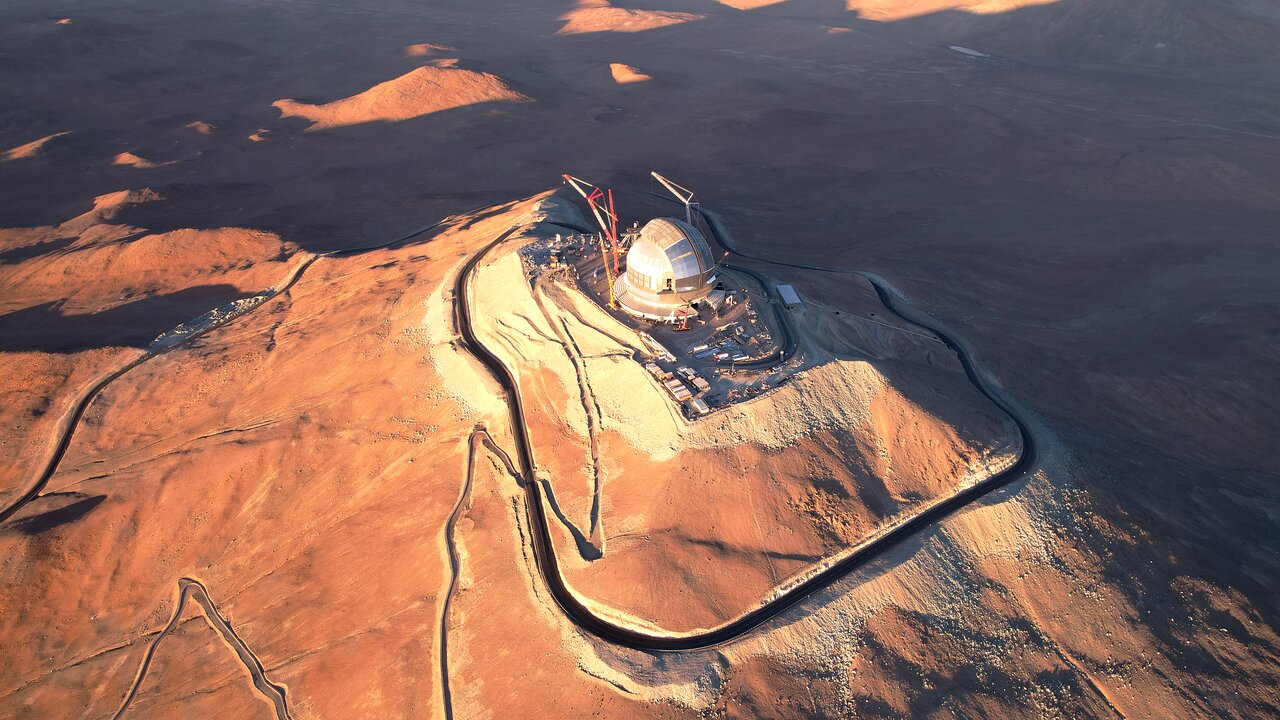
ESO:n ELT:tä rakennetaan parhaillaan Chilen Atacaman autiomaassa, joka on ainutlaatuinen paikka maapallolla tähtitaivaan havainnointiin. ELT:n aloittaessa havaintonsa myöhemmin tällä vuosikymmenellä se tulee mullistamaan käsitystämme maailmankaikkeudesta, ja saa meidät miettimään uudelleen paikkaamme maailmankaikkeudessa.
"MOSAIC tulee olemaan erittäin tärkeä instrumentti ELT:lle, koska se pystyy samanaikaisesti ottamaan spektrejä useista eri kohteista näkyvän- ja infrapunavalon alueella", erikoistutkija Hanindyo Kuncarayakti Suomen ESO-keskuksesta FINCA:sta sanoi. Suomi osallistuu hankkeessa infrapunakanavan kehittämiseen. Osallistumalla tähän valtavaan projektiin Suomi odottaa edistyvänsä instrumenttien, sekä tieteellisessä että teknologisessa kehityksessä.
Lisähuomioita
[1] Allekirjoitusseremoniassa oli mukana seuraavia henkilöitä: Pascal Chevrot (Head of the CNRS Directorate of Innovative Instrumental Developments for Research and Observation), Myriam Rodrigues (MOSAIC Systems Engineer, Paris Observatory), Hermine Schnetler (MOSAIC Project Manager, Paris Observatory), Jesus Gallego (MOSAIC Board Co-Chair, Universidad Complutense de Madrid), Michiel Rodenhuis (NOVA Executive Director and Institutional Board member), sekä kaksi ESO-neuvoston edustajaa Ranskan puolesta: Karine Perraut (CNRS INSU) ja Guy Perrin (Ministry of Higher Education, Research and Innovation, Paris).
Xavier Barconsin lisäksi ESO:sta mukana olivat Suzanne Ramsay (Deputy Instrumentation Programme Manager), Michele Cirasuolo (Instrumentation Programme Manager), Jarle Brinchmann (Director for Science), Claudia Burger (Director of Administration), Andreas Kaufer (Director of Operations), Sara Krauss (Director of Engineering), Adrian Russell (Director of Programmes), Patrick Caillier (MOSAIC Project Manager), Alessandro Meoli (MOSAIC Detector Systems Work Package Manager), Oliver Pfuhl (MOSAIC Project Engineer), Alain Delorme (Acting Head of Contracts & Procurement), Cyrielle Blanc (Contract and Procurement Officer), Roberto Tamai (ELT Programme Manager), Enrico Marchetti (Instrumentation Programme Engineer) ja Joël Vernet (Acting ELT Programme Scientist).
Lisätietoja
MOSAIC-projektia hallinnoi 13 maan tutkimusinstituutin muodostama kansainvälinen konsortio:
- Itävalta: Wienin yliopisto; Itävallan tiede- ja teknologiainstituutti (ISTA);
- Brasilia: Kansallinen astrofysiikan laboratorio; São Paulon yliopisto;
- Suomi: Helsingin yliopisto; Suomen ESO-keskus FINCA, Turun yliopisto;
- Ranska: National Institute for Earth Sciences and Astronomy at the National Centre for Scientific Research (CNRS-INSU) ; UNité d'Ingénierie et de Développements Instrumentaux pour l'Astrophysique (UNIDIA) ja Laboratoire d'étude de l'Univers et des phénomènes eXtrêmes (LUX) Pariisin observatoriossa-PSL; Astrofysiikan ja planetologian tutkimuslaitos Toulousen yliopistossa; Marseillen astrofysiikan laboratorio. Laboratoire Joseph-Louis Lagrange (LAGRANGE);
- Saksa: Leibnizin astrofysiikan instituutti Potsdamissa; LSW Heidelberg;
- Italia: INAF – Italian national Institute of Astrophysics;
- Alankomaat: Netherlands Research School for Astronomy (NOVA); Amsterdamin yliopisto
- Portugali: Centro de Investigação em Astronomia/Astrofísica da Universidade do Porto; FCiências.ID – Lissabonin yliopisto;
- Espanja: Universidad Complutense de Madrid (UCM); Instituto de Astrofísica de Andalucía (IAA-CSIC); Centro de Astrobiología (CAB, CSIC-INTA), Universidad Politécnica de Madrid (UPM)
- Ruotsi: Tukholman yliopisto; Lundin yliopisto; Uppsalan yliopisto;
- Sveitsi: Geneven yliopisto; École polytechnique fédérale de Lausanne
- Yhdistynyt kuningaskunta: Durhamin yliopisto; Oxfordin yliopisto / RAL Space; UK Astronomy Technology Centre;
- Yhdysvallat: Michiganin yliopisto; Space Telescope Science Institute.
Linkit
Yhteystiedot
Hanindyo Kuncarayakti
Erikoistutkija
FINCA, Turun yliopisto
S-posti: hankun@utu.fi
Bárbara Ferreira
ESO Media Manager
Garching bei München, Saksa
Puh.: +49 89 3200 6670
S-posti: press@eso.org
Tiedotteesta
| Tunnistus: | ann25008 |
Kuvat
Our use of Cookies
We use cookies that are essential for accessing our websites and using our services. We also use cookies to analyse, measure and improve our websites’ performance, to enable content sharing via social media and to display media content hosted on third-party platforms.
ESO Cookies Policy
The European Organisation for Astronomical Research in the Southern Hemisphere (ESO) is the pre-eminent intergovernmental science and technology organisation in astronomy. It carries out an ambitious programme focused on the design, construction and operation of powerful ground-based observing facilities for astronomy.
This Cookies Policy is intended to provide clarity by outlining the cookies used on the ESO public websites, their functions, the options you have for controlling them, and the ways you can contact us for additional details.
What are cookies?
Cookies are small pieces of data stored on your device by websites you visit. They serve various purposes, such as remembering login credentials and preferences and enhance your browsing experience.
Categories of cookies we use
Essential cookies (always active): These cookies are strictly necessary for the proper functioning of our website. Without these cookies, the website cannot operate correctly, and certain services, such as logging in or accessing secure areas, may not be available; because they are essential for the website’s operation, they cannot be disabled.
Functional Cookies: These cookies enhance your browsing experience by enabling additional features and personalization, such as remembering your preferences and settings. While not strictly necessary for the website to function, they improve usability and convenience; these cookies are only placed if you provide your consent.
Analytics cookies: These cookies collect information about how visitors interact with our website, such as which pages are visited most often and how users navigate the site. This data helps us improve website performance, optimize content, and enhance the user experience; these cookies are only placed if you provide your consent. We use the following analytics cookies.
Matomo Cookies:
This website uses Matomo (formerly Piwik), an open source software which enables the statistical analysis of website visits. Matomo uses cookies (text files) which are saved on your computer and which allow us to analyze how you use our website. The website user information generated by the cookies will only be saved on the servers of our IT Department. We use this information to analyze www.eso.org visits and to prepare reports on website activities. These data will not be disclosed to third parties.
On behalf of ESO, Matomo will use this information for the purpose of evaluating your use of the website, compiling reports on website activity and providing other services relating to website activity and internet usage.
Matomo cookies settings:
Additional Third-party cookies on ESO websites: some of our pages display content from external providers, e.g. YouTube.
Such third-party services are outside of ESO control and may, at any time, change their terms of service, use of cookies, etc.
YouTube: Some videos on the ESO website are embedded from ESO’s official YouTube channel. We have enabled YouTube’s privacy-enhanced mode, meaning that no cookies are set unless the user actively clicks on the video to play it. Additionally, in this mode, YouTube does not store any personally identifiable cookie data for embedded video playbacks. For more details, please refer to YouTube’s embedding videos information page.
Cookies can also be classified based on the following elements.
Regarding the domain, there are:
- First-party cookies, set by the website you are currently visiting. They are stored by the same domain that you are browsing and are used to enhance your experience on that site;
- Third-party cookies, set by a domain other than the one you are currently visiting.
As for their duration, cookies can be:
- Browser-session cookies, which are deleted when the user closes the browser;
- Stored cookies, which stay on the user's device for a predetermined period of time.
How to manage cookies
Cookie settings: You can modify your cookie choices for the ESO webpages at any time by clicking on the link Cookie settings at the bottom of any page.
In your browser: If you wish to delete cookies or instruct your browser to delete or block cookies by default, please visit the help pages of your browser:
Please be aware that if you delete or decline cookies, certain functionalities of our website may be not be available and your browsing experience may be affected.
You can set most browsers to prevent any cookies being placed on your device, but you may then have to manually adjust some preferences every time you visit a site/page. And some services and functionalities may not work properly at all (e.g. profile logging-in, shop check out).
Updates to the ESO Cookies Policy
The ESO Cookies Policy may be subject to future updates, which will be made available on this page.
Additional information
For any queries related to cookies, please contact: pdprATesoDOTorg.
As ESO public webpages are managed by our Department of Communication, your questions will be dealt with the support of the said Department.